


Cloud Computing Articles
From Beginner to DevOps Engineer: How HCL GUVI Zen Class Helps You Get There
12 Important Azure Admin Roles and Responsibilities- Complete Guide


Get In Touch For Details! Request More Information
Multiplexing in Computer Networks: Everything You Need to Know!
Aug 09, 2026 8 Min Read 4403 Views
(Last Updated)
Multiplexing in computer networks is something you already experience daily, whether you’re on a video call, streaming a show, or browsing on shared Wi-Fi. In simple terms, it’s the technique that lets multiple data streams share a single communication channel without interfering with one another — like carpooling for data, where everyone reaches their destination but shares the ride to save space and costs.
This blog takes a closer look at multiplexing in computer networks — what it is, the different types, how it actually works, and the advantages and disadvantages that come with it.
Table of contents
- TL;DR Summary
- What is Multiplexing in Computer Networks?
- Types of Multiplexing in Computer Networks
- Frequency Division Multiplexing (FDM)
- Time Division Multiplexing (TDM)
- Wavelength Division Multiplexing (WDM)
- Code Division Multiplexing (CDM)
- Orthogonal Frequency Division Multiplexing (OFDM)
- Space Division Multiplexing (SDM)
- How Multiplexing in a Computer Network Works?
- Step 1: Combining Streams at the Sender Side
- Step 2: Transmitting the Composite Signal Through the Channel
- Step 3: Separating Streams at the Receiver Side
- Advantages of Multiplexing in Computer Networks
- Efficient Use of the Communication Channel
- Lower Infrastructure and Operational Costs
- Stronger Scalability for Expanding Networks
- Reduced Channel Congestion and Signal Conflicts
- Improved Transmission Quality and Predictable Performance
- Real-World Examples of Multiplexing in Computer Networks
- Mobile Networks Carrying Voice and Control Signals Together
- Fiber Backbones Moving High-Volume Traffic Between Cities
- Cable TV Networks Delivering Many Channels on One Coax Line
- Aircraft Communication Systems Sharing Limited Wireless Channels
- IoT Gateways Handling Sensor Clusters in Industrial Sites
- Challenges and Solutions in Multiplexing
- Challenge: Signal Interference During Shared Transmission
- Challenge: Processing Load on Multiplexing Equipment
- Challenge: Latency Introduced by Coordination Tasks
- Challenge: Reduced Performance During Heavy Traffic
- Challenge: Single Point of Failure at MUX or DEMUX
- Future Advancements in Multiplexing
- Quantum-Assisted Multiplexing for Ultra-Secure Channels
- Terahertz-Band Multiplexing for Extreme Data Capacity
- AI-Aligned Adaptive Slot Allocation
- Integrated Space Division Multiplexing in Next-Gen Fiber
- Optical Superchannel Multiplexing for Data Center Interconnects
- Advanced Beam-Based Multiplexing in 6G Networks
- Disadvantages of Multiplexing in Computer Networks
- Types of Multiplexing in Computer Networks: Comparison Table
- Multiplexing in Real Telecom Systems — 4G, Fiber Optic
- Multiplexing vs Demultiplexing — Difference and Relationship
- Conclusion
- FAQs
- What is multiplexing in simple words?
- What are the 6 types of multiplexing?
- What is the difference between multiplexing and demultiplexing?
- Why is multiplexing used in computer networks?
- Which multiplexing technique is used in 4G and 5G networks?
- What is an example of multiplexing in real life?
TL;DR Summary
- Multiplexing in computer networks combines multiple data streams into one shared channel using six main types: FDM, TDM, WDM, CDM, OFDM, and SDM.
- Each type separates signals differently — by frequency, time slots, wavelength, code, or physical path — to avoid interference.
- It works in three steps: combining streams at the sender, transmitting them together, then separating them at the receiver — offering benefits like cost savings and scalability, but adding hardware complexity and processing overhead.
- It powers real-world systems like 4G networks, fiber optic backbones, cable TV, and IoT gateways.
- While multiplexing combines streams for transmission, demultiplexing does the reverse — restoring each stream to its original form once it reaches the receiver.
What is Multiplexing in Computer Networks?
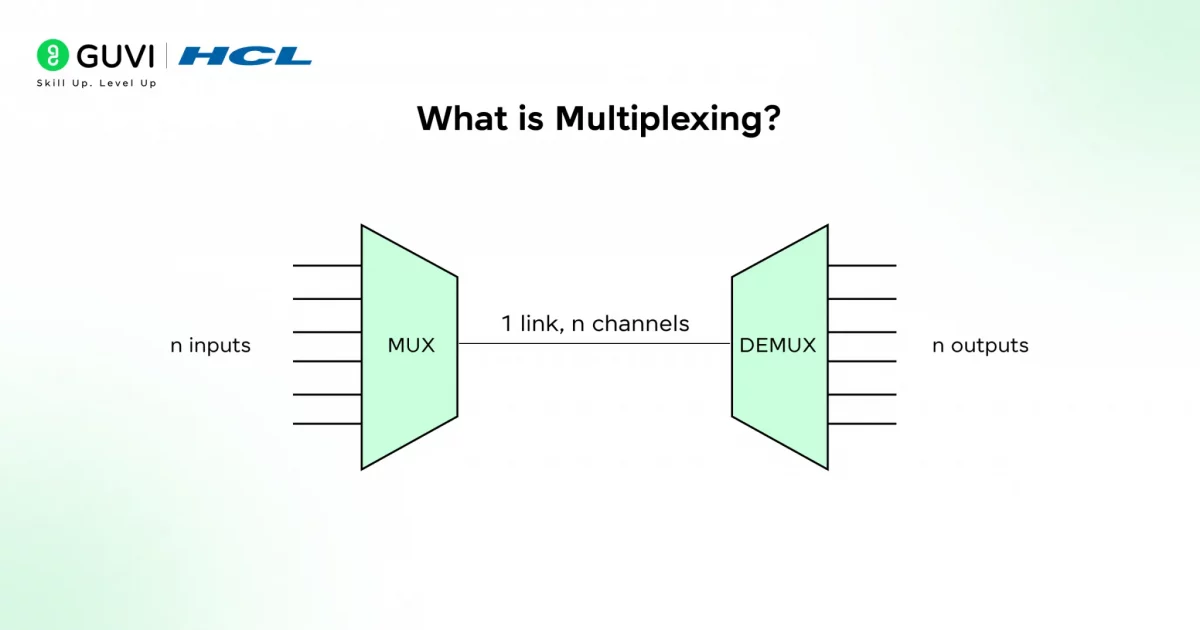
Multiplexing in computer networks is a method that allows several independent data streams to travel over a shared communication medium without losing their structure. The process relies on controlled separation of signals through time slots, frequency ranges or code patterns that prevent overlap during transmission.
Each stream retains its identity because the system assigns a defined position within the shared channel. This approach improves bandwidth efficiency and supports high traffic volumes. It seamlessly helps networks maintain orderly communication across limited physical resources.
Take the next step in your tech career with the HCL GUVI FSD 101 Course. Learn in-demand full-stack development skills, including React Bootstrap, Node.js, Express.js, MongoDB, API integration, Git, and deployment, through practical, hands-on learning. Build real-world web applications, strengthen your portfolio, and gain the confidence to become a job-ready full-stack developer. Enroll today and start building the future, one project at a time!
Types of Multiplexing in Computer Networks
1. Frequency Division Multiplexing (FDM)
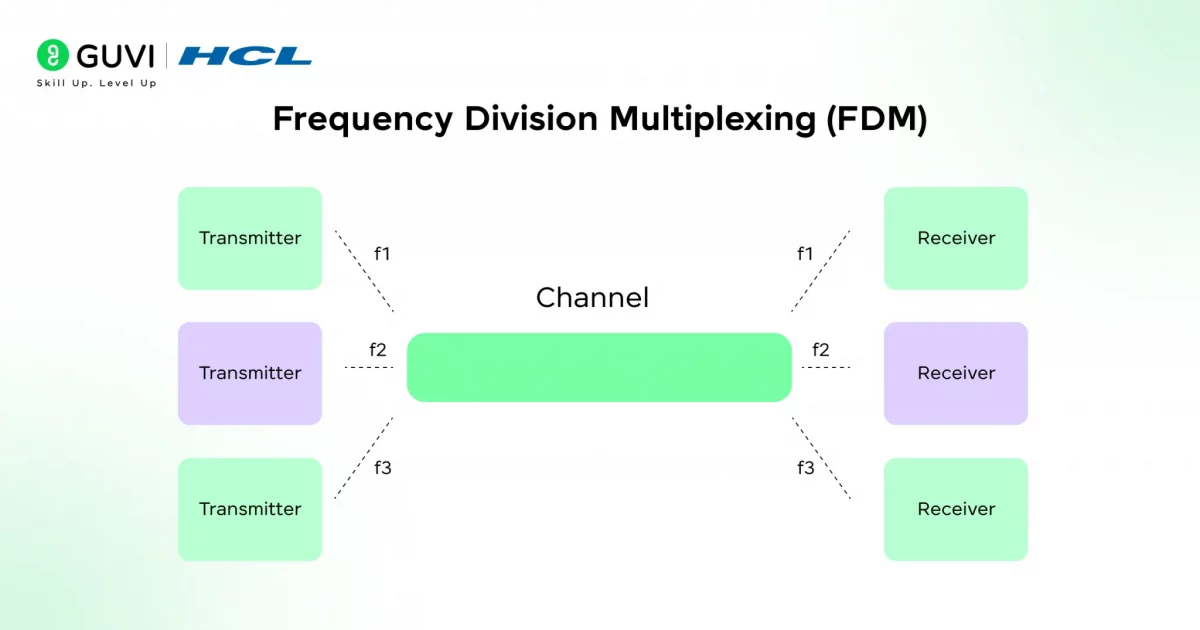
FDM assigns individual frequency bands to different data streams so they travel together without interfering. Each stream stays inside its own frequency range, which helps maintain clarity even during long periods of continuous transmission. The method suits channels that remain active for extended durations and need separation at the physical signal level.
Key Strengths
- Dedicated frequency bands preserve signal clarity and prevent mutual interference
- Continuous signals flow smoothly without requiring strict timing coordination
- Strong performance in environments that operate with stable analog behavior
Best Use Cases
- Radio broadcasting and television transmission
- Traditional telephone lines use analog channels
- Long-range communication that depends on steady, uninterrupted signals
Limitations
- Requires careful spacing of frequency bands to prevent overlap
- Becomes sensitive to noise that targets specific frequency ranges
2. Time Division Multiplexing (TDM)
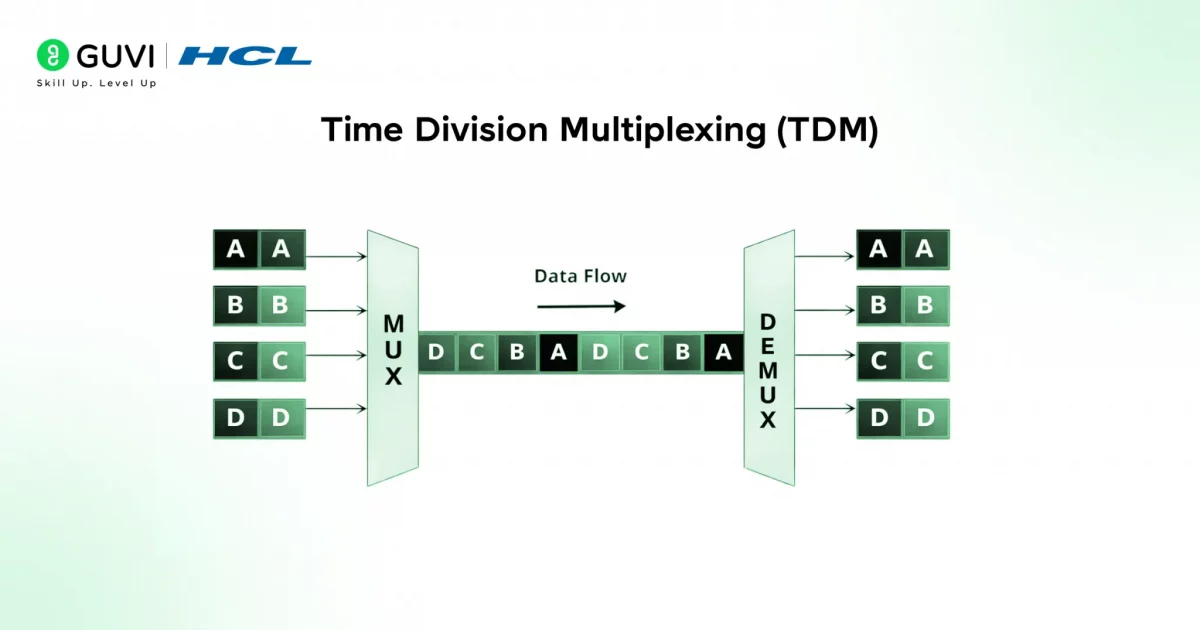
TDM divides channel time into structured slots so each data stream transmits during its assigned moment. Signals share one physical path but stay separated through precise timing. The approach suits digital networks that benefit from orderly switching between multiple sources.
- Synchronous TDM
Synchronous TDM gives each device a reserved slot in every cycle, even when the device has nothing to send. This maintains predictable timing across all sources and simplifies reconstruction on the receiver side.
Key Strengths
- Predictable timing pattern that supports systems requiring clear synchronization
- Fixed slot structure allows straightforward separation at the receiver
Best Use Cases
- Digital telephony systems
- Networks with steady traffic patterns
- Environments that value timing consistency over bandwidth efficiency
Limitations
- Idle slots reduce overall channel utilization during periods of low activity
- Statistical TDM
Statistical TDM allocates slots only to active sources. The multiplexer observes which streams have data and assigns slots according to demand, which improves bandwidth utilization.
Key Strengths
- Efficient use of channel capacity because idle sources do not consume slots
- Suitable for irregular traffic patterns with varied device activity
Best Use Cases
- Packet-switched networks
- Big data networks with fluctuating load
- Situations where channel efficiency carries high importance
Limitations
- Continuous monitoring increases processing load at the multiplexer
3. Wavelength Division Multiplexing (WDM)
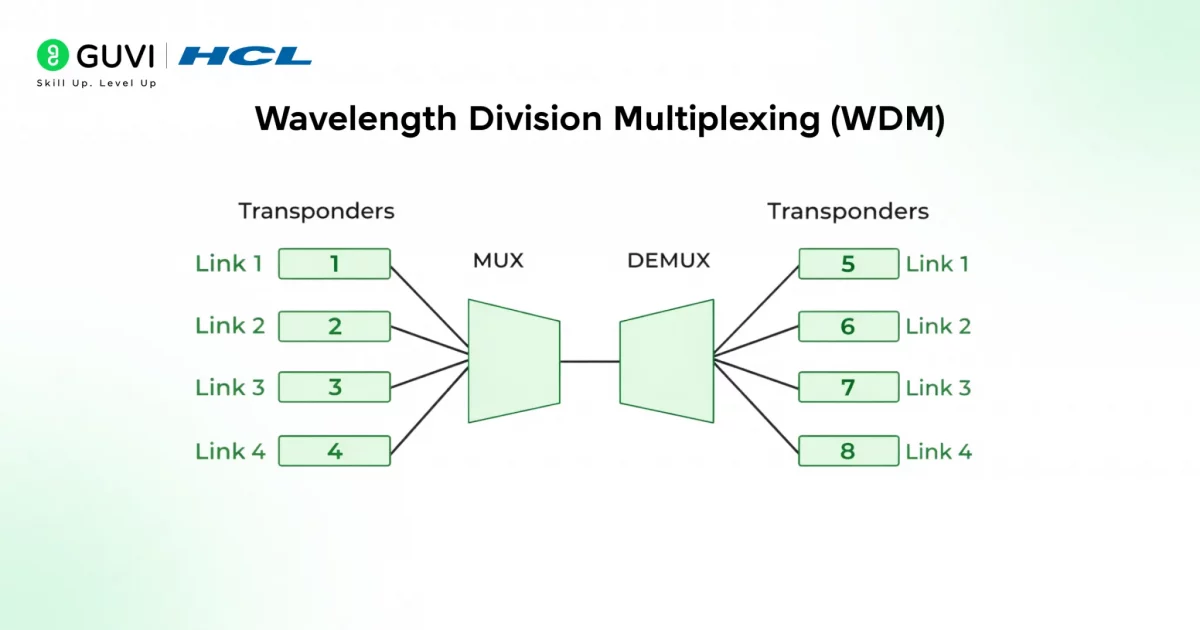
WDM applies multiplexing to fiber optics by assigning each data stream a specific light wavelength. Multiple wavelengths travel simultaneously through a single fiber strand while remaining isolated through optical separation. This allows extremely high bandwidth and long-distance transmission with minimal signal degradation.
Key Strengths
- Massive data capacity across one fiber because wavelengths remain independent
- Minimal signal interference due to clear optical separation
- Strong performance in high-bandwidth infrastructure
Best Use Cases
- Telecom backbone networks
- Long-distance fiber links connecting data centers
- High-capacity cloud and enterprise optical networks
Limitations
- Requires advanced optical components that increase deployment and maintenance cost
4. Code Division Multiplexing (CDM)
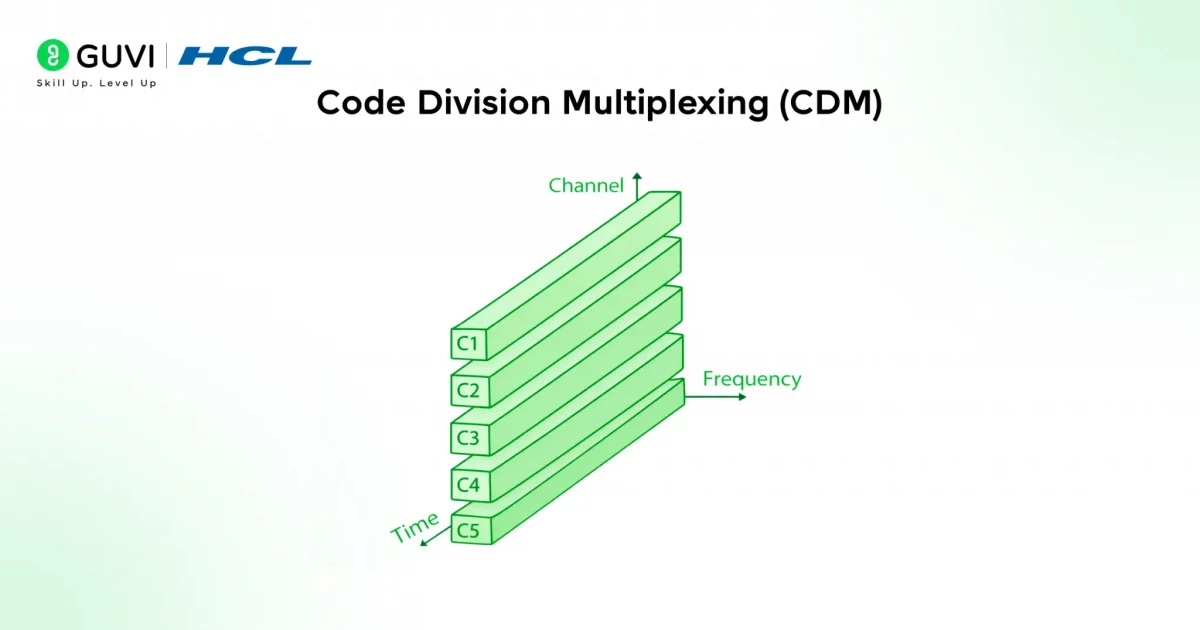
CDM assigns a unique code to every data stream so multiple users share the same channel without interfering. Each stream spreads its signal across the entire bandwidth, and the receiver uses the matching code to isolate the intended data. This structure supports simultaneous communication and maintains clarity even when several users transmit at the same time.
Key Strengths
- Unique codes create a strong separation between streams across the full bandwidth
- Supports many users at once without strict time or frequency division
- Offers steady performance in wireless environments with fluctuating signal conditions
Best Use Cases
- Mobile communication systems that handle many users
- Satellite communication channels
- Wireless networks where simultaneous access matters
Limitations
- Requires accurate code management to prevent signal overlap
5. Orthogonal Frequency Division Multiplexing (OFDM)
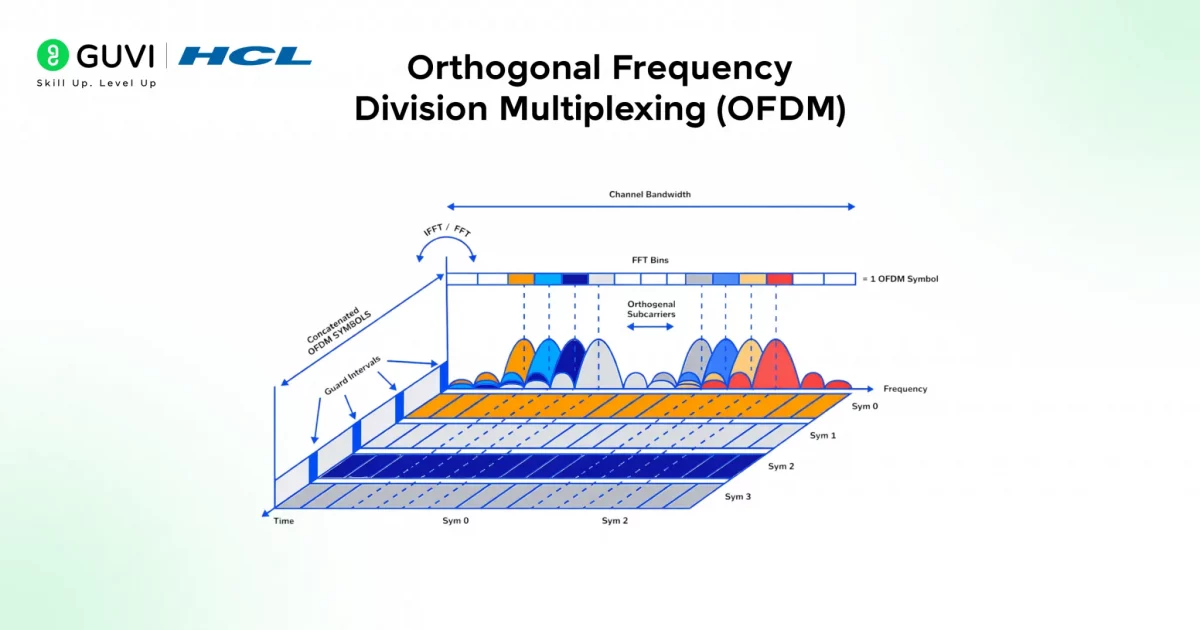
OFDM divides data into smaller blocks and transmits them across several closely spaced frequencies that remain mathematically orthogonal. This structure reduces the risk of interference between subcarriers and strengthens performance in environments with signal reflections or obstacles. The method suits modern wireless systems that require stable throughput under varying conditions.
Key Strengths
- Orthogonal subcarriers reduce interference even in reflective environments
- Handles high-speed data transmission with strong resistance to distortion
- Efficient use of the spectrum supports wideband communication
Best Use Cases
- Wi-Fi networks
- 4G and 5G systems
- Broadband access in urban areas with signal reflections
Limitations
- Requires precise synchronization to maintain the orthogonal structure
6. Space Division Multiplexing (SDM)
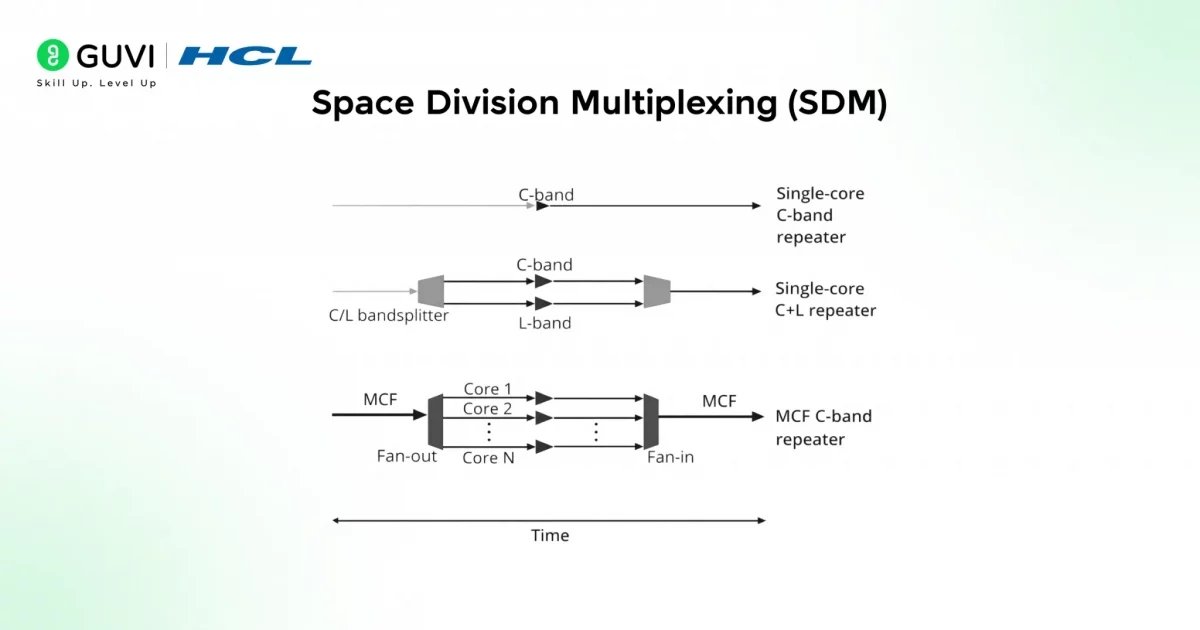
SDM increases capacity by transmitting separate data streams through physically distinct paths. These paths may be different fiber cores, wireless beams or separate antennas. The method expands network throughput without modifying frequency or time allocation, which makes it valuable for high-capacity communication systems.
Key Strengths
- Expands bandwidth by adding additional physical transmission paths
- Reduces pressure on time and frequency resources
- Strong value in large-scale communication where demand continues to grow
Best Use Cases
- Multi-core fiber optic systems
- Massive MIMO setups in advanced wireless networks
- High-capacity data exploration center interconnects
Limitations
- Requires physical infrastructure that increases deployment effort
Also, Explore: Best Real-life Projects for Developers and Computer Science Students [Source Code]
How Multiplexing in a Computer Network Works?
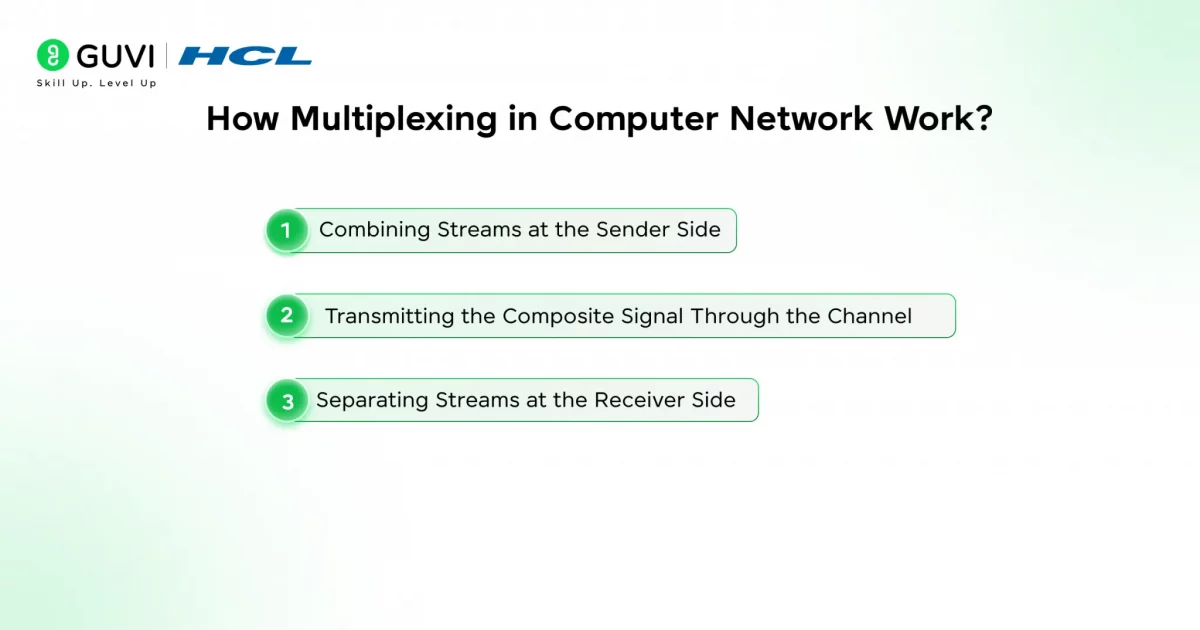
Step 1: Combining Streams at the Sender Side
The multiplexer begins by examining each incoming stream and determining its placement within the shared channel. It creates structural boundaries shaped either by timing windows or frequency partitions.
These boundaries prevent collisions because every stream enters the medium with a defined identity that the system recognizes. The MUX also stabilizes the rate of entry so the channel receives a disciplined flow instead of scattered transmissions.
Step 2: Transmitting the Composite Signal Through the Channel
Once combined, the unified stream travels through the communication channel as a controlled sequence. The internal structure formed at the sender side persists during movement, which keeps the channel from interpreting it as random fluctuations.
This organized flow strengthens channel efficiency because unused sections of the medium become active carriers instead of gaps. The channel’s capacity is therefore utilized with stronger consistency and higher predictability.
Step 3: Separating Streams at the Receiver Side
The demultiplexer processes the incoming composite stream and retrieves the structural markers assigned earlier. It aligns these markers with its internal synchronization pattern and restores each stream to its original state.
The DEMUX checks timing alignment, frequency boundaries or code signatures to ensure accurate recovery. This reconstruction maintains integrity because each stream returns with its original ordering and behavior preserved.
Also Read: Router in a Computer Network: Everything You Need to Know
Advantages of Multiplexing in Computer Networks
1. Efficient Use of the Communication Channel
Multiplexing supports a single channel to carry several independent streams without wasting capacity. Instead of leaving silent gaps or unused frequencies idle, the channel stays active with structured portions assigned to each stream. This disciplined sharing turns a limited medium into a high-value resource that supports more communication without adding extra physical links.
2. Lower Infrastructure and Operational Costs
Organizations can avoid building separate cables or parallel wireless links for every communication line by seamlessly combining many streams onto a shared path. The system reduces hardware demand because one channel serves multiple users. This lowers installation effort and ongoing maintenance, therefore making the network more economical without compromising performance.
3. Stronger Scalability for Expanding Networks
More streams can be integrated into the existing channel through controlled allocation of timing slots or coded sequences as communication needs grow. The underlying structure remains stable because the MUX adapts stream placement without altering the physical medium. This proficiency to grow without restructuring the channel strengthens long-term scalability.
4. Reduced Channel Congestion and Signal Conflicts
Multiplexing assigns dedicated structural boundaries to each stream, which prevents collisions and chaotic overlap. Every signal carries its own identity, so streams no longer fight over the medium. This structured movement improves consistency in delivery and lowers retransmission events that usually arise from contention.
5. Improved Transmission Quality and Predictable Performance
Because multiplexing organizes the flow of signals, each stream receives a dependable share of the medium. The channel experiences fewer fluctuations that typically disrupt timing or degrade clarity. The predictable pattern enhances stability, which is especially valuable for voice or data services that rely on steady, jitter-free movement.
Real-World Examples of Multiplexing in Computer Networks
1. Mobile Networks Carrying Voice and Control Signals Together
Modern mobile systems send voice calls, internet data, and device-control messages across the same radio channel. Multiplexing assigns each stream its own structural position, which helps the network handle thousands of users in one area without mixing their signals. This structure supports smooth switching between calls, browsing, and background device communication.
2. Fiber Backbones Moving High-Volume Traffic Between Cities
Long-haul fiber routes send several optical wavelengths through a single strand to move massive amounts of traffic between regions. Multiplexing allows carriers to expand capacity without laying new fibers, which strengthens reliability across national communication routes that link data centers, ISPs and enterprise hubs.

3. Cable TV Networks Delivering Many Channels on One Coax Line
Cable providers deliver television channels, on-demand streams, and broadband data over a single coaxial line. Multiplexing isolates these services through defined frequency positions. This structure helps households access several services at once without requiring separate wiring for each.
4. Aircraft Communication Systems Sharing Limited Wireless Channels
An aircraft uses a restricted set of radio channels to manage pilot communication, aircraft sensor updates, and passenger connectivity. Multiplexing structures these transmissions so all systems remain operational during flight. This organized flow strengthens safety and improves channel utilization inside the aircraft’s controlled environment.
5. IoT Gateways Handling Sensor Clusters in Industrial Sites
Factories rely on gateways that collect readings from sensors measuring temperature, vibration or pressure. Multiplexing organizes these streams into one outbound channel so data reaches monitoring systems with steady timing. This helps operators supervise large machines that cannot afford delays or inconsistent reporting.
Explore: HTTP in Computer Networks Explained: Basics, Methods & More
Challenges and Solutions in Multiplexing
1. Challenge: Signal Interference During Shared Transmission
Noise or overlapping boundaries can weaken clarity when several streams share one medium.
Solution: Use structured separation such as precise timing control, well-spaced frequencies or stronger optical filtering to maintain clear boundaries.
2. Challenge: Processing Load on Multiplexing Equipment
The multiplexer and demultiplexer must organize and restore several streams, which increases processing demand.
Solution: Deploy hardware with optimized switching capacity and use algorithms that assign positions efficiently under varying traffic levels.
3. Challenge: Latency Introduced by Coordination Tasks
Organizing streams through time slots, codes, or wavelengths may increase delay during busy periods.
Solution: Use adaptive scheduling and buffer management that prioritize active streams and reduce waiting time.
4. Challenge: Reduced Performance During Heavy Traffic
A shared channel struggles when many streams compete for limited space or timing positions.
Solution: Increase channel capacity through techniques such as SDM or add additional links to spread the load across a larger infrastructure.
5. Challenge: Single Point of Failure at MUX or DEMUX
A malfunction at either end disrupts every connected stream and halts communication.
Solution: Use redundant multiplexers that switch instantly during faults and apply monitoring tools that detect early signs of degradation.
Future Advancements in Multiplexing
1. Quantum-Assisted Multiplexing for Ultra-Secure Channels
Quantum principles will support channels that assign unique quantum states to streams, which strengthens confidentiality and prevents interception. This structure helps future networks carry sensitive data with higher certainty and integrity.
2. Terahertz-Band Multiplexing for Extreme Data Capacity
Future wireless systems will use terahertz frequencies that support wider channel spacing. Multiplexing across this range increases throughput and helps dense environments handle heavy traffic with stronger stability.
3. AI-Aligned Adaptive Slot Allocation
Machine learning systems will evaluate channel conditions in real time and adjust slot or code placement automatically. This refinement improves efficiency during sudden load changes and reduces waste across the shared medium.
4. Integrated Space Division Multiplexing in Next-Gen Fiber
Future fiber designs will use multi-core and multi-mode structures that support several spatial paths inside one strand. This approach expands backbone capacity without requiring additional underground infrastructure.
5. Optical Superchannel Multiplexing for Data Center Interconnects
Data centers will rely on bundled wavelengths grouped into optical superchannels that move high-density traffic across short and long spans. This structure supports rapid scaling as cloud workloads continue to grow.
6. Advanced Beam-Based Multiplexing in 6G Networks
6G systems will form several focused wireless beams from the same antenna array. Multiplexing across these beams strengthens coverage and helps devices maintain structure even during movement through crowded zones.’
Discover: Bridge in Computer Networks: How Networks Talk to Each Other
Disadvantages of Multiplexing in Computer Networks
- Multiplexing requires dedicated hardware, which increases system complexity and raises the initial deployment effort.
- Shared transmission channels remain vulnerable to interference, which can degrade clarity during busy communication periods.
- Continuous coordination between signals introduces processing overhead that may reduce overall transmission speed.
- Heavy traffic can strain allocated slots or frequencies, which affects the consistency of delivered data.
- A fault in the multiplexer or demultiplexer interrupts every connected stream and disrupts communication.
Types of Multiplexing in Computer Networks: Comparison Table
Here’s a quick comparison of the different types of multiplexing in computer networks, along with their techniques, efficiency, and real-world use cases:
| Type | Full Form | Technique | Efficiency | Examples | Use Case |
|---|---|---|---|---|---|
| FDM | Frequency Division Multiplexing | Assigns separate frequency bands to each stream | Moderate — needs spacing between bands to avoid overlap | Radio broadcasting, analog telephone lines | Long-range, continuous analog transmission |
| TDM | Time Division Multiplexing | Divides channel time into fixed or dynamic slots per stream | Low in Synchronous TDM (idle slots waste capacity); Higher in Statistical TDM (slots go to active streams only) | Digital telephony, packet-switched networks | Digital networks with steady or fluctuating traffic |
| WDM | Wavelength Division Multiplexing | Assigns each stream a distinct light wavelength on fiber | High — supports massive data capacity per fiber strand | Telecom backbones, fiber links between data centers | High-bandwidth, long-distance fiber optic transmission |
| CDM | Code Division Multiplexing | Assigns a unique code to each stream across the full bandwidth | Good for multi-user access, but depends on accurate code management | Mobile communication systems, satellite links | Wireless environments needing simultaneous multi-user access |
| OFDM | Orthogonal Frequency Division Multiplexing | Splits data across closely spaced orthogonal subcarriers | High — resistant to interference and signal reflection | Wi-Fi, 4G and 5G networks | Wireless broadband in reflective/urban environments |
| SDM | Space Division Multiplexing | Sends streams through physically separate paths (fiber cores, beams, antennas) | High, but requires added physical infrastructure | Multi-core fiber systems, massive MIMO setups | High-capacity networks needing extra physical bandwidth |
Multiplexing in Real Telecom Systems — 4G, Fiber Optic
a. How 4G Networks Use Multiplexing
Every time you make a call or scroll through your phone on 4G, multiple types of data are moving at once — voice packets, browsing data, app notifications, and background sync requests. All of this travels over the same limited radio spectrum.
4G networks rely on OFDM (Orthogonal Frequency Division Multiplexing) to split this spectrum into many small subcarriers, letting thousands of users share the same tower without their signals colliding.
This is one of the clearest real-world examples of multiplexing in computer networks, where a shared, limited resource is organized so efficiently that it feels seamless to the end user.
b. How Fiber Optic Networks Use Multiplexing
Fiber optic backbones carry the bulk of the world’s internet traffic between cities, countries, and continents. Instead of laying a new physical cable every time more capacity is needed, telecom companies use WDM (Wavelength Division Multiplexing) to send multiple beams of light — each carrying its own data stream — through a single strand of fiber.
This is a huge cost-saver and a major reason why global data transfer keeps getting faster without requiring endless new infrastructure. It’s a great example of how multiplexing in computer networks solves real capacity problems at a massive scale.
c. Why This Matters
Without multiplexing, modern telecom infrastructure simply couldn’t function at today’s speed or scale. Every video call, every streamed show, every fiber connection depends on this quiet, background process of combining and separating signals — efficiently, reliably, and almost invisibly.
Multiplexing vs Demultiplexing — Difference and Relationship
Multiplexing and demultiplexing aren’t two separate processes — they’re two ends of the same journey. Multiplexing occurs first on the sender’s side, where the MUX combines multiple data streams into a single signal for transmission over the shared channel. Demultiplexing happens last, at the receiver’s side, where the DEMUX takes that combined signal and separates it back into its original individual streams.
Visualize It
Think of it like a school bus picking up kids from different houses (multiplexing) and dropping each of them off at their own house at the end of the day (demultiplexing). The bus is the shared channel, and without a clear system for who gets on and off where, everyone would end up at the wrong stop.
| Aspect | Multiplexing | Demultiplexing |
|---|---|---|
| Function | Combines multiple streams into one signal | Splits one signal back into multiple streams |
| Device Used | Multiplexer (MUX) | Demultiplexer (DEMUX) |
| Occurs At | Sender side | Receiver side |
Conclusion
Multiplexing stands at the core of modern communication, enabling countless independent signals to coexist within a single medium without losing structure, clarity, or intent. By assigning every stream its own position, whether through time, frequency, wavelength, or code, it turns limited channels into highly efficient carriers of voice, video, and data.
As networks scale and demands intensify, multiplexing remains essential for preserving order, improving bandwidth utilisation, and ensuring consistent, reliable performance across today’s connected world.
FAQs
1. What is multiplexing in simple words?
It’s a technique that lets multiple data streams travel together over one channel and then get separated at the receiving end.
2. What are the 6 types of multiplexing?
The six main types are FDM, TDM, WDM, CDM, OFDM, and SDM — each separating signals using a different method like frequency, time, wavelength, code, or physical path.
3. What is the difference between multiplexing and demultiplexing?
Multiplexing combines streams into one signal at the sender’s side; demultiplexing splits them back at the receiver’s side.
4. Why is multiplexing used in computer networks?
It makes efficient use of limited channels, cuts infrastructure costs, and lets multiple users share the same medium.
5. Which multiplexing technique is used in 4G and 5G networks?
4G and 5G mainly use OFDM, since it handles high-speed data well and resists interference in crowded areas.
6. What is an example of multiplexing in real life?
Fiber optic networks use WDM to send multiple data streams as different light wavelengths through a single fiber strand.
Success Stories








Did you enjoy this article?