


Software Development Articles
How to Read and Understand System Design Diagrams?
System Engineer Roles and Responsibilities: 12 Proven Duties for Growth
SAP Consultant Roles and Responsibilities: 12 Proven Duties for Growth and Success
Network Engineer Roles and Responsibilities: 12 Essential Duties for Success


Get In Touch For Details! Request More Information
Best Programming Languages For Software Developers in 2026
Aug 03, 2026 9 Min Read 3886 Views
(Last Updated)
Imagine for a moment the computers we use, the mobile phones and tablets we rely on for performing our daily tasks and fulfilling our needs. Consider every electronic device we use in our day-to-day lives. If all these systems were only restricted to perform raw hardware operations, such as reading and writing data in memory, involvement in conducting arithmetic computations, logical operations (like AND, OR, NOT, XOR), and fetching instructions from memory, how isolated and stagnant the software systems would be.
That’s why programming languages are created, which are basically a set of instructions integrated with logic and algorithms that allow users to interact and communicate seamlessly with the computer systems and platforms, as well as control their operations.
Through programming languages, human beings and machines are connected, and by using these languages, individuals gain the ability to create and design software, applications, web apps, websites, games, and databases.
Now, we are all in a stage where online activities, such as browsing the internet, e-commerce shopping, online transactions, data analysis and reporting, forwarding or sending emails and messages, and even streaming movies and music, are being developed and backed by programming languages.
In this blog, we aim to explore the most popular and widely adopted programming languages for software developers in 2026, as well as the essential elements associated with them.
Table of contents
- What is a Programming Language?
- Top Programming Languages For Software Developers
- Python
- Java
- C++
- JavaScript
- Go (Golang)
- Rust
- Kotlin
- PHP
- Swift
- Conclusion
- FAQs
- Which programming language is best from a development perspective?
- What is the difference between software programming and development?
- Which programming language is the most difficult and which is the easiest to learn?
What is a Programming Language?
A programming language is essentially a set of instructions and rules that is coded in a structured way so that machines can process it. In other words, it is defined in terms of syntax and semantics to ensure that the hardware systems correctly interpret it and execute the required instructions.
When a developer or programmer writes code in any particular language, that language is compiled or interpreted and translated into machine language. With this machine-level code, the hardware systems are then responsible for executing the program line by line at a very high speed, which varies based on processing power and memory storage.
For a better comprehension, remember this flowchart: Writing Code -> Syntax and Rules -> Compiling/Interpreting -> Code Execution.
Insight: Compiling means converting and processing the entire code into machine language before execution, whereas interpreting a language means executing the code line by line in a sequential order.
Top Programming Languages For Software Developers
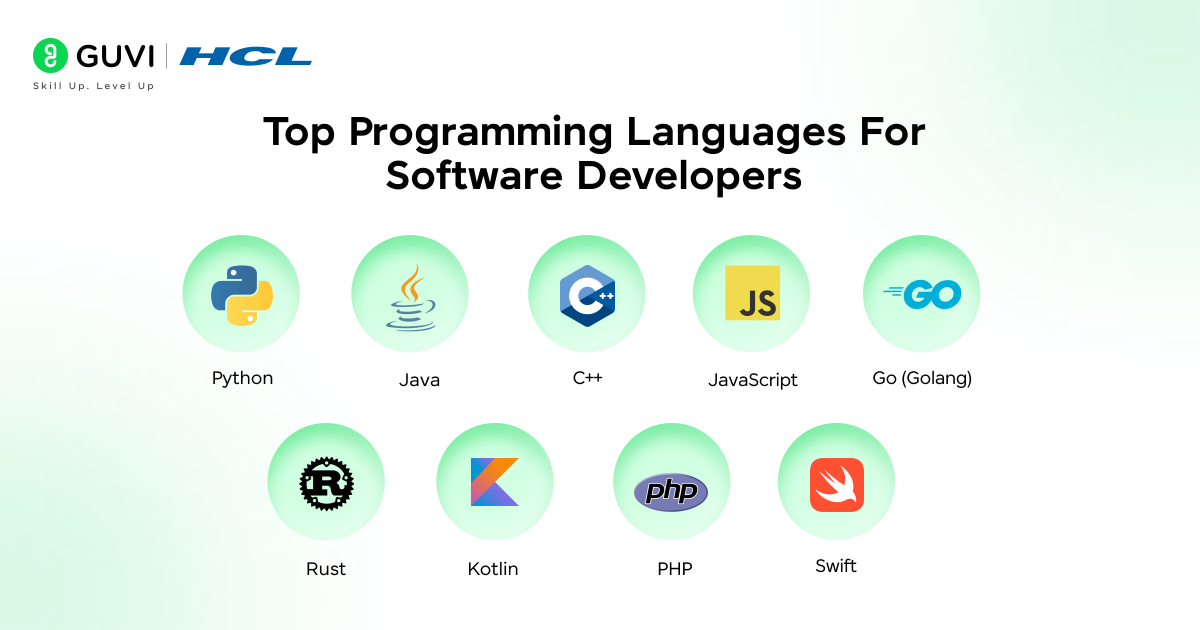
Let’s discuss the following programming languages:
1. Python
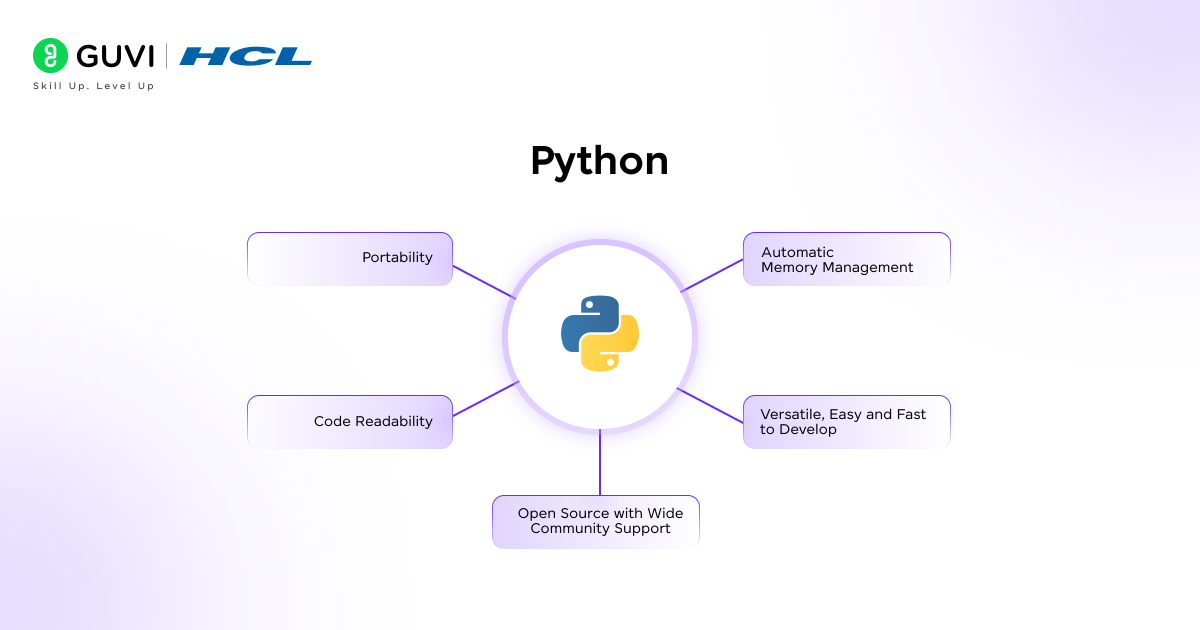
Python is a high-level, interpreted software programming language created to enhance readability, simplicity, and ease of managing and writing complex codebases. It is a powerful language that is suitable for both professional developers and beginners. The main principle of Python is to ensure clean and concise code that enables programmers to write fewer yet effective lines while maintaining the quality.
Key Features
- Python is easy to comprehend due to its straightforward and intuitive English-like syntax.
- As it interprets the line of code one by one, it simplifies the debugging process.
- Due to its built-in modules and packages, Python enables developers to perform various tasks, such as file management, web development, and data manipulation.
- This language can run smoothly across different operating systems such as Linux, Windows, macOS, iOS, and Android.
- It also helps in creating and designing prototype models in a much faster way, which makes it a great option in fast-paced development cycles.
Applications
- Web Development
- Data Science and Analysis
- Automation and Scripting applications
- Game Development
- Artificial Intelligence (AI) and NLP (Natural Language Processing) projects
Popular Frameworks/Libraries
- Django: Framework for web apps
- Flask: Framework for small apps & APIs
- TensorFlow: Library for ML & DL
- PyTorch: Library for AI & neural nets
- NumPy: Library for math & numbers
- Pandas: Library for data handling
- FastAPI: Framework for fast APIs
Future Scope
If we have to observe the current technology landscape, then Python is widely used across multiple industries due to its versatility and ease of learning. Based on its current scenario, it is likely to become the go-to or preferred language for building AI, machine learning, and data science projects.
Individuals and professionals who opt to build a strong foundation in the Python programming language have a great career path ahead. As a Python developer, Data scientist, and AI/ML engineer, you will be required to implement features and functionalities that will be based on Python and its core concepts. Having competency in Python can enhance your employability significantly and can be a gateway to high-paying tech roles.
2. Java
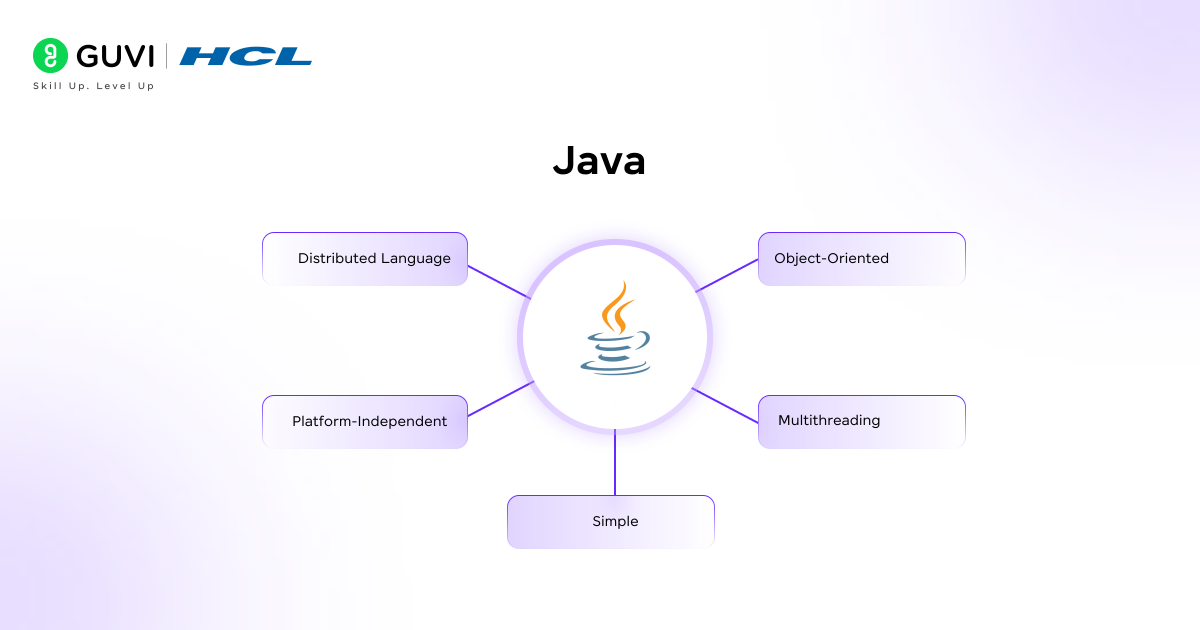
JAVA is a high-level, object-oriented programming language that doesn’t depend on any platform. It was created with a sole purpose to encourage reusability; in other words, developers don’t have to repeat code at every section or part of the main program.
JAVA is implemented in complex and scalable software projects to ensure robustness, security, and reliability. Enterprise-grade applications and platforms are designed and developed with the help of this language due to its wide array of libraries and rich development ecosystem.
Key Features
- Its object-oriented approach to developing projects enables developers to simulate real-world entities via classes and objects, as a result of which the entire codebase becomes modular in nature and easier to manage.
- Java is also cross-platform compatible, meaning it can run on any operating system with a JVM (Java virtual machine).
- It is a very robust programming language that can perform complex tasks such as memory management, exception handling, or performing program operations while processing the user actions simultaneously.
- JAVA also enables concurrent execution of multiple threads, due to which the overall performance in complex applications and platforms is enhanced without any degradation.
- It uses automatic garbage collection to handle the memory part of various programs and software, which means the data that is corrupted and unnecessary or no longer needed in executing tasks is automatically stored in the heap and is later reclaimed (if necessary). By doing this, memory leaks and consumption are minimized, which leads to optimal program performance.
Applications
- Enterprise-grade apps and backend systems
- Android mobile app development
- Web development
- Java Full-Stack development
- Big data technologies (Hadoop, Apache Spark)
Popular Frameworks/Libraries
- Spring: Framework for enterprise apps
- Hibernate: A Tool for Database Mapping
- Apache Struts: Framework for Java web apps
- JavaFX: Library for desktop GUI apps
- JUnit: Framework for testing Java code
- Maven/Gradle: Tools for build & dependency management
Future Scope
Since its inception, JAVA has been one of the phenomenal programming languages and will continue to stay relevant in the future also. And the reason behind its strong relevance lies in its robustness, scalability, and security features that make it an ideal choice for enterprise solutions, Android development, and large-scale software systems.
Upskilling yourself with JAVA as your primary language can open up diverse career options such as backend developer, full-stack engineer, big data engineer, or Android app developer. Its widespread adoption and mature ecosystem make it a reliable choice for long-term career growth.
3. C++
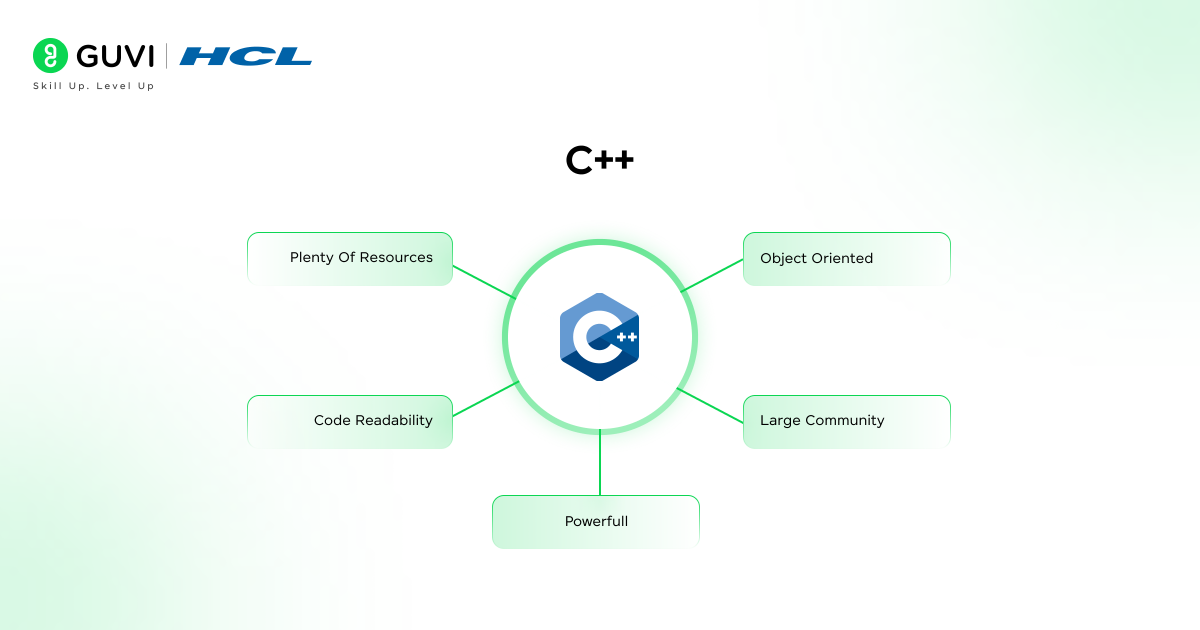
C++ is a high-level, compiled programming language that was developed as an extension of the C language. It is a language that blends the features such as procedural, object-oriented, and generative programming, due to which it becomes suitable for system-level programming, developing high-quality games and performance-critical applications and systems.
As compared to other programming languages, C++ has a more complex syntax structure, but in terms of other technical aspects such as speed, efficiency, and control over system resources, it is one of the best programming languages one can implement to build software products. It also provides developers the flexibility to optimize the performance of the applications for speed and resource allocation.
Key Features
- Maintaining the codebases is way easier in C++ as it allows modularity by supporting classes, objects, inheritance, polymorphism, and encapsulation.
- The conversion of code to machine language is very fast in C++, resulting in a very low code execution time.
- It is portable and can be run on different operating systems with very minimal modifications.
- It also allows access to the memory directly via using pointers (variables that refer to the memory location of other variables).
- It supports various types of programming styles such as object-oriented, procedural, and generic.
Applications
- Operating system development
- Game engines and high-performance graphics
- Embedded systems and IoT (Internet of Things)devices
- Real-time simulations and scientific computing
- Software requiring speed and resource optimization
Popular Frameworks/Libraries
- STL (Standard Template Library): Data structures and algorithms
- Boost: Collection of portable C++ libraries
- Qt: Framework for GUI applications
- OpenCV: Library for computer vision applications
- CMake: Build automation and project management tool
Future Scope
Nowadays, the applications and software systems being developed are built with a perspective that ensures they will require optimal resources in the long run. In this case, C++ acts as an imperative language by providing these systems with speed, efficiency, and control over hardware.
Learning C++ can make you capable of working on various tech domains such as embedded systems, gaming, robotics, IoT applications, blockchain, and many more. And due to this versatility, tech organizations often look for proficient C++ developers.
4. JavaScript
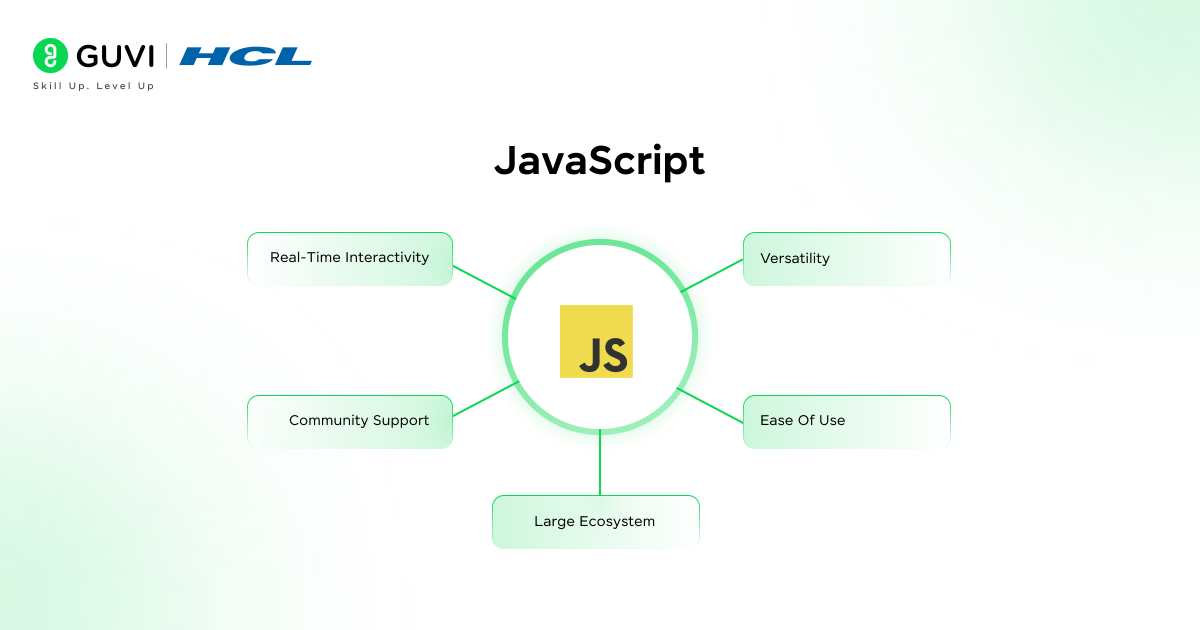
JavaScript is a high-level, dynamic, single-threaded, and synchronous programming language that was created for integrating interactivity and functional logic into static web pages. It is supported by almost all modern browsers existing in the market, and apart from this, it is a client-side scripting language, which means that rather than running on the server, it runs on the client’s web browser, in which the JS engine processes the whole code (for the Chrome browser, the JS engine is V8).
And with the arrival of Node.js, which is a JavaScript runtime environment, developers also got the flexibility to write JS code for server-side, making it suitable for both frontend and backend systems. JavaScript’s widespread adoption, flexibility, and active community have made it one of the most essential and future-proof languages in the programming world.
Key Features
- JavaScript runs seamlessly across the majority of web browsers without any need for additional software requirements.
- Dynamic event handling capability, meaning when users trigger any interaction, such as clicks, keypresses, or mouse movement, JS can render the visual component or data based on those events.
- JS supports asynchronous functions through async/await, callbacks, and promises, due to which the code execution doesn’t freeze in case of slow methods, API calls, or any database queries.
- JavaScript allows flexibility while defining variables, as the data types are determined at runtime instead of being predefined.
- Applications and websites can be designed and developed quickly by using JavaScript while maintaining the build quality. It is possible because JS supports an extensive collection of frameworks (like Angular, React, Vue), libraries, and npm (Node Package Manager) packages.
Applications

- Interactive websites and web applications
- Backend development with Node.js
- Mobile apps
- Desktop apps
- Game development
- IoT and real-time applications
Popular Frameworks/Libraries
- React.js: Library for building user interfaces
- Angular: Framework for dynamic web apps
- Vue.js: Progressive framework for UI and SPAs
- Node.js: Runtime for backend development
- Express.js: Web application framework for Node.js
- Next.js: Framework for server-side rendering and full-stack apps
Future Scope
JavaScript is one of the most used languages across the world when it comes to developing real-world applications and websites, where visual components, design patterns, interactivity, and advanced features and functionalities are the essential elements. By looking at the current tech landscape, we can observe that from developing full-stack projects to progressive web-apps (PWAs), from creating and crafting real-time chat apps to designing serverless architectures, JavaScript is acting as the main ingredient.
Career opportunities are vast—frontend developer, backend developer, full-stack developer, mobile app developer, and even roles in gaming and IoT. Without JavaScript, the web as we know it—dynamic, interactive, and user-friendly—would not exist.
The guide itself points to mastering Data Structures & Algorithms alongside your chosen language. HCL GUVI’s Code Kata gives you hands-on coding problems across languages, including DSA-focused challenges, to build the well-rounded skill set this guide recommends.
5. Go (Golang)
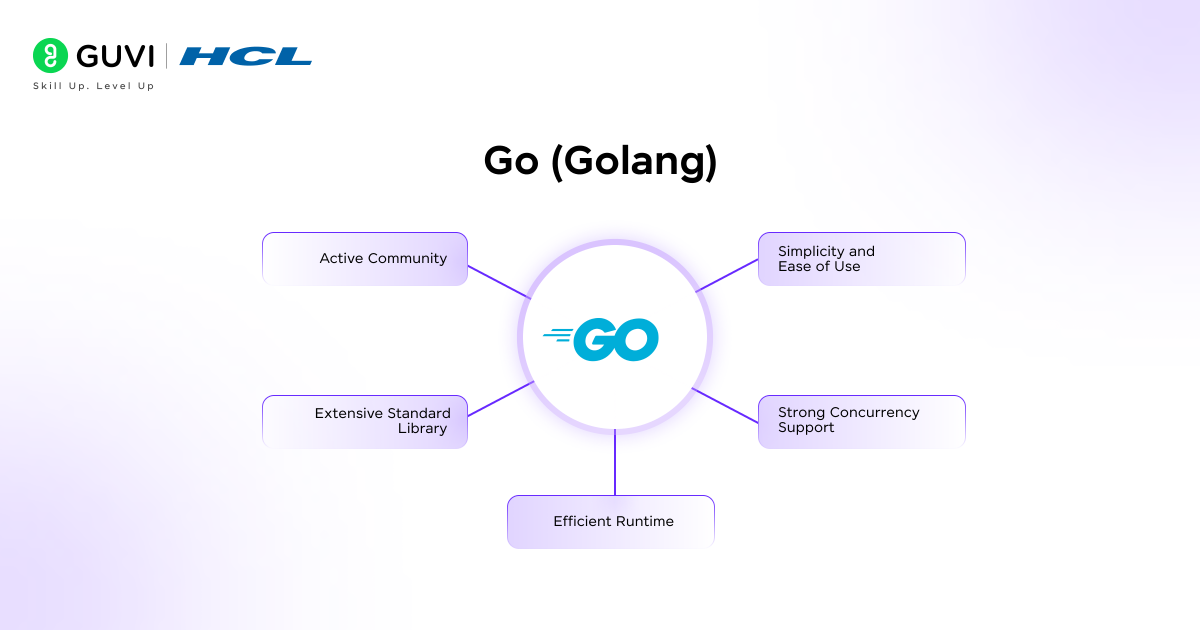
Go, commonly known as Golang, is an open-source, compiled programming language developed by Google. It was designed to be simple, efficient, and highly concurrent, making it well-suited for building scalable systems, cloud-native applications, and server-side software. Go combines the performance benefits of low-level languages with the simplicity of high-level ones, which is why it has gained significant popularity in backend development and distributed computing.
Key Features
- Concurrency is built into the language with goroutines and channels, enabling the creation of scalable, parallel systems.
- Very fast compilation and execution due to its compiled nature.
- Provides a garbage collector that simplifies memory management.
- Strong standard library with powerful built-in packages.
- Highly portable and can run seamlessly across different platforms.
Applications
- Cloud-native development and microservices
- Backend and server-side development
- Networking and distributed systems
- DevOps tools and infrastructure software
- High-performance web services
Popular Frameworks/Libraries
- Gin: Web framework for building APIs
- Beego: Full-stack web framework
- Revel: High-productivity web framework
- Go-kit: Toolkit for microservices
- GORM: ORM library for databases
Future Scope
With the rise of cloud computing, containerization, and microservices, Go continues to see wide adoption, especially in large-scale backend and infrastructure projects. It is the backbone of many modern technologies like Kubernetes, Docker, and Terraform. The simplicity and scalability of Go make it an excellent choice for developers looking to build efficient, distributed systems.
6. Rust
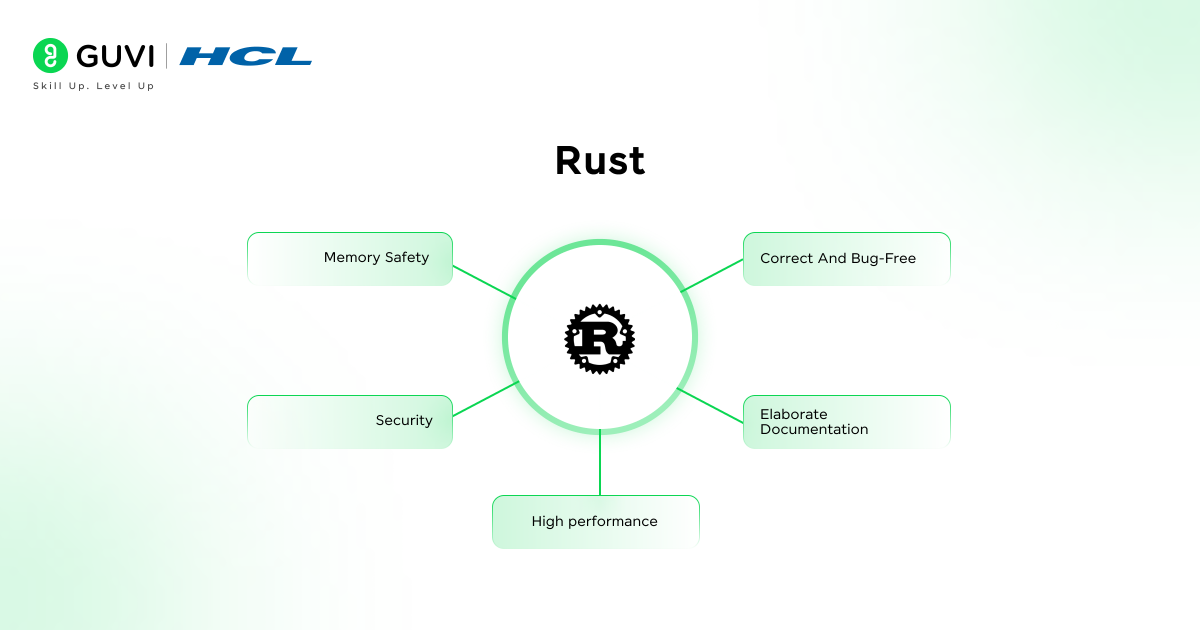
Rust is a modern, high-performance programming language developed by Mozilla. It is designed with a focus on memory safety, concurrency, and zero-cost abstractions. Rust eliminates common programming errors, such as null pointer dereferencing and data races, making it one of the safest languages for system-level development.
Key Features
- Memory safety without garbage collection using an ownership model.
- High performance similar to C and C++ while maintaining safety.
- Strong type system to prevent runtime errors.
- Built-in concurrency support for parallel programming.
- Cross-platform compatibility.
Applications
- Operating systems and system-level programming
- WebAssembly (Wasm) applications
- Game engines and graphics rendering
- Blockchain development
- Performance-critical applications
Popular Frameworks/Libraries
- Rocket: Web framework for APIs
- Actix: High-performance web framework
- Tokio: Asynchronous runtime for Rust
- Diesel: ORM for database interactions
- Serde: Serialization and deserialization library
Future Scope
Rust is gaining immense popularity for its safety and performance, making it a top choice for building reliable systems, embedded solutions, and blockchain applications. Many big tech companies are adopting Rust in place of C and C++ for critical projects, ensuring its strong future in system-level programming and beyond.
7. Kotlin
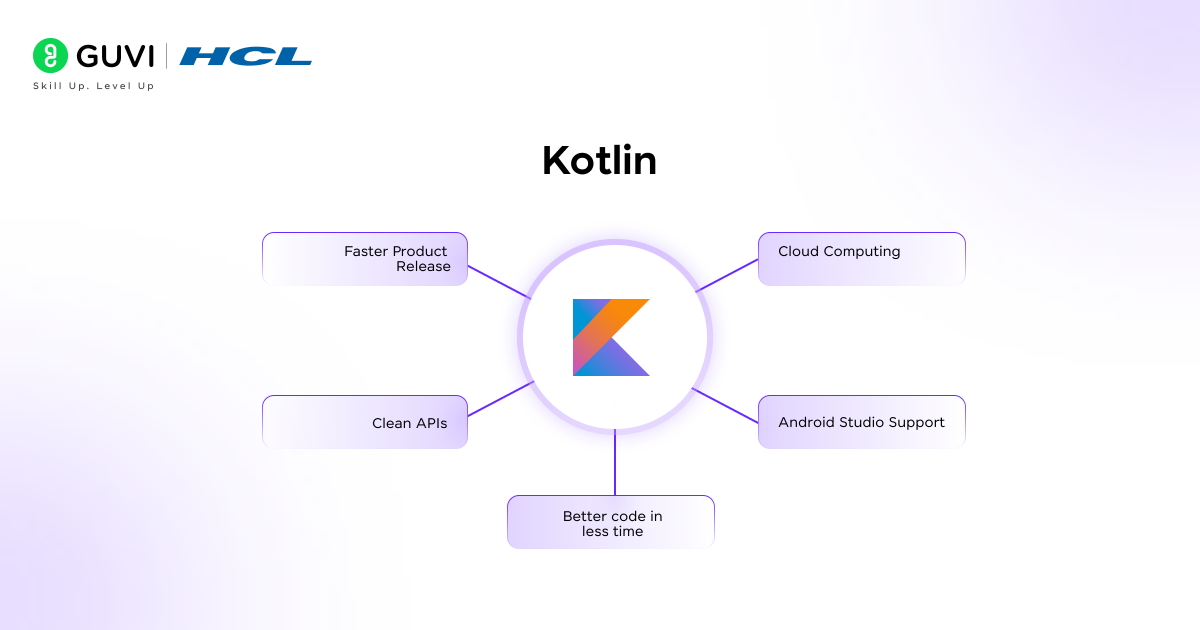
Kotlin is a modern, statically typed programming language developed by JetBrains. It runs on the Java Virtual Machine (JVM) and is fully interoperable with Java. Due to its concise syntax, null safety, and rich feature set, Kotlin has become the best language for mobile app development and is also widely used for cross-platform and server-side applications.
Key Features
- Interoperability with Java makes it easy to adopt in existing projects.
- Concise syntax, reducing boilerplate code compared to Java.
- Null safety features to minimize runtime crashes.
- Supports object-oriented, functional, and procedural paradigms.
- Compatible with multiple platforms (JVM, Android, JavaScript, and native).
Applications
- Android mobile application development
- Cross-platform app development
- Server-side and backend development
- Desktop applications
- Web development (via Kotlin/JS)
Popular Frameworks/Libraries
- Ktor: Framework for building connected applications
- Spring (with Kotlin support): For enterprise-level applications
- Jetpack Compose: UI toolkit for Android development
- Exposed: ORM framework for databases
- Kotlinx Coroutines: Library for concurrency
Future Scope
As the official language for Android app development, Kotlin is already a dominant player in the mobile space. Its cross-platform support and growing adoption in server-side development are expanding its scope. With continuous support from Google and JetBrains, Kotlin is set to remain one of the most in-demand programming languages in mobile and enterprise domains.
8. PHP
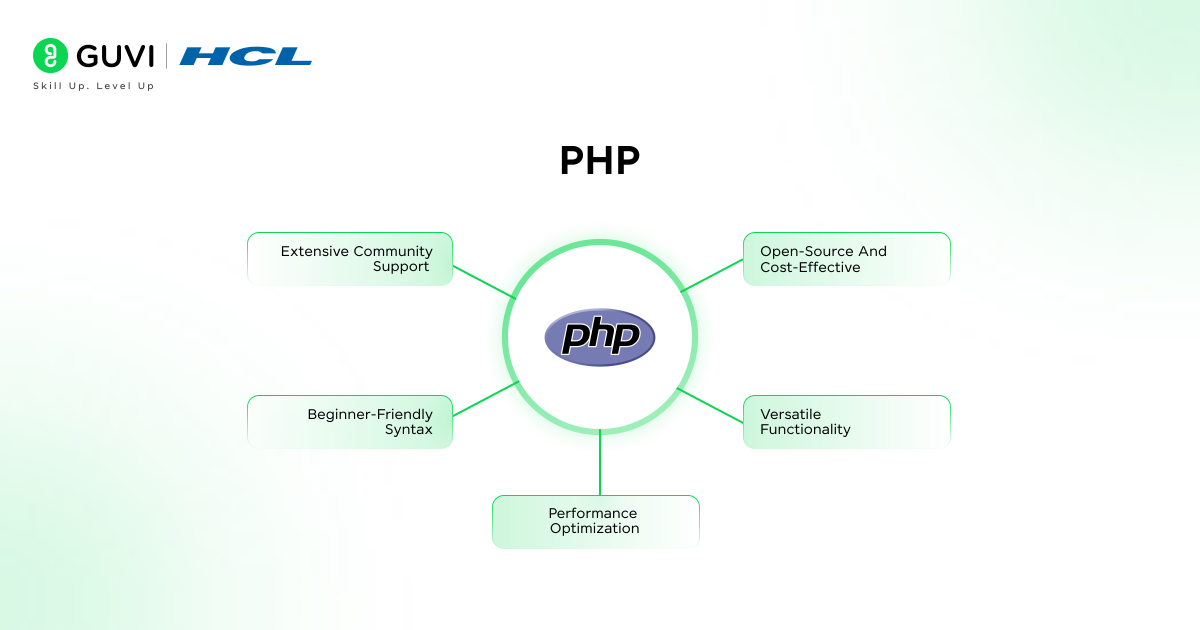
PHP (Hypertext Preprocessor) is a widely used, open-source scripting language primarily designed for server-side web development. It is embedded within HTML and is primarily known for powering dynamic websites and applications. Although it is an older language, PHP continues to evolve and remains a core component of the web ecosystem.
Key Features
- Easy to learn and use with a simple syntax.
- Open-source and widely supported by hosting providers.
- Strong integration with databases, especially MySQL.
- Large ecosystem with extensive libraries and frameworks.
- Cross-platform compatibility across major operating systems.
Applications
- Server-side scripting for dynamic web pages
- Content Management Systems (CMS) like WordPress, Joomla, Drupal
- E-commerce platforms (Magento, WooCommerce)
- API development
- Web applications requiring database integration
Popular Frameworks/Libraries
- Laravel: Modern PHP framework for web apps
- Symfony: Reusable PHP components and framework
- CodeIgniter: Lightweight PHP framework
- CakePHP: Framework for rapid development
- Composer: Dependency management tool
Future Scope
Although new backend technologies are rising, PHP still powers a significant portion of the web, including WordPress-based sites that account for a large share of the internet. With frameworks like Laravel making it modern and efficient, PHP will continue to be relevant for web development, especially in content-driven applications.
9. Swift
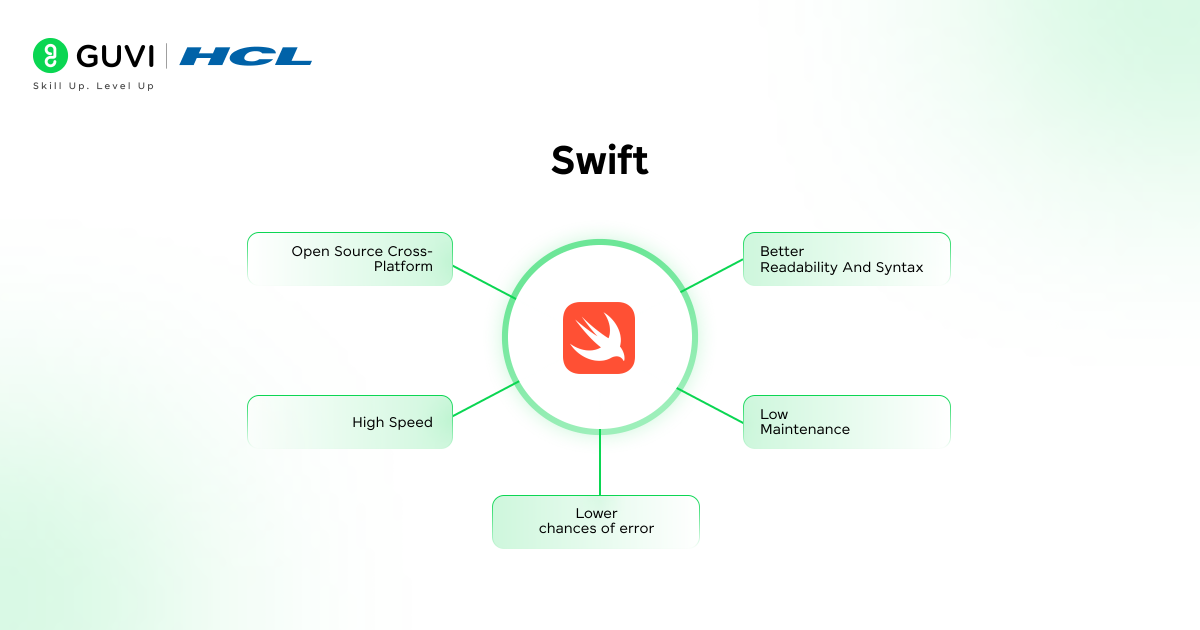
Swift is a modern, compiled programming language developed by Apple for iOS, macOS, watchOS, and tvOS development. It is designed to be safe, fast, and expressive, offering an intuitive syntax for developers while delivering high performance. Swift has largely replaced Objective-C as the preferred language for Apple ecosystem development.
Key Features
- Safe and modern syntax that reduces common errors.
- High performance comparable to C-based languages.
- Optionals and strong typing ensure safety and reliability.
- Interoperable with Objective-C for legacy projects.
- Supports functional, procedural, and object-oriented programming.
Applications
- iOS and macOS application development
- Game development using SpriteKit and SceneKit
- Cross-platform apps with Swift for server-side programming
- WatchOS and tvOS applications
- Machine learning integration via Core ML
Popular Frameworks/Libraries
- SwiftUI: Framework for building user interfaces
- Vapor: Web framework for server-side Swift
- Kitura: IBM’s web framework for Swift
- CoreData: Data persistence framework
- Alamofire: HTTP networking library
Future Scope
Swift continues to dominate Apple’s ecosystem and is expanding into server-side and cross-platform development. With Apple’s continuous investment, Swift remains the go-to language for building innovative and high-performance applications for iOS and macOS, ensuring a bright future for developers skilled in it.
Here’s an interesting fact: Ada Lovelace, who is also known as the first computer programmer, wrote an algorithm for the Analytical Engine that was designed by Charles Babbage in the 1840s.
If you want to take your tech career to the next level, then upskill yourself by enrolling in HCL GUVI’s IITM Pravartak & MongoDB certified AI Software Development Course. From learning the fundamentals of programming language to developing a strong command of Data Structures and Algorithms (DSA), from mastering databases and system design to boosting your profile with insightful interview preparation and strategies, we’ve got you covered. Join today to learn from the best in the industry and unlock your path to success.
Conclusion
After having a thorough discussion on the most popular and best programming languages for software developers, we can conclude that these powerful scripts are responsible for laying the foundation of the digital world we live in today. As we move forward in 2026, the demand for programming languages is set to increase exponentially. And due to this reason, the future belongs to those who have a learning attitude and curiosity to delve deep into all the intricacies of a programming language.
FAQs
Which programming language is best from a development perspective?
The answer to this question is not concrete; the definition of the best programming language actually depends on the project’s goals and objectives. In simple words, it varies according to the development area (mobile app development, web development, database engineering, or game development).
For example, JavaScript is a superior choice to Python when it comes to designing and developing a fully-functional website.
What is the difference between software programming and development?
Without any complication, imagine programming as a subset of development. Software programming is the process of writing code pieces in the form of an algorithm and logic to solve a particular problem with the most optimal solution.
Whereas Software development is the broader area of creating an entire workable software, and this includes the whole software development life cycle (SDLC), starting from project planning and requirement analysis to code execution, testing, and final deployment and ongoing maintenance.
Which programming language is the most difficult and which is the easiest to learn?
In terms of simple syntax, readability, and ease of managing memory, Python, JavaScript, and Ruby can be categorized as the easiest languages to learn and adapt.
On the other hand, C++, JAVA, and Assembly are generally considered the most difficult due to their complex syntax, manual memory management, and advanced concepts and principles. As a result, they required a steep learning curve.
Success Stories









Did you enjoy this article?