


Software Development Articles
How to Read and Understand System Design Diagrams?
System Engineer Roles and Responsibilities: 12 Proven Duties for Growth
SAP Consultant Roles and Responsibilities: 12 Proven Duties for Growth and Success
Network Engineer Roles and Responsibilities: 12 Essential Duties for Success


Get In Touch For Details! Request More Information
What are the Types of Software Development Life Cycle (SDLC)
Aug 06, 2026 6 Min Read 3858 Views
(Last Updated)
Two teams, same skill level, same deadline. One ships on time and the other burns out chasing requirements that keep changing. The difference often comes down to one decision made in week one: which software development process they picked.
Every software product, whether a mobile application or a huge enterprise system, follows a structured process to ensure the product meets user requirements and business goals.
This process is called the Software Development Life Cycle, and it provides a roadmap for planning, creating, testing, deploying, and maintaining software.
Over time, different Types of Software Development Life Cycle models have been created to suit various project requirements. Some projects benefit from flexible, continuous improvement; others demand a strict structure and a tightly controlled process.
The Types of Software Development Life Cycle are the different structured approaches (Waterfall, Agile, Spiral, V-Model, DevOps, and more) that teams follow to plan, build, test, and deliver software. Each type trades off flexibility, risk control, speed, and documentation differently, so the right choice depends entirely on your project.
Here’s a quick snapshot of what’s covered in this guide:
- The 7 core phases every SDLC model shares: planning, requirement analysis, design, development, testing, deployment, and maintenance.
- All 10 major Types of Software Development Life Cycle models in active use in 2026, with real pros and cons for each.
- A model-selection table so you can match your project type to the right SDLC model in seconds.
- Where SDLC and Agile actually differ (a mix-up that trips up a lot of beginners).
- The tools teams actually use in each phase, real-world examples of which companies lean on which model, and the mistakes to avoid when choosing one.
By the end of this guide, you’ll be able to tell which Types of Software Development Life Cycle model actually fits your project, instead of defaulting to whatever your last team happened to use.
Table of contents
- What is the Software Development Life Cycle (SDLC)?
- Phases of the Software Development Life Cycle
- Why Do Multiple SDLC Models Exist?
- SDLC vs Agile: What's the Difference?
- What are the Different Types of SDLC Models?
- Waterfall Model in SDLC
- Agile Model in SDLC
- Spiral Model in SDLC
- V-Model in SDLC
- Big Bang Model in SDLC
- Iterative Model in SDLC
- Incremental Model in SDLC
- Rapid Application Development (RAD) Model in SDLC
- Lean Model in SDLC
- DevOps Model in SDLC
- Which SDLC Model Fits Your Project?
- Comparison of SDLC Models
- SDLC Advantages and Disadvantages
- Advantages of SDLC:
- Disadvantages of SDLC:
- Real-World Examples: Which Companies Use Which SDLC Model?
- SDLC Tools Used in Each Phase (2026)
- How to Choose the Right SDLC Model for Your Project
- Common Mistakes Teams Make When Choosing an SDLC Model
- Final thoughts..
- FAQs
- Q1) What is the Software development life cycle in simple terms?
- Q2) Why is the Software development life cycle important?
- Q3) What are the most common types of SDLC?
- Q4) Which SDLC model is best?
- Q5) What is the difference between waterfall and agile SDLC models?
What is the Software Development Life Cycle (SDLC)?
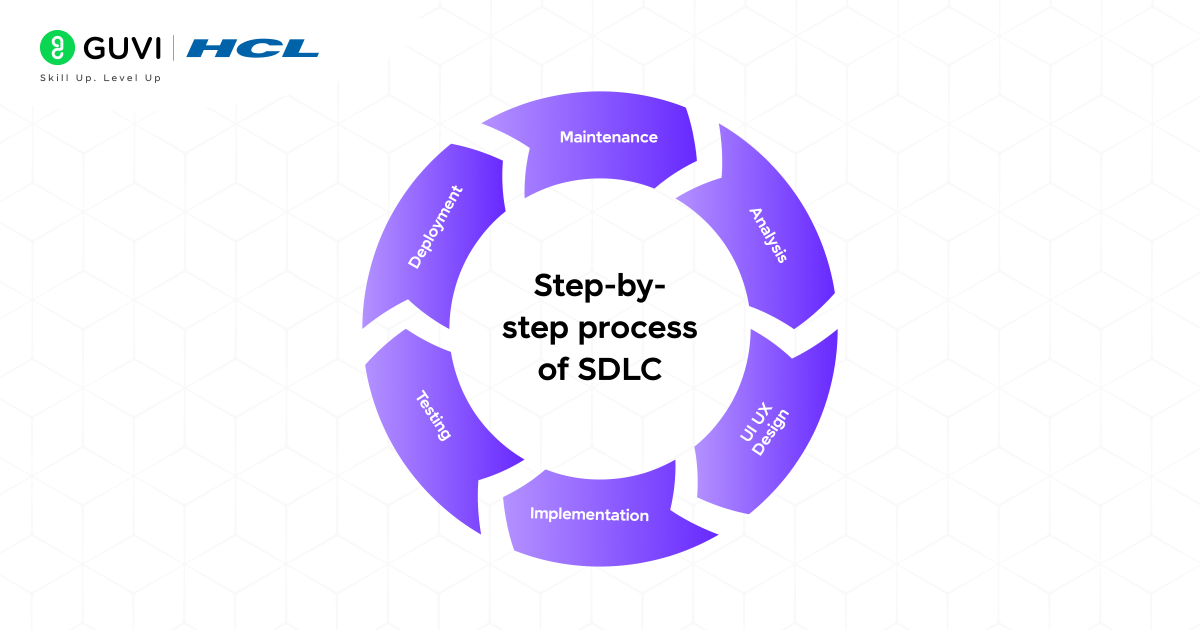
SDLC is the step-by-step process of building software in a way that maintains quality throughout the project. It typically runs through planning, analysis, design, implementation, testing, deployment, and maintenance.
Different projects handle these phases differently, which is why the various Types of Software Development Life Cycle models exist.
Phases of the Software Development Life Cycle
Most software development work moves through these common phases:
Planning: Scope, feasibility, resources, timelines, and risk assessment.
Requirement Analysis: Gathering exactly what the software needs to do and for whom.
Design: Architecture, tech stack, database structure, and UI layout. This is where system design at a high and low level happens.
Development: Writing the actual code from the finalized specifications.
Testing: QA testers find and resolve bugs before release.
Deployment: Releasing the software to users, in stages or all at once.
Maintenance: Ongoing updates, bug fixes, and feature additions to keep the product relevant.
Why Do Multiple SDLC Models Exist?
A safety-critical system needs a different approach than a small internal tool, which is exactly why multiple Types of Software Development Life Cycle exist. Each one balances trade-offs differently.
What drives the choice:
- Project complexity.
- Customer involvement.
- Budget and timeline.
- Acceptable risk level.
SDLC vs Agile: What’s the Difference?
SDLC is the umbrella concept, the overall process of planning, building, testing, and maintaining software. Agile is one specific model within that umbrella, not a replacement for it.
Every Agile project still runs through the same SDLC phases; it just repeats them in short sprints instead of one long sequence like Waterfall. Asking “SDLC or Agile?” is like asking “vehicle or car”: Agile is a type of SDLC, not a separate category.
What are the Different Types of SDLC Models?
Here are the most widely used Types of Software Development Life Cycle, with where each one fits best.
1. Waterfall Model in SDLC
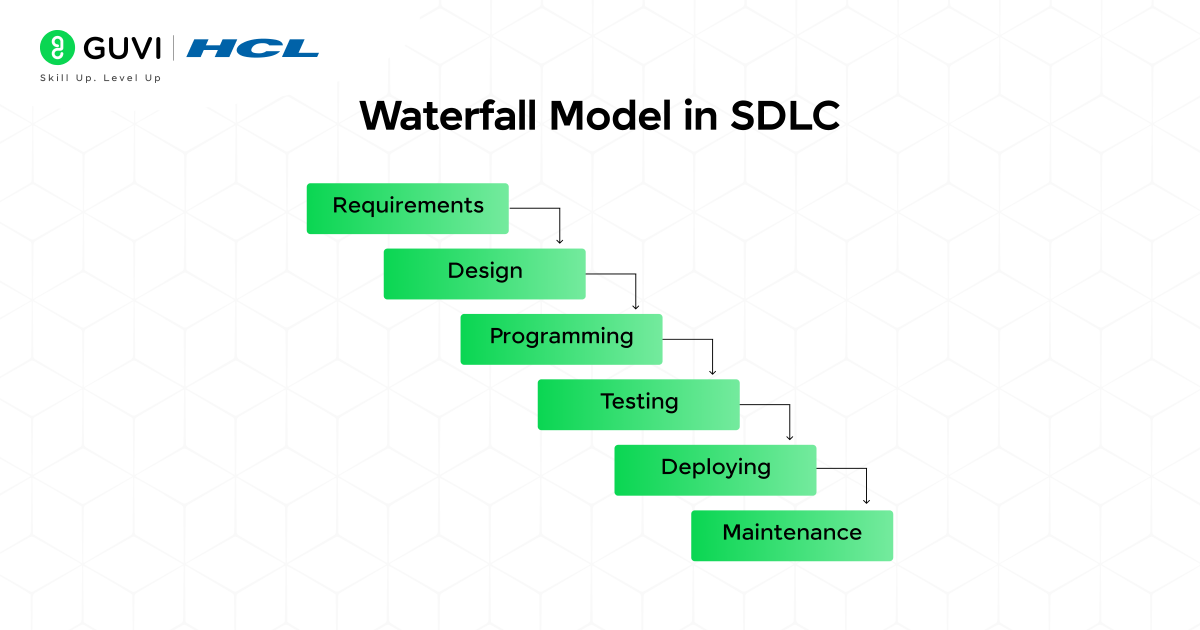
One of the oldest Types of Software Development Life Cycle, and the most traditional model: linear and sequential, where each stage must finish before the next begins.
Advantages:
- Straightforward and easy to manage.
- Best for projects with fixed requirements.
- Works well for smaller, well-defined projects.
Disadvantages:
- Inflexible once a phase is complete.
- Errors are hard to catch early.
- Poor fit for dynamic, evolving projects.
2. Agile Model in SDLC
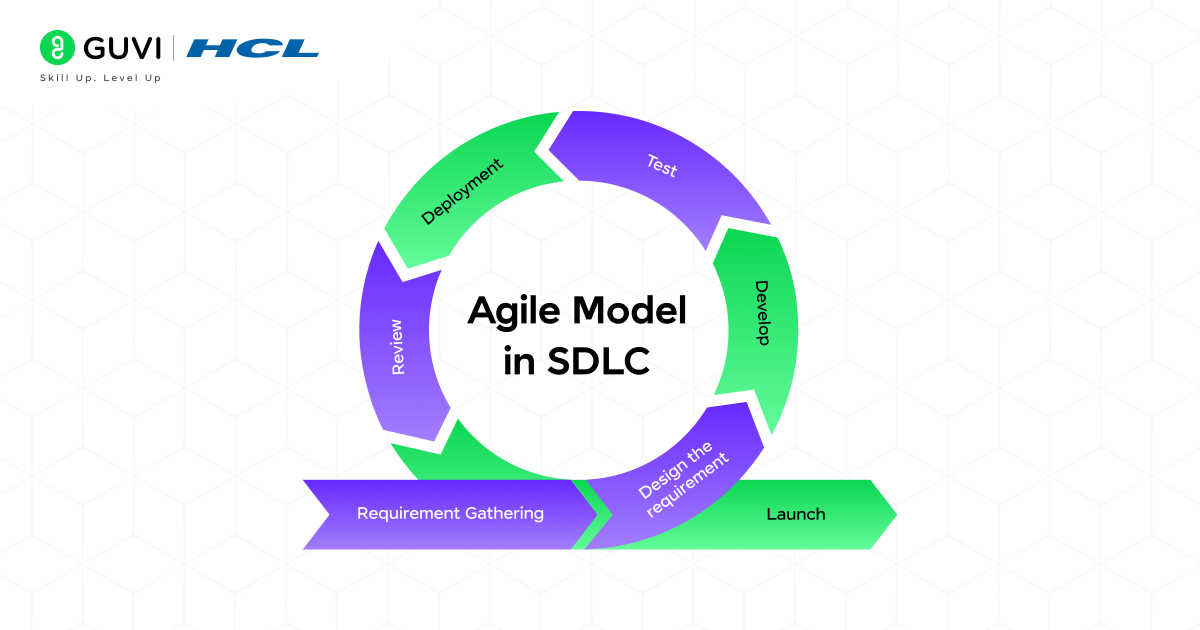
The fastest, most widely adopted of the modern Types of Software Development Life Cycle. Projects split into short sprints that ship quickly and adapt easily to change.
Advantages:
- Adapts quickly to changes.
- Encourages customer collaboration.
- Delivers functional software faster.
Disadvantages:
- Requires continuous stakeholder involvement.
- It can be difficult to estimate costs and timelines.
- Not ideal for projects needing strict documentation.
3. Spiral Model in SDLC
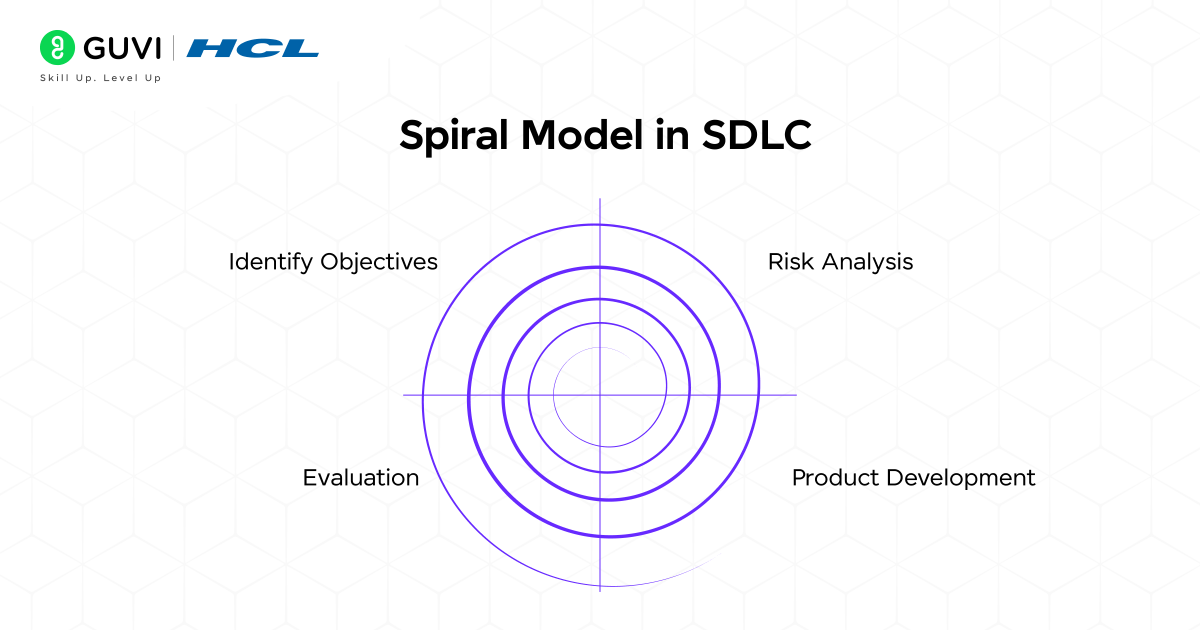
The spiral model in SDLC is a combination of the iterative and sequential linear development model. This model works in loops (spiral), with each loop consisting of planning, risk analysis, development and testing.
Advantages:
- A high amount of risk analysis is done
- Useful for large and complex systems.
- Incorporates user feedback at every stage.
Disadvantages:
- Projects are time-consuming.
- It can be very expensive.
- Requires expert project management.
4. V-Model in SDLC
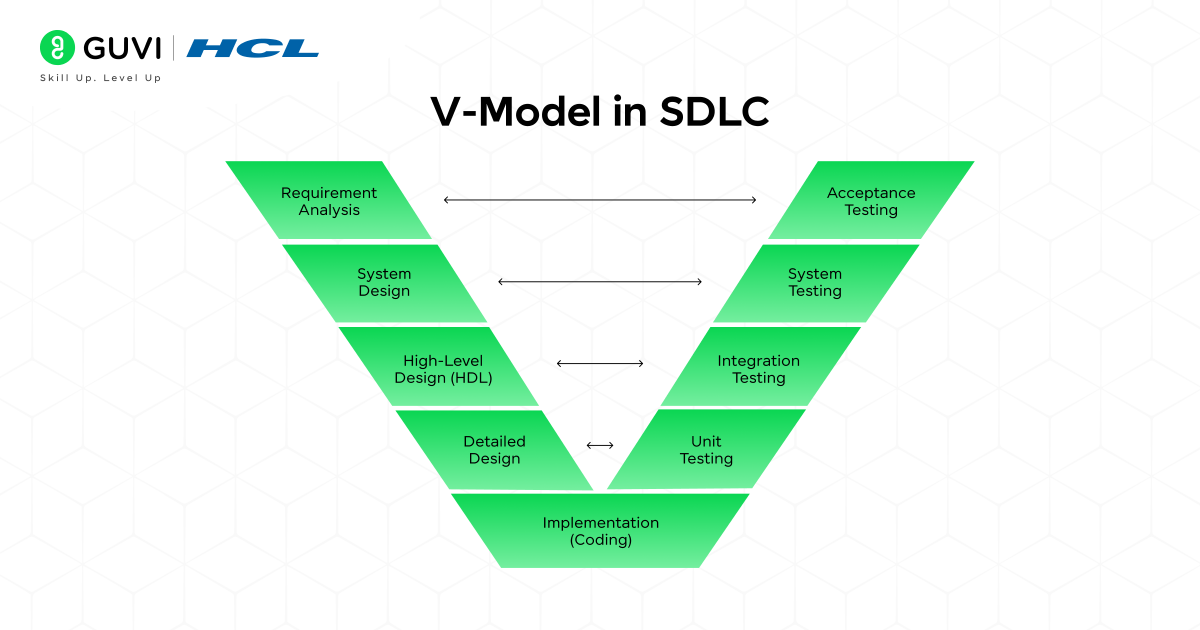
The V-Model in SDLC is also known as the verification and validation model, where development and testing go concurrently. Meaning testing is required in every phase of the project.
Advantages:
- High emphasis on testing and quality assurance.
- Progress can be tracked easily.
- Works well when requirements are clear.
Disadvantages:
- Inflexible to requirement changes.
- Heavily dependent on initial documentation.
- It is not recommended for object-oriented projects.
5. Big Bang Model in SDLC
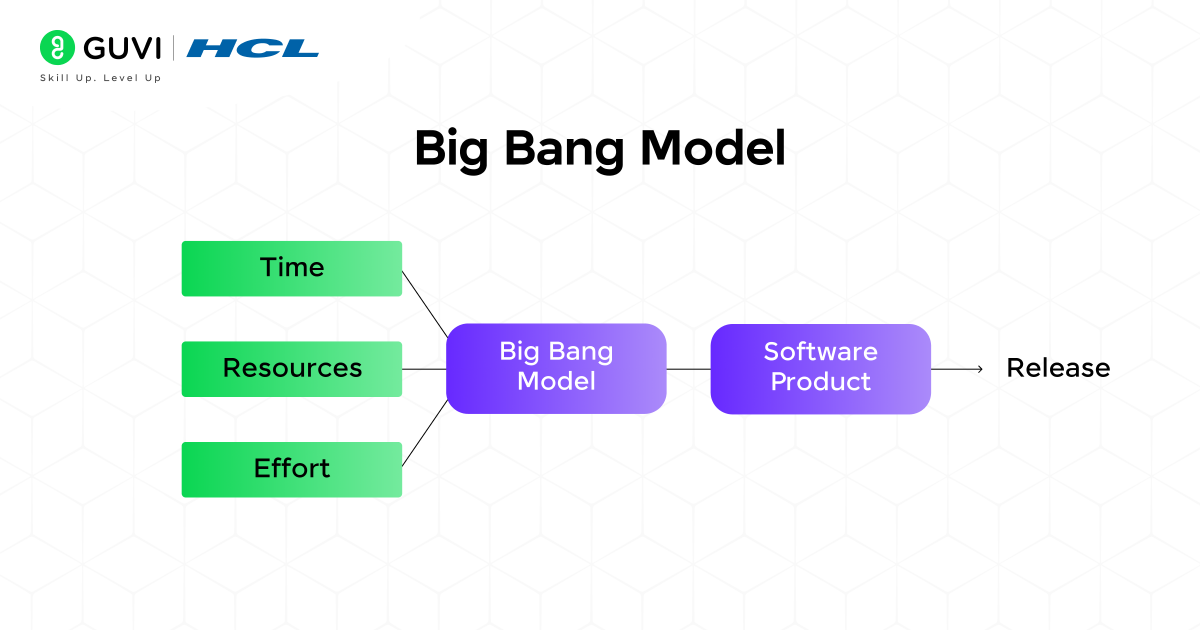
The big bang model in SDLC is one of the simplest methodologies. It requires minimal planning and basic resources to begin the project. This model does not follow any techniques to build the software and is adaptable to quick changes.
Advantages:
- Minimal planning overhead.
- Simple and quick for small projects.
- Few resources required.
Disadvantages:
- Not suitable for larger and complex projects
- Lack of structure often leads to rework.
- Risk is very high.
6. Iterative Model in SDLC
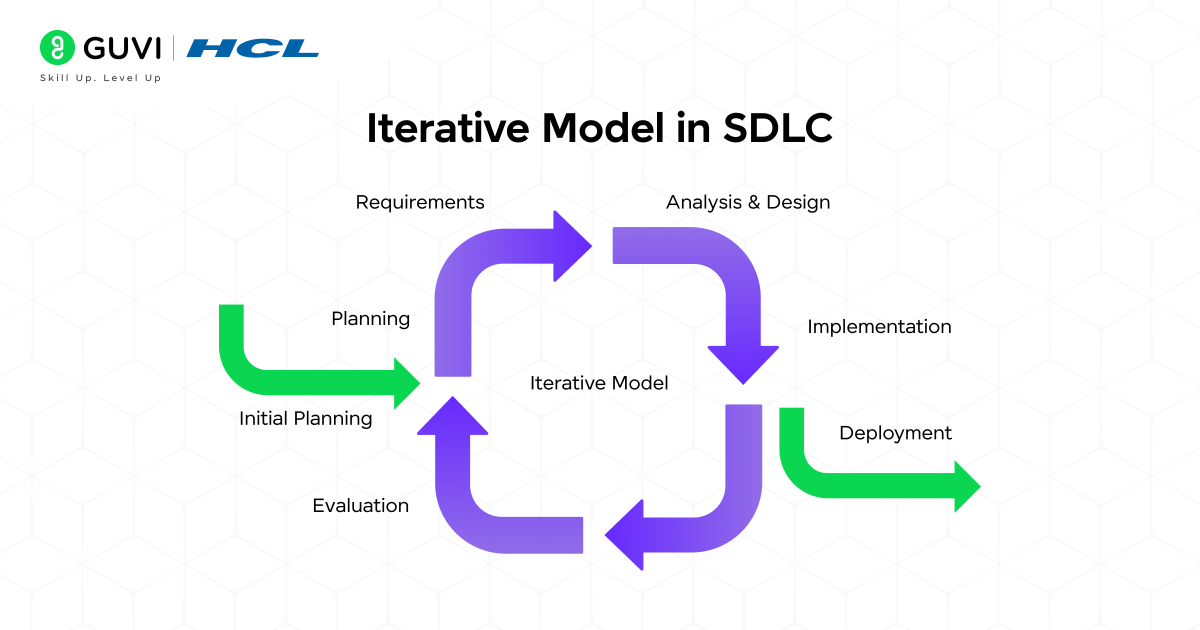
The Iterative model in SDLC delivers software in cycles. This SDLC model divides the project into smaller parts known as iterations, and these iterations produce a working version, which is improved in subsequent versions until the final product is ready.
Advantages:
- Early delivery of working software.
- Allows continuous improvements.
- Adapts well to changing requirements.
Disadvantages:
- It can be expensive with multiple iterations.
- Requires proper planning and resources.
- Not the best choice for smaller projects
7. Incremental Model in SDLC
The Incremental model breaks down the system into smaller functional units or increments. Each increment adds more features, and the final product is developed through repeated cycles.
Advantages:
- Delivers working functionality early.
- Easier testing and debugging.
- Flexible to customer feedback and evolving requirements.
Disadvantages:
- Total cost may be higher than expected.
- System architecture must be well planned from the start.
- May not be suitable for all types of applications.
8. Rapid Application Development (RAD) Model in SDLC
RAD is focused on rapid prototyping and quick feedback over long drawn-out development cycles. It encourages user involvement and reusability of components.
Advantages:
- Faster development and delivery.
- Encourages user feedback and involvement.
- Reduces development time through reusable components.
Disadvantages:
- Not suitable for large-scale or complex projects.
- Requires skilled and experienced developers.
- Poor design can lead to software instability.
9. Lean Model in SDLC
Inspired by lean manufacturing principles, the Lean model focuses on delivering value with minimal waste. It encourages efficiency, continuous improvement, and respect for the team.
Advantages:
- Efficient use of time and resources.
- Emphasizes quality and simplicity.
- Empowers teams to make decisions.
Disadvantages:
- Requires a cultural shift in the organization.
- May not work well with rigid hierarchies.
- Risk of under-documentation.
10. DevOps Model in SDLC
DevOps integrates software development (Dev) with IT operations (Ops) to shorten the development lifecycle and improve software quality. It emphasizes automation, continuous integration (CI), continuous delivery (CD), and constant monitoring.
Advantages:
- Faster and more reliable software delivery.
- Enhances collaboration across teams.
- Automation reduces manual errors.
Disadvantages:
- Requires significant changes in culture and tools.
- High initial setup effort for automation and CI/CD pipelines.
- Security can be a challenge if not handled correctly.

Which SDLC Model Fits Your Project?
With 10 Types of Software Development Life Cycle to pick from, matching one to your actual project makes the choice concrete.
| Project Type | Team Size | Recommended Model | Why |
|---|---|---|---|
| Fixed-scope government or compliance project | Any | Waterfall or V-Model | Clear requirements, heavy documentation, strict testing |
| Startup MVP or fast-changing product | Small to medium | Agile or Lean | Fast iteration, frequent pivots |
| Large, high-risk enterprise system | Large | Spiral | Continuous risk assessment over long cycles |
| Safety-critical software (medical, aerospace) | Any | V-Model | Testing runs parallel to every phase |
| Quick prototype or proof of concept | Small | Big Bang or RAD | Minimal planning, fast turnaround |
| Cloud-native product, frequent releases | Any | DevOps | Automated CI/CD, continuous delivery |
| Legacy system replacement, phased rollout | Medium to large | Incremental | Deliver in pieces, manage risk gradually |
Comparison of SDLC Models
| Model | Flexibility | Risk Management | Best For |
|---|---|---|---|
| Waterfall | Low | Low | Small, fixed projects |
| Agile | High | Medium | Dynamic, evolving projects |
| Spiral | Medium | High | Complex, high-risk projects |
| V-Model | Low | Medium | Safety-critical software |
| Big Bang | Very High | Very Low | Small prototypes |
| Iterative | Medium | Medium | Large projects with evolving needs |
| Incremental | Medium | Medium | Medium to large projects |
| RAD | High | Low | Quick delivery with user feedback |
| Lean | High | Medium | Efficient, value-driven projects |
| DevOps | High | High | Continuous delivery and automation |
More than 70% of companies today do not rely on a single SDLC model. Instead, they adopt a hybrid approach, combining methods like Agile, DevOps, or Iterative to achieve the right balance between flexibility, speed, and control for their projects.
SDLC Advantages and Disadvantages
Advantages of SDLC:
- Structured Process – A clearly indicated step-by-step process will keep the project organized and manageable.
- Detailed documentation – It is helpful to have detailed documentation of all requirements, designs, and tests so there are no miscommunications.
- Risk Reduction – Model methods such as Spiral and Agile decrease risks, since feedback and testing are continuous.
- Involvement of the clients – Ensures that the final product aligns with business needs and user expectations.
Disadvantages of SDLC:
- Rigid and inflexible – Some models (like Waterfall or V-Model) don’t handle changes well once development begins.
- Time-Consuming Documentation – Some models require time-consuming documentation, which can slow down the progress in fast-moving projects.
- High Costs in Some Models – Models like Spiral may become costly due to risk analysis and iterations.
- Dependency on Requirements – If the requirements at the start of the project are not clear, then the entire project can be impacted.
If you are curious about software development and want to become a software developer, then grab the opportunity to learn with HCL GUVI’s IITM Pravartak and MongoDB Certified Online AI Software Development Course. The NSDC-endorsed course gives you a globally recognized certificate to add to your résumé, which is a significant advantage that will help you stand out in the competitive employment market.
Real-World Examples: Which Companies Use Which SDLC Model?
Waterfall still runs government contracts, banking core systems, and healthcare software, where sign-off and documentation outweigh speed.
Agile is the standard at product companies like Spotify and Google, built around sprint-based, cross-functional teams shipping incrementally.
DevOps underpins Netflix and Amazon, where automated CI/CD lets teams deploy many times a day.
Spiral has deep roots in aerospace and defense, where NASA-style projects demand continuous risk assessment across long timelines.
Incremental and Iterative show up in large legacy platforms (enterprise suites, ERP systems), where a full rewrite is too risky, so functionality gets replaced piece by piece.
SDLC Tools Used in Each Phase (2026)
Picking a model from the many Types of Software Development Life Cycle is one decision; picking tools is another. Here’s what teams reach for per phase in 2026, regardless of which Types of Software Development Life Cycle they follow.
| SDLC Phase | Popular Tools (2026) |
|---|---|
| Planning | Jira, Asana, Monday.com |
| Requirement Analysis | Confluence, Notion, Miro |
| Design | Figma, Lucidchart, draw.io |
| Development | VS Code, GitHub Copilot, GitHub/GitLab |
| Testing | Selenium, Postman, Jest, Cypress |
| Deployment | Jenkins, GitHub Actions, Docker, Kubernetes |
| Maintenance | Datadog, New Relic, PagerDuty |
How to Choose the Right SDLC Model for Your Project
Choosing among the Types of Software Development Life Cycle comes down to a few practical questions, not whatever’s trendy.
How clear are your requirements? Locked-in requirements favor Waterfall or V-Model. Evolving ones favor Agile or Lean.
How much risk can you tolerate? High-stakes systems (aerospace, finance, healthcare) benefit from Spiral’s continuous risk analysis.
How fast do you need to ship? RAD or Agile gets something usable in front of users faster than documentation-heavy models.
How experienced is your team? RAD and DevOps assume skilled, self-directed teams; less experienced teams often do better with Waterfall or V-Model’s structure.
Replacing a system or building new? Incremental and Iterative models exist specifically for replacing pieces of a live system safely.
Common Mistakes Teams Make When Choosing an SDLC Model
- Picking a model because it’s trendy. Agile suits unclear, evolving requirements, but is a poor fit for a fixed-scope compliance project needing strict sign-off.
- Ignoring team experience. Forcing RAD or DevOps onto an inexperienced team usually produces unstable software, not speed.
- Cutting documentation to move faster. Skipping documentation on a Waterfall or V-Model project defeats the point of choosing that model.
- Sticking with one model forever. A startup that began with Big Bang or RAD often needs to shift toward Agile or DevOps as the product matures.
- Confusing the model with the tools. Buying Jira licenses doesn’t make a team Agile; the model is about how decisions happen, not which software tracks them.
Final thoughts..
Every one of the Types of Software Development Life Cycle serves different goals: V-Model for testing and quality, Spiral for risk management, Big Bang for small experimental projects.
A one-size-fits-all answer doesn’t exist. The right model depends on complexity, budget, risk, and customer involvement, and many teams blend more than one. If design decisions are on your mind too, it’s worth reading up on system design diagrams, since they shape everything that follows in the SDLC.
FAQs
Q1) What is the Software development life cycle in simple terms?
It is a process where the software is built. It is a step-by-step process that helps software developers to develop and alter the software according to the business needs and from the clients feedback.
Q2) Why is the Software development life cycle important?
Because it offers a proper and structured approach to software development, the SDLC is important because it ensures high quality, efficiency, and alignment with business objectives. Proper documentation can help create the application faster and more efficiently.
Q3) What are the most common types of SDLC?
The most common and widely used SDLC model types are waterfall, agile, big bang, V model, spiral, and Iterative model.
Q4) Which SDLC model is best?
Every SDLC model is unique and has its own advantages and disadvantages. Depending on the needs of the projects, you can choose which SDLC model suits you best.
Q5) What is the difference between waterfall and agile SDLC models?
The main difference is that the waterfall model is sequential, while the agile model is incremental and iterative. Also, the waterfall model delivers the product at the end of SDLC, whereas the agile model is released during the initial phase of development to get client feedback.
Success Stories

About the Author
Jebasta
I translate the language of data into stories that anyone can understand. As a writer with a data science background, I simplify analytics, AI, and decision-making so beginners and enthusiasts can confidently explore the world of data.
View all posts by Jebasta
Connect with me @







Did you enjoy this article?