


Software Development Articles
How to Read and Understand System Design Diagrams?
System Engineer Roles and Responsibilities: 12 Proven Duties for Growth
SAP Consultant Roles and Responsibilities: 12 Proven Duties for Growth and Success
Network Engineer Roles and Responsibilities: 12 Essential Duties for Success


Get In Touch For Details! Request More Information
Introduction to System Design: HLD and LLD Explained
Aug 05, 2026 4 Min Read 2573 Views
(Last Updated)
System Design is a frequently used term among software developers, often treated as a surface-level expression. But in reality, it is a vast, deep topic that extends beyond theoretical concepts and also involves the practical implementation of best coding practices.
Just take a moment and think of all the top-notch software products/apps of this decade, from Netflix, Zerodha, and PhonePe to Flipkart. Each of these platforms has a strong, flexible System Design that enables it to scale its digital operations with minimal technical constraints. In this blog, we will extend this decision to understand exactly what System Design is and its elements.
TL;DR Summary
- Helps you clearly understand System Design, including its definition and the 2 levels of System Design process: HLD and LLD.
- Gives a clear view of the Stages of System Design Process: From Planning to Maintenance, so you know how real systems are built step by step.
- Makes it easier to connect concepts like High-Level Design (HLD) and Low-Level Design (LLD) with how they are used in real development.
Table of contents
- System Design: Definition
- Important Note:
- For Example:
- Levels of System Design
- High-Level Design (HLD)
- Low-Level Design (LLD)
- Stages of System Design Process: From Planning to Maintenance
- Stage 1: Planning
- Stage 2: Feasibility Analysis
- Stage 3: Requirement Analysis
- Stage 4: High-Level Design (HLD)
- Stage 5: Low-Level Design (LLD)
- Stage 6: Implementation
- Stage 7: Testing
- Stage 8: Deployment
- Stage 9: Maintenance
- Conclusion
- FAQs
- Why do we need System Design before coding?
- Is System Design only for big companies?
- What is the main difference between HLD and LLD?
- Can a developer start coding without System Design?
- Why do apps like Zomato or Netflix need different system designs?
- Is System Design fixed, or does it change?
System Design: Definition
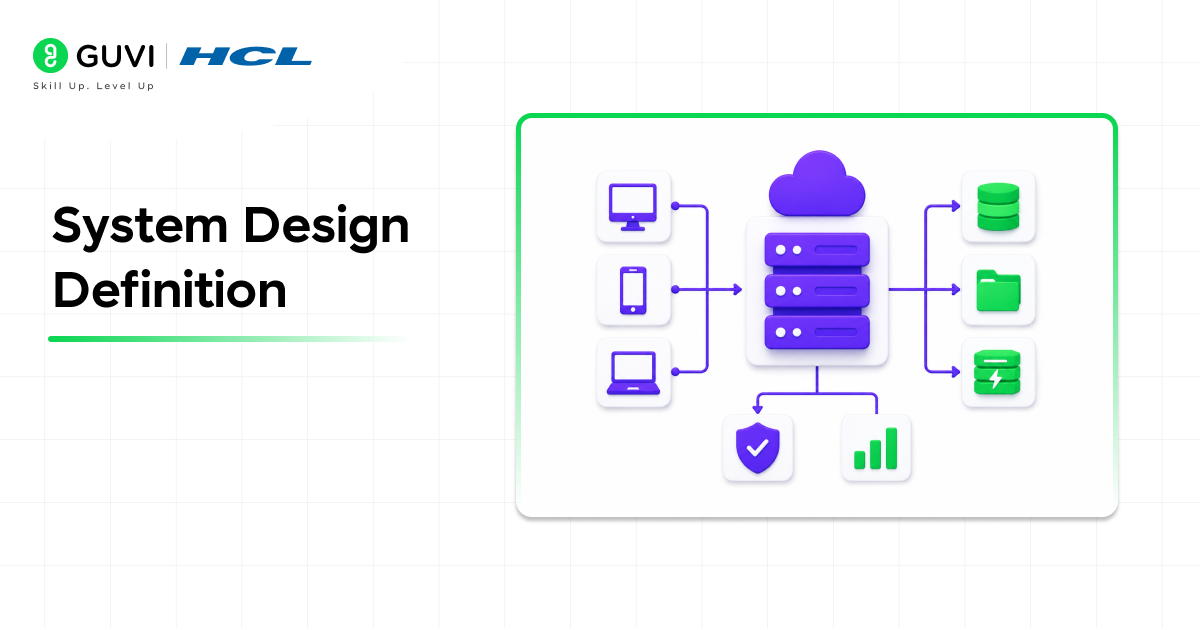
System Design is the process of developing the complete software architecture for a product, in which the development team focuses on structuring the system’s components and establishing communication channels to ensure data flows smoothly.
(Components are units that together build a complete system. Frontend, Backend, APIs, Server, Database, Authentication, Authorisation, Logging, Storage, CDN, etc.: these are some essential examples of System Design components.)
Any software product or platform without a robust system design will eventually become sluggish, struggle to handle a high volume of users, and be vulnerable to frequent system crashes. To avoid all these expensive issues, an efficient design is vital as it guarantees system stability, reliability, and safety.
Also Read: System Design Roadmap
In large-scale System Design, systems are often built to handle millions of requests per second (e.g., Google Search handles over 100,000 queries per second globally on average) using a distributed architecture, load balancing, and horizontal scaling.
Earn a widely recognised certification in System Design and master the fundamental concepts from web architecture to performance optimisation with HCL GUVI’s System Design Course.
Important Note:
Always keep in mind that System Design is not a rigid process; i.e., every application or platform you use online has a unique System Design. This is because each app is developed to solve different types of problems, and accordingly, priorities vary, leading to the inclusion of tailored system components.
For Example:
An e-commerce app like Myntra focuses on order management and payments, whereas an ed-tech platform like HCL GUVI invests the majority of its effort in delivering quality content to the learners. So, depending on the product requirements, the System Design varies.
Levels of System Design
There are 2 levels of the System Design process:
- High-Level Design (HLD)
- Low-Level Design (LLD)
1. High-Level Design (HLD)
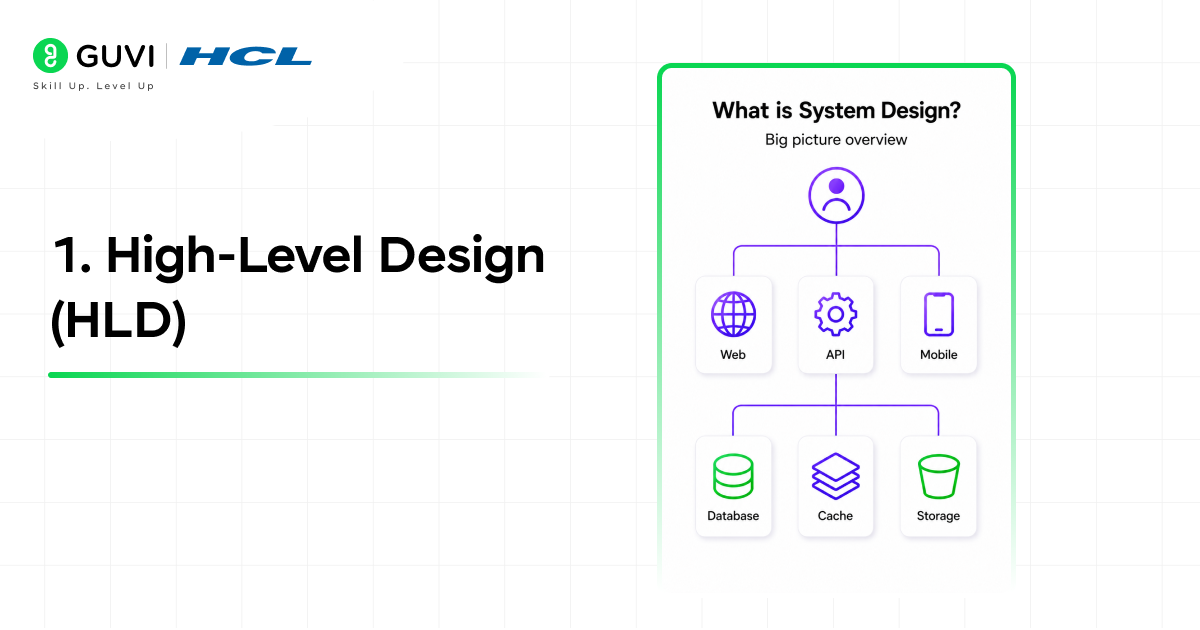
High-Level Design (HLD) is the process of defining the overall structure of a software system, including the main components (to be developed by the technical team) and their inter-relationships. In simple terms, it is a process in which the complete system is broken down into primary modular parts, and connections are built between them.
Rather than designing the functionality and features of each component, HLD focuses on how data will flow between components, which components will trigger the APIs, and how the frontend and backend communicate.
HLDs are mostly represented using architectural diagrams, in which each component is shown as a block.
HLD Components Examples:
User Interface, Frontend, Backend, APIs, Database, Load Balancer, Cache, Microservices, Authentication, Payment Gateway, Notification System
Importance
- Gives a clear overall system structure before coding starts
- Helps teams (frontend, backend, database) work in sync
- Prevents confusion in large system planning
Real-world Example:
In Zomato (a food delivery app), the HLD is implemented by identifying the core elements, including the user app, restaurant app, delivery partner app, backend server, database, payment system, and notification service.
Once that is done, then the components are organised, and the data flow path is then decided, like user places order → backend processes request → restaurant receives order → delivery partner is assigned → payment is handled → status updates are sent.
Without focusing on the system’s code-level architecture, the entire architecture is drawn to highlight the product’s working mechanism.
2. Low-Level Design (LLD)
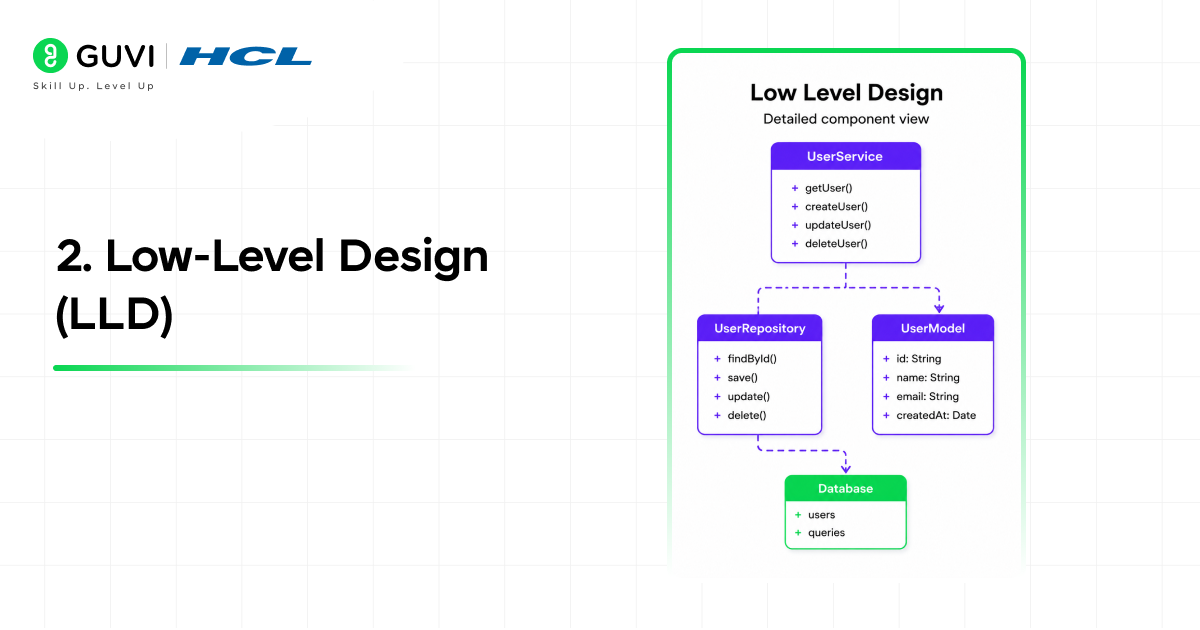
Low-Level Design (LLD) focuses solely on crafting each system component, including defining the logic, designing classes, functions, and database tables, establishing relationships, and designing APIs.
During LLD, developers spend most of their time and effort on programming the intricate details of each module and its interfaces.
By referring to the LLD document, a programmer can directly start coding with minimal debugging and testing.
In simple terms, LLD is a way to break down the HLD components into more precise building blocks that can be programmed without getting muddled.
LLD Components Examples:
Classes, Objects, Methods, Functions, Data Structures, Database Tables, Relationships, API Endpoints, Logic Flow, Sequence Diagrams
Importance
- Defines the exact logic of how each feature works
- Helps write clean, bug-free, and maintainable code
- Makes implementation easier for developers in real coding tasks
Real-world Example:
Let’s take the same example of Zomato. In this case, the LLD defines the specific features and their functionality, enabling a smooth backend operation.

For instance, the “Place Order” feature in the app involves many details, such as how the order object is structured, which functions calculate the total price, how database tables store order details, and how APIs process requests.
Apart from this, logical methods are also designed to execute the delivery process, like how delivery partners are assigned based on distance or how order status changes (placed → accepted → preparing → delivered).
Stages of System Design Process: From Planning to Maintenance
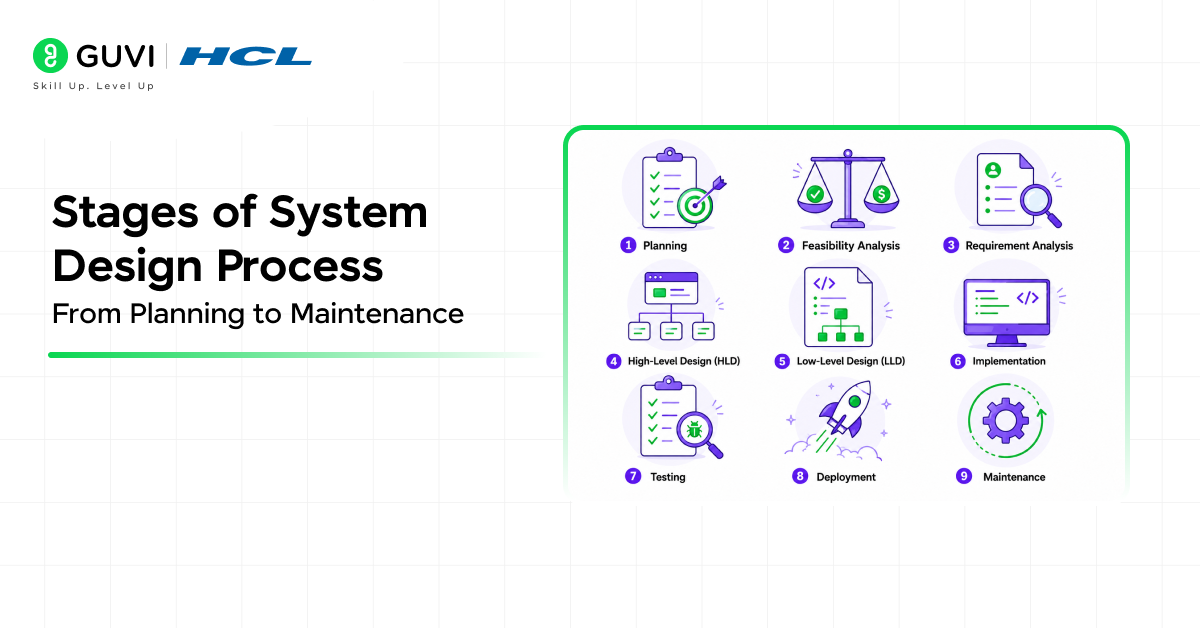
The following are the key stages involved in the system design process:
Stage 1: Planning
This is the first stage, where the idea is clearly understood, and the system’s goal is defined. Teams decide what problem they are solving and what the final product should achieve. This stage gives direction, so everything built later stays aligned with the main purpose.
Stage 2: Feasibility Analysis
After planning, the team checks whether the system can actually be built with available technology, time, and cost. It helps in understanding risks, limitations, and whether the idea is practical in real-world conditions before moving forward.
Stage 3: Requirement Analysis
In this stage, all the user needs and system requirements are collected in detail. Teams decide what features are required, what users expect, and what the system must support. This becomes the base for all future design work.
Stage 4: High-Level Design (HLD)
Now the system is broken into major components like the frontend, backend, database, and APIs, and how they connect is determined. It shows the overall architecture and data flow, helping teams understand how the system will work at a big-picture level.
Stage 5: Low-Level Design (LLD)
Here, each component is detailed. Developers define classes, functions, database tables, and logic flow. This stage converts the high-level plan into code that can be directly implemented.
Stage 6: Implementation
This is the coding stage where developers begin building the system using LLD. All features and logic are written in actual code, turning the design into a working software system.
Stage 7: Testing
Once the system is built, it is tested to find bugs, errors, and performance issues. Different types of testing ensure the system works correctly under real conditions and behaves as expected.
Stage 8: Deployment
After testing, the system is released to real users. It is hosted on servers and made live so users can access the actual working application in real time.
Stage 9: Maintenance
After deployment, the system is continuously monitored and improved. Bugs are fixed, updates are added, and performance is optimised so the system stays stable, secure, and scalable over time.
Unlock your tech career with HCL GUVI’s IITM Pravartak & MongoDB Certified AI Software Development Course, covering Java Foundations, DSA, Databases (MySQL & MongoDB), System Design for scalable applications, and Interview Preparation & Readiness—learn by building, grow with AI-driven skills, and step confidently into your dream tech job
Conclusion
Most software developers or programmers limit themselves to working on a specific technology stack, which is fine, but as humans, we have the choice to live up to our potential. And if we look at it from this perspective, developing an understanding of System Design (including HLD and LLD) helps you get the bigger picture of how the system really works in the background and how various components are integrated to enable smooth data flow.
Remember, an individual with an active track record of designing systems will always have the upper hand over a developer focused on a specific tech stack.
FAQs
Why do we need System Design before coding?
System Design helps plan how the whole app will work, so developers don’t build random pieces that later don’t connect.
Is System Design only for big companies?
Small apps also use it, but it becomes especially important as the system grows, with more users and features.
What is the main difference between HLD and LLD?
HLD shows the overall structure and flow of the system, while LLD explains how each part works internally in detail.
Can a developer start coding without System Design?
Coding without design often leads to confusion, bugs, and rework because the system structure is not clearly planned.
Why do apps like Zomato or Netflix need different system designs?
Each app has different goals, users, and features, so their structures, scaling needs, and data flows differ.
Is System Design fixed, or does it change?
It keeps evolving based on user growth, new features, and the application’s performance needs.
Success Stories













Did you enjoy this article?