


Salesforce Articles
Top 10 Apex Interview Questions & Answers in Salesforce
Salesforce Admin Interview Questions and Answers for Success in 2026


Get In Touch For Details! Request More Information
9 Best Salesforce Developer Courses in 2026: Fees, Syllabus & Certifications
Sep 29, 2026 9 Min Read 5165 Views
(Last Updated)
Table of contents
- TL;DR
- Salesforce Developer Courses at a Glance
- Top 9 Salesforce Developer Courses in 2026
- 1) HCL GUVI’s Salesforce Developer Course
- 2) Salesforce Development Training for Beginners (Udemy)
- 3) Salesforce Platform Developer I Certification Course (Udemy)
- 4) Salesforce Developer Training with Real-Time Projects
- 5) Salesforce Certified Platform Developer II Course
- 6) Salesforce App Builder Certification Course
- 7) Salesforce LWC (Lightning Web Components) Course
- 8) Salesforce Developer: AI for Beginners
- 9) Apex Academy: Fundamental Salesforce Coding Techniques (Pluralsight)
- Salesforce Developer Skills to Learn in 2026
- Which Salesforce Developer Course Should You Choose?
- If you're a complete beginner
- If you want to become a Salesforce developer
- If you're preparing for Platform Developer I
- If you already know Salesforce development
- If you're interested in front-end development
- If you want to explore Salesforce AI
- Salesforce Developer Roadmap for 2026
- Salesforce Developer Projects to Build
- Free vs Paid Salesforce Developer Courses
- Salesforce Developer Certifications in 2026
- Is Salesforce Development a Good Career in 2026?
- How Long Does It Take to Learn Salesforce Development?
- Concluding Thoughts…
- FAQs
- Which Salesforce developer course is best for beginners?
- What should I learn first to become a Salesforce developer?
- Is Salesforce development difficult for beginners?
- Which Salesforce certification should a developer pursue?
- Is Salesforce development still relevant in 2026?
- Can I learn Salesforce development for free?
- How long does it take to learn Salesforce development?
- What programming languages are used in Salesforce development?
- Is Apex enough to become a Salesforce developer?
- Should Salesforce developers learn AI and Agentforce?
TL;DR
- Beginners: Start with a Salesforce development fundamentals course that covers CRM, Apex, SOQL, and basic development.
- Certification aspirants: Choose a Platform Developer-focused course for structured exam preparation.
- Developers: Build skills in Apex, LWC, APIs, testing, and deployment.
- Advanced learners: Look for Platform Developer II and advanced Apex training.
- Future-ready skills: Add Salesforce AI, automation, integrations, and Agentforce-related concepts to your learning path.
Salesforce development is no longer just about managing CRM data. Developers today work with Apex, Lightning Web Components (LWC), APIs, automation, integrations, and increasingly, AI-powered Salesforce features.
But with so many Salesforce courses available online, choosing the right one can be confusing. Some courses focus on the basics, while others are designed around certifications, Apex, LWC, or advanced development.
This guide covers 9 Salesforce developer courses in 2026, comparing their course content, duration, pricing, learning focus, and certification preparation to help you choose a course based on your career goals.
Salesforce Developer Courses at a Glance
| Course | Best For | Level | Main Focus | Format |
| HCL GUVI Salesforce Developer Course | Beginners | Beginner | Salesforce development fundamentals | Online |
| Salesforce Development Training for Beginners | New learners | Beginner | Apex and Salesforce development | Online |
| Platform Developer I Course | Certification aspirants | Intermediate | Platform Developer I preparation | Online |
| Salesforce Developer Training with Projects | Practical learners | Intermediate | Projects and integrations | Online |
| Platform Developer II Course | Experienced developers | Advanced | Advanced Salesforce development | Online |
| Salesforce App Builder Course | Declarative development | Beginner–Intermediate | App building and automation | Online |
| Salesforce LWC Course | Front-end developers | Intermediate | Lightning Web Components | Online |
| Salesforce AI Course | Developers exploring AI | Beginner–Intermediate | Salesforce AI concepts | Online |
| Apex Academy | Apex learners | Beginner–Intermediate | Apex programming | Online |
Note: Course fees, durations, curriculum, and certification requirements can change. Check the respective course provider’s current page before enrolling.
Top 9 Salesforce Developer Courses in 2026
These top Salesforce developer courses offer everything from foundational CRM concepts to hands-on Apex, Visualforce, and Lightning development.
Designed for both beginners and professionals, each course equips you with practical skills and certifications to thrive in the growing Salesforce job market.
1) HCL GUVI’s Salesforce Developer Course
HCL GUVI’s Salesforce Developer Course introduces learners to Salesforce development through a combination of core concepts and practical skills.
It covers important areas such as Apex, Visualforce, Lightning components, APIs, data management, and Salesforce security.
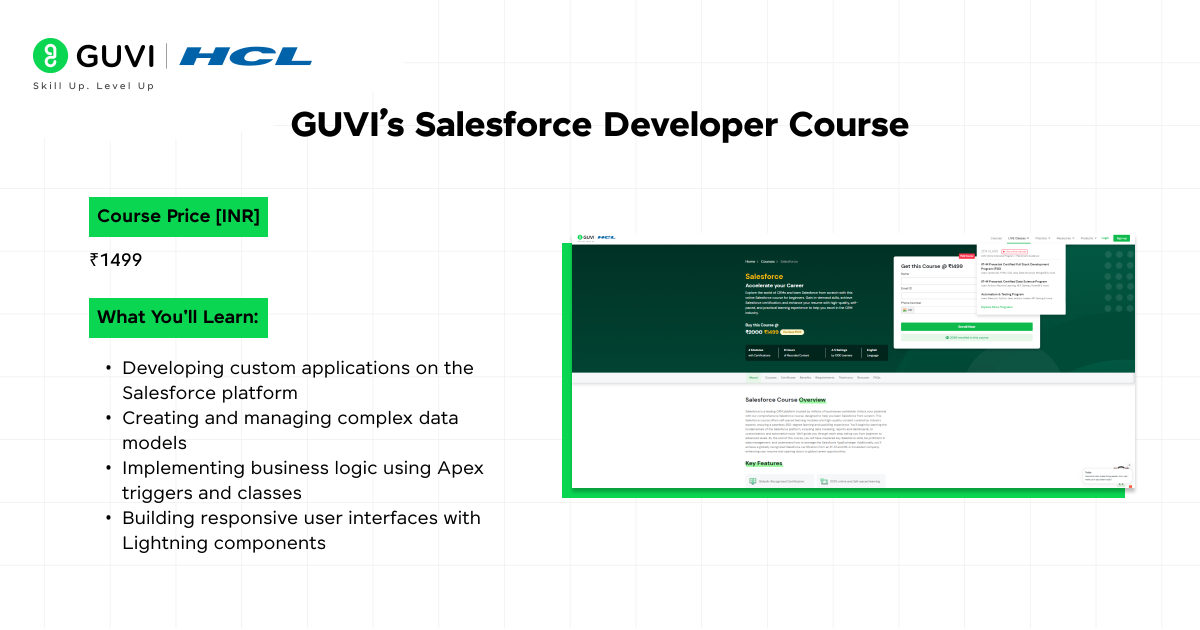
Course Price: ₹ ₹1499
Course Duration: 6 hours
Level: Beginner
Course Content:
- Foundational CRM concepts and Salesforce architecture
- Apex programming language fundamentals and advanced techniques
- Visualforce framework for creating custom user interfaces
- Lightning Component Framework and Lightning Web Components
- Integration options using REST and SOAP APIs
- Data modeling and management best practices
- Salesforce security models and implementation
The course is designed with real-world applications in mind, ensuring you gain practical knowledge that directly applies to industry demands.
Key Features:
- Industry-Expert Instructors – Learn from professionals with extensive Salesforce implementation experience
- Personalized Learning Path – Customized guidance based on your existing skill level
- Project-Based Learning – Work on real-world projects that simulate actual business scenarios
- Lifetime Access – Revisit course materials anytime as Salesforce updates its platform
- Dedicated Mentorship – One-on-one sessions to address your specific learning needs
What You’ll Learn:
- Developing custom applications on the Salesforce platform
- Creating and managing complex data models
- Implementing business logic using Apex triggers and classes
- Building responsive user interfaces with Lightning components
- Integrating Salesforce with external systems and applications
- Implementing security controls and sharing rules
- Writing test classes and achieving code coverage requirements
Course Link: HCL GUVI Salesforce Developer Course
2) Salesforce Development Training for Beginners (Udemy)
This course is designed for learners who are new to Salesforce development and want to understand how Apex works within the Salesforce platform.
It starts with programming fundamentals before moving into triggers, automation, SOQL, DML, and practical development tasks.
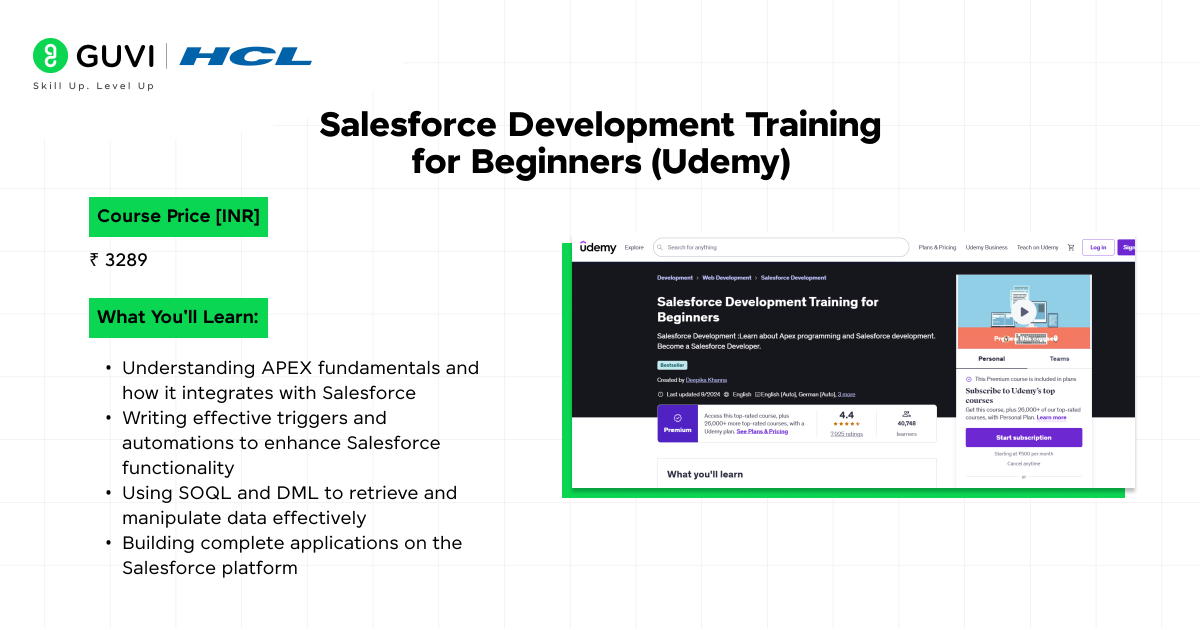
Course Price: ₹ 3509
Course Duration: 13.5 hours
Level: Beginner
Prerequisites: No prior coding experience required
Course Content:
- Introduction to Salesforce and how APEX fits into the platform
- Basic APEX syntax and programming fundamentals
- Advanced concepts, including triggers and automations
- SOQL (Salesforce Object Query Language) and DML (Data Manipulation Language)
- Real-world project implementations
Key Features:
What makes this Udemy offering particularly valuable is its transformative approach.
The course takes you from feeling confused and overwhelmed by APEX to confidently writing, debugging, and deploying code like a professional. Key highlights include:
- Step-by-step instructions designed specifically for non-programmers
- Hands-on coding exercises that reinforce theoretical concepts
- Real-world Salesforce development projects for practical experience
- Simple explanations for complex concepts without technical jargon
- Exclusive resources and support from experienced instructors
What You’ll Learn:
- Understanding APEX fundamentals and how it integrates with Salesforce
- Writing effective triggers and automations to enhance Salesforce functionality
- Using SOQL and DML to retrieve and manipulate data effectively
- Building complete applications on the Salesforce platform
- Following best practices for Salesforce development
Course Link: Salesforce Development Training for Beginners (Udemy)
3) Salesforce Platform Developer I Certification Course (Udemy)
If your goal is to prepare for the Salesforce Platform Developer I certification, a certification-focused course can provide a more structured learning path than a general Salesforce development course.
This course covers the major areas involved in Salesforce development, including application development, automation, user interfaces, testing, debugging, and deployment.
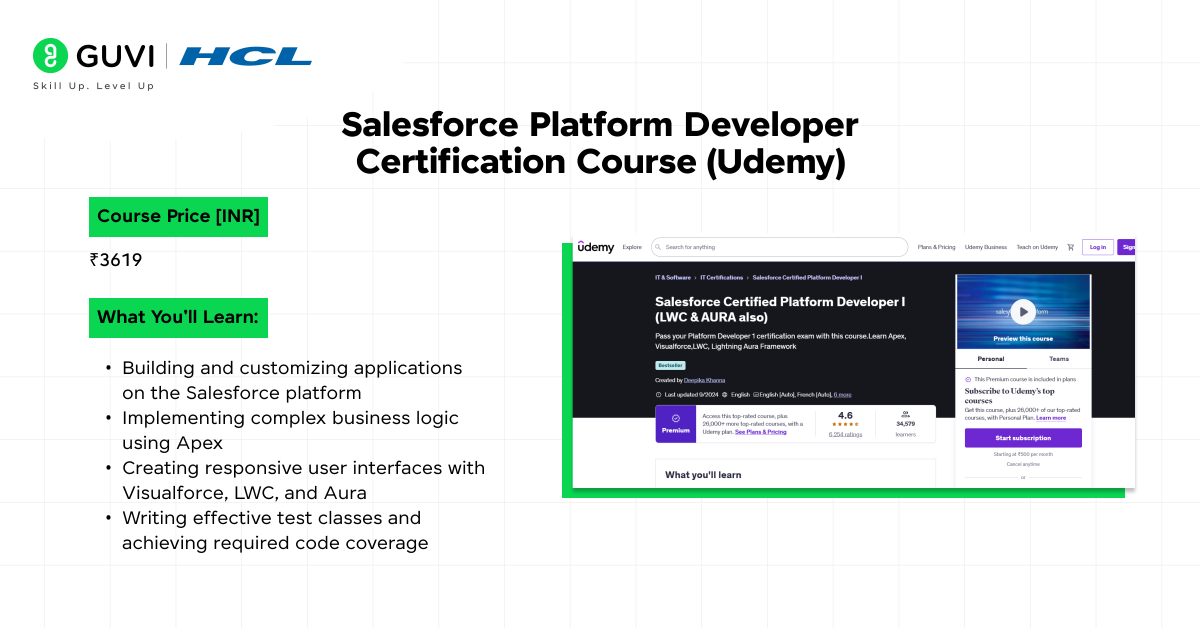
Course Price: ₹3,279
Course Duration: 38.5 hours
Level: Intermediate
Focus: Platform Developer I preparation
Course Content:
- Developer Fundamentals (23%) – Covering core Salesforce concepts and architecture
- Process Automation and Logic (30%) – Exploring both declarative and programmatic approaches
- User Interface (25%) – Mastering Visualforce, Lightning Web Components (LWC), and Aura
- Testing, Debugging and Deployment (22%) – Ensuring code quality and deployment best practices
Key Features:
- 22+ hours of comprehensive video training tailored specifically to the certification exam
- Strategic study plan that optimizes your preparation time
- Real exam-style questions after each section to test your understanding
- Hands-on practice environments with real-world examples
- In-depth coverage of Lightning Web Components and Aura, crucial for modern Salesforce development
What You’ll Learn:
- Building and customizing applications on the Salesforce platform
- Implementing complex business logic using Apex
- Creating responsive user interfaces with Visualforce, LWC, and Aura
- Writing effective test classes and achieving the required code coverage
- Troubleshooting and debugging Salesforce applications
- Deploying changes across different Salesforce environments
Course Link: Salesforce Platform Developer I Certification Course (Udemy)
4) Salesforce Developer Training with Real-Time Projects
Learning Salesforce concepts is one thing. Being able to use those concepts to build an application is another.
This project-based training focuses on practical Salesforce development through an end-to-end application. It includes Apex, Visualforce, REST services, integrations, settings, triggers, and controller extensions.
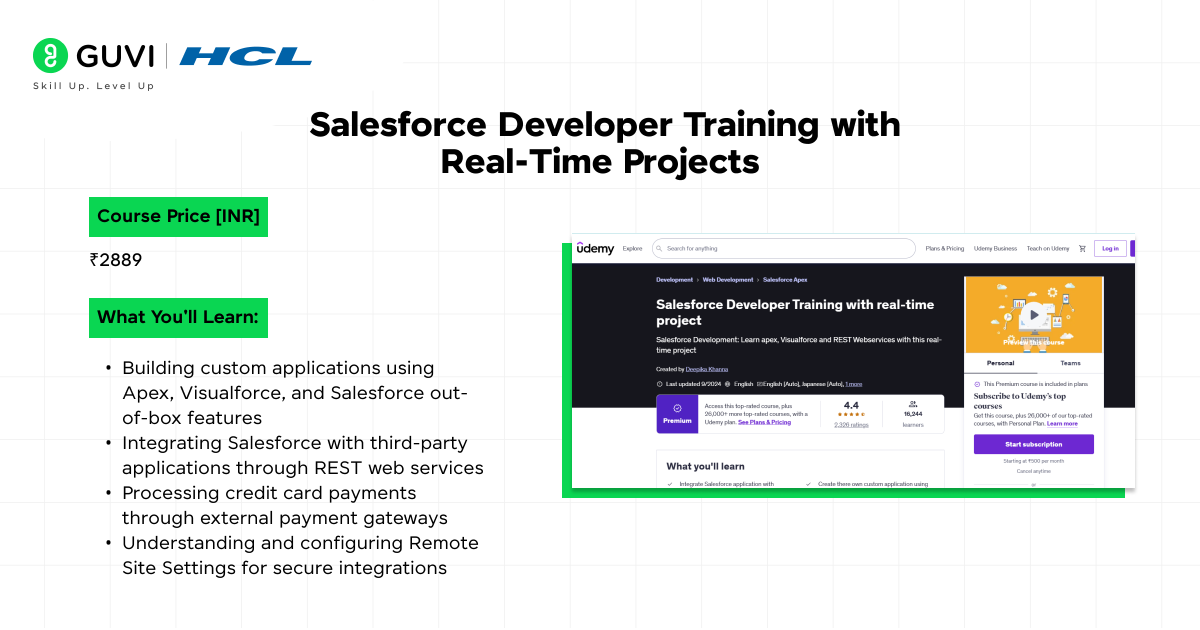
Course Price: ₹2,929
Course Duration: 4 hours
Level: Intermediate
Focus: Practical Salesforce development
Course Content:
- End-to-end development of a complete Property Management Application
- Mastery of Apex programming and Visualforce for custom application development
- Implementation of REST web services for third-party integrations
- Credit card payment processing using Authorize.Net integration
- Configuration of Remote Site Settings and Custom Settings
- Development of controller extensions, triggers, and RESTful web services
Key Features:
- Resume-worthy project development – Build a complete application you can confidently discuss in interviews
- Hands-on coding experience – Write actual code rather than passively watching demonstrations
- Third-party integration practice – Connect Salesforce with external applications using REST
- Real-world problem solving – Apply your knowledge to challenges similar to those faced in professional settings
- Individual feedback from senior Salesforce engineers on weekly assignments
- A capstone project that demonstrates your abilities to potential employers
What You’ll Learn:
- Building custom applications using Apex, Visualforce, and Salesforce out-of-box features
- Integrating Salesforce with third-party applications through REST web services
- Processing credit card payments through external payment gateways
- Understanding and configuring Remote Site Settings for secure integrations
- Mastering both List and Hierarchy Custom Settings implementation
- Writing controller extensions, triggers, and RESTful web services for complex functionality
Course Link: Salesforce Developer Training with Real-Time Projects
5) Salesforce Certified Platform Developer II Course
Platform Developer II-level training is intended for learners who already have a strong understanding of Salesforce development and want to work with more advanced concepts.
The course focuses on advanced Apex, application architecture, integrations, testing, deployment, asynchronous programming, and performance.
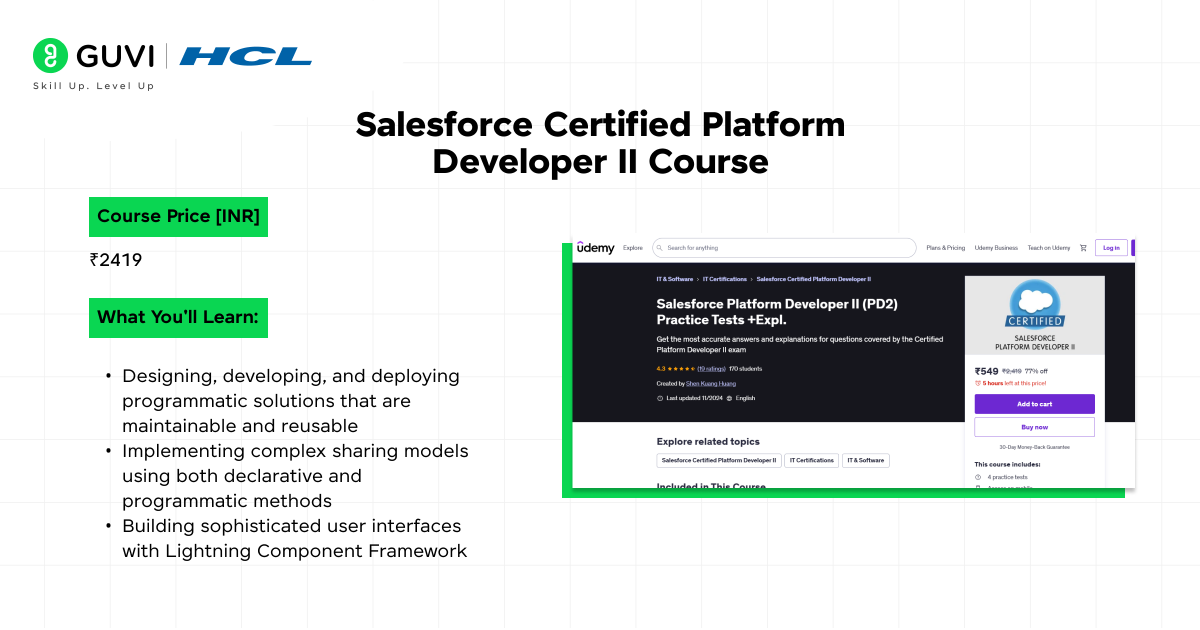
Course Price: ₹2,589
Course Duration: 24+ hours
Level: Advanced
Focus: Platform Developer II preparation
Course Content:
- Advanced Apex Programming – Complex business logic implementation and system integration techniques
- Process Automation and Logic (27% of exam) – Advanced trigger development and design patterns
- User Interface Development (20% of exam) – Lightning Component Framework and sophisticated Visualforce applications
- Testing, Debugging, and Deployment (20% of exam) – Comprehensive test plans and deployment strategies
- Performance Optimization (18% of exam) – Techniques for handling large data volumes and optimizing code
Key Features:
- Prerequisite Knowledge – Requires Platform Developer I certification, ensuring all participants have foundational skills
- Dual Certification Path – Combines both the multiple-choice exam and the practical superbadge completion
- Real-world Application – Focuses on solving complex business challenges through programmatic solutions
- Advanced Programming Techniques – Covers sophisticated development patterns beyond entry-level courses
- Expert Instruction – Led by developers with extensive Salesforce implementation experience
What You’ll Learn:
- Designing, developing, and deploying programmatic solutions that are maintainable and reusable
- Implementing complex sharing models using both declarative and programmatic methods
- Building sophisticated user interfaces with Lightning Component Framework
- Developing Apex code that scales to large data sets with performance optimization
- Creating and implementing asynchronous programming solutions (queueable, batchable, schedulable, @future)
- Integrating external systems using SOAP and REST web services
Course Link: Salesforce Certified Platform Developer II Course
6) Salesforce App Builder Certification Course
Not every Salesforce professional needs to spend most of their time writing code.
The Salesforce App Builder path focuses more on declarative development, allowing learners to create applications using Salesforce’s configuration and automation capabilities.
This makes it relevant for professionals interested in Salesforce application development without a heavy programming focus.
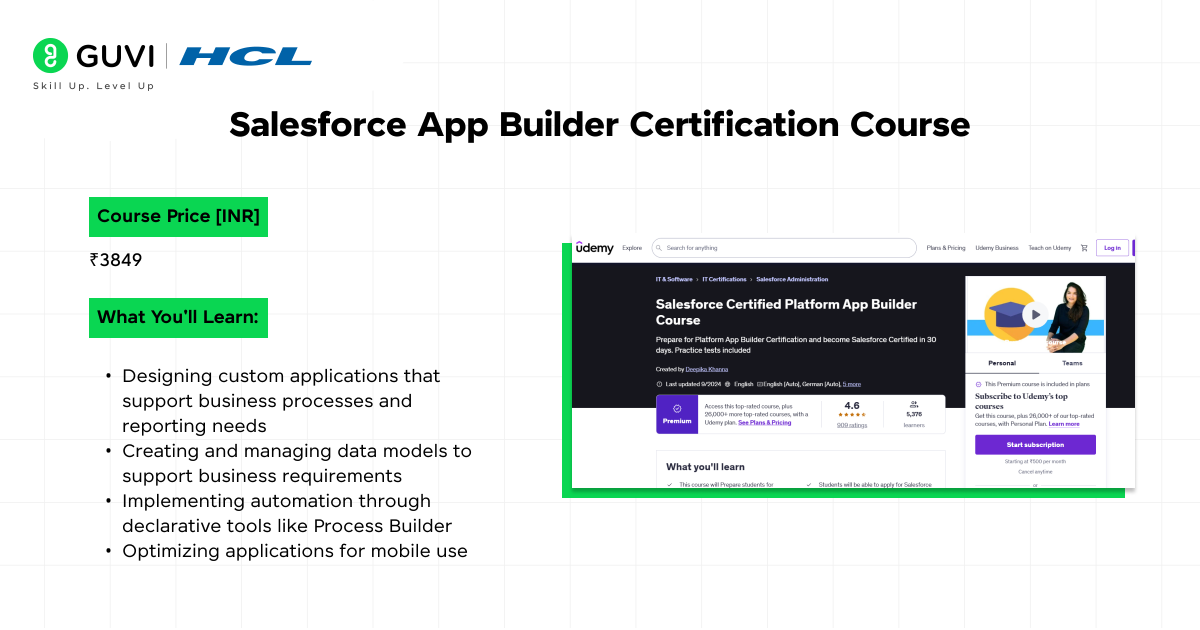
Course Price: ₹3849
Course Duration: 27 hours+
Level: Beginner to Intermediate
Focus: Salesforce App Builder preparation
Course Content:
- Business Logic and Process Automation – Making up 28% of the exam, this section focuses on implementing business logic through validation rules, formula fields, and workflow automation tools
- Salesforce Fundamentals – Comprising 23% of the exam, covering standard objects, sharing solutions, and programmatic use cases
- Data Modeling and Management – Accounting for 22% of the exam, addressing database design principles and relationship types
- User Interface – Representing 17% of the exam, focusing on customizing user experience through Lightning App Builder
- App Deployment – Constituting 10% of the exam, covering deployment strategies and change management
Key Features:
- Declarative Focus – Concentrates on point-and-click development tools rather than programming
- Broad Application – Valuable for administrators, consultants, and developers alike
- Practical Application – Emphasizes real-world problem solving through configuration
- Interactive Study Tools – Preparation includes scenario-based questions and flashcards
- No Prerequisites – No prior certifications required to pursue this credential
What You’ll Learn:
- Designing custom applications that support business processes and reporting needs
- Creating and managing data models to support business requirements
- Implementing automation through declarative tools like Process Builder
- Optimizing applications for mobile use
- Identifying when to use declarative versus programmatic solutions
- Deploying changes between Salesforce environments effectively
Course Link: Salesforce App Builder Certification Course
7) Salesforce LWC (Lightning Web Components) Course
Lightning Web Components, or LWC, is an important part of modern Salesforce user interface development.
This course focuses on the fundamentals of LWC and introduces developers to component creation, data binding, lifecycle hooks, communication between components, JavaScript, and Salesforce data services.
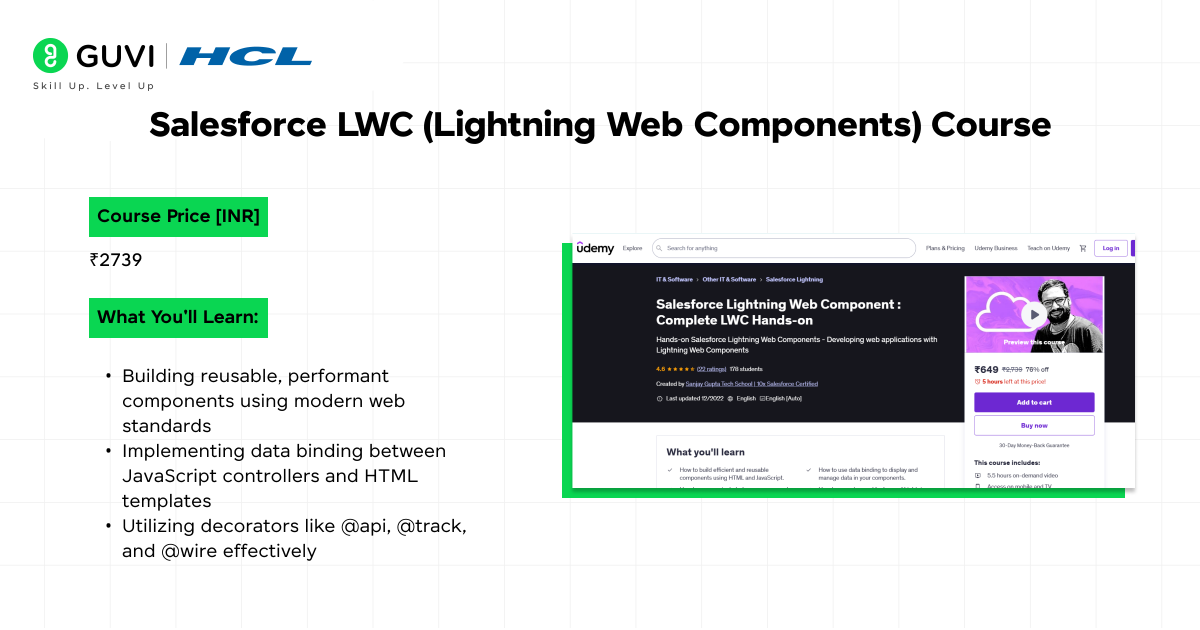
Course Price: ₹ 649
Course Duration: 5.5+ hours
Level: Intermediate
Focus: Lightning Web Components
Course Content:
- Introduction to LWC – Framework basics and comparison with Aura components
- Development Environment Setup – Installing Salesforce CLI, SFDX, and Visual Studio
- Component Fundamentals – Understanding component bundles and structure
- Data Binding & Rendering – Template usage and conditional rendering
- Lifecycle Hooks – Constructor, connected/disconnected callbacks, render callbacks
- Communication Patterns – Parent-child communication using events
- Lightning Data Service – Working with Salesforce data without Apex
- Integration with Apex – Using wire adapters and imperative calls
Key Features:
- Hands-on Projects – Building real components rather than just theoretical knowledge
- Modern JavaScript Focus – Training in ES6+ features essential for LWC development
- Practical Application – Development of components usable in Lightning App Builder and other contexts
- Component Communication – Mastering event-based communication between components
- Testing Framework – Introduction to Jest for testing LWC components
What You’ll Learn:
- Building reusable, performant components using modern web standards
- Implementing data binding between JavaScript controllers and HTML templates
- Utilizing decorators like @api, @track, and @wire effectively
- Creating responsive interfaces using SLDS (Salesforce Lightning Design System)
- Implementing component communication patterns
- Integrating with Salesforce data using wire adapters
Course Link: Salesforce LWC (Lightning Web Components) Course
8) Salesforce Developer: AI for Beginners
Salesforce development is also evolving alongside AI. Developers now have to understand how AI can be used with CRM data, business processes, prompts, and Salesforce applications.
An introductory Salesforce AI course can help learners understand the basics before moving into more advanced AI and Agentforce-related concepts.
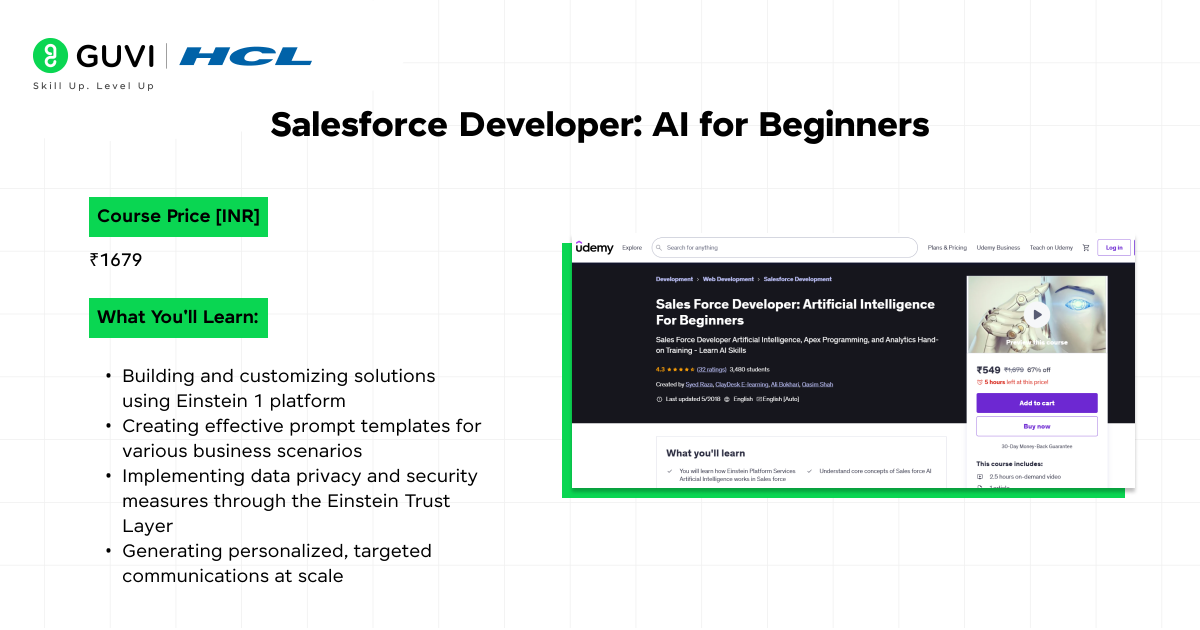
Course Price: ₹549
Course Duration: 2.5+ hours

Level: Beginner
Focus: Salesforce AI
Course Content:
- Understanding Einstein, Salesforce’s native AI technology
- Exploring CodeGen, the large language model (LLM) that powers Einstein for Developers
- Learning about generative and predictive AI applications in CRM environments
- Mastering Prompt Builder for creating effective AI-led prompts
- Implementing the Einstein Trust Layer to protect data privacy and security
- Creating prompt templates for business-specific use cases
Key Features:
- Hands-on AI Experience – Work directly with Einstein tools rather than just theoretical concepts
- Free Learning Path – Available through Trailhead’s interactive platform at no cost
- Self-paced Format – Learn at your convenience with accessible online modules
- Real-world Scenarios – Practice with actual business cases like summarizing support tickets and generating personalized emails
- Community Connection – Join the Agentblazers community to network with AI specialists worldwide
What You’ll Learn:
- Building and customizing solutions using the Einstein 1 platform
- Creating effective prompt templates for various business scenarios
- Implementing data privacy and security measures through the Einstein Trust Layer
- Generating personalized, targeted communications at scale
- Integrating AI capabilities into existing Salesforce implementations
- Building custom AI models using Model Builder
Course Link: Salesforce Developer: AI for Beginners
Tip: If you are learning Salesforce development in 2026, don’t stop with traditional development skills. Understanding how Salesforce’s current AI ecosystem fits into development workflows can make your learning path more relevant.
9) Apex Academy: Fundamental Salesforce Coding Techniques (Pluralsight)
Apex is one of the core programming languages used for Salesforce development. For learners who want to strengthen their coding fundamentals, Apex-focused training can be a useful addition to a broader Salesforce learning path.
Apex Academy focuses on fundamental programming concepts before moving into database operations, triggers, and testing.
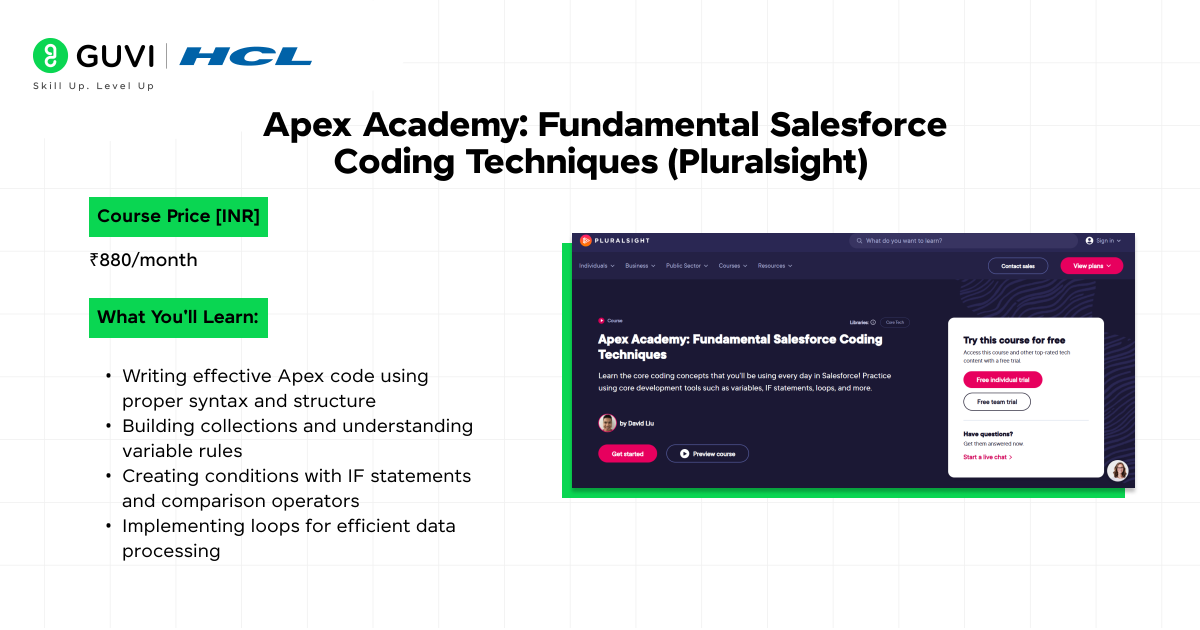
Course Price: Subscription type per month/yearly
Course Duration: 3 hours 27 mins
Level: Beginner to Intermediate
Focus: Apex programming
Course Content:
- Variables and collections (54 minutes of instruction)
- Dot notation for accessing fields and methods
- IF statements and comparison operators
- Loops including FOR EACH and FOR loops
- Data Manipulation Language (DML)
- SOQL queries and database operations
Key Features:
- Instructor Expertise – Learn from David Liu, who runs SFDC99.com, the world’s most popular Salesforce blog
- Hands-on Approach – Practice with real-world scenarios like “Opportunity Price Wars” and “Secret Information” triggers
- System.debug() tutorials for effective troubleshooting
- Progressive Learning Path – Starts with basics and advances to complex concepts
- Comprehensive Coverage – Includes both trigger creation and test class development
What You’ll Learn:
- Writing effective Apex code using proper syntax and structure
- Building collections and understanding variable rules
- Creating conditions with IF statements and comparison operators
- Implementing loops for efficient data processing
- Developing triggers that respond to record changes
- Writing test classes that validate your code functions correctly
Course Link: Apex Academy: Fundamental Salesforce Coding Techniques (Pluralsight)
Salesforce Developer Skills to Learn in 2026
Choosing a course is only the first step. Salesforce developers should also build a broader technical skill set.
Here are some skills worth adding to your learning roadmap:
| Skill | Why It Matters |
| Salesforce Fundamentals | Helps you understand the platform |
| Apex | Used to implement custom business logic |
| SOQL/SOSL | Helps developers work with Salesforce data |
| LWC | Used to build modern Salesforce interfaces |
| APIs | Important for system integrations |
| Data Modeling | Helps structure Salesforce applications |
| Security | Important for protecting Salesforce data |
| Testing | Helps maintain reliable applications |
| Deployment | Required for moving changes between environments |
| JavaScript | Useful for LWC development |
| AI and Agentforce concepts | Helps developers understand Salesforce’s evolving AI ecosystem |
Which Salesforce Developer Course Should You Choose?
Your ideal course depends on where you are starting and what you want to achieve.
If you’re a complete beginner
Start with a beginner-friendly Salesforce development course. Focus on Salesforce fundamentals, Apex, SOQL, data models, and basic application development.
If you want to become a Salesforce developer
Choose a broader development program that covers Apex, LWC, APIs, security, testing, and deployment.
If you’re preparing for Platform Developer I
A certification-focused course can give you a structured path covering the areas tested in the certification.
If you already know Salesforce development
Consider advanced Apex or Platform Developer II-level training to strengthen your development and architecture skills.
If you’re interested in front-end development
An LWC-focused course can help you build Salesforce interfaces using modern JavaScript-based development.
If you want to explore Salesforce AI
Start with the fundamentals of Salesforce AI and then move toward current AI capabilities, prompt-based development, data, and Agentforce concepts.
Salesforce Developer Roadmap for 2026
If you’re starting from scratch, you don’t need to learn everything at once.
A practical learning path can look like this:
Step 1: Learn Salesforce and CRM fundamentals
↓
Step 2: Understand objects, fields, relationships, and data modeling
↓
Step 3: Learn Apex fundamentals
↓
Step 4: Practice SOQL, SOSL, and DML
↓
Step 5: Learn triggers and business logic
↓
Step 6: Learn Lightning Web Components and JavaScript
↓
Step 7: Understand APIs and integrations
↓
Step 8: Learn testing, debugging, and deployment
↓
Step 9: Build Salesforce projects
↓
Step 10: Prepare for a relevant Salesforce certification
↓
Step 11: Add Salesforce AI and Agentforce-related skills
Salesforce Developer Projects to Build
Projects can help you move from watching tutorials to actually applying what you learn.
Here are a few ideas:
| Project | Skills You Can Practice |
| Lead Management System | Apex, objects, automation |
| Employee Management App | Data modeling, Apex, LWC |
| Customer Support Dashboard | LWC, SOQL, reports |
| Property Management System | Apex, Visualforce, APIs |
| Payment Integration | REST APIs, integrations |
| Sales Dashboard | Data modeling, reports, LWC |
| AI-Powered Support Assistant | AI, prompts, CRM workflows |
Try to build projects that solve a specific business problem rather than creating another basic CRUD application.
Free vs Paid Salesforce Developer Courses
You don’t necessarily need to pay to begin learning Salesforce.
Salesforce’s own learning ecosystem provides resources for learning platform fundamentals and preparing for different Salesforce skills and credentials.
Paid courses, on the other hand, may provide a more structured curriculum, instructor guidance, projects, practice questions, or mentorship.
| Free Learning | Paid Learning |
| Lower cost | Usually requires payment |
| Self-paced | Often more structured |
| Good for fundamentals | May offer deeper specialization |
| Community-based support | May include instructor support |
| Flexible learning | May include projects and assignments |
| Certification preparation varies | Certification-focused courses available |
A good approach is to use free resources to understand the basics and choose paid training when you need a more structured or specialized learning path.
Salesforce Developer Certifications in 2026
Certifications can help demonstrate your knowledge of the Salesforce ecosystem, but they should complement practical development skills rather than replace them.
For developers, certification preparation may include areas such as:
- Salesforce fundamentals
- Apex
- Data modeling
- Security
- Automation
- LWC
- Testing
- Debugging
- Deployment
- Integrations
Before preparing for any certification, check the current Salesforce certification requirements and exam structure because Salesforce regularly updates its certification portfolio.
Also remember the difference between a course completion certificate and an official Salesforce certification. Completing an online course does not automatically grant an official Salesforce credential.
Is Salesforce Development a Good Career in 2026?
Salesforce development can be a career option for people interested in cloud platforms, application development, CRM systems, and business automation.
However, the role is changing.
Developers are increasingly expected to understand more than Apex alone. Skills in LWC, JavaScript, APIs, integrations, data, security, deployment, and AI can help developers work across a wider range of Salesforce projects.
If you’re starting your career, focus on building a strong foundation first. Once you understand the platform and core development concepts, you can specialize in areas such as:
- Salesforce development
- LWC development
- Salesforce integrations
- Salesforce architecture
- Salesforce automation
- Salesforce AI
- Agentforce development
How Long Does It Take to Learn Salesforce Development?
The time required depends on your existing technical knowledge and how deeply you want to learn Salesforce.
A beginner may first spend time understanding Salesforce fundamentals before moving into Apex and LWC. Someone with prior programming experience may progress through the coding concepts faster.
A simple learning progression could be:
- 1-2 weeks: Salesforce fundamentals
- 2-4 weeks: Apex and SOQL basics
- 2-4 weeks: LWC and JavaScript
- 2-4 weeks: Projects, APIs, testing, and deployment
- Ongoing: Certification preparation and advanced specialization
Instead of focusing only on completing a course quickly, focus on whether you can actually build and explain Salesforce applications.
Concluding Thoughts…
Salesforce continues to shape the future of cloud-based business solutions, and the demand for skilled developers is only rising. Doesn’t matter if you’re just starting or looking to specialize in areas like Lightning, Apex, or AI, these top courses offer the right blend of hands-on experience and industry-recognized certifications.
Now is the perfect time to invest in your skills, earn credentials that employers value, and step confidently into one of the most rewarding tech careers of 2026.
Choose your path, commit to learning, and take the first step toward becoming a certified Salesforce developer. Good Luck!
FAQs
1. Which Salesforce developer course is best for beginners?
Beginners should look for a course that starts with Salesforce fundamentals and gradually introduces Apex, SOQL, data modeling, and application development. HCL GUVI’s Salesforce Developer Course and beginner-focused Salesforce development courses are examples of this approach.
2. What should I learn first to become a Salesforce developer?
Start with Salesforce and CRM fundamentals. Then move to data modeling, Apex, SOQL, DML, triggers, LWC, APIs, testing, and deployment.
3. Is Salesforce development difficult for beginners?
Salesforce development can take time to learn because it combines platform concepts with programming. Beginners can make the process easier by learning Salesforce fundamentals first and then gradually moving into Apex and LWC.
4. Which Salesforce certification should a developer pursue?
The right certification depends on your experience and career goal. Developers should review Salesforce’s current certification paths and choose one that matches their skills and intended specialization.
5. Is Salesforce development still relevant in 2026?
Salesforce development continues to evolve around application development, automation, integrations, data, and AI. Developers who keep their skills updated beyond basic Apex can work with a broader range of Salesforce technologies.
6. Can I learn Salesforce development for free?
Yes. Salesforce provides free learning resources through its learning ecosystem. Paid courses can be useful when you want a structured curriculum, projects, mentorship, or focused certification preparation.
7. How long does it take to learn Salesforce development?
It depends on your background and learning goals. Someone with programming experience may progress faster, while a complete beginner needs additional time to understand both Salesforce and programming fundamentals.
8. What programming languages are used in Salesforce development?
Apex is the primary programming language for Salesforce server-side development. JavaScript is also important for Lightning Web Components and modern Salesforce user interface development.
9. Is Apex enough to become a Salesforce developer?
Apex is an important Salesforce development skill, but it is not the only one. Developers should also understand SOQL, LWC, JavaScript, APIs, testing, deployment, security, and data modeling.
10. Should Salesforce developers learn AI and Agentforce?
AI is becoming an important part of the Salesforce ecosystem. Developers interested in staying current should understand how AI, prompts, CRM data, automation, and Agentforce-related capabilities can fit into Salesforce solutions.
Success Stories

About the Author
Hashmithaa
Hi, I’m Hashmithaa — a content writer with a love for words. Writing isn’t just what I do; it’s how I connect, communicate, and create meaning in a noisy digital world. And if my words help someone make a better decision, learn something new, or feel more confident, then I’ve done my job well.
View all posts by Hashmithaa
Connect with me @








Did you enjoy this article?