


Database Articles
How to Use MySQL Workbench for Database Design and Querying: Complete and Best Guide
How to Use Supabase to Build a Backend in Minutes (With Auth & DB)
How to Use MongoDB Compass: Master Querying & Managing NoSQL Data
How to Use Apache Airflow: 5 Easy Steps to Build Your First Data Pipeline


Get In Touch For Details! Request More Information
What is Normalization in DBMS? An Informative Guide [2026]
Jan 05, 2026 5 Min Read 8590 Views
(Last Updated)
In this age and time, one of the prominent roles that lays the foundation for any business or organization is the database management system.
It is basically collecting, storing, analyzing, and retrieving data. In that powerful domain, there is a concept called Normalization which every data scientist should know!
This article is going to be all about that concept – Normalization. Through the course of this article, you will be enriched with knowledge about normalization that can potentially make you stand out of the crowd!
So, without further ado, let us get started!
Table of contents
- What is Normalization?
- Why Should You Care About Normalization?
- How Does Normalization Work?
- The Steps of Normalization
- The Normal Forms
- First Normal Form (1NF)
- Second Normal Form (2NF)
- Third Normal Form (3NF)
- Why Go Through All These Steps?
- Implementing Normalization: A Step-by-Step Guide
- Step 1: Analyze Your Data
- Step 2: Define Primary Keys
- Step 3: Break Down Data into Related Tables
- Step 4: Eliminate Redundancy
- Step 5: Ensure Referential Integrity
- Step 6: Test and Validate Your Database
- Conclusion
- FAQs
- Why is it important to have atomic values in a table?
- Can you achieve normalization without using primary keys?
- Why is it necessary to eliminate transitive dependencies in 3NF?
- What is denormalization, and when might it be used?
- Is normalization always beneficial for all types of databases?
What is Normalization?

Let us start with the basics. When you work with database management systems, you might have heard the term normalization quite a bit. But what exactly does it mean? Let’s break it down in simple terms.
Normalization is a process that helps you organize the data in your database more efficiently. Think of it like cleaning up a messy room. Instead of having things scattered all over the place, you put them in their right spots so you can easily find what you need and keep everything in order.
This is what normalization is all about.
Why Should You Care About Normalization?
You might wonder, “Why should I bother with normalization?” Here are a few reasons why you should bother:
- Reduces Redundancy: In databases, storing the same piece of data multiple times can be inefficient and prone to errors. Normalization helps you avoid this by ensuring each piece of data is stored only once.
- Improves Data Integrity: Data integrity means your data is accurate and consistent. When you normalize your database, you reduce the risk of having conflicting or outdated information.
- Enhances Performance: A well-organized database can process your queries faster.
- Simplifies Maintenance: With a normalized database, making updates and changes becomes easier. You can update information in one place, and it will automatically reflect everywhere it’s needed.
Learn: Best MySQL Course Online with Certification
How Does Normalization Work?
Normalization involves breaking down your data into smaller, related tables. This might sound not very easy, but let’s use a simple example to make it clear.
Imagine you run a small online store, and you want to keep track of orders, customers, and products. Without normalization, you might have a table that looks like this:
| OrderID | CustomerName | CustomerAddress | ProductName | ProductPrice |
|---|---|---|---|---|
| 1 | John Doe | 123 Elm St | Widget A | 10 |
| 2 | Jane Smith | 456 Oak St | Widget B | 15 |
| 3 | John Doe | 123 Elm St | Widget C | 20 |
Here are the problems with this setup:
- Redundancy: John’s address appears twice.
- Inconsistency: If John moves, you have to update his address in multiple places.
- Maintenance: If you need to update product prices, you must do it for every order.
Breaking It Down
To normalize this data, you would create separate tables for customers, products, and orders. This is similar to tables that you create in database management systems like MySQL.
Customers Table:
| CustomerID | CustomerName | CustomerAddress |
|---|---|---|
| 1 | John Doe | 123 Elm St |
| 2 | Jane Smith | 456 Oak St |
Products Table:
| ProductID | ProductName | ProductPrice |
|---|---|---|
| 1 | Widget A | 10 |
| 2 | Widget B | 15 |
| 3 | Widget C | 20 |
Orders Table:
| OrderID | CustomerID | ProductID |
|---|---|---|
| 1 | 1 | 1 |
| 2 | 2 | 2 |
| 3 | 1 | 3 |
Now, let’s see how this helps:
- Redundancy Reduced: John’s address is stored only once.
- Consistency Improved: If John moves, you update his address in one place.
- Maintenance Simplified: Updating a product price is straightforward.

The Steps of Normalization
Normalization typically follows a series of steps called normal forms, each building on the previous one:
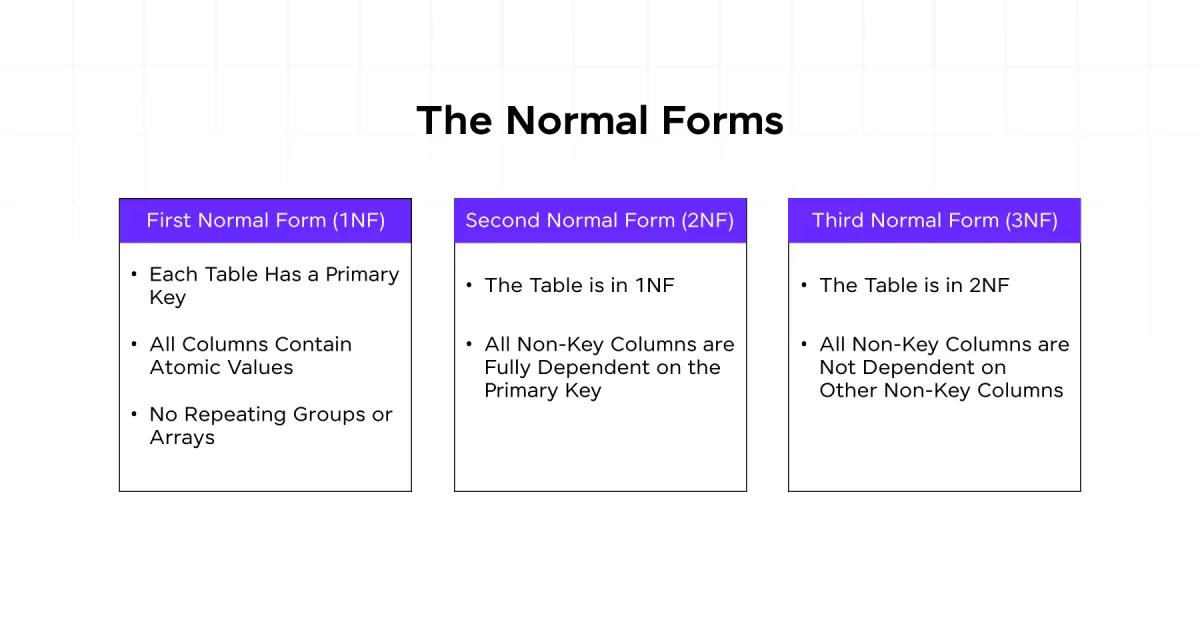
- First Normal Form (1NF): Ensure each table has a primary key and that all columns contain atomic (indivisible) values. Remove repeating groups.
- Second Normal Form (2NF): Ensure the table is in 1NF and that all non-key columns are fully dependent on the primary key.
- Third Normal Form (3NF): Ensure the table is in 2NF and that all non-key columns are not dependent on other non-key columns.
Normalization might seem like a technical and complex process, but it’s really about making your data easier to manage, more consistent, and more efficient. Let us understand more about this further!
Read More: Mastering Database Management: A Beginner’s Guide
The Normal Forms
Now that you have a basic understanding of what normalization is and why it’s important, let’s dive into the details of the normal forms.
But before we go any further, it is important that you have a basic understanding of data science. If not, consider enrolling in a professionally certified online Data Science Course that teaches you everything about databases and helps you get started as a data scientist.
Additionally, if you want to explore SQL through a self-paced course, try HCL GUVI’s SQL Server self-paced course.
You have already seen a gist of normal forms in the previous section. Let us see about it in detail. Each normal form builds on the previous one to help you achieve a more structured and efficient database.
First Normal Form (1NF)
The First Normal Form (1NF) is the foundational step in the normalization process. To achieve 1NF, you need to ensure that your table meets the following criteria:
- Each Table Has a Primary Key: This is a unique identifier for each record in your table. Think of it as a way to uniquely tag every piece of data.
- All Columns Contain Atomic Values: This means that each column should hold only one piece of information. For example, instead of having a “PhoneNumbers” column that stores multiple numbers separated by commas, you should have a separate row for each phone number.
- No Repeating Groups or Arrays: You should not have columns that contain lists or sets of values.
Example:
Before 1NF:
| OrderID | CustomerName | ProductList |
|---|---|---|
| 1 | John Doe | Widget A, Widget B |
| 2 | Jane Smith | Widget C, Widget D |
After 1NF:
| OrderID | CustomerName | ProductName |
|---|---|---|
| 1 | John Doe | Widget A |
| 1 | John Doe | Widget B |
| 2 | Jane Smith | Widget C |
| 2 | Jane Smith | Widget D |
In this example, we’ve broken down the “ProductList” into individual rows, making the table comply with 1NF.
Second Normal Form (2NF)
The Second Normal Form (2NF) builds on the First Normal Form. To achieve 2NF, you need to ensure that your table meets the following criteria:
- The Table is in 1NF: This means you’ve already applied the rules of the First Normal Form.
- All Non-Key Columns are Fully Dependent on the Primary Key: This means that every non-key column should be directly related to the entire primary key, not just a part of it.
Example:
Before 2NF:
| OrderID | ProductID | CustomerName | ProductName | ProductPrice |
|---|---|---|---|---|
| 1 | 101 | John Doe | Widget A | 10 |
| 2 | 102 | Jane Smith | Widget B | 15 |
After 2NF: Orders Table:
| OrderID | ProductID | CustomerID |
|---|---|---|
| 1 | 101 | 1 |
| 2 | 102 | 2 |
Customers Table:
| CustomerID | CustomerName |
|---|---|
| 1 | John Doe |
| 2 | Jane Smith |
Products Table:
| ProductID | ProductName | ProductPrice |
|---|---|---|
| 101 | Widget A | 10 |
| 102 | Widget B | 15 |
In this example, we’ve separated the customer and product information into their own tables. The Orders table now only references these entities by their IDs.
Third Normal Form (3NF)
The Third Normal Form (3NF) takes normalization a step further. To achieve 3NF, you need to ensure that your table meets the following criteria:
- The Table is in 2NF: This means you’ve already applied the rules of the Second Normal Form.
- All Non-Key Columns are Not Dependent on Other Non-Key Columns: This means that non-key columns should depend only on the primary key and not on other non-key columns.
Example:
Before 3NF:
| OrderID | CustomerID | CustomerName | CustomerAddress |
|---|---|---|---|
| 1 | 1 | John Doe | 123 Elm St |
| 2 | 2 | Jane Smith | 456 Oak St |
After 3NF: Orders Table:
| OrderID | CustomerID |
|---|---|
| 1 | 1 |
| 2 | 2 |
Customers Table:
| CustomerID | CustomerName | CustomerAddress |
|---|---|---|
| 1 | John Doe | 123 Elm St |
| 2 | Jane Smith | 456 Oak St |
In this example, we’ve moved the “CustomerAddress” into the Customers table, ensuring that each piece of data is stored only once and is directly related to the primary key.
Why Go Through All These Steps?
You might wonder why you need to go through all these steps. Here’s why:
- Improved Data Integrity: By eliminating redundancy, you reduce the chances of inconsistencies.
- Easier Maintenance: With a clear structure, updates become simpler and less error-prone.
- Better Performance: A normalized database can handle queries more efficiently.
Understanding and applying the normal forms in database normalization helps you create a well-organized, efficient, and scalable database.
Explore: A Complete Guide To Become A Data Scientist In 3 Months
Implementing Normalization: A Step-by-Step Guide
Now that you understand the concept and importance of normalization, let’s dive into how you can implement it in your database.
Implementing normalization might sound technical, but if you break it down into clear steps, it becomes much more manageable.
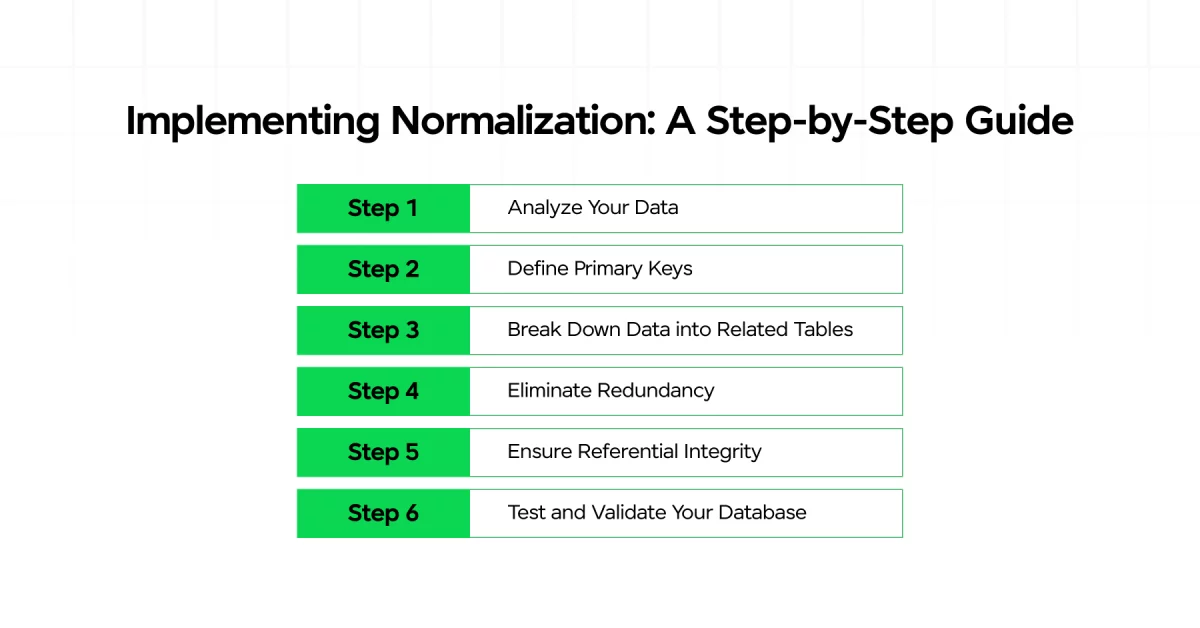
Step 1: Analyze Your Data
The first step in normalization is to thoroughly analyze your data. You need to understand the types of data you have and how they relate to each other. Start by asking yourself:
- What information do you need to store?
- How is this information currently organized?
- What are the relationships between different pieces of data?
Step 2: Define Primary Keys
Next, identify the primary keys for your tables. A primary key is a unique identifier for each record in a table. It helps you uniquely identify each row of data.
Step 3: Break Down Data into Related Tables
Start dividing your data into related tables based on the normal forms. This means creating separate tables for each type of entity (e.g., books, authors, sales).
Step 4: Eliminate Redundancy
After breaking down your data, review your tables to ensure there’s no redundant data. Each piece of information should be stored only once. If you find any data that repeats across tables, adjust your structure to eliminate it.
Step 5: Ensure Referential Integrity
Referential integrity means that relationships between tables are maintained correctly. Use foreign keys to link tables together. A foreign key in one table points to a primary key in another table, creating a relationship between the two.
Explore More: Best SQL Server Course Online with Certification
Step 6: Test and Validate Your Database
After organizing your data and establishing relationships, it’s crucial to test your database. Run various queries to ensure that the data retrieval works as expected. Check for:
- Data Integrity: Verify that data is consistent across tables.
- Query Performance: Ensure that queries run efficiently without unnecessary delays.
- Ease of Maintenance: Make sure that updating information in one place reflects correctly across the database.
This is how you can implement normalization in your database and experience the pleasure of cleaning up the messy data.
If you want to learn more about Normalization and Databases in data science, then consider enrolling in HCL GUVI’s Certified Data Science Career Program which not only gives you theoretical knowledge but also practical knowledge with the help of real-world projects.
Alternatively, if you would like to explore SQL through a Self-paced course, try
HCL GUVI’s SQL Server Self-Paced certification course.
Also Read: Is Data Science A Good Career Choice In 2026?
Conclusion
In conclusion, implementing normalization in your database might seem like a complex task, but by following these clear steps, you can achieve a well-organized, efficient, and scalable database.
Start by analyzing your data, defining primary keys, breaking down data into related tables, eliminating redundancy, ensuring referential integrity, and testing your database thoroughly.
Remember, normalization is an ongoing process that evolves with your database needs. By keeping your database well-structured, you ensure its longevity and reliability, making your data management tasks much easier in the long run.
FAQs
1. Why is it important to have atomic values in a table?
Atomic values ensure that each column contains only one piece of information, making the data easier to manage and query.
2. Can you achieve normalization without using primary keys?
No, primary keys are essential for normalization as they uniquely identify each record and establish relationships between tables.
3. Why is it necessary to eliminate transitive dependencies in 3NF?
Eliminating transitive dependencies ensures that non-key columns are only dependent on the primary key, which reduces redundancy and improves data integrity.
4. What is denormalization, and when might it be used?
Denormalization is the process of combining tables to reduce the complexity of queries and improve performance in certain scenarios, such as read-heavy applications.
5. Is normalization always beneficial for all types of databases?
While normalization is beneficial for ensuring data integrity and reducing redundancy, in some cases, such as read-heavy applications, denormalization might be preferred for performance reasons.
Success Stories

About the Author
Lukesh S
A professional content writer who has experience in freelancing and now working as a Technical Content Writer at HCL GUVI having sound knowledge in Blog Writing and Creative Writing!
View all posts by Lukesh S
Connect with me @
















Did you enjoy this article?