


Full Stack Development Articles
Claude for Architecture and Engineering Documentation
Freelancing as a Python Developer: Getting Your First Client

Get In Touch For Details! Request More Information
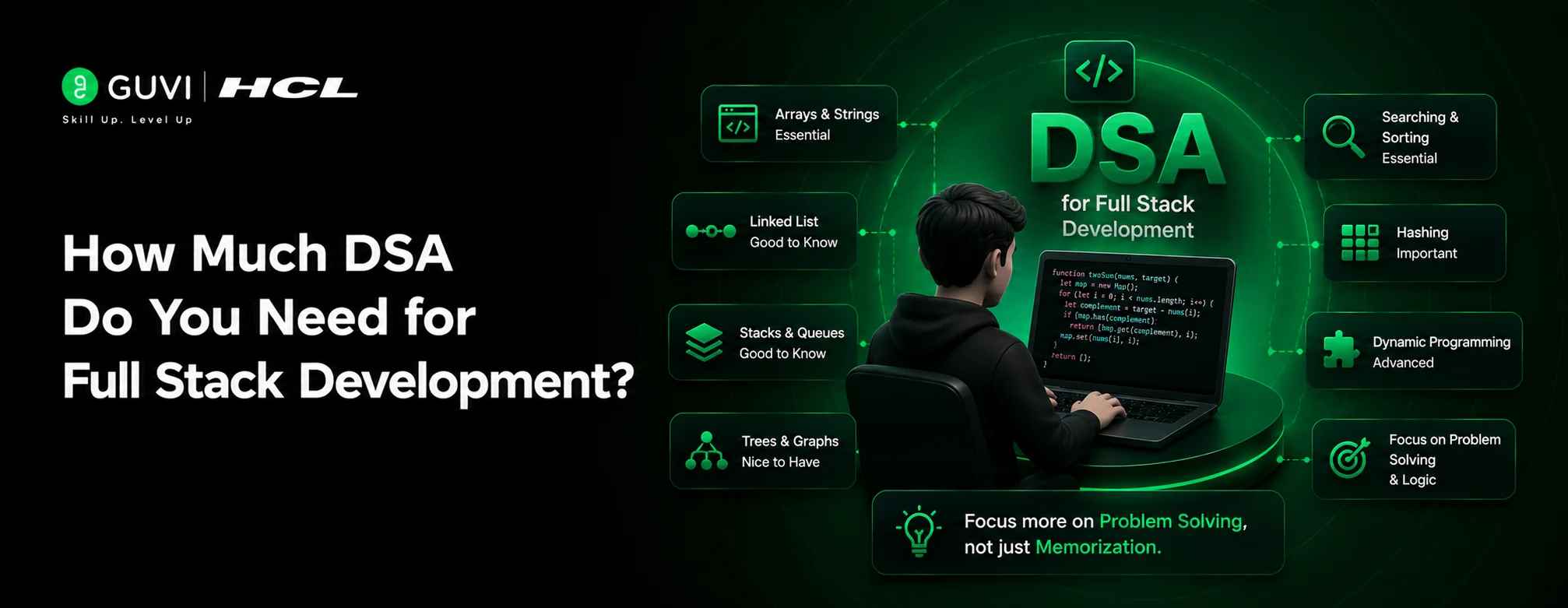
How Much DSA Do You Need for Full Stack Development? Honest Answer 2026
Jul 29, 2026 4 Min Read 22749 Views
(Last Updated)
You need around 8 to 10 core DSA topics, not full DSA mastery. That’s the honest answer, and this guide breaks down exactly which ones matter, which ones you can skip, and why the answer changes depending on where you’re applying.
In this blog, we’re going to answer this question – How much DSA for Full stack Development Is Required? What concepts should you learn and how much? Get all your doubts cleared in this blog by going through each step.
Table of contents
- TL;DR Summary
- DSA Topics for Full Stack Developers: Quick Reference Table
- Why DSA Still Matters for Full Stack Developers?
- Where DSA Actually Helps in Real Work
- Full Stack DSA at Startups vs Product Companies (Huge Difference)
- At Startups
- At Product-Based Companies
- DSA Topics to Skip as a Full Stack Developer
- Common Mistakes Full Stack Developers Make with DSA
- Conclusion
- FAQs
- How much DSA is required for full stack development in 2026?
- Is DSA more important for backend or frontend in full stack roles?
- Do startups ask DSA questions in interviews?
- Can I become a full stack developer without learning DSA at all?
- Which DSA topics should I prioritize first as a beginner?
- Is dynamic programming necessary for full stack interviews?
TL;DR Summary
- You don’t need competitive-programming-level DSA to become a full stack developer
- Focus on arrays, strings, hashing, recursion, searching, sorting, linked lists, stacks, queues, and basic trees
- Startups rarely test deep DSA. Product-based companies (Amazon, Google, Flipkart) test it heavily
- Skip tries, segment trees, advanced graph algorithms, and heavy bit manipulation unless you’re targeting SDE roles at large product companies
- Real-world backend work (database queries, caching, API design) uses DSA concepts more than it uses DSA puzzles
DSA Topics for Full Stack Developers: Quick Reference Table
| DSA Topic | Needed for Full Stack? | How Often Asked in Interviews? |
|---|---|---|
| Arrays and Strings | Yes | Very often |
| Hashing / HashMaps | Yes | Very often |
| Recursion and Backtracking | Yes | Often |
| Searching and Sorting | Yes | Often |
| Linked Lists | Yes | Often |
| Stacks and Queues | Yes | Moderate |
| Trees (Binary Trees, BST) | Yes | Moderate |
| Graphs (BFS/DFS basics) | Depends on company | Moderate at product firms |
| Dynamic Programming | Depends on role level | Rare at startups, moderate at product firms |
| Tries, Segment Trees, Advanced Graphs | No | Rare |
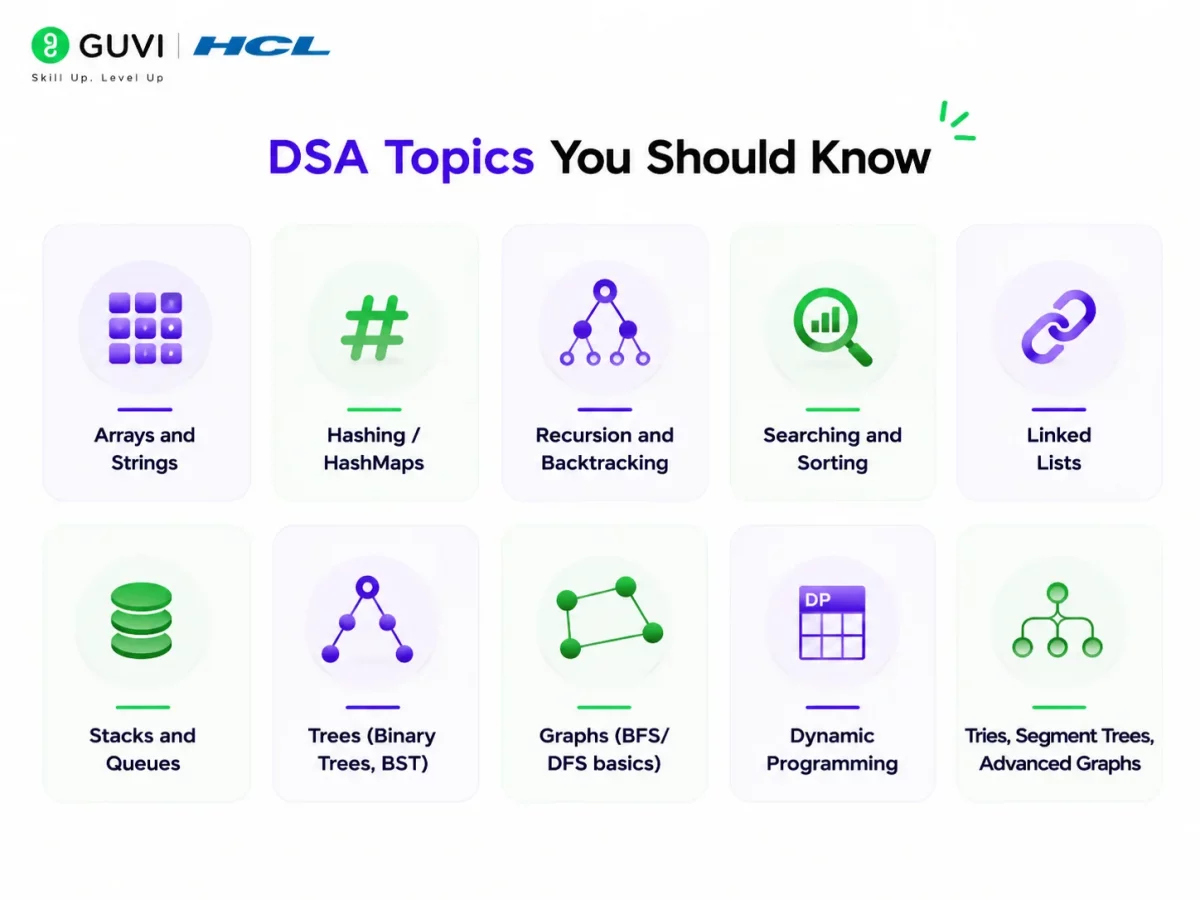
If you’re wondering where to start, this table is your shortlist. Everything in the “Yes” rows is worth your time. Everything in the last row can wait, or be skipped entirely, depending on your target companies.
Why DSA Still Matters for Full Stack Developers?
You might be thinking, “I build UIs and APIs, why does any of this matter?” Fair question. Here’s the honest reason.
DSA doesn’t show up as puzzles in your daily job. It shows up as instincts. When you write a database query that should take milliseconds but takes seconds, that’s a data structure problem. When your React list re-renders slowly with 10,000 items, that’s an algorithm problem.
Where DSA Actually Helps in Real Work
- Backend queries: Choosing the right data structure affects how fast you fetch and filter records
- Frontend rendering: Understanding time complexity helps you avoid unnecessary re-renders and loops
- API design: Recursion and tree logic show up in nested JSON, comment threads, and category trees
- Debugging: Recognizing an O(n²) loop buried in your code saves you from production slowdowns
According to interview prep platforms tracking 2025-2026 hiring data, arrays, strings, and hashmaps alone account for a majority of DSA questions asked in full stack developer interviews at Indian product companies. Mastering these three areas covers more ground than any other single investment you can make in DSA prep.
Full Stack DSA at Startups vs Product Companies (Huge Difference)
This is the part most guides skip, and it’s the one that actually changes how you should prepare.
At Startups
Startups usually care more about what you can ship than how you solve a whiteboard problem. Your interview will likely include:
- A practical coding round (build a small feature, fix a bug, or extend existing code)
- Light DSA questions, mostly arrays, strings, and basic logic
- Heavy focus on your projects, GitHub, and how you think through real problems
You can get hired at most startups with a solid grip on the “Yes” rows in the table above and nothing more.
At Product-Based Companies
Companies like Amazon, Google, Microsoft, and well-funded product startups (think Flipkart, Swiggy, Razorpay) run a separate DSA round, often 2 to 3 rounds deep. Here, you’re expected to:
- Solve medium to hard problems on arrays, trees, graphs, and dynamic programming
- Explain time and space complexity clearly
- Handle follow-up questions like “how would this scale to a million records?”
If your goal is an SDE role at a product company, DSA prep needs to look closer to a computer science fundamentals course than a quick refresher.
The takeaway: know your target before you plan your prep. Studying DSA the way a product company expects, when you’re applying to startups, wastes time you could spend building projects instead.
DSA Topics to Skip as a Full Stack Developer
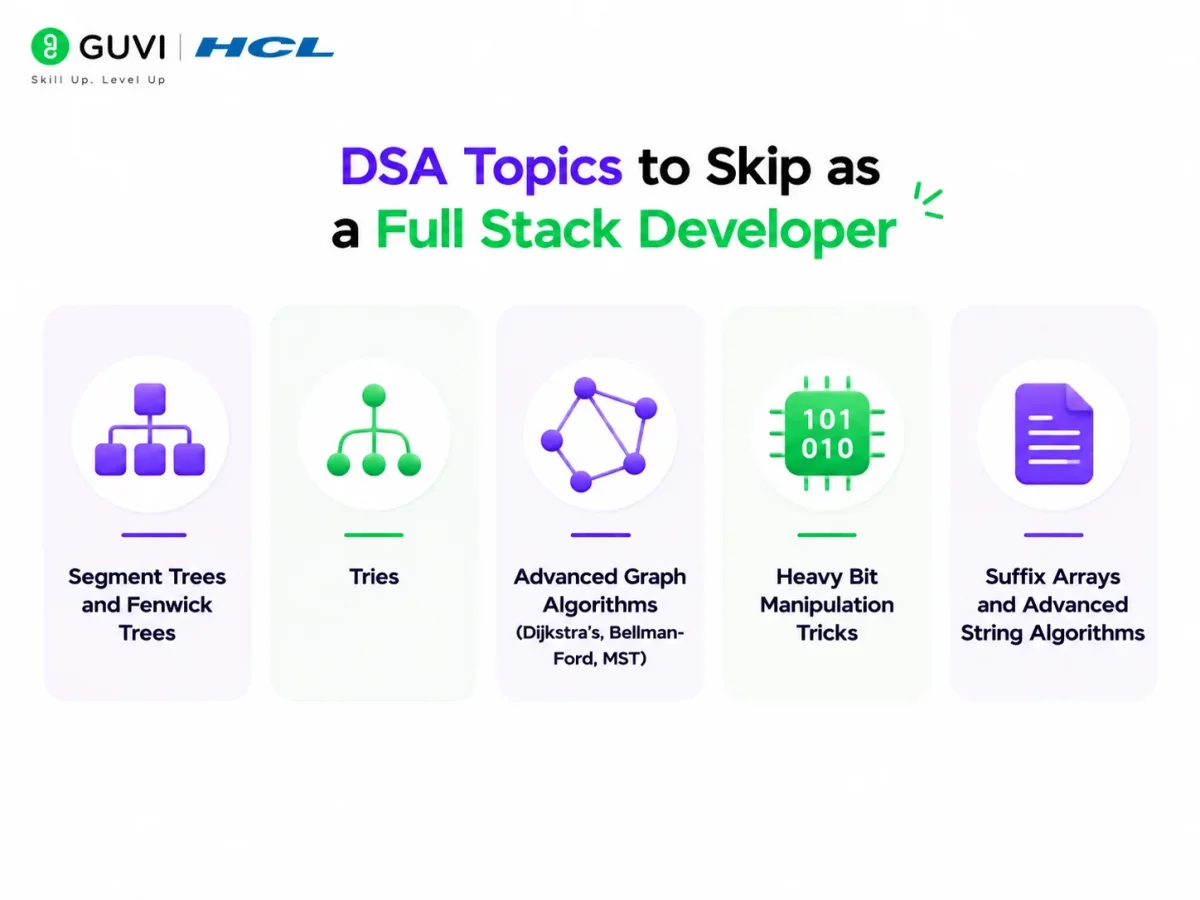
Not every DSA topic deserves your limited study hours. Here’s what you can safely deprioritize unless you’re specifically targeting SDE roles at large product companies.

- Segment trees and Fenwick trees: Rarely asked outside competitive programming and specialized backend infra roles
- Tries: Useful for autocomplete systems, but a niche ask in most full stack interviews
- Advanced graph algorithms (Dijkstra’s, Bellman-Ford, Minimum Spanning Tree): Come up mostly in senior or infrastructure-heavy roles
- Heavy bit manipulation tricks: Occasionally tested at top-tier product companies, almost never elsewhere
- Suffix arrays and advanced string algorithms: Reserved for competitive programming, not typical interview rounds
Skipping these doesn’t mean ignoring problem-solving altogether. It means spending your prep time where interviews and real work actually overlap.
Common Mistakes Full Stack Developers Make with DSA
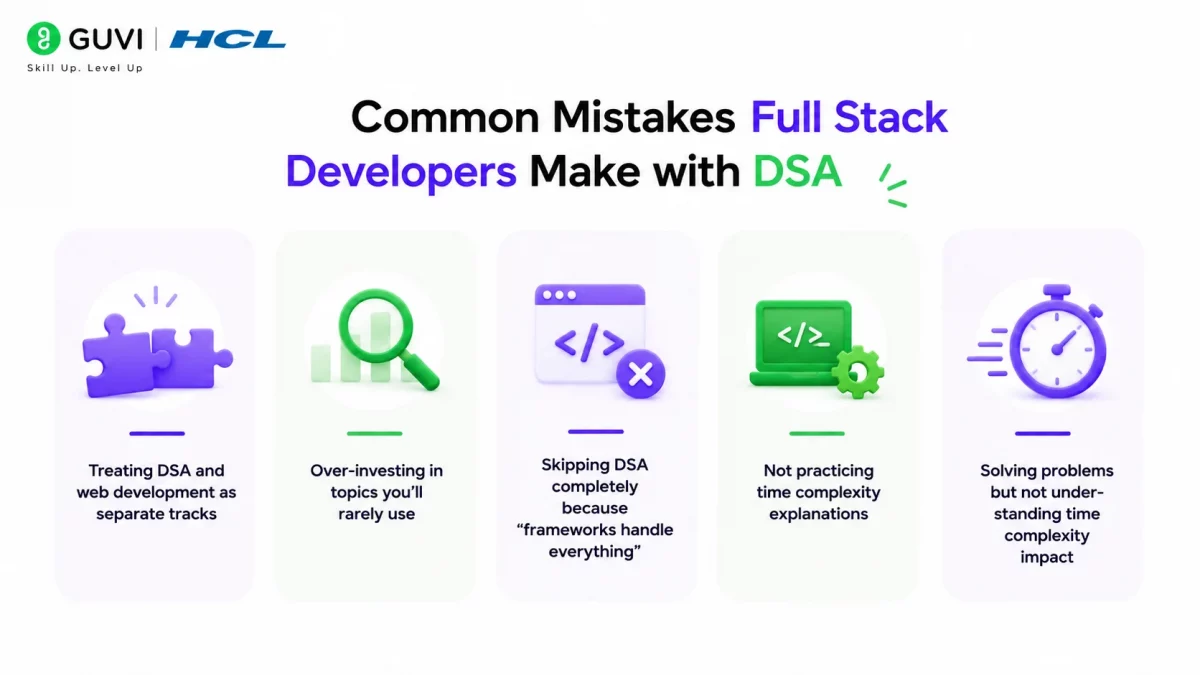
- Treating DSA and web development as separate tracks: Many learners study DSA in isolation instead of connecting it to real projects. Apply concepts inside actual apps, like optimizing a search filter or a pagination system.
- Over-investing in topics you’ll rarely use: Spending weeks on segment trees while your resume has no deployed project is a poor trade-off for most full stack roles.
- Skipping DSA completely because “frameworks handle everything”: Frameworks handle syntax, not logic. Interviewers still expect you to reason through a problem from scratch.
- Not practicing time complexity explanations: Solving a problem isn’t enough. You need to explain why your solution is O(n) instead of O(n²) when asked.
Want a project-based way to strengthen both your web development and problem-solving skills together? GUVI’s full stack development courses include focused DSA modules built specifically for full stack roles, so you’re not learning generic competitive programming, you’re learning what interviews and real projects actually need.
Conclusion
You don’t need to become a competitive programmer to succeed as a full stack developer. What you need is a working grip on arrays, strings, hashing, recursion, searching, sorting, linked lists, stacks, queues, and basic trees. That covers most interview rounds and almost all real backend and frontend problem-solving you’ll face on the job.
Where you’re applying changes how deep you should go. Startups want practical builders. Product companies want structured problem solvers. Know your target, prepare accordingly, and don’t burn hours on topics you’ll rarely use.
FAQs
How much DSA is required for full stack development in 2026?
You need a solid grip on 8 to 10 core topics, arrays, strings, hashing, recursion, searching, sorting, linked lists, stacks, queues, and basic trees. Full mastery of advanced DSA is not required for most full stack roles.
Is DSA more important for backend or frontend in full stack roles?
DSA matters more for backend work, since it directly affects database queries, caching, and data processing. Frontend developers still benefit from it for rendering performance and state management logic.
Do startups ask DSA questions in interviews?
Yes, but usually lighter versions focused on arrays, strings, and basic logic. Startups weigh practical coding and project experience more heavily than deep DSA rounds.
Can I become a full stack developer without learning DSA at all?
It’s possible to get hired, especially at smaller companies, but it’s uncommon and limits your options at product-based companies. Basic DSA knowledge also makes you a stronger problem solver on the job.
Which DSA topics should I prioritize first as a beginner?
Start with arrays and strings, then move to hashing, recursion, and basic sorting and searching algorithms. These cover the highest percentage of real interview questions.
Is dynamic programming necessary for full stack interviews?
Only if you’re targeting product-based companies or senior roles. Most startup interviews and entry-level full stack roles rarely go beyond basic DP problems, if at all.
Success Stories

About the Author
Lukesh S
A professional content writer who has experience in freelancing and now working as a Technical Content Writer at HCL GUVI having sound knowledge in Blog Writing and Creative Writing!
View all posts by Lukesh S
Connect with me @































Did you enjoy this article?