


Project Articles
Automated Resume Screener: NLP-Based Python Project with Source Code
Business Analysis in Digital Transformation Projects - Best Guide
Build No-Code AI Agents with Flowise AI: Step-by-Step Beginner Guide


Get In Touch For Details! Request More Information
Best Project Ideas for Robotic Applications – Including All 3 Levels [2026]
Sep 09, 2026 10 Min Read 36010 Views
(Last Updated)
Real-world projects are one of the most important things you can do to improve your skill set and resume. Choosing a project from the numerous lists available is a challenging task in itself, and for a robotic engineer or enthusiast, selecting a project can be even more daunting.
As there are many applications for robots, it is better to choose any project ideas for robotic applications, as that can enhance your resume and skills as a robotic engineer.
That is why, in this article, we curated a list of project ideas for robotic applications that you can take up and work on to gain practical knowledge on the subject. To make it more interesting, we actually listed projects on three levels – Beginner, Intermediate, and Advanced. You can pick any one of the project ideas for robotic applications from these levels that suit your taste.
So, without further ado, let’s get started.
TL;DR
Robotics projects help learners combine programming, electronics, mechanical design, and problem-solving through practical applications. The right project should match the learner’s experience, available hardware, budget, and career goal.
- Beginners can start with line-following or obstacle-avoidance robots.
- Arduino works best for direct sensor and motor control.
- Raspberry Pi supports computer vision, networking, and AI applications.
- Simulation tools allow learners to practice without buying hardware.
- AI-powered projects can include object sorting or autonomous navigation.
- Hackathon-ready projects should solve a clear problem and show measurable results.
Table of contents
- Project Ideas for Robotic Applications - Beginner Level
- Line Following Robot
- Obstacle Avoidance Robot
- Remote-Controlled Surveillance Robot
- Project Ideas for Robotic Applications - Intermediate Level
- Robotic Hand
- Maze Solver Robot
- Gesture-Controlled Robot
- Project Ideas for Robotic Applications - Advanced Level
- Automated Chess Playing Robot
- Voice-Controlled Assistant
- Solar-Powered Robot
- Robotics Projects: Hardware, Software, and Cost Comparison
- Robotics Projects Using Raspberry Pi vs. Arduino
- Robotics Projects Using Arduino
- Bluetooth-Controlled Robot Car
- Fire-Fighting Robot
- Self-Balancing Robot
- Smart Parking Barrier
- Robotics Projects Using Raspberry Pi
- Rubik’s Cube Solver Robot
- Autonomous Delivery Robot
- Emotion-Aware Companion Robot
- Quadruped Robot Dog
- Should You Choose Arduino or Raspberry Pi?
- AI-Powered Robotics Project Ideas for College: 2026 Trend
- AI Waste-Sorting Robot
- Imitation-Learning Pick-and-Place Robot
- Vision-Language Controlled Robot
- AI-Powered Agricultural Rover
- Conversational Service Robot
- AI Chess Robot With Human Interaction
- Edge-AI Safety Monitoring Robot
- Robotics Projects for Beginners With Zero Hardware Experience
- Virtual Line-Following Robot
- Arduino Obstacle Sensor Simulation
- Maze Solver in Python
- ROS 2 TurtleBot Navigation
- Virtual Robotic Arm
- Sensor Dashboard Without Hardware
- Robotics Project Ideas That Get Shortlisted for Hackathons
- Disaster-Response Mapping Rover
- Smart Waste-Segregation Robot
- Assistive Indoor Delivery Robot
- Agricultural Monitoring Rover
- Sign-Language Robotic Hand
- Campus Safety Patrol Robot
- Flood and Drain Inspection Robot
- What Makes a Robotics Project Hackathon-Ready?
- Conclusion
- FAQs
- What programming languages are used in robotics?
- Can AI be integrated into robotics projects?
- What are some project ideas for integrating AI and robotics?
- What are some challenges in combining AI with robotics?
- What future trends are emerging in robotics and AI?
Project Ideas for Robotic Applications – Beginner Level
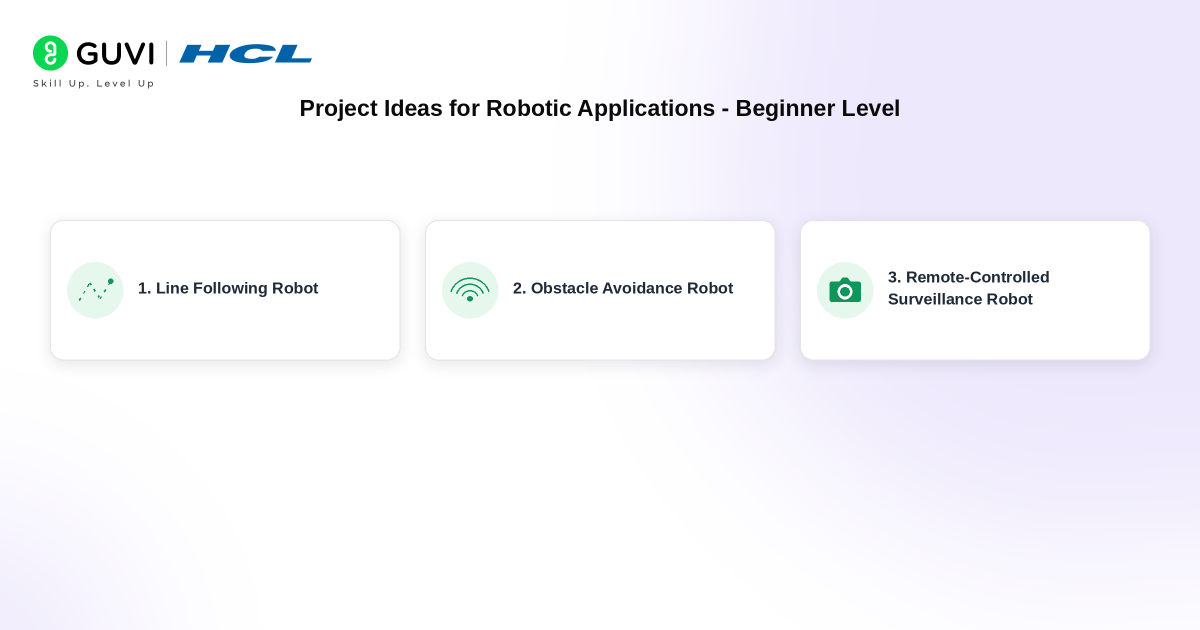
Let’s start off this list of project ideas for robotic applications at the beginner level. We have a list of 3 project ideas for robotic applications that we deemed to be suitable for you if you want to start light.
Make sure you understand machine learning fundamentals like Python, SQL, deep learning, data cleaning, and cloud services before we explore them in the next section. You should consider joining HCL GUVI’s Machine Learning Course, which covers tools like Pyspark API, Natural Language Processing, and many more and helps you get hands-on experience by building real-time projects.
Following is the list of projects:
1. Line Following Robot

Basic Idea of the Project:
The project “Line Following Robot” is your introduction to the world of robotics. This project involves building a robot that can follow a pre-defined path, marked by a line on the floor. The robot uses sensors to detect the line and a set of instructions programmed by you to follow it.
Things to Know Beforehand:
Before you set your mind to this, it’s essential to familiarize yourself with basic electronic components like motors, sensors, and microcontrollers (like Arduino). A bit of programming knowledge, especially in C++ or Python, will come in handy when you start working on this.
Skills you gain from this Project:
This project, in the list of beginner project ideas for robotic applications, is fantastic for understanding sensor integration and the basics of programming. As you work on it, you’ll gain knowledge about:
- Calibrating the Sensors: Fine-tuning sensors to accurately detect the line.
- Motor control: Understanding how to maneuver the robot along the path.
- Basic programming logic: Writing the code that dictates the robot’s behavior.
To put it in simple terms, this project is teaching your robot to follow a certain line or a path.
GitHub Link- Line-Following Robot
Read: Artificial Intelligence vs Human Intelligence: A Definitive Comparison
2. Obstacle Avoidance Robot

Basic Idea of the Project:
In this project, you’ll create a robot that can autonomously detect and navigate around obstacles. Using sensors like ultrasonic or infrared, your robot will perceive objects in its path and decide how to avoid them.
Things to Know Beforehand:
You’ll need a grounding knowledge of sensors and a slightly advanced understanding of programming languages compared to the Line Following Robot. Knowledge of how different sensors work and basic algorithm development is the key to this project.
Skills you gain from this Project:
This project elevates your skills to a new level. You’ll understand all about:
- Autonomous navigation: Learning how to make your robot make decisions on its own.
- Sensor data processing: Interpreting signals from sensors to understand the robot’s surroundings.
- More complex programming: Developing algorithms that guide the robot around obstacles.
This is a highly recommended project among all the other beginner project ideas for robotic applications as it equips you with the knowledge that will take you to the next level!
GitHub Link- Obstacle-Avoidance Robot
3. Remote-Controlled Surveillance Robot

Basic Idea of the Project:
This project involves building a robot that can be controlled remotely, possibly equipped with a camera for surveillance purposes. It’s one of the exciting ideas in the project ideas for robotic applications as it lets you venture into the world of wireless communication and real-time control.
Things to Know Beforehand:
Before starting, you should understand basic remote communication technologies (like Bluetooth or Wi-Fi) and have some experience with video transmission if you opt to include a camera. A basic grasp of electronics to assemble the robot and the camera system is also necessary.
Skills you gain from this Project:
Working on this project hones you with several key skills:
- Remote operation: You’ll learn how to control a robot from a distance, which is a fundamental aspect of many modern project ideas for robotics applications.
- Video transmission: If you choose to include a camera, you’ll gain insights into real-time video streaming.
- Integration of multiple systems: Combining motors, wireless communication, and possibly video in one project teaches you about system integration and everything related to it.
This project is something similar to building your own mini Mars Rover, controlled from your command station (aka your computer or smartphone), making it an interesting pick from the project ideas for robotic applications.
GitHub Link- Remote-Controlled Surveillance Robot
Explore: AI vs ML vs Data Science: What Should You Learn In 2026?
Project Ideas for Robotic Applications – Intermediate Level
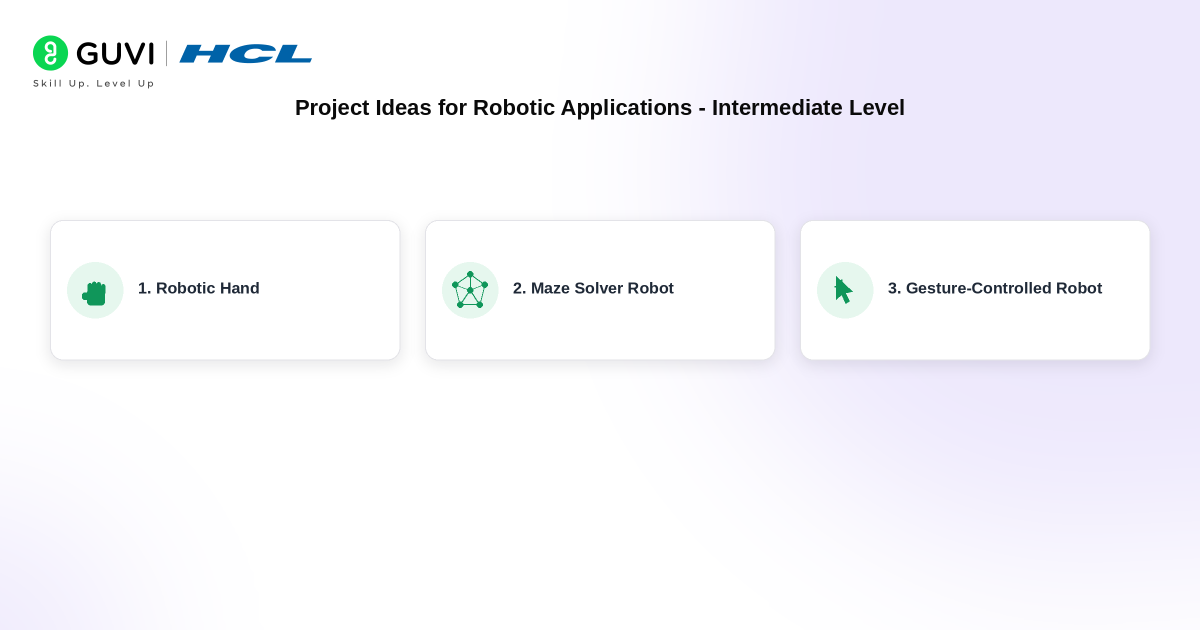
Stepping up from the beginner project ideas for robotic applications, we are now moving on to intermediate-level project ideas for robotic applications that offer you a fantastic opportunity to expand your skill set and challenge your understanding.
These projects are designed to push your boundaries and encourage you to explore more complex aspects of robotics. Let’s understand each of these project ideas for robotic applications with a bit more detail.
1. Robotic Hand

Basic Idea of the Project:
First on the list of intermediate project ideas for robotic applications is the Robotic Hand project. You’re tasked with creating a robotic arm that mimics the movement of a human hand. This involves understanding the mechanics of fingers and translating that into a series of controlled movements using motors and sensors. This is like creating an arm of the Iron Man suit
Things to Know Beforehand:
Before starting, you should have a good grasp of basic robotics, including motor control and sensor integration. Familiarity with concepts like servos, joints, and flex sensors will be a huge plus. Basic programming skills for controlling the movement of the hand are essential.
Skills you gain from this Project:
This project is a great way to understand complex mechanical design and control systems. You’ll learn about:
- Advanced motor control: Fine-tuning movements to achieve a similar movement of a human hand.
- Sensor integration: Using sensors to guide the movements and provide feedback.
- More intricate programming: Developing algorithms for coordinated motion.
GitHub Link- Robotic Hand
Also, Find Out Top 20 Best Robotic Process Automation Tools in 2026
2. Maze Solver Robot

Basic Idea of the Project:
Your goal is to build a robot that can autonomously navigate through a maze and find its way out. This project combines mechanical design with advanced programming, requiring the robot to make decisions based on the maze’s layout. This is an advanced version of the project “Obstacle Avoidance Robot” in the previous section.
Things to Know Beforehand:
A solid understanding of sensors and basic robotics principles is necessary. You’ll also need to be comfortable with programming, particularly in writing algorithms that can guide the robot through various scenarios. Knowledge of pathfinding algorithms like the A* (A-Star) algorithm can be particularly useful.
Skills you gain from this Project:
Through this project, you’ll enhance your skills in:
- Algorithm development: Designing algorithms for efficient pathfinding and decision-making.
- Sensor application: Using sensors to understand and navigate the robot’s environment.
- Complex problem-solving: Integrating various aspects of robotics to solve the maze challenge.
GitHub Link- Maze-Solving Robot
3. Gesture-Controlled Robot

Basic Idea of the Project:
This project involves creating a robot that responds to human gestures. Using sensors like accelerometers or gyroscopes, you’ll program the robot to interpret hand movements and translate them into actions.
Things to Know Beforehand:
You’ll need a basic understanding of sensors like accelerometers and gyroscopes, as well as experience in processing sensor data. Programming skills are crucial, especially in handling real-time data and controlling the robot’s movements based on that data.
Skills you gain from this Project:
Working on a gesture-controlled robot will boost your skills in:
- Human-robot interaction: Understanding how to make robots intuitively interact with humans.
- Real-time data processing: Managing and interpreting live data streams from sensors.
- Advanced programming: Writing sophisticated code that can quickly and accurately respond to human gestures.
You’re essentially building a bridge between human intention and robotic action, which is a significant step in robotics and making this a desirable project among the project ideas for robotic applications.
GitHub Link- Gesture-Controlled Robot
Know More: Best Product-Based Companies for AI Engineers in 2026
Project Ideas for Robotic Applications – Advanced Level
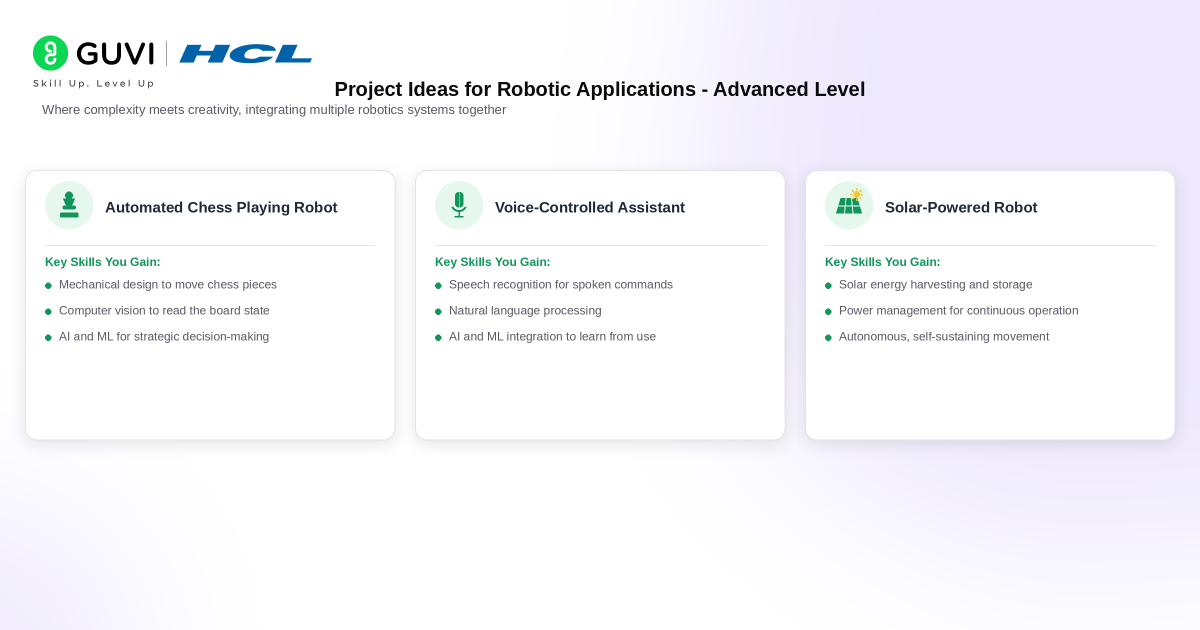
Enough with the simple projects, now we are moving into advanced project ideas for robotic applications where complexity meets creativity, and your skills are put to the ultimate test.
These advanced project ideas for robotic applications are designed to stretch your abilities and encourage you to integrate various aspects of robotics into sophisticated systems.
Let’s delve into each one of the project ideas for robotic applications in-depth.
1. Automated Chess Playing Robot

Basic Idea of the Project:
The title itself is self-explanatory but let us just explain it. In this project, you’re going to create a robot that can play chess against a human opponent. This involves mechanical design to move the chess pieces, vision systems to recognize the state of the board, and AI and ML algorithms to make strategic decisions.
This is deemed to be one of the fun and entertaining project ideas for robotic applications.
Things to Know Beforehand:
You’ll need a solid understanding of mechanical engineering principles to create the arm that moves the chess pieces. Familiarity with computer vision to recognize the chessboard layout and knowledge of AI and ML algorithms for decision-making in chess is crucial. Proficiency in programming is a given, as you’ll be integrating multiple complex systems.
Skills you gain from this Project:
This project is a phenomenal way to hone a diverse set of skills:
- Mechanical design and control: Designing a system capable of precise movements to move chess pieces.
- Computer vision: Implementing technology to accurately interpret the chessboard’s state.
- Artificial Intelligence and Machine Learning: Developing strategies for playing chess, which involves complex decision-making algorithms.
GitHub Link- Automated Chess-Playing Robot
2. Voice-Controlled Assistant

Basic Idea of the Project:
In this project, you’ll create a robot that can understand and respond to voice commands. This involves integrating speech recognition algorithms, processing natural language, and executing commands in a way that mimics human assistants like Siri or Alexa.
Things to Know Beforehand:
Prior experience with speech recognition technologies and Natural Language Processing (NLP) is essential. You should be comfortable with programming in environments that support AI and machine learning.
Knowledge of server-side processing for more complex tasks might also be required, depending on how sophisticated you want your assistant to be, so make sure to understand that before taking this from the list of project ideas for robotic applications.
Skills you gain from this Project:
This project will greatly advance your skills in:
- Speech recognition: Developing a system that can accurately convert spoken words into digital data.
- Natural language processing: Understanding and processing human language to generate appropriate responses.
- AI and machine learning integration: Using advanced algorithms to improve the assistant’s ability to understand and learn from interactions.
GitHub Link- Voice-Controlled Assistant
3. Solar-Powered Robot

Basic Idea of the Project:
Your task is to create a robot that operates on solar power. This project requires a deep understanding of solar energy, power management, and efficient design to make the most of the energy collected by solar panels. This proves to be a challenging project in this list of project ideas for robotic applications as it involves various diverse fields of study.

Things to Know Beforehand:
A strong background in electronics and power systems is necessary. You should understand how solar panels work and how to store and manage the energy they produce. Efficiency in design is key, as solar energy can be limited, especially in smaller, mobile robots.
Skills you gain from this Project:
By building a solar-powered robot, you’ll develop skills in:
- Renewable energy systems: Understanding and implementing solar technology in robotics.
- Power management: Learning how to efficiently use and store solar energy.
- Sustainable design: Creating a robot that operates with minimal environmental impact.
That is it for the project ideas for robotic application, we covered all the major project ideas that we can think of and hope it helps you on a great scale.
GitHub Link- Solar-Powered Robot
Kickstart your Machine Learning journey by enrolling in HCL GUVI’s Machine Learning Course where you will master technologies like matplotlib, pandas, SQL, NLP, and deep learning, and build interesting real-life UI/UX projects.
Robotics Projects: Hardware, Software, and Cost Comparison
| Project | Difficulty | Hardware Required | Software | Estimated Cost |
|---|---|---|---|---|
| Line-Following Robot | Beginner | Arduino Uno, IR sensors, motor driver, motors, chassis | Arduino IDE, C++ | $25–$45 |
| Obstacle-Avoidance Robot | Beginner | Arduino Uno, ultrasonic sensor, servo, motors, chassis | Arduino IDE, C++ | $30–$50 |
| Remote-Controlled Surveillance Robot | Beginner–Intermediate | Raspberry Pi, camera, motor driver, chassis | Python, Flask, OpenCV | $70–$140 |
| Robotic Hand | Intermediate | Arduino, servo motors, flex sensors, 3D-printed hand | Arduino IDE, C++ | $60–$150 |
| Maze-Solving Robot | Intermediate | Arduino Nano, IR sensors, motors, encoders | Arduino IDE, C++ | $35–$70 |
| Gesture-Controlled Robot | Intermediate | Two Arduino boards, motion sensor, wireless modules, chassis | Arduino IDE, C++ | $45–$90 |
| Automated Chess Robot | Advanced | Raspberry Pi, camera, robotic arm or XY mechanism | Python, OpenCV, Stockfish | $150–$400 |
| Voice-Controlled Assistant Robot | Advanced | Raspberry Pi, microphone, speaker, motors | Python, speech recognition, NLP tools | $80–$180 |
| Solar-Powered Robot | Advanced | Arduino, solar panel, battery, charge controller, chassis | Arduino IDE, C++ | $60–$140 |
| AI Object-Sorting Robot | Advanced | Raspberry Pi or Jetson, camera, robotic arm | Python, OpenCV, PyTorch | $120–$300 |
| ROS 2 SLAM Rover | Advanced | Raspberry Pi, LiDAR, camera, motors, encoders | ROS 2, Python, C++, Gazebo | $180–$450 |
| AI Pick-and-Place Robot | Advanced | Robot arm, cameras, gripper, edge AI board | LeRobot, PyTorch, Python | $200–$600 |
Robotics Projects Using Raspberry Pi vs. Arduino
Robotics Projects Using Arduino
1. Bluetooth-Controlled Robot Car
Build a robot car that receives movement commands from a smartphone through Bluetooth. This project teaches wireless communication and basic motor control.
2. Fire-Fighting Robot
Create a robot that detects smoke or flames and activates a water pump. Students can also add an alarm for faster emergency response.
3. Self-Balancing Robot
Develop a two-wheel robot that uses an inertial sensor and control algorithm to maintain balance. This project introduces feedback control and sensor calibration.
4. Smart Parking Barrier
Build a miniature parking system that detects available spaces and controls an entry barrier. An LCD can display the number of open slots.
Robotics Projects Using Raspberry Pi
1. Rubik’s Cube Solver Robot
Create a robot that scans a Rubik’s Cube and calculates the required moves. Motors then rotate the cube until it is solved.
2. Autonomous Delivery Robot
Build a robot that transports small packages inside a campus, office, or hospital. The system can use ROS for navigation and delivery coordination.
3. Emotion-Aware Companion Robot
Develop a robot that recognizes facial expressions and responds through speech, movement, or lights. The project combines computer vision with human-robot interaction.
4. Quadruped Robot Dog
Create a four-legged robot capable of walking and performing programmed movements. Advanced versions can include vision or autonomous navigation.
Should You Choose Arduino or Raspberry Pi?
Choose Arduino for direct sensor readings and predictable motor control. It is affordable and suitable for beginners working with electronics.
Choose Raspberry Pi for image processing, AI, web control, or advanced networking. Some projects use both platforms, with Raspberry Pi handling intelligence and Arduino controlling motors.
AI-Powered Robotics Project Ideas for College: 2026 Trend
AI robotics moved toward multimodal perception, edge intelligence, and robot-learning systems during 2025. Vision-language-action models became a major area of development because they connect visual understanding and language instructions with physical actions.
1. AI Waste-Sorting Robot
Build a robot that identifies paper, plastic, or metal through a camera. A servo-controlled mechanism then places the object inside the correct container.
Measure classification accuracy and sorting time. These metrics make the project more valuable during evaluation.
Suggested software: Python, OpenCV, YOLO, TensorFlow Lite
GitHub resource
2. Imitation-Learning Pick-and-Place Robot
Record examples of a person controlling a robotic arm. Train a policy that learns to repeat the demonstrated pick-and-place task.
Hugging Face’s LeRobot provides models, datasets, and tools for real-world robot learning. It includes resources for imitation learning and policy evaluation.
Suggested software: Python, PyTorch, LeRobot
GitHub resource
3. Vision-Language Controlled Robot
Allow users to provide instructions such as “move toward the red box.” The system should identify the object and translate the instruction into a movement plan.
Begin with a small set of supported commands. Add safety checks before allowing autonomous movement.
Suggested software: Python, OpenCV, a vision-language model
GitHub resource
4. AI-Powered Agricultural Rover
Create a rover that captures plant images and identifies visible crop stress. It can also record temperature or soil-moisture readings.
The final dashboard should display the detected condition and field location. This gives the project a clear agricultural use case.
Suggested software: Python, OpenCV, TensorFlow Lite
GitHub resource
5. Conversational Service Robot
Build a robot that accepts spoken requests and converts them into actions. It may guide visitors, provide campus information, or deliver small objects.
A stronger version can process speech locally to reduce dependence on internet access.
Suggested software: ROS 2, Python, speech-to-text, text-to-speech
GitHub resource
6. AI Chess Robot With Human Interaction
Develop a chess robot that recognizes pieces and physically executes moves. Voice responses or robotic gestures can make the interaction more engaging.
The OpenChessRobot project demonstrates computer vision, physical movement, and human-robot interaction in one reproducible system.
7. Edge-AI Safety Monitoring Robot
Build a mobile robot that detects smoke, blocked exits, or people entering restricted areas. Processing data on the device can reduce response time and network dependence.
Edge AI became increasingly relevant to physical robotics in 2025. NVIDIA introduced Jetson Thor as a platform for multimodal and multisensor robotic processing.
Suggested software: Python, OpenCV, TensorRT, ROS 2
GitHub resource
Robotics Projects for Beginners With Zero Hardware Experience
Beginners do not need to purchase components immediately. Simulation tools allow them to practise programming, sensors, and robot movement before building a physical prototype.
1. Virtual Line-Following Robot
Create a simulated robot with downward-facing sensors. Program it to remain on a black track and recover after sharp turns.
This project teaches control logic without requiring motors or physical sensors.
Recommended platform: Webots
GitHub resource
2. Arduino Obstacle Sensor Simulation
Use a virtual ultrasonic sensor to detect objects. Program simulated motors or LEDs to respond when the distance falls below a threshold.
Recommended platform: Wokwi
GitHub resource
3. Maze Solver in Python
Represent a maze as a grid and program a virtual robot to find the exit. Start with breadth-first search before trying A*.
Recommended software: Python, Pygame
GitHub resource
4. ROS 2 TurtleBot Navigation
Use Gazebo to control a TurtleBot inside a simulated room. Add obstacles and test autonomous navigation.
ROS 2 provides step-by-step tutorials that build foundational robotics skills.
Recommended software: ROS 2, Gazebo, RViz
GitHub resource
5. Virtual Robotic Arm
Create a simulated robotic arm and move its joints through Python. Add a target object after learning basic joint control.
Recommended software: PyBullet
GitHub resource
6. Sensor Dashboard Without Hardware
Generate sample temperature, distance, or motion readings in Python. Display the values through a real-time dashboard.
This project helps students understand sensor pipelines before working with electronic components.
Recommended software: Python, Streamlit
GitHub resource
Robotics Project Ideas That Get Shortlisted for Hackathons
Hackathon judges generally respond better to projects that solve a defined problem and present a reliable working prototype. A clear metric is more convincing than a long feature list.
1. Disaster-Response Mapping Rover
Build a rover that enters areas considered unsafe for people. It can stream video and create a basic map of detected obstacles.
A strong demo should show coverage area and obstacle-detection accuracy.
2. Smart Waste-Segregation Robot
Create a system that recognizes waste categories and sorts objects automatically.
Show the number of correctly classified items. Include the estimated cost per unit.
3. Assistive Indoor Delivery Robot
Design a robot that carries medicine or small supplies inside a hospital or campus building.
Add obstacle detection and an emergency stop. These features demonstrate practical safety planning.
4. Agricultural Monitoring Rover
Build a rover that records plant images and soil conditions. The system can flag areas requiring inspection.
A location-based dashboard can make the presentation more useful for judges.
5. Sign-Language Robotic Hand
Develop a robotic hand that reproduces selected sign-language gestures. The project can support communication or classroom demonstrations.
A 2025 open-source robotic hand study demonstrated how low-cost hardware can reproduce sign-language hand shapes.
6. Campus Safety Patrol Robot
Create a mobile robot that detects blocked corridors or smoke. It can send alerts with images and location information.
Avoid facial identification unless the project has clear consent and privacy controls.
7. Flood and Drain Inspection Robot
Develop a small rover that monitors water level or detects possible blockages. The system can send alerts before the level crosses a selected threshold.
A waterproof enclosure and safe low-voltage design can improve the prototype.
What Makes a Robotics Project Hackathon-Ready?
A strong project should clearly explain the user problem and show a working solution. The demonstration must prove that the robot performs its core task consistently.
Include measurable results such as response time or detection accuracy. Present the hardware cost and state what can be improved after the hackathon.
Conclusion
In conclusion, exploring the world of robotics through hands-on project ideas for robotic applications is an immensely rewarding journey, one that not only enhances your technical skills but also fuels your creativity and problem-solving abilities.
Whether you’re a beginner taking your first steps, an intermediate learner understanding the complexities, or an advanced enthusiast who’s ready to combine multiple fields of studies, each project in this list of project ideas for robotic applications offers a unique opportunity to explore the fascinating world of robotics.
These projects are not just about building machines; they’re about shaping the future, one robot at a time.
Also Read: 20 Best Robotic Process Automation Use Cases in 2026
FAQs
1. What programming languages are used in robotics?
Common languages include Python, C++, and JavaScript. Python is particularly popular due to its simplicity and extensive libraries.
2. Can AI be integrated into robotics projects?
A: Yes, AI can be integrated for tasks like object recognition, decision-making, and autonomous navigation.
3. What are some project ideas for integrating AI and robotics?
A: Projects like a robotic hand that learns from human movements, a self-learning maze-solving robot, or a facial recognition security robot are good examples.
4. What are some challenges in combining AI with robotics?
A: Key challenges include ensuring real-time processing, data accuracy, and creating adaptable learning algorithms.
5. What future trends are emerging in robotics and AI?
Future trends include increased integration of AI in everyday robots, advancements in autonomous vehicles, and the development of more sophisticated personal assistant robots.
Success Stories

About the Author
Vaishali
I'm a seasoned writer with four years of experience across technical, non-technical, and just about every genre or niche you can imagine. Adaptable and curious, I enjoy exploring new topics and making information engaging and easy to understand. Fueled by a steady stream of tea, I approach each project with creativity, reliability, and genuine enthusiasm for storytelling.
View all posts by Vaishali
Connect with me @

Did you enjoy this article?
Comments













t is very interesting and useful for the students for their bright future