


AWS Kubernetes Articles
Istio Service Mesh Tutorial for Beginners
Crossplane Tutorial: A Practical Guide for Learners


Get In Touch For Details! Request More Information
Top AWS Services You Should Know in 2026
Sep 26, 2026 10 Min Read 29601 Views
(Last Updated)
If you have ever opened the AWS console and felt a little lost, you are not alone. AWS Services span everything from storage and computing to machine learning and security, and the sheer number of options can be overwhelming even for people who have been using the cloud for years.
The truth is, you do not need to master all of them. Most teams rely on a handful of core services that cover most of their needs, and knowing which ones matter can save you weeks of trial and error. That said, it helps to know where to start. In this post, we’ll walk through the best AWS services worth knowing.
Table of contents
- TL;DR Summary
- What is AWS Service?
- Why Use AWS Services?
- Top 30 AWS Services List
- Amazon EC2 (Elastic Compute Cloud)
- Amazon S3 (Simple Storage Service)
- AWS Lambda
- Amazon RDS (Relational Database Service)
- Amazon DynamoDB
- Amazon ECS (Elastic Container Service)
- AWS Elastic Beanstalk
- Amazon VPC (Virtual Private Cloud)
- Amazon Route 53
- AWS CloudFormation
- AWS CloudWatch
- Amazon SQS (Simple Queue Service)
- AWS Step Functions
- AWS Glue
- Amazon Kinesis
- AWS Direct Connect
- AWS Identity and Access Management (IAM)
- Amazon EMR (Elastic MapReduce)
- AWS CodePipeline
- Amazon Polly
- AWS WAF (Web Application Firewall)
- AWS Key Management Service (KMS)
- Amazon Aurora
- AWS DataSync
- Amazon VPC Lattice
- Amazon Elastic File System (EFS)
- AWS CloudTrail
- Amazon Neptune
- AWS Organizations
- AWS Secrets Manager
- Conclusion
- FAQs
- What are the top AWS Services to learn in 2026?
- How many AWS Services are there?
- Which AWS service is best for beginners?
- Are AWS Services free to use?
- Why are AWS Services important for businesses?
TL;DR Summary
- This blog covers 30 of the most widely used AWS Services, ranging from compute and storage to databases, networking, and security.
- It helps beginners understand what an AWS Service actually is and why AWS remains the most comprehensive cloud platform available today.
- Readers get a breakdown of why teams choose AWS Services, from scalability and cost-effectiveness to global reach and reliability.
- You’ll find the objective and key features behind every service, so it’s clear what each one is actually good for.
- It also explores how AWS Services fit together across a real project, from provisioning infrastructure to securing and monitoring it.
What is AWS Service?
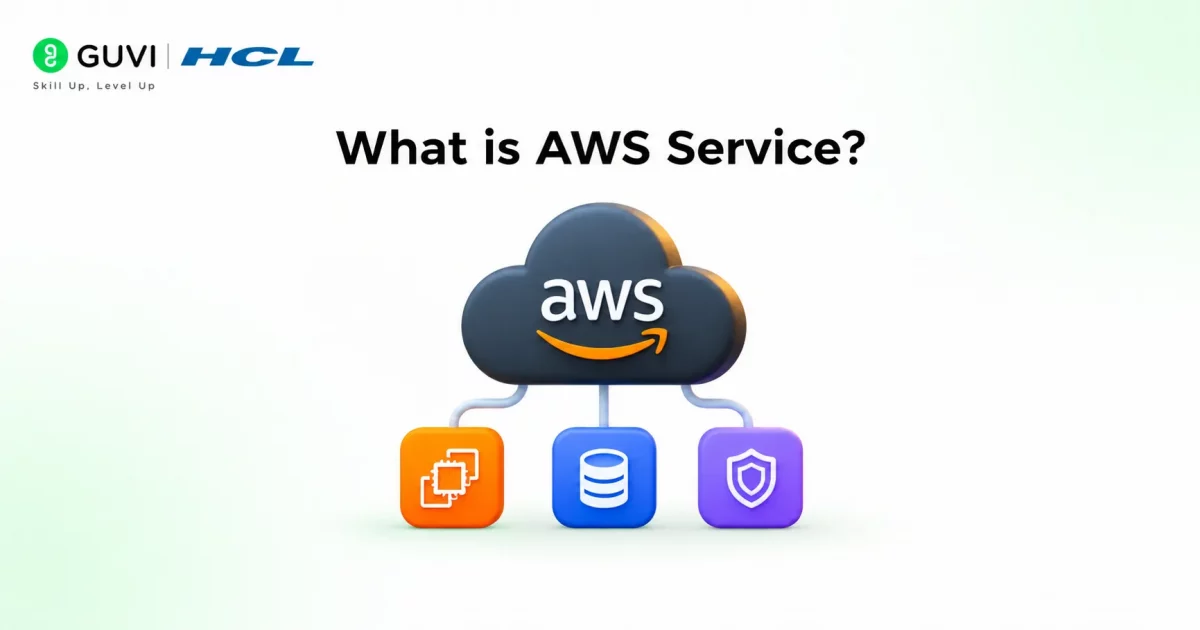
An AWS Service is a cloud-based service provided by Amazon Web Services (AWS) that helps you perform different tasks over the internet. Instead of buying and managing your own servers, storage, databases, or other hardware, you can use these services as needed.
AWS provides many different services for different purposes. For example, you can use Amazon EC2 to run applications, Amazon S3 to store files and data, and Amazon RDS to manage databases. These services make it easier to build, run, and manage applications without maintaining physical infrastructure yourself.
Also Read: AWS vs Azure vs Google Cloud: Comparing the Top Cloud Service Providers
Ready to go from reading about AWS Services to actually using them? HCL GUVI’s AWS Fundamentals Course walks you through EC2, S3, IAM, and more with hands-on modules and a certification at the end. Enroll today and turn what you just learned into a real skill!
Why Use AWS Services?
- Scalability: Easily scale resources up or down as demand changes.
- Cost–Effective: Pay only for the services and resources you use.
- Global Reach: Access to a vast network of data centers worldwide.
- Flexibility: Wide range of services for diverse business needs.
- Security: Robust security features and compliance measures.
- Reliability: High availability and redundancy for mission-critical applications.
- Performance: High-performance computing and storage capabilities.
- Community and Support: Extensive community and professional support resources.
Also Read: Is AWS Certification Worth It?
Want to actually build with AWS Services instead of just reading about them? HCL GUVI’s AWS Infrastructure for Beginners Course dives into IAM, S3, VPC, EC2, and databases through hands-on modules, ending with a certificate you can add to your profile. Enroll now and start building!
Top 30 AWS Services List
Let’s look at the top 30 AWS Services that meet developers’ needs and requirements.
Also Read: Does AWS Require Coding?
1. Amazon EC2 (Elastic Compute Cloud)
Amazon EC2 (Elastic Compute Cloud) is a web service provided by Amazon Web Services (AWS) that allows users to rent virtual servers in the cloud. EC2 lets developers easily scale compute capacity up or down based on application requirements.
Features of Amazon EC2:
- Virtual Servers: Provision resizable compute capacity in the cloud.
- Scalability: Easily scale instances up or down based on demand.
- Variety of Instance Types: Choose from a diverse set of instance types optimized for different workloads.
- Customizable: Configure instances with various operating systems, instance types, and storage options.
- Security Groups and VPC: Control access to instances using security groups within Virtual Private Clouds (VPCs).
2. Amazon S3 (Simple Storage Service)
Amazon S3 (Simple Storage Service) is a widely used object storage service provided by Amazon Web Services (AWS). It allows users to store and retrieve any amount of data at any time over the internet.
S3 provides a highly scalable, durable, and secure storage solution, making it suitable for a diverse range of applications.
Features of Amazon S3:
- Scalability: Easily scale storage capacity as needed.
- Security: Provides robust access controls and encryption options.
- Versioning: Keep multiple versions of an object to protect data.
- Lifecycle Policies: Automate object transitions and expiration.
- Event Notifications: Trigger events based on changes to objects in S3.
3. AWS Lambda
AWS Lambda is a serverless computing service provided by Amazon Web Services (AWS) that enables developers to run code without provisioning or managing servers.
With Lambda, users can upload their code, and define the triggering events, and Lambda automatically takes care of the infrastructure needed to execute the code.
Features of AWS Lambda:
- Serverless Computing: Execute code without managing servers.
- Event-Driven: Trigger functions in response to events from various AWS services or custom sources.
- Pay-as-You-Go Pricing: Pay only for the compute time consumed during code execution.
- Multi-Language Support: Supports multiple programming languages including Node.js, Python, Java, and more.
- Integrated Logging and Monitoring: Easily monitor and troubleshoot functions with integrated AWS CloudWatch.
4. Amazon RDS (Relational Database Service)
Amazon RDS (Relational Database Service) is a managed relational database service offered by Amazon Web Services (AWS).
It simplifies setting up, operating, and scaling a relational database, allowing users to focus on their applications rather than the underlying infrastructure.
Features of Amazon RDS:
- Managed Service: AWS handles database maintenance tasks, including backups, patch management, and automatic software updates.
- Multiple Database Engines: Supports various relational database engines to accommodate different application requirements.
- Automated Backups and Snapshots: Provides automated backup and restore capabilities for data protection.
- Security: Implements robust security features, including encryption at rest and in transit, and integrates with AWS Identity and Access Management (IAM).
5. Amazon DynamoDB
Amazon DynamoDB is a fully managed NoSQL database service provided by Amazon Web Services (AWS), offering seamless scalability, low-latency performance, and high availability.
Designed for both document and key-value data models, DynamoDB is a serverless solution that eliminates the need for users to manage the underlying infrastructure.
Features of Amazon DynamoDB:
- Serverless NoSQL Database: Fully managed, eliminating the need for users to manage infrastructure.
- Automatic Scaling: Dynamically scales to handle varying throughput and storage requirements.
- Flexible Data Models: Supports both document and key-value data models for versatile applications.
- Global Tables: Replicates data globally for high availability and low-latency access across regions.
- On-Demand and Provisioned Capacity: Offers pay-per-request or provisioned capacity options for cost efficiency.
6. Amazon ECS (Elastic Container Service)
Amazon ECS (Elastic Container Service) is a fully managed container orchestration service by Amazon Web Services (AWS) that simplifies the deployment and management of containerized applications. It lets users run Docker containers on a scalable, highly available cluster of virtual or physical machines.
Features of Amazon ECS:
- Fully Managed Container Orchestration: AWS manages the underlying infrastructure, allowing for seamless container deployment.
- Docker Compatibility: Supports Docker containers for easy migration and deployment.
- Task and Service Definitions: Define parameters for running containers and manage long-running services.
- Auto Scaling: Adjusts the number of running tasks based on application demand.
- Integration with AWS Services: Easily integrates with other AWS services like VPC, IAM, and CloudWatch.
7. AWS Elastic Beanstalk
AWS Elastic Beanstalk is a fully managed platform-as-a-service (PaaS) offering from Amazon Web Services (AWS) that simplifies application deployment, scaling, and management. It supports various programming languages and frameworks, letting developers focus on code while AWS manages the underlying infrastructure.
Features of AWS Elastic Beanstalk:
- Fully Managed PaaS: AWS manages the infrastructure, so developers can focus on coding.
- Multi-Language Support: Supports multiple programming languages and frameworks.
- Auto-Scaling: Dynamically scales resources based on application demand.
- Deployment Options: Supports rolling, blue-green, and canary deployments for seamless updates.
- Monitoring and Logging: Integrated tools to monitor application health and manage logs.
8. Amazon VPC (Virtual Private Cloud)
Amazon VPC (Virtual Private Cloud) is a service provided by Amazon Web Services (AWS) that lets users create and manage isolated virtual networks within the AWS cloud. VPC provides a secure, customizable environment where users can launch AWS resources such as Amazon EC2 instances and RDS databases.
Features of Amazon VPC:
- Isolated Virtual Network: Users can create their own isolated network environment in the AWS cloud.
- Customizable IP Address Range: Define IP address ranges for VPC and subnets.
- Subnet Configuration: Create subnets within the VPC to segment resources.
- Routing Tables: Configure custom routing tables to control traffic between subnets.
- Network Access Control Lists (ACLs): Define rules to control inbound and outbound traffic at the subnet level.
9. Amazon Route 53
Amazon Route 53 is a scalable and highly available Domain Name System (DNS) web service provided by Amazon Web Services (AWS). It routes end-user requests to globally distributed AWS resources, such as EC2 instances, S3 buckets, and load balancers, providing reliable, low-latency access.
Features of Amazon Route 53:
- Domain Registration: Register and manage domain names through the service.
- Scalable and Reliable DNS: Provides scalable and reliable DNS service with low-latency resolution.
- DNS Routing Policies: Supports various routing policies, including simple, weighted, and latency-based routing.
10. AWS CloudFormation
AWS CloudFormation is a service provided by Amazon Web Services (AWS) that allows users to define and provision infrastructure as code. It enables automated creation and management of AWS resources, supporting application deployment and scaling.
Features of AWS CloudFormation:
- Infrastructure as Code (IaC): Define and provision AWS infrastructure using code.
- Templates: Use JSON or YAML templates to describe the architecture and resources.
- Stacks: Organize resources into stacks to manage them as a single unit.
- Declarative Syntax: Specify the desired state of the infrastructure, and CloudFormation handles the execution.
- Resource Provisioning: Automatically creates, updates, and deletes AWS resources based on the defined templates.
11. AWS CloudWatch
Amazon CloudWatch is a monitoring and observability service provided by Amazon Web Services (AWS) that allows users to collect and track metrics, collect and monitor log files, and set alarms. It provides insights into the performance, health, and operational status of AWS resources and applications.
Features of Amazon CloudWatch:
- Metrics and Dashboards: Collect and visualize metrics from various AWS resources through customizable dashboards.
- Alarms: Set alarms to monitor metric values and take automated actions when thresholds are breached.
- Logs: Collect, monitor, and analyze log data from applications, services, and resources.
- Events: Respond to changes in AWS resources by triggering automated actions using CloudWatch Events.
- Synthetic Monitoring: Create and run synthetic tests to monitor application endpoints and workflows.
12. Amazon SQS (Simple Queue Service)
Amazon Simple Queue Service (SQS) is a fully managed message queuing service offered by Amazon Web Services (AWS). SQS decouples components of a cloud application by allowing them to communicate asynchronously.
Features of Amazon SQS:
- Fully Managed: AWS handles message-queue operations, including server maintenance.
- Scalable: SQS automatically scales to handle varying message volumes and sizes.
- Message Retention: Messages can be retained in queues for configurable durations.
- At-Least-Once Delivery: SQS ensures that messages are delivered at least once, and in some cases, more than once.
- Distributed Queues: Supports distributed architectures with queues distributed across different AWS regions.
13. AWS Step Functions
AWS Step Functions is a fully managed service provided by Amazon Web Services (AWS) that enables you to create and orchestrate workflows that coordinate multiple AWS services and microservices in a serverless architecture.
It lets users design and run state machines that define a series of steps or stages that execute in sequence or in parallel.
Features of AWS Step Functions:
- State Machines: Define workflows using state machines, specifying sequential or parallel execution of steps.
- Visual Workflow Editor: Utilize a visual editor to design and visualize workflows easily.
- Built-in Error Handling: Automatically handle errors, retries, and timeouts within workflows.
- Integration with AWS Services: Seamlessly integrates with various AWS services, including Lambda, S3, DynamoDB, and more.
14. AWS Glue
AWS Glue is a fully managed extract, transform, and load (ETL) service provided by Amazon Web Services (AWS). It simplifies the process of preparing and loading data for analysis by allowing users to discover, catalog, transform, and move data among data stores.
Features of AWS Glue:
- Data Catalog: Provides a centralized metadata repository for discovering and managing data assets.
- ETL Jobs: Automates data extraction, transformation, and loading across various sources.
- Data Crawlers: Automatically discover and catalog metadata from diverse data sources.
- Serverless Execution: Automatically provisions and scales the required resources for ETL jobs.
15. Amazon Kinesis
Amazon Kinesis is a suite of fully managed services by Amazon Web Services (AWS) that enables real-time processing of streaming data at scale. Kinesis provides solutions for ingesting, processing, and analyzing streaming data, allowing users to derive insights and take actions in near real-time.
Features of Amazon Kinesis:
- Kinesis Data Streams: Enables real-time ingestion of streaming data at scale by breaking it into shards for parallel processing.
- Kinesis Data Firehose: Simplifies delivering streaming data to destinations such as S3, Redshift, and Elasticsearch, with automatic scaling and buffering.
- Kinesis Data Analytics: Enables real-time analytics on streaming data using SQL queries without managing infrastructure.
- Kinesis Video Streams: Ingests, processes, and analyzes video streams for applications like video analytics and machine learning.

16. AWS Direct Connect
Amazon Direct Connect is a network service provided by Amazon Web Services (AWS) that enables dedicated network connections between an on-premises data center and AWS.
Direct Connect establishes private, dedicated network connections that offer higher bandwidth, lower latency, and greater reliability than standard internet connections.
Features of AWS Direct Connect:
- Dedicated Network Connection: Establish private, dedicated, and high-bandwidth connections between on-premises data centers and AWS.
- Consistent Network Performance: Provides more predictable network performance compared to internet-based connections.
- Reduced Latency: Low-latency connectivity for mission-critical applications and workloads.
- Increased Security: Offers a more secure connection by bypassing the public internet, reducing exposure to potential security risks.
17. AWS Identity and Access Management (IAM)
AWS Identity and Access Management (IAM) is a web service provided by Amazon Web Services (AWS) that helps control access to AWS resources securely. IAM enables users to manage users and their level of access to the AWS environment, allowing organizations to establish and enforce security policies.
Features of AWS IAM:
- User Management: Create and manage IAM users within an AWS account.
- Groups: Organize IAM users into groups to apply policies collectively.
- Roles: Define roles with specific permissions and assign them to AWS resources or users.
- Policies: Attach policies to users, groups, or roles to grant or deny permissions.
- Access Control: Control access to AWS resources based on roles, groups, and policies.
18. Amazon EMR (Elastic MapReduce)
Amazon EMR (Elastic MapReduce) is a cloud-based big data processing service provided by Amazon Web Services (AWS). EMR simplifies the processing of large datasets using popular frameworks like Apache Spark, Apache Hadoop, Apache Hive, Apache HBase, and more.
Features of Amazon EMR:
- Managed Clusters: Easily launch, manage, and scale compute clusters with pre-configured software.
- Compatibility: Supports popular big data frameworks, including Apache Hadoop, Apache Spark, Apache Hive, Apache HBase, and more.
- Integration with AWS Services: Seamlessly integrates with other AWS services like S3, DynamoDB, and IAM.
- Automatic Scaling: Dynamically adjusts the size of clusters based on workloads to optimize performance and costs.
19. AWS CodePipeline
AWS CodePipeline is a fully managed continuous integration and continuous delivery (CI/CD) service provided by Amazon Web Services (AWS).
It automates the build, test, and deployment phases of releasing software, allowing organizations to quickly and reliably deliver updates to their applications.
Features of AWS CodePipeline:
- Workflow Automation: Orchestrates and automates the end-to-end release process, from source code to deployment.
- Integration with Various Tools: Easily integrates with other AWS services, including AWS CodeBuild, AWS CodeDeploy, and AWS Lambda, as well as third-party tools.
- Pipeline Visualization: Provides a visual representation of the entire release process, making it easy to understand and troubleshoot.
- Flexible Execution: Supports custom actions, allowing users to incorporate third-party tools and scripts into the pipeline.
20. Amazon Polly
Amazon Polly is a cloud service provided by Amazon Web Services (AWS) that converts text into lifelike speech using advanced deep learning technologies.
Polly offers a variety of voices and supports multiple languages, allowing developers to incorporate natural-sounding speech synthesis into their applications, products, or services.
Features of Amazon Polly:
- Text-to-Speech (TTS): Converts input text into natural-sounding speech in real time.
- Multiple Voices: Offers a diverse set of lifelike voices with different accents and tones.
- Multilingual Support: Supports a wide range of languages for global applications.
- SSML (Speech Synthesis Markup Language): Lets you fine-tune speech output with markup for pauses, emphasis, and more.
- Neural Text-to-Speech (NTTS): Utilizes advanced deep learning techniques for more natural and expressive speech.
21. AWS WAF (Web Application Firewall)
AWS WAF (Web Application Firewall) is a cloud-based firewall service provided by Amazon Web Services (AWS) that helps protect web applications from common web exploits and malicious attacks.
Features of AWS WAF:
- Application Layer Protection: Safeguards web applications at the application layer by inspecting and filtering HTTP traffic.
- Rule-Based Security Policies: Lets you create custom rules and security policies to filter and monitor incoming traffic.
- Managed Rule Sets: Provides pre-configured rule sets to protect against common vulnerabilities, such as SQL injection and cross-site scripting (XSS).
22. AWS Key Management Service (KMS)
AWS Key Management Service (KMS) is a fully managed service provided by Amazon Web Services (AWS) that lets users create and control encryption keys to secure their data.
AWS KMS makes it easy to create and manage keys for AWS services and applications that require secure, compliant encryption.
Features of AWS Key Management Service (KMS):
- Key Creation and Management: Create, rotate, and manage encryption keys securely and compliantly.
- Integration with AWS Services: Seamlessly integrates with other AWS services like S3, EBS, and Redshift for easy data encryption.
- Key Policies: Define key access policies using AWS Identity and Access Management (IAM) to control who can use and manage keys.
- Envelope Encryption: Uses envelope encryption to protect data by encrypting it with a data key, then encrypting the data key with a master key.
23. Amazon Aurora
Amazon Aurora is a fully managed relational database service provided by Amazon Web Services (AWS). It is designed to offer high performance, scalability, and reliability, compatible with popular database engines like MySQL and PostgreSQL.
Features of Amazon Aurora:
- High Performance: Offers high-performance database capabilities with low-latency read and write operations.
- Compatibility: Supports MySQL and PostgreSQL, making it easy to migrate from these database engines to Aurora.
- Automated Backups: Provides automated and continuous backups with point-in-time recovery options.
- Replication: Supports Aurora Replicas for read scalability, offloading read traffic from the primary instance.
24. AWS DataSync
AWS DataSync is a fully managed service by Amazon Web Services (AWS) that facilitates data transfer between on-premises storage, Amazon S3, Amazon EFS (Elastic File System), and Amazon FSx for Windows File Server.
DataSync simplifies and accelerates large-volume data movement, providing secure, efficient, automated transfers.
Features of AWS DataSync:
- Data Migration: Enables fast and secure migration of data between on-premises storage systems and AWS storage services.
- Incremental Transfers: Performs incremental transfers, transferring only the changes made to files since the last transfer to minimize data transfer time.
- Parallel Data Transfer: Utilizes multiple parallel streams to transfer data efficiently, optimizing network and storage resources.
- Bandwidth Control: Lets users control the bandwidth DataSync uses to avoid impacting other network activities.
25. Amazon VPC Lattice
Amazon VPC Lattice is a fully managed AWS service that connects your services across different VPCs and accounts without requiring you to set up load balancers, proxies, or manage IP addresses yourself. It handles the networking, so your team can focus on building the application.
Features of Amazon VPC Lattice:
- Service Directory: A centralized view of every service you own or that’s been shared with you via AWS Resource Access Manager.
- Service Networks: Groups services under one logical boundary, handling discovery and connectivity while applying shared access and observability policies.
- Cross-Account and Cross-VPC Connectivity: Automatically manages networking between VPCs and accounts, including translation between IPv4, IPv6, and overlapping IP ranges.
- IAM-Based Access Control: Uses AWS Identity and Access Management to enforce fine-grained, service-level permissions, supporting zero-trust-style access between services.
- Weighted and Path-Based Routing: Supports traffic routing based on request characteristics, plus weighted routing for blue/green and canary-style deployments.
26. Amazon Elastic File System (EFS)
Amazon Elastic File System (EFS) is a scalable, fully managed file storage service provided by Amazon Web Services (AWS). It provides highly available, durable file storage that can be easily shared across multiple Amazon EC2 instances and services.
Features of Amazon Elastic File System (EFS):
- Fully Managed: EFS is a fully managed service, eliminating the need for users to manage infrastructure or file system administration.
- Scalable Storage: Scales elastically with your applications’ storage needs without manual intervention.
- Highly Available: Offers high availability by distributing data across multiple availability zones within a region.
- Shared File System: Supports concurrent access by multiple EC2 instances and services, enabling shared file storage for applications.
27. AWS CloudTrail
AWS CloudTrail is a service provided by Amazon Web Services (AWS) that enables governance, compliance, operational auditing, and risk auditing of AWS accounts. It records and logs AWS API calls, providing visibility into actions taken within AWS services.
Features of AWS CloudTrail:
- Audit Trails: Creates detailed event logs of AWS API calls, capturing information such as the caller’s identity, the call time, the source IP address, and more.
- Multi-Region Support: Tracks events across multiple AWS regions to provide a comprehensive view of activity.
- Integration with AWS Services: Integrates with various AWS services, including AWS Identity and Access Management (IAM), AWS Key Management Service (KMS), AWS CloudWatch, and AWS S3.
28. Amazon Neptune
Amazon Neptune is a fully managed, highly available, and secure graph database service provided by Amazon Web Services (AWS). It efficiently stores and queries highly connected data, making it suitable for applications that represent and analyse relationships and complex data models.
Features of Amazon Neptune:
- Graph Database: Supports property graph and RDF graph models, providing flexibility for various graph data representations.
- Highly Available and Replicable: Ensures high availability and durability with automatic backups and replication across multiple Availability Zones.
- Fully Managed: Amazon Neptune is a fully managed service that handles routine database tasks such as patching, backups, and monitoring.
29. AWS Organizations
AWS Organizations is a service provided by Amazon Web Services (AWS) that allows customers to consolidate multiple AWS accounts into an organization that you create and centrally manage.
Features of AWS Organizations:
- Consolidated Billing: Aggregates the billing for multiple AWS accounts, providing a single payment method and invoice for the entire organization.
- Account Organization: Allows grouping of AWS accounts into organizational units (OUs) for logical organization and management.
- Service Control Policies (SCPs): Define fine-grained access controls and permissions across accounts by setting broad policies.
30. AWS Secrets Manager
AWS Secrets Manager is a fully managed service provided by Amazon Web Services (AWS) that helps organizations protect sensitive information such as API keys, passwords, database credentials, and other secrets.
It provides a secure and centralized way to manage, rotate, and retrieve these secrets for applications, services, and infrastructure.
Features of AWS Secrets Manager:
- Secret Storage: Safely stores and manages sensitive information, including API keys, passwords, and database credentials.
- Rotation: Automates secret rotation to improve security and compliance with industry best practices.
- Versioning: Supports secret versioning, allowing users to retrieve and manage previous versions if needed.
Conclusion
AWS offers a wide range of services, but not all of them are equally important for everyday work. The AWS services covered in this post are the ones most commonly used across real projects, and getting familiar with them gives you a solid foundation. From there, learning any additional service as needed becomes much easier.
FAQs
1. What are the top AWS Services to learn in 2026?
The most important AWS Services include EC2, S3, Lambda, RDS, DynamoDB, IAM, and VPC, since these cover compute, storage, databases, and security.
2. How many AWS Services are there?
AWS offers over 180+ services covering computing, storage, databases, networking, and more.
3. Which AWS service is best for beginners?
Amazon EC2 and S3 are good starting points, since they cover the basics of compute and storage that most other AWS Services build on.
4. Are AWS Services free to use?
AWS follows a pay-as-you-go model, though many services offer a free tier for new users to try before paying.
5. Why are AWS Services important for businesses?
They offer scalability, cost efficiency, security, and global reach, making it easier for businesses to run applications reliably.
Success Stories

Did you enjoy this article?
Comments











This was very helpful ! Thank you