


Programming Languages Articles
Product Manager Portfolio: How to Build The Best One That Gets You Hired in 2026
Code Review Best Practices: How to Give and Receive Feedback Effectively


Get In Touch For Details! Request More Information
Does AWS Require Coding? 2026 Guide for Beginners and Cloud Career Aspirants
Sep 07, 2026 7 Min Read 15389 Views
(Last Updated)
Many beginners hesitate before learning AWS because they assume cloud computing is only for programmers. Do you need Python before opening the AWS Management Console? Can someone without an IT degree understand cloud computing? Is coding compulsory for every AWS job?
The short answer is no. You can begin learning AWS without knowing how to code. AWS itself positions its foundational Cloud Practitioner certification as a starting point for people with no prior IT or cloud experience, including professionals working in non-technical roles.
Coding becomes more important only when you move from using cloud services to building, automating or deploying applications and infrastructure at scale. For example, uploading files to Amazon S3 does not require programming. Creating an application with AWS Lambda usually does. Designing infrastructure through Terraform or AWS CDK also requires you to become comfortable with code or configuration.
This guide explains exactly when AWS requires coding, which AWS tasks you can perform without programming, the skills different AWS careers need and how beginners in India can start learning AWS in 2026.
Quick Answer: No, you do not need coding skills to start learning AWS in 2026. Beginners can learn cloud concepts, IAM, EC2, S3, networking, billing and the AWS Management Console without programming, while developer, DevOps and infrastructure-as-code roles gradually require scripting or coding.
- No coding required: AWS fundamentals, cloud concepts, basic storage, IAM and console-based administration.
- Some coding helpful: Solutions Architecture, SysOps and Cloud Support.
- Coding required: AWS Developer, DevOps, DevSecOps and automation-heavy cloud roles.
- Best languages to learn later: Python, JavaScript, Bash and an infrastructure-as-code tool such as Terraform or AWS CDK.
Table of contents
- What Is AWS?
- Does AWS Require Coding?
- AWS Tasks That Need Coding vs Those That Do Not
- AWS Tasks You Can Do Without Coding
- Learn Core AWS Services
- Store Files With Amazon S3
- Launch and Manage Virtual Servers
- Manage IAM Permissions
- Monitor AWS Resources
- Build Some Applications With Low-Code Tools
- AWS Tasks That Require Coding or Scripting
- Developing Cloud Applications
- Building AWS Lambda Functions
- Automating AWS Infrastructure
- Using the AWS CLI
- Building CI/CD Pipelines
- How Much Coding Do Different AWS Jobs Require?
- Does an AWS Solutions Architect Need Coding?
- Does a DevOps Engineer Need Coding for AWS?
- Which Programming Language Is Best for AWS?
- Python
- JavaScript and TypeScript
- Bash
- Java
- Infrastructure Languages
- Basic Requirements to Learn AWS in 2026
- Basic Computer Knowledge
- Networking Fundamentals
- Linux Basics
- Database Fundamentals
- Basic Security Concepts
- Programming Later
- Can a Non-IT Student Learn AWS?
- Complete AWS Learning Path in India in 2026
- Step 1: Learn Cloud Computing Basics
- Step 2: Learn Core AWS Services
- Step 3: Create an AWS Account and Practise
- Step 4: Learn Linux and Networking
- Step 5: Learn Python or Bash
- Step 6: Learn Infrastructure as Code
- Step 7: Learn CI/CD
- Step 8: Build AWS Projects
- AWS Careers and Salaries in India in 2026
- AWS Solutions Architect
- DevOps Engineer
- AWS Tools Beginners Should Know in 2026
- Common Mistakes Beginners Make While Learning AWS
- Trying to Learn Every AWS Service
- Learning Only the AWS Console
- Ignoring Networking
- Avoiding Programming Completely
- Memorising Services Instead of Building Projects
- Conclusion
- FAQs
- Does AWS require coding for beginners?
- Can I learn AWS without programming knowledge?
- Which AWS jobs do not require coding?
- Which programming language should I learn for AWS?
- Does AWS DevOps require coding?
What Is AWS?
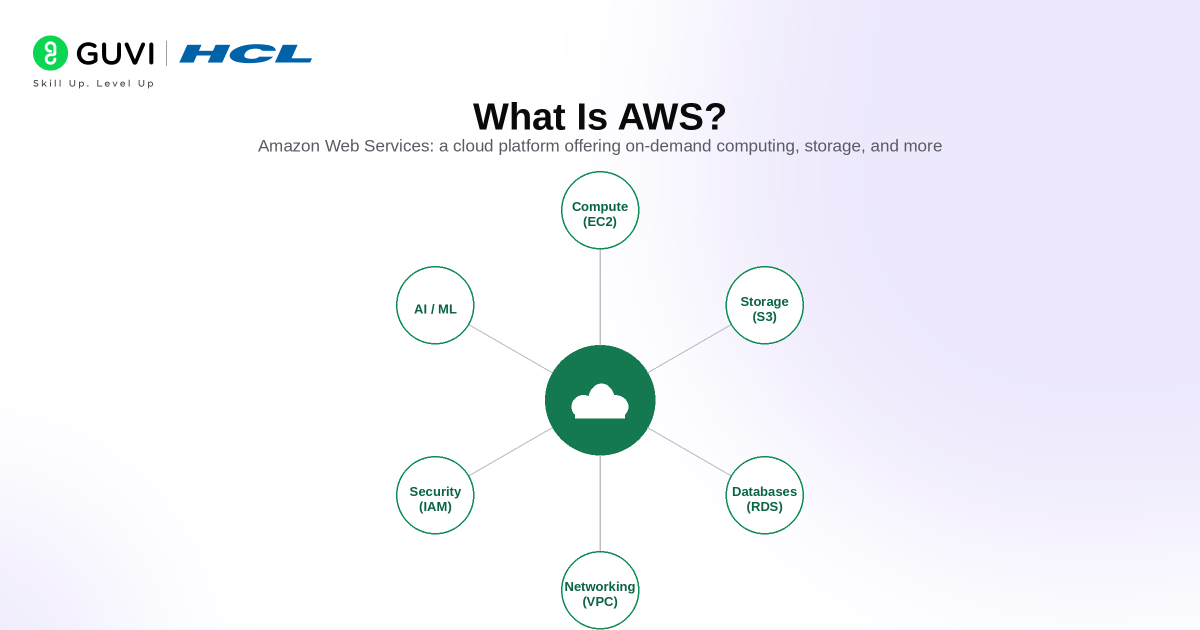
Amazon Web Services or AWS is a cloud computing platform that provides infrastructure and managed services over the internet.
Instead of buying and maintaining physical servers, organisations can use AWS for:
- Computing
- Storage
- Databases
- Networking
- Security
- Analytics
- Artificial intelligence
- Application hosting
- Monitoring
- DevOps
- Serverless computing
AWS infrastructure is distributed across multiple geographic Regions and Availability Zones. In India, AWS currently operates the Asia Pacific (Mumbai) Region and Asia Pacific (Hyderabad) Region, each with three Availability Zones.
You can interact with AWS through several approaches:
- AWS Management Console
- AWS Command Line Interface
- APIs
- SDKs
- Infrastructure-as-code tools
- Low-code services
This flexibility is why the amount of coding required depends heavily on what you are trying to do.
Does AWS Require Coding?
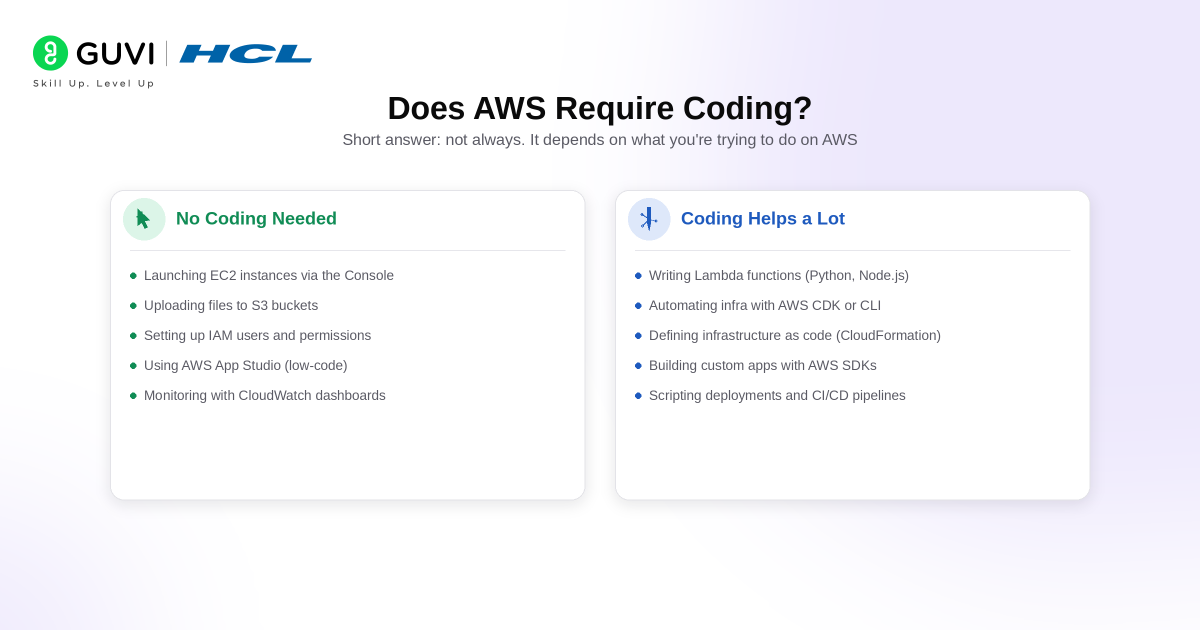
AWS itself does not require coding to get started.
Many AWS tasks can be completed through the graphical AWS Management Console.
A beginner can learn how to:
- Launch a virtual machine
- Create a storage bucket
- Configure basic IAM permissions
- Explore databases
- Review billing
- Configure simple networking
- Monitor resources
without writing a traditional application.
However, coding becomes increasingly valuable when your work involves:
- Application development
- Serverless functions
- Automation
- Infrastructure as code
- DevOps
- CI/CD
- APIs
- Cloud-native architecture
A useful way to think about AWS is:
Learning AWS fundamentals → Coding optional
Working in advanced cloud engineering → Coding increasingly important
AWS Tasks That Need Coding vs Those That Do Not
| AWS Task | Coding Required? | Typical Skill Needed | Example |
|---|---|---|---|
| Learn cloud fundamentals | No | Basic cloud concepts | Regions and Availability Zones |
| Upload files to Amazon S3 | No | AWS Console | File storage |
| Launch an EC2 instance | No | Console and Linux basics | Virtual server |
| Create IAM users and roles | No | Security fundamentals | Access control |
| Create a basic database | No | Database basics | Amazon RDS |
| Monitor resources | No | CloudWatch fundamentals | CPU monitoring |
| Build low-code applications | Low | Logic and data concepts | AWS App Studio |
| Manage AWS with CLI | Low | Command line | AWS CLI |
| Build Lambda functions | Yes | Python, JavaScript or another supported language | Serverless application |
| Develop AWS applications | Yes | Programming and SDKs | Backend application |
| Build CI/CD pipelines | Usually | Scripting and DevOps | Automated deployment |
| Use Terraform | Yes/Configuration | HCL and infrastructure concepts | Infrastructure as code |
| Use AWS CDK | Yes | TypeScript, Python, Java or another supported language | Infrastructure as code |
| DevSecOps automation | Yes | Scripting, security and CI/CD | Security automation |
The important distinction is therefore not whether AWS requires coding. It is which AWS task requires coding.
AWS Tasks You Can Do Without Coding
1. Learn Core AWS Services
Beginners can explore core AWS concepts through the Management Console.
Important starting services include:
- Amazon EC2
- Amazon S3
- IAM
- Amazon RDS
- Amazon VPC
- Amazon CloudWatch
The goal at this stage is understanding what each service does rather than automating everything.
2. Store Files With Amazon S3
Amazon S3 is an object-storage service.
You can create a bucket and upload files directly through the AWS Management Console without writing code.
Programming becomes relevant later if your application needs to upload, retrieve or process S3 files automatically.
3. Launch and Manage Virtual Servers
Amazon EC2 allows you to create cloud-based virtual machines.
The console lets you choose:
- Operating system
- Instance size
- Storage
- Network
- Security settings
without writing application code.
However, Linux commands and scripting become useful once you begin configuring servers professionally.
4. Manage IAM Permissions
Identity and Access Management is fundamental to AWS.
You can create:
- Users
- Roles
- Policies
- Permissions
through the console.
Understanding security concepts matters more than knowing a programming language at this stage.
5. Monitor AWS Resources
Amazon CloudWatch helps monitor AWS services and applications.
Basic dashboards, alarms and metrics can be created through the console without programming.
6. Build Some Applications With Low-Code Tools
AWS has also expanded its low-code capabilities.
AWS App Studio is a generative AI-powered application-building service that allows technical professionals to describe an application in natural language and generate interfaces, data models and business logic without requiring deep software-development skills.
This makes the boundary between coding and no-code cloud development increasingly flexible. You can also explore how no-code development fits into modern application development.
AWS Tasks That Require Coding or Scripting
Coding starts becoming important when you move beyond manual administration.
1. Developing Cloud Applications
If you are developing an application that runs on AWS, you will usually need a programming language.
Common options include:
- Python
- JavaScript or TypeScript
- Java
- Go
- C#
- PHP
For example, an application may use an AWS SDK to upload customer files automatically to Amazon S3.
2. Building AWS Lambda Functions
AWS Lambda allows code to run without managing a server.
A Lambda function still contains code.
For example, Python might be used to:
- Process uploaded files
- Resize images
- Trigger workflows
- Connect AWS services
- Handle APIs
Serverless does not mean code-free. It means AWS manages more of the infrastructure for you.
3. Automating AWS Infrastructure
Cloud engineers rarely want to create hundreds of resources manually.
Infrastructure-as-code tools allow infrastructure to be defined in files and reproduced consistently.
Common tools include:
- AWS CloudFormation
- Terraform
- AWS CDK
Terraform 1.16.0 is the latest stable Terraform release as of August 2026, while the Terraform 1.17 series is still in alpha.
AWS CDK is currently on the 2.x generation, with AWS documentation listing version 2.267.0 as the latest version.
AWS CDK requires programming because infrastructure is defined using supported programming languages.
4. Using the AWS CLI
The AWS Command Line Interface allows developers and administrators to manage AWS services through terminal commands.
AWS CLI Version 2 remains the current major version and includes the latest AWS CLI features.
For example:
aws s3 ls
does not require traditional programming.
But once you combine CLI commands into Bash or Python scripts, scripting knowledge becomes extremely useful.
5. Building CI/CD Pipelines
DevOps teams automate:
- Builds
- Tests
- Deployments
- Infrastructure changes
- Rollbacks
This generally requires scripting, configuration files or programming.
Tools may include:
- AWS CodePipeline
- GitHub Actions
- Jenkins
- Terraform
- Docker
Coding may not occupy every minute of a DevOps engineer’s job, but being unable to understand scripts becomes a major limitation.
AWS can help you host a website without writing much code, but custom web applications eventually require frontend or backend skills. HCL GUVI’s WebKata gives you hands-on practice with core web-development fundamentals.
How Much Coding Do Different AWS Jobs Require?
The coding requirement changes considerably by role.
| AWS Career | Coding Level | What You Should Know |
|---|---|---|
| Cloud Sales/Business Role | Very low | AWS services and business value |
| Cloud Practitioner | Very low | Cloud fundamentals |
| AWS Solutions Architect | Low to moderate | Architecture, networking and some scripting |
| Cloud Support Engineer | Moderate | Linux, troubleshooting and scripts |
| SysOps Administrator | Moderate | Linux, CLI and automation |
| AWS Cloud Engineer | Moderate to high | Python/Bash, IaC and Linux |
| AWS Developer | High | Application programming and AWS SDKs |
| DevOps Engineer | High | Scripting, CI/CD and infrastructure automation |
| DevSecOps Engineer | High | Security automation and scripting |
| Cloud Application Developer | High | Backend/frontend programming |
This is why the statement “AWS jobs do not require coding” is too broad.
Some roles require very little code.
Others depend on it every day.
Does an AWS Solutions Architect Need Coding?
Not necessarily at the same level as a software developer.
Solutions Architects primarily need to understand:
- AWS architecture
- Networking
- Security
- Reliability
- Scalability
- Cost optimisation
- Databases
- Application design
However, basic scripting and programming knowledge can make the role much easier. A Solutions Architect who understands how applications, APIs and infrastructure code work can communicate more effectively with development and DevOps teams. So the answer is: Coding is not the main skill for an AWS Solutions Architect, but technical scripting and programming knowledge are valuable.
Build strong AWS and cloud computing fundamentals to understand where coding fits in an AWS career with HCL GUVI’s AWS Course. Learn AWS services, cloud infrastructure, deployment basics, networking, storage, and practical cloud workflows through structured training designed for beginners and cloud career aspirants in 2026.
Does a DevOps Engineer Need Coding for AWS?
Yes.
DevOps is one of the AWS-related career paths where coding and scripting become much more important.
A DevOps engineer commonly works with:
- Bash
- Python
- YAML
- Terraform
- Docker
- Git
- CI/CD systems
They may automate infrastructure provisioning, deployment and monitoring rather than building user-facing applications.
The coding style is different from traditional software development, but automation skills are essential.
If programming feels difficult initially, this guide on how to learn any programming language can help you structure your learning.
Which Programming Language Is Best for AWS?
You do not need to learn every language.

1. Python
Python is one of the most practical languages for AWS learners.
It is useful for:
- Automation
- Lambda
- AWS SDK scripts
- DevOps
- Data engineering
2. JavaScript and TypeScript
Useful for:
- Web applications
- Node.js
- Lambda
- AWS CDK
- Serverless development
3. Bash
Bash is especially important for:
- Linux administration
- Shell scripts
- Automation
- CI/CD
4. Java
Java remains valuable for enterprise AWS applications and backend systems.
5. Infrastructure Languages
Terraform uses HashiCorp Configuration Language. CloudFormation generally uses JSON or YAML templates. AWS CDK lets developers define infrastructure using actual programming languages. Learning at least one OOP language can also help you understand application architecture more deeply.
Basic Requirements to Learn AWS in 2026
You do not need an IT degree or prior cloud job to start. AWS itself states that its Cloud Practitioner certification is suitable for individuals new to cloud computing and even those without an IT background. However, several basic skills will make learning easier.
1. Basic Computer Knowledge
You should understand:
- Files
- Applications
- Operating systems
- Browsers
2. Networking Fundamentals
Learn:
- IP addresses
- DNS
- Ports
- HTTP/HTTPS
- Public and private networks
Networking becomes essential once you start using Amazon VPC.
3. Linux Basics
Many EC2 workloads run Linux.
Useful commands include:
cd
ls
mkdir
cp
rm
ssh
You do not need to become a Linux administrator before learning AWS, but basic terminal knowledge helps considerably.
4. Database Fundamentals
Understand:
- Tables
- Records
- SQL basics
- Relational vs NoSQL databases
This makes Amazon RDS and DynamoDB easier to understand.
5. Basic Security Concepts
Learn:
- Authentication
- Authorization
- Permissions
- Encryption
- Least privilege
These concepts are fundamental to IAM.
6. Programming Later
You can add Python or JavaScript once you are comfortable with core cloud concepts.
For most beginners:
AWS first → basic Linux/networking → Python or scripting → automation
works better than trying to learn everything before opening an AWS account.
Can a Non-IT Student Learn AWS?
Yes.
Someone from:
- Commerce
- Management
- Sales
- Finance
- Operations
- Project management
- Other non-technical backgrounds
can learn AWS fundamentals.
AWS’s own Cloud Practitioner certification specifically includes candidates in line-of-business roles such as sales, marketing, product and project management.
However, moving into deeply technical cloud jobs requires additional skills.
For example, someone targeting Cloud Engineering will eventually need to learn:
- Networking
- Linux
- Security
- Programming or scripting
- Infrastructure automation
Your educational background does not prevent you from learning these skills.
Complete AWS Learning Path in India in 2026
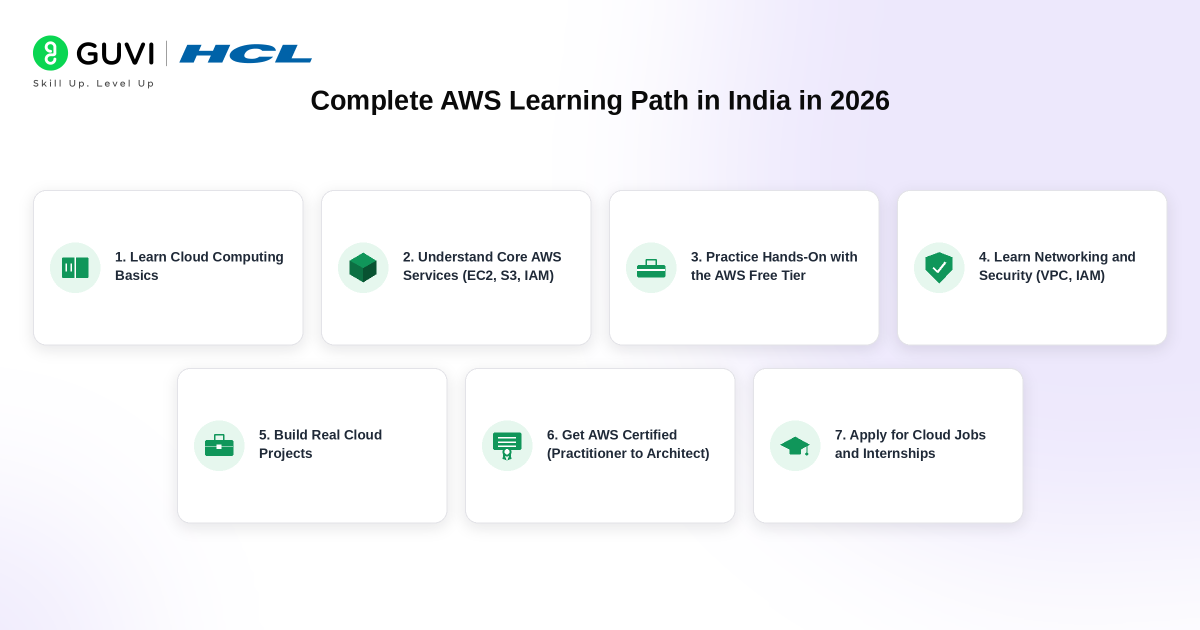
For Indian learners starting from zero, a practical path is:
Step 1: Learn Cloud Computing Basics
Understand:
- What cloud computing is
- IaaS
- PaaS
- SaaS
- Regions
- Availability Zones
- Shared responsibility
You can explore more topics in HCL GUVI’s cloud computing resources.
Step 2: Learn Core AWS Services
Begin with:
- EC2
- S3
- IAM
- VPC
- RDS
- CloudWatch
Step 3: Create an AWS Account and Practise
AWS updated its Free Tier model for new customers.
New AWS customers currently receive $100 in credits after account creation and can earn up to an additional $100 in credits through eligible activities. AWS also provides access to more than 30 services with ongoing monthly free usage allowances.
Always monitor billing and configure budget alerts while practising.
Step 4: Learn Linux and Networking
These skills become essential for technical AWS roles.
Step 5: Learn Python or Bash
Begin with simple automation.
You do not need advanced algorithms to automate common AWS tasks.
Step 6: Learn Infrastructure as Code
Start with:
- CloudFormation
or:
- Terraform
Later, developers may add AWS CDK.
Step 7: Learn CI/CD
Understand:
- Git
- Build pipelines
- Automated testing
- Deployment
- Docker
Step 8: Build AWS Projects
Examples include:
- Static website on S3
- EC2-hosted web application
- Serverless API
- VPC architecture
- Automated infrastructure
- CI/CD pipeline
AWS Careers and Salaries in India in 2026
Coding requirements also influence which AWS career path may suit you.
AWS Solutions Architect
Solutions Architecture focuses heavily on designing reliable and scalable cloud systems rather than writing application code all day.
Glassdoor data for India reports an average AWS Solutions Architect base salary of around ₹7 lakh per year, with the typical base-pay range at approximately ₹4 lakh to ₹11.8 lakh per year. Actual compensation varies considerably by experience, company and location.
DevOps Engineer
DevOps requires significantly more scripting and automation.
Glassdoor currently reports an average DevOps Engineer base salary of around ₹8 lakh per year in India, with a typical base-pay range around ₹5 lakh to ₹12 lakh per year.
These figures should be treated as market estimates rather than guaranteed AWS-specific salaries.
Your actual pay depends on:
- Experience
- City
- Employer
- AWS knowledge
- Linux
- Networking
- Programming
- DevOps skills
- Certifications
AWS Tools Beginners Should Know in 2026
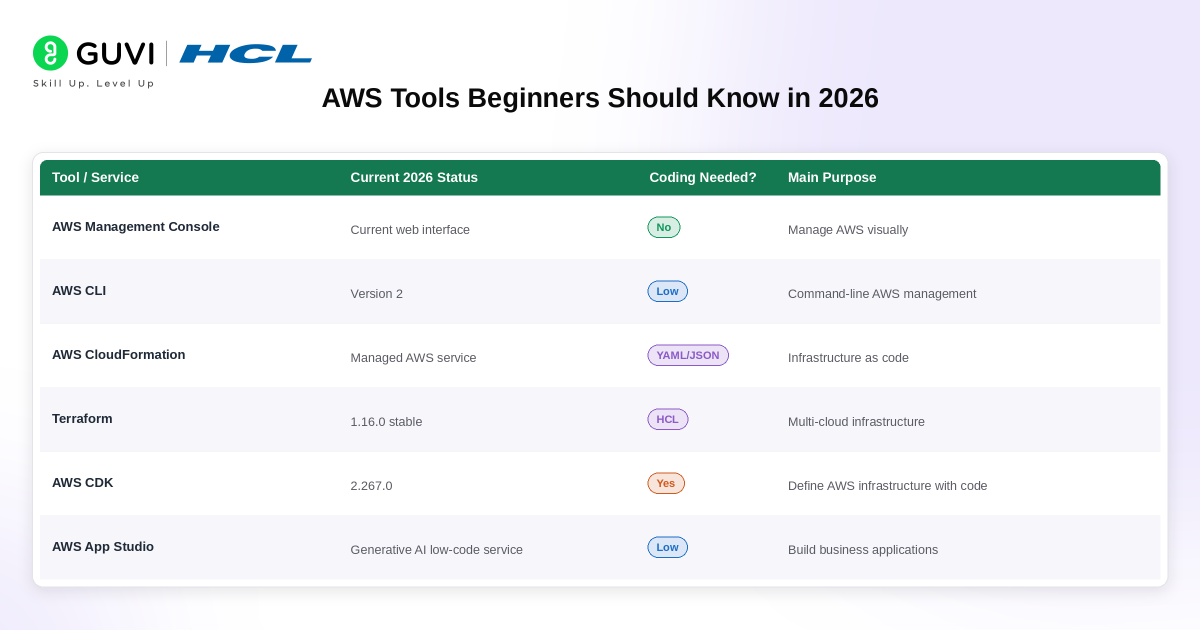
| Tool/Service | Current 2026 Status | Coding Needed? | Main Purpose |
|---|---|---|---|
| AWS Management Console | Current web interface | No | Manage AWS visually |
| AWS CLI | Version 2 | Low | Command-line AWS management |
| AWS CloudFormation | Managed AWS service | YAML/JSON | Infrastructure as code |
| Terraform | 1.16.0 stable | HCL | Multi-cloud infrastructure |
| AWS CDK | 2.267.0 | Yes | Define AWS infrastructure with code |
| AWS App Studio | Generative AI low-code service | Low | Build business applications |
AWS CLI Version 2 remains the recommended current major generation. Terraform 1.16.0 is the current stable Terraform release, while AWS documentation lists AWS CDK 2.267.0 as its latest v2 version.
Do not try to learn all these tools at once. Begin with the AWS Console and core services. Add CLI and infrastructure-as-code tools after you understand what the underlying resources actually do.
Common Mistakes Beginners Make While Learning AWS
1. Trying to Learn Every AWS Service
AWS contains a very large service ecosystem. Beginners only need a small core set initially. Focus on:
- IAM
- EC2
- S3
- VPC
- RDS
- CloudWatch
2. Learning Only the AWS Console
The console is excellent for learning. Professional cloud roles increasingly require CLI, automation and infrastructure as code. Use the console first, but do not stop there.
3. Ignoring Networking
Many AWS concepts become confusing when networking fundamentals are weak. Learn IP addresses, subnets, DNS and routing early.
4. Avoiding Programming Completely
You do not need coding to start AWS. But refusing to learn any scripting can restrict your career options later.
5. Memorising Services Instead of Building Projects
You will remember cloud concepts more effectively by building. Launch an instance. Create an S3 bucket. Configure IAM. Build a VPC. AWS becomes much easier when concepts have a practical context.
Conclusion
You do not need to become a programmer before learning AWS. A beginner can start with cloud concepts, EC2, S3, IAM, databases and networking using the AWS Management Console. That is enough to understand how AWS works and decide whether cloud computing is the right career direction.
Coding becomes important when you move towards AWS Developer, Cloud Engineer, DevOps or DevSecOps roles, because these jobs rely heavily on automation, APIs, infrastructure as code and application development.
So do not delay learning AWS because you cannot code yet. Start with the cloud. Learn Linux and networking. Then add Python, Bash or JavaScript when your AWS projects require them. The better question is not “Does AWS require coding?” It is “How much coding does the AWS career I want require?”
FAQs
Does AWS require coding for beginners?
No. Beginners can learn AWS fundamentals and use services such as EC2, S3, IAM, RDS and CloudWatch through the AWS Management Console without writing code. Coding becomes more important as you move into application development, automation, DevOps and infrastructure-as-code work.
Can I learn AWS without programming knowledge?
Yes. AWS explicitly positions its Cloud Practitioner certification as suitable for people with no prior IT or cloud experience. You can begin with cloud concepts, networking, IAM, storage and compute before learning a language such as Python.
Which AWS jobs do not require coding?
Cloud business roles and some entry-level cloud administration or architecture responsibilities may require little traditional programming. Solutions Architects generally focus more on architecture than application coding, although scripting knowledge is valuable. Developer, DevOps and Cloud Engineering roles usually require much stronger automation or coding skills.
Which programming language should I learn for AWS?
Python is a strong first choice because it is widely used for scripting, automation, AWS Lambda and cloud engineering. JavaScript or TypeScript is useful for web applications, Node.js, Lambda and AWS CDK. Bash is also important for Linux and DevOps workflows.
Does AWS DevOps require coding?
Yes. AWS DevOps work usually involves scripting and infrastructure automation. DevOps engineers commonly work with Bash, Python, YAML, Terraform, CI/CD tools and Docker. You may not build traditional applications every day, but automation is a central part of the role.
Success Stories

About the Author
Vaishali
I'm a seasoned writer with four years of experience across technical, non-technical, and just about every genre or niche you can imagine. Adaptable and curious, I enjoy exploring new topics and making information engaging and easy to understand. Fueled by a steady stream of tea, I approach each project with creativity, reliability, and genuine enthusiasm for storytelling.
View all posts by Vaishali
Connect with me @








Did you enjoy this article?