


Data Analysis Articles
What Is Finance Analytics? Career Scope and Job Roles
Marketing Analyst to Data Scientist: Skills and Career Path
Healthcare Team Leads, Operations Managers and Implementation Leads to Analytics Leadership
Chat Support Executive to Data Analyst: Which Skills Transfer?


Get In Touch For Details! Request More Information
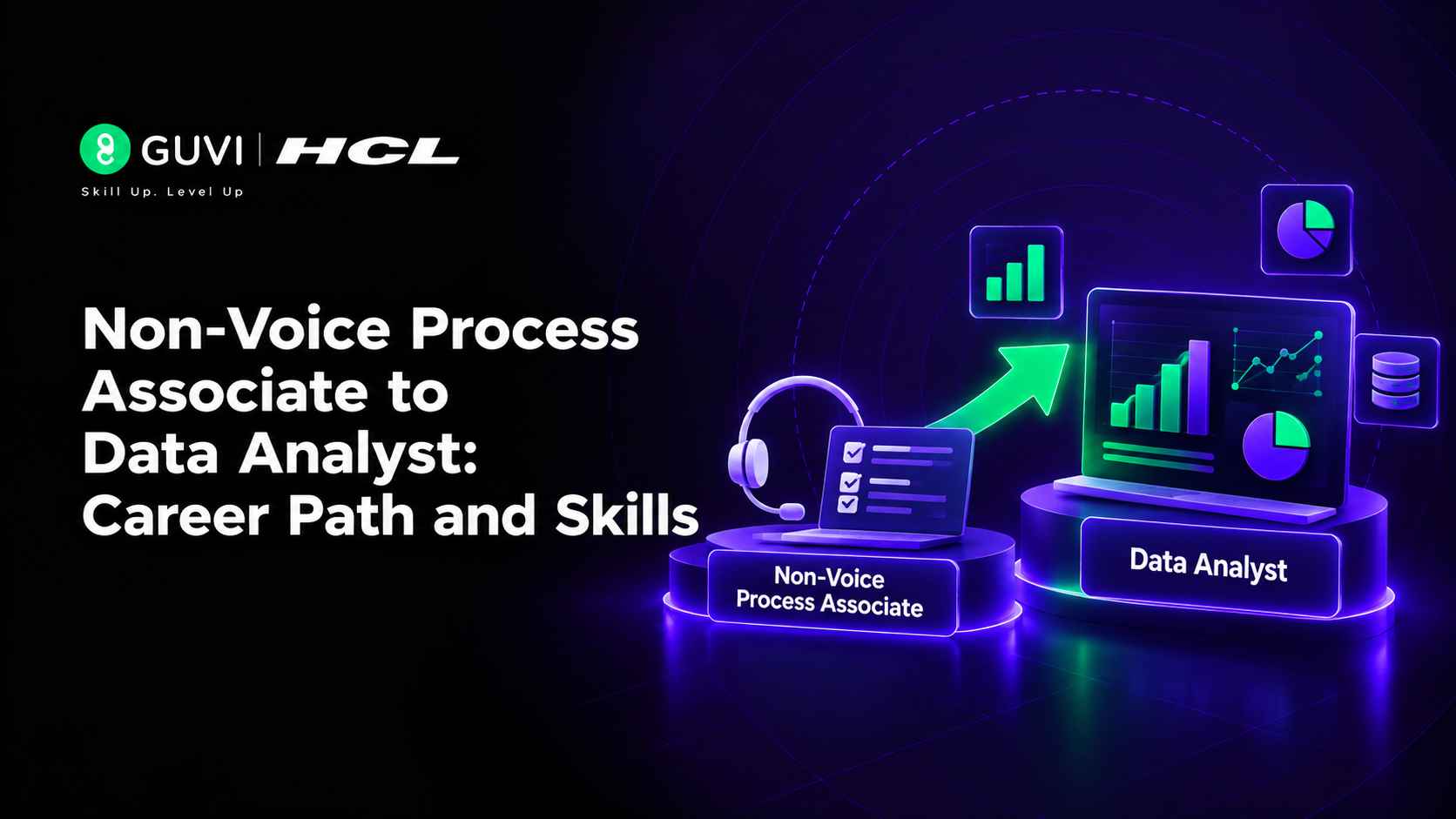
Non-Voice Process Associate to Data Analyst: Career Path and Skills
Nov 02, 2026 5 Min Read 22 Views
(Last Updated)
Every customer ticket you process, record you update, and performance report you maintain contains information that can reveal something about business operations. But have you ever wondered what happens when that information is analysed to identify patterns, reduce delays, or improve productivity?
That is where data analytics comes in. A Non-Voice Process Associate already understands operational workflows, data accuracy, and performance metrics. Moving into a Data Analyst role means building on this experience with technical skills such as Excel, SQL, Power BI, and statistics.
Read this guide to understand how to transition from a non-voice process to data analytics, the skills you need, and the career path you can follow.
Quick Answer
Yes, a Non-Voice Process Associate can become a Data Analyst by building on existing BPO experience and learning technical skills. Here is the career path:
- Transferable Skills: Data handling, Excel, reporting, SLA tracking.
- Technical Skills: Advanced Excel, SQL, Power BI, statistics, Python.
- Career Path: Non-Voice Associate → MIS Executive → Junior Data Analyst → Data Analyst.
- Learning Roadmap: 6 months of structured learning and practical projects.
- Job Preparation: Build a portfolio, update your resume, and practise interviews.
Table of contents
- Can a Non-Voice Process Associate Become a Data Analyst?
- Non-Voice Process Associate vs Data Analyst: What Is the Difference?
- Essential Technical Skills to Switch From Non-Voice Process to Data Analyst
- Career Path Staircase: Non-Voice Process Associate to Data Analyst
- Step 1: Non-Voice Process Associate
- Step 2: MIS Executive / Reporting Analyst
- Step 3: Junior Data Analyst / Operations Analyst
- Step 4: Data Analyst
- Step 5: Senior Data Analyst
- Non-Voice Process to Data Analyst Career Path: 6-Month Roadmap
- Common Mistakes to Avoid When Switching From a Non-Voice Process to Data Analytics
- Conclusion
- FAQs
- Does non-voice BPO experience count for Data Analyst jobs?
- Can a BA or BCom graduate become a Data Analyst after working in a non-voice process?
- Is Python compulsory to become a Data Analyst from a non-voice BPO role?
- Can I get a Data Analyst job without previous analytics work experience?
- Will I be considered a fresher when switching from a non-voice process to data analytics?
Can a Non-Voice Process Associate Become a Data Analyst?
Yes, a Non-Voice Process Associate can become a Data Analyst by building on their experience in data handling, back-office operations, reporting, and process monitoring. Although these roles have different responsibilities, many skills developed in a non-voice BPO process are directly relevant to data analytics.
Here is how your existing experience can support the transition:
- Data Handling and Accuracy: Maintaining customer records, verifying transactions, and correcting entries develop attention to detail. In data analytics, these skills support data cleaning, validation, and identifying missing or duplicate records.
- Excel and Spreadsheet Management: Preparing trackers and organising operational data provide a foundation for advanced Excel. Learning Pivot Tables, XLOOKUP, and Power Query can help you analyse ticket volumes, employee productivity, and processing trends.
- Process Monitoring and SLA Tracking: Monitoring turnaround times and Service Level Agreements (SLAs) builds familiarity with business KPIs. Data Analysts use these metrics to investigate delays, identify performance gaps, and recommend improvements.
- Quality Assurance and Error Identification: Checking processing errors and following quality standards develops problem-solving abilities. These skills help analysts identify recurring issues, examine error patterns, and perform root-cause analysis.
- Reporting and Performance Analysis: Preparing daily reports and quality scorecards introduces you to operational performance data. With SQL and Power BI, you can progress towards analysing historical trends, building dashboards, and presenting actionable insights.
Transition from a non-voice BPO role to data analytics with HCL GUVI’s Data Science Course. Build practical skills in SQL, Python, statistics, and data visualisation through live online classes, real-world projects, and expert mentorship. Develop job-ready analytical skills to pursue data analyst opportunities.
Non-Voice Process Associate vs Data Analyst: What Is the Difference?
The main difference between a Non-Voice Process Associate and a Data Analyst is how they work with information. A non-voice associate processes records, updates customer details, and follows operational workflows. A Data Analyst examines that information to identify trends, understand problems, and support business decisions.
Both roles involve data, but their responsibilities, tools, and expected outcomes differ.
| Comparison | Non-Voice Process Associate | Data Analyst |
| Primary Role | Processes and maintains operational records | Analyses data to generate business insights |
| Daily Tasks | Data entry, email support, ticket processing, record updates | Data cleaning, analysis, dashboards, reporting |
| Technical Skills | Basic Excel, CRM tools, process software | Advanced Excel, SQL, Power BI, Python |
| Performance Metrics | Accuracy, productivity, SLA compliance | Data quality, analysis accuracy, business KPIs |
| Decision-Making | Follows defined workflows and escalation rules | Identifies trends and recommends improvements |
| Career Growth | Senior Associate, SME, Team Leader | Senior Data Analyst, Analytics Lead, Analytics Manager |
Essential Technical Skills to Switch From Non-Voice Process to Data Analyst
Moving from a non-voice process to a Data Analyst role requires technical skills that help you collect, clean, analyse, and present business data. Your experience with operational records and performance metrics provides a useful starting point, but you need to learn tools that can turn this information into meaningful insights.
Here are the essential data analytics skills to focus on:
- Advanced Excel: Learn Pivot Tables, XLOOKUP, conditional formatting, and Power Query to clean and analyse datasets. These skills can help you examine ticket volumes, employee productivity, and SLA performance beyond routine reporting.
- SQL and Database Management: Develop skills in filtering, JOINs, GROUP BY, Common Table Expressions (CTEs), and window functions. SQL helps you retrieve and analyse large datasets, such as identifying customer requests with the longest resolution times.
- Power BI: Learn Power Query, data modelling, DAX, and interactive dashboard development. You can use Power BI to track operational KPIs, compare team performance, and monitor processing backlogs.
- Statistics and Analytical Thinking: Understand averages, percentages, distributions, correlations, and trend analysis. These concepts help you recognise unusual performance changes and investigate factors affecting process efficiency.
- Python for Data Analysis: Start with Python fundamentals, Pandas, and exploratory data analysis. Python is useful for cleaning larger datasets, automating repetitive tasks, and performing analyses that are difficult to manage in spreadsheets.
- Data Visualisation and Storytelling: Learn to select appropriate charts, present KPIs, and explain analytical findings clearly. A Data Analyst must communicate what the numbers reveal and how those findings can improve business operations.
Start with advanced Excel and SQL, then move towards Power BI and statistical analysis. Python can follow as your technical confidence grows. Practising these skills with customer support, quality audit, or SLA datasets will help you build a portfolio relevant to entry-level data analytics jobs.
Career Path Staircase: Non-Voice Process Associate to Data Analyst
A non-voice associate can transition into data analytics through reporting, MIS, or operations analytics roles. These positions help bridge the gap between process execution and analytical responsibilities.
A possible career progression looks like this:
Non-Voice Process Associate → MIS Executive / Reporting Analyst → Junior Data Analyst / Operations Analyst → Data Analyst → Senior Data Analyst
Step 1: Non-Voice Process Associate
Your main responsibilities include processing customer requests, maintaining records, checking data accuracy, and meeting operational targets. Focus on developing stronger Excel skills and understanding the metrics used to evaluate your process.
Step 2: MIS Executive / Reporting Analyst
At this stage, responsibilities shift towards preparing performance reports, maintaining dashboards, and analysing operational KPIs. Advanced Excel, Power Query, and basic SQL become particularly useful.
Step 3: Junior Data Analyst / Operations Analyst
The work involves cleaning datasets, writing SQL queries, investigating trends, and developing dashboards. You also begin explaining how operational findings relate to business performance.
Step 4: Data Analyst
A Data Analyst independently handles analytical tasks, defines useful KPIs with stakeholders, and interprets business data. Strong SQL, visualisation, statistical reasoning, and communication skills are important at this level.

Step 5: Senior Data Analyst
Senior analysts handle more complex business questions, improve analytical processes, guide junior team members, and communicate recommendations to stakeholders. Their responsibilities may also include advanced modelling and analytics project ownership.
Do you need to complete every stage? No. This is an illustrative career staircase, not a mandatory promotion sequence. A non-voice associate with strong SQL and Power BI skills, a relevant project portfolio, and good analytical reasoning can apply directly for suitable junior Data Analyst roles.
Your actual entry point will depend on your experience, technical proficiency, portfolio, and the requirements of individual employers.
Non-Voice Process to Data Analyst Career Path: 6-Month Roadmap
A career transition roadmap is a step-by-step learning plan that helps you develop the skills, practical experience, and confidence needed to move into a new role. For a Non-Voice Process Associate, a six-month data analytics roadmap provides a structured way to progress from handling operational records to analysing data and generating business insights.
The idea is to build one skill on another. You can begin with Excel and statistics, learn SQL to analyse larger datasets, and then use Power BI to present your findings. Working with a familiar dataset, such as customer support tickets or SLA reports, makes it easier to connect technical concepts with real business problems.
As you progress, focus on completing projects that demonstrate your analytical abilities. Six months is a suggested learning timeline rather than a guaranteed timeframe for securing a job. Your progress will depend on your existing skills, practice, and learning consistency.
Here is a practical six-month roadmap to help you transition from a non-voice BPO role to data analytics:
| Timeline | Learning Focus | Practical Outcome |
| Month 1 | Advanced Excel and basic statistics | Create a productivity and SLA performance report |
| Month 2 | SQL and database fundamentals | Analyse operational records using SQL queries |
| Month 3 | Power BI and data visualisation | Build an interactive operations dashboard |
| Month 4 | Data cleaning and exploratory analysis | Complete a ticket resolution or quality analysis project |
| Month 5 | Portfolio development and optional Python | Complete a second business-focused analytics project |
| Month 6 | Resume, interview preparation, and job applications | Apply for suitable MIS, reporting, and junior analytics roles |
Common Mistakes to Avoid When Switching From a Non-Voice Process to Data Analytics
- Learning Too Many Tools at Once: Trying to master Excel, SQL, Power BI, and Python simultaneously can make learning overwhelming. Start with Excel and SQL, then gradually move towards dashboards and programming.
- Ignoring Your Existing BPO Experience: Your understanding of SLAs, productivity metrics, quality scores, and operational workflows is relevant to analytics. Use these examples in projects and interviews rather than presenting yourself as someone with no applicable experience.
- Focusing Only on Certifications: Certificates demonstrate learning, but employers also need evidence of practical skills. Build projects involving ticket resolution, SLA performance, or process efficiency to show how you analyse data.
- Skipping SQL and Data Fundamentals: Learning to create attractive dashboards without understanding data cleaning, SQL queries, or basic statistics limits your analytical abilities. Focus on interpreting data accurately before presenting it.
- Using Generic Resumes: Listing routine responsibilities such as data entry and email processing may not clearly demonstrate your analytical potential. Highlight reporting tasks, Excel proficiency, process improvements, and relevant portfolio projects without exaggerating your experience.
- Expecting an Immediate Career Switch: Completing a six-month roadmap does not automatically guarantee a Data Analyst job. Assess your technical readiness, practise interviews, and consider MIS or Reporting Analyst opportunities that match your experience.
Conclusion
Moving from a Non-Voice Process Associate to a Data Analyst is a practical career transition when you build on the experience you already have. Your understanding of business processes, reporting, SLAs, and data accuracy can help you approach analytical problems with relevant operational knowledge.
Start with advanced Excel and SQL, develop your Power BI and statistical skills, and build projects based on familiar business scenarios. A strong portfolio and the ability to explain your findings will matter more than simply listing technical tools on your resume.
FAQs
Does non-voice BPO experience count for Data Analyst jobs?
Yes, non-voice BPO experience can be relevant, particularly when your responsibilities include reporting, quality monitoring, SLA tracking, or process analysis. However, employers may distinguish operational experience from direct analytics experience. Highlight relevant responsibilities and demonstrate your technical skills through projects.
Can a BA or BCom graduate become a Data Analyst after working in a non-voice process?
Yes. Graduates from arts, commerce, and other non-technical backgrounds can pursue data analytics. A computer science degree is not universally required, although eligibility varies by employer. Skills in Excel, SQL, Power BI, and statistics, supported by practical projects, can strengthen your applications.
Is Python compulsory to become a Data Analyst from a non-voice BPO role?
No, Python is not compulsory for every entry-level Data Analyst position. Many reporting and operations analytics roles prioritise Excel, SQL, Power BI, and statistical understanding. Python becomes particularly useful for automating repetitive analysis and handling complex datasets.
Can I get a Data Analyst job without previous analytics work experience?
Yes, some entry-level positions consider candidates without formal analytics experience. Build a portfolio demonstrating SQL queries, data cleaning, dashboard development, and business insights. Projects involving customer ticket analysis or SLA performance can help connect your non-voice experience to analytical responsibilities.
Will I be considered a fresher when switching from a non-voice process to data analytics?
Not necessarily. Employers may recognise your previous BPO experience as relevant operational experience, but they might assess your analytics proficiency separately. Your starting designation and salary will depend on the job requirements, your technical capabilities, and how closely your previous responsibilities match the new role.
Success Stories

About the Author
Vaishali
I'm a seasoned writer with four years of experience across technical, non-technical, and just about every genre or niche you can imagine. Adaptable and curious, I enjoy exploring new topics and making information engaging and easy to understand. Fueled by a steady stream of tea, I approach each project with creativity, reliability, and genuine enthusiasm for storytelling.
View all posts by Vaishali
Connect with me @








Did you enjoy this article?