


Data Analysis Articles
Non-Voice Process Associate to Data Analyst: Career Path and Skills
Chat Support Executive to Data Analyst: Which Skills Transfer?
Customer Service Representative to Data Analyst: Is It a Realistic Switch?
Healthcare Associates and Senior Executives to Data Analytics: From Process Work to RCM Analytics


Get In Touch For Details! Request More Information
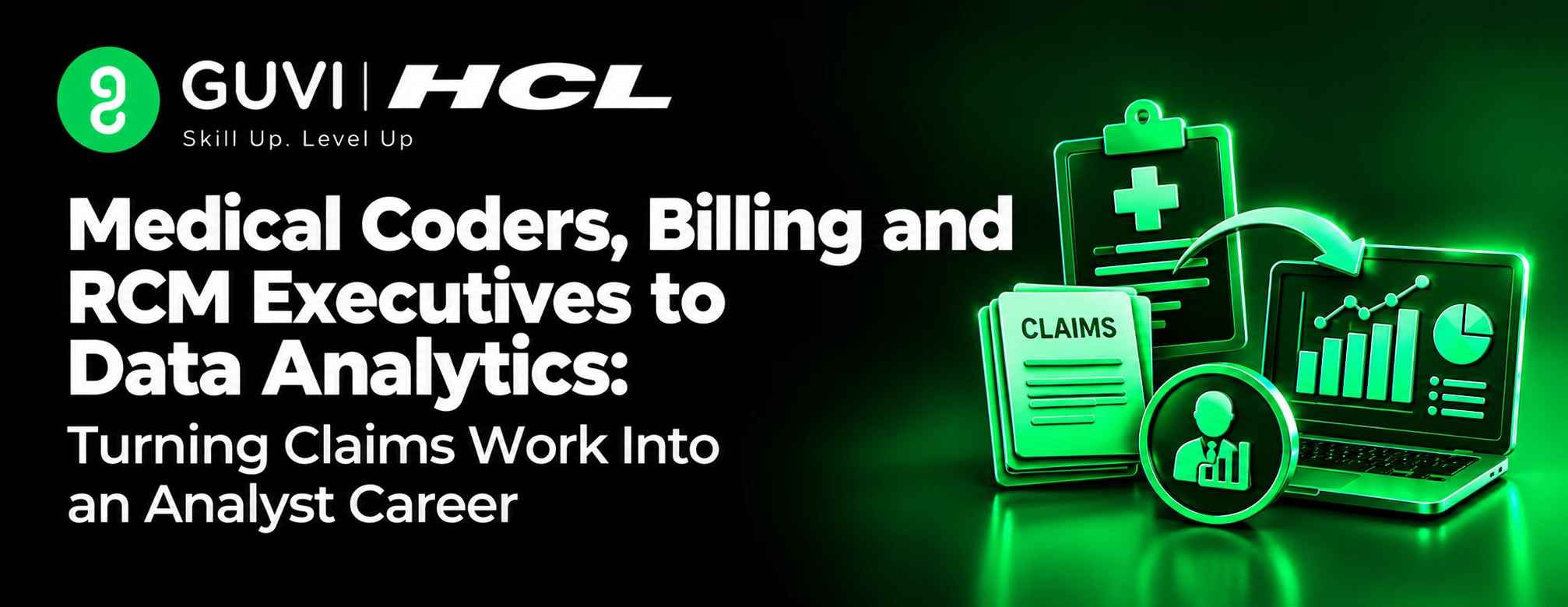
Medical Coder to Data Analyst: How to Transition from Healthcare Coding to Analytics
Nov 02, 2026 3 Min Read 14 Views
(Last Updated)
Medical coders work with diagnosis codes, procedure classifications, clinical documentation, and healthcare records every day. This experience can provide a useful foundation for data analytics. By learning technical tools and practising with relevant datasets, medical coders can explore analytical careers while building on their healthcare knowledge.
Table of contents
- TL;DR
- Quick Answer
- Identify Your Transferable Skills as a Medical Coder
- Data Accuracy and Documentation
- Healthcare Knowledge and Claims Understanding
- Turn Medical Coding Responsibilities into Analytical Work
- Convert Coding Tasks into Business Questions
- Develop Reporting and Communication Skills
- Learn the Technical Skills Needed for Data Analytics
- Start with Excel and SQL
- Add Power BI and Basic Statistics
- Build Healthcare Analytics Portfolio Projects
- Project 1: Medical Coding Accuracy Analysis
- Project 2: Claims Denial Analysis
- Project 3: Healthcare Documentation Dashboard
- Conclusion
- FAQs
- Can a medical coder become a data analyst?
- Is medical coding experience useful for data analytics?
- Which tools should medical coders learn first?
- Can medical coders move into healthcare data analytics without an IT degree?
- What projects should medical coders build?
- Can billing and RCM executives also transition into data analytics?
- Which jobs can medical coders explore after learning data analytics?
TL;DR
- Medical coding experience develops data accuracy, documentation, and attention to detail.
- Knowledge of diagnosis codes and healthcare records can provide useful context for analysing healthcare information.
- Learn Excel, SQL, Power BI, and basic statistics to develop analytical skills.
- Build projects involving coding accuracy, claim denials, and healthcare reporting.
- Explore roles such as Healthcare Data Analyst, Medical Coding Analyst, Claims Analyst, and Reporting Analyst.
Quick Answer
| A medical coder can transition into data analytics by combining healthcare coding knowledge with technical skills. Start by learning Excel for data organisation, SQL for querying records, and Power BI for reporting. Then build projects analysing coding trends, claim denials, and documentation accuracy. These projects can demonstrate your ability to work with healthcare datasets to potential employers. |
Identify Your Transferable Skills as a Medical Coder
Your coding responsibilities may already involve activities that connect with analytical work. Recognising these transferable skills helps you understand where to begin.
1. Data Accuracy and Documentation
Medical coders review clinical documentation and assign appropriate diagnosis and procedure codes. This requires attention to detail, consistency, and the ability to identify missing or unclear information.
These responsibilities connect with data analytics activities such as:
- Identifying missing or inconsistent records.
- Reviewing coding error patterns.
- Checking data quality before analysis.
- Comparing coding volumes across periods.
- Monitoring documentation-related discrepancies.
Your familiarity with structured healthcare information can help you understand datasets more effectively.
2. Healthcare Knowledge and Claims Understanding
Medical coding knowledge can also help you understand how clinical information connects with billing and claims processes. If your responsibilities include working with claim corrections or denial-related information, you may already be familiar with recurring operational issues.
This experience can support analytical questions about coding accuracy, claim rejection patterns, and documentation-related delays. Billing and Revenue Cycle Management (RCM) professionals can apply similar knowledge when analysing payment and reimbursement trends.
Turn Medical Coding Responsibilities into Analytical Work
1. Convert Coding Tasks into Business Questions
Data analysts investigate questions using available information. You can begin by connecting your existing responsibilities with questions that can be answered through datasets.
For example:
- Coding accuracy: Which categories have the most corrections?
- Documentation: How frequently are records missing required information?
- Claims: Which categories experience repeated rejections?
- Coding trends: How do coding volumes change each month?
- Operations: How long does the review process take?
These questions can become practical projects that connect your healthcare experience with analytical problem-solving.
2. Develop Reporting and Communication Skills
Preparing reports is different from analysing information. An analyst must explain what the findings mean and why they matter.
Practise presenting the business question, the evidence from your dataset, and the possible operational implications. Your experience explaining coding discrepancies or documenting corrections can help you communicate findings clearly.
Healthcare analytics involves more than clinical information. Coding, claims, billing, and documentation datasets can also help organisations examine data quality, operational performance, and revenue cycle trends. This makes healthcare domain knowledge relevant to several analytical responsibilities.
Learn the Technical Skills Needed for Data Analytics
1. Start with Excel and SQL
Excel is a practical starting point for organising and analysing healthcare records. Learn formulas, lookup functions, sorting, filtering, pivot tables, charts, and data cleaning.
Next, learn SQL to retrieve and summarise information from databases. Focus on:
- SELECT, WHERE, and ORDER BY to retrieve and filter records.
- GROUP BY and aggregate functions to calculate totals and averages.
- Joins to combine related datasets.
- CASE WHEN to categorise records.
Practice calculating coding correction rates, comparing claim volumes, and summarising monthly trends.

2. Add Power BI and Basic Statistics
Power BI helps turn healthcare datasets into interactive dashboards. Learn to import data, create relationships, build visualisations, apply filters, and develop measures.
Basic statistics is also important. Understand averages, percentages, distributions, and correlation versus causation. These concepts help you interpret healthcare information without making unsupported conclusions.
Build Healthcare Analytics Portfolio Projects
A portfolio demonstrates that you can apply technical skills to healthcare-related questions. Use public or synthetic datasets instead of confidential employer information.
Project 1: Medical Coding Accuracy Analysis
Create a synthetic dataset containing coding categories, correction counts, and review statuses. Use Excel or SQL to identify patterns and Power BI to present correction trends.
Project 2: Claims Denial Analysis
Analyse claim volumes, denial categories, approval rates, and monthly changes. Use SQL to summarise records and Power BI to create a dashboard showing claim outcomes.
Project 3: Healthcare Documentation Dashboard
Use synthetic data to examine missing documentation, review statuses, processing times, and correction patterns. Present the findings through charts and filters.
For each project, document the business question, dataset, cleaning steps, tools, findings, and limitations.
Important: Never upload patient records, protected health information, confidential claims, or internal employer reports to a public portfolio. Use public or synthetic datasets.
Conclusion
Moving from medical coding to data analytics is a practical career direction if you are ready to develop new technical skills. Your understanding of diagnosis codes, documentation, and healthcare records provides useful context, while projects demonstrate your ability to analyse information.
Start with Excel, progress to SQL, and learn Power BI. Build projects using safe healthcare datasets, document your findings, and explore entry-level roles that match your abilities. Consistent practice can help you turn your medical coding experience into an analytical career.
FAQs
1. Can a medical coder become a data analyst?
Yes. Medical coders can build on their healthcare knowledge by learning Excel, SQL, Power BI, and basic statistics and demonstrating their skills through projects.
2. Is medical coding experience useful for data analytics?
Yes. Experience with structured records, documentation, coding accuracy, and healthcare information can provide useful context for analysing datasets.
3. Which tools should medical coders learn first?
Start with Excel, followed by SQL and Power BI. Learn basic statistics and consider Python after developing these foundations.
4. Can medical coders move into healthcare data analytics without an IT degree?
Requirements vary by employer. An IT degree is not mandatory for every position, but relevant qualifications, technical skills, and practical projects can strengthen an application.
5. What projects should medical coders build?
Medical coding accuracy analysis, claims denial analysis, and healthcare documentation dashboards are relevant project ideas. Use public or synthetic datasets.
6. Can billing and RCM executives also transition into data analytics?
Yes. Their experience with claims, payment records, denials, reconciliation, and reimbursement can support projects involving healthcare financial and operational data.
7. Which jobs can medical coders explore after learning data analytics?
Consider Healthcare Data Analyst, Medical Coding Analyst, Claims Analyst, RCM Analyst, Reporting Analyst, and MIS Analyst positions. Review job descriptions to identify the skills each employer requires.
Success Stories

About the Author
HCL GUVI
This article was selected and published as part of the HCL GUVI AI Blogathon 2026, an initiative designed to encourage students, AI enthusiasts, and aspiring tech writers to simplify complex AI concepts through impactful technical content. The contest recognized high-quality, original, and insightful AI-focused blogs, with selected authors receiving publication opportunities on the HCL GUVI blog platform along with official author credits and recognition.
View all posts by HCL GUVI
Connect with me @









Did you enjoy this article?