


Data Science Articles
Can a Deputy Manager in Finance Switch to Data Analytics Mid-Career?
What Skills Do Finance Team Leads Need for Finance Analytics Leadership?
Can a Finance Team Lead Become a Data Analyst?
Data Analytics for Finance Professionals Best Career Guide for Accountants
Get In Touch For Details! Request More Information
Can an Accounting Manager Become a Data Scientist?
Oct 14, 2026 4 Min Read 19 Views
(Last Updated)
Accounting managers handle financial reporting, budgeting, audits, reconciliations, and performance analysis. These responsibilities require attention to detail, analytical thinking, and a strong understanding of business operations. As organizations increasingly use data to guide decisions, experienced accounting professionals may find opportunities to apply these strengths in Data Science.
If you are considering moving from accounting management to a data science role, the transition is possible. However, financial expertise alone is not enough. You will need to develop programming, statistics, data analysis, and machine learning skills to work with complex datasets and build predictive models.
Your management experience can still be valuable. You understand how financial decisions affect businesses, how to interpret performance metrics, and how to communicate findings to stakeholders. By combining this knowledge with technical skills, you can explore a new career direction without treating your previous experience as wasted effort.
Table of contents
- TL;DR
- Can an Accounting Manager Become a Data Scientist?
- What Skills Does an Accounting Manager Need to Learn?
- Python Programming
- SQL and Database Management
- Statistics and Mathematics
- Data Cleaning and Visualization
- Machine Learning
- How Can You Transition From Accounting Management to Data Science?
- What Projects Should Accounting Managers Build?
- How Long Does the Career Transition Take?
- Should You Start With Data Analytics Before Data Science?
- What Career Opportunities Can Accounting Managers Explore?
- Conclusion
- FAQs
- Can an accounting manager become a data scientist?
- Does an accounting manager need a computer science degree?
- Is Python necessary for an accounting manager entering Data Science?
- Can I move into Data Science without leaving my accounting job immediately?
- What is a good first Data Science project for an accounting manager?
- Should accounting managers learn Data Analytics before Data Science?
TL;DR
- Accounting managers can transition into Data Science by combining financial knowledge with technical skills.
- Python, SQL, statistics, and machine learning are important areas to learn.
- Experience in budgeting, reporting, and financial analysis can help identify meaningful business problems.
- Finance-related projects can demonstrate your ability to apply data science techniques.
- Data Analytics may be a practical starting point if you have limited programming experience.
- Your transition timeline depends on your current skills, learning schedule, and target job requirements.
Can an Accounting Manager Become a Data Scientist?
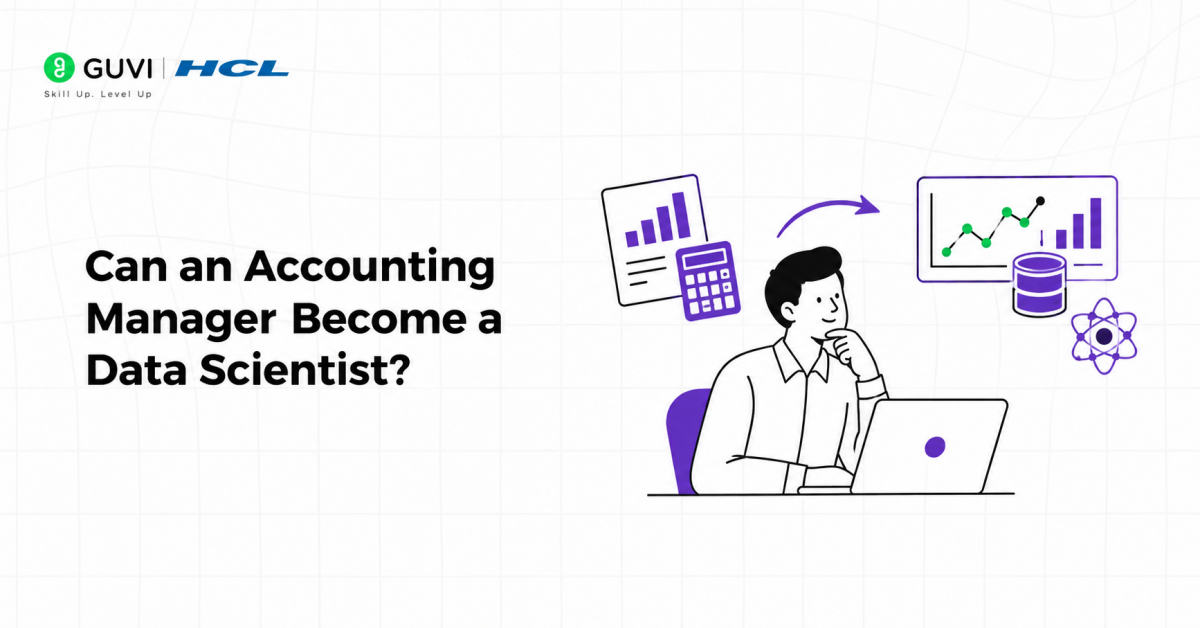
Yes. An accounting manager can become a data scientist by developing the required technical skills and demonstrating them through practical projects.
Your current role may already involve reviewing financial performance, investigating discrepancies, identifying risks, and explaining trends. These responsibilities help you understand business problems, which is an important part of analytical work.
For example, an accounting manager might investigate why operating expenses increased over several quarters. A data scientist could take this further by building a model to forecast expenses using historical data and relevant business variables.
The difference is the technical approach. Data Science involves programming, statistical analysis, and machine learning to uncover patterns or estimate future outcomes.
Your accounting background gives you useful context, but you must still demonstrate that you can prepare data, build appropriate models, and evaluate their results.
Accounting managers can build on their financial and analytical experience to explore data science opportunities. HCL GUVI’s Data Science Course helps you develop practical skills in Python, statistics, data analysis, and machine learning through hands-on projects.
What Skills Does an Accounting Manager Need to Learn?
You do not need to master every tool at once. Build your foundation in stages.
1. Python Programming
Python is widely used for data preparation, analysis, visualization, and machine learning.
Start with variables, loops, functions, data structures, and file handling. Then learn libraries such as Pandas and NumPy to work with datasets.
2. SQL and Database Management
SQL helps you retrieve, filter, combine, and summarize data stored in databases.
Practice joins, grouping, subqueries, common table expressions, and window functions. These skills can help you analyze transactions, expenses, revenue, and payment records.
3. Statistics and Mathematics
Data Science requires a working understanding of probability, descriptive statistics, distributions, hypothesis testing, correlation, and regression.
Focus on understanding what these concepts mean and when to use them. Apply them to practical business questions instead of relying only on theory.
4. Data Cleaning and Visualization
Real-world data often contains missing values, inconsistent formats, and duplicate records. Learn how to clean datasets, investigate unusual values, and communicate findings.
Excel, Power BI, or Tableau can help you present financial trends clearly, while Python provides additional analytical capabilities.
5. Machine Learning
After learning programming and statistics, explore regression, classification, clustering, and model evaluation.
For example, you could build a model to forecast expenses or identify transactions that may require further investigation. Learn how to evaluate model performance and explain its limitations before applying it to business decisions.
How Can You Transition From Accounting Management to Data Science?
A structured roadmap can help you use your existing knowledge while developing new technical abilities.
Step 1: Assess your current skills.
List your experience with financial reporting, budgeting, auditing, forecasting, and risk assessment. Identify whether you already use Excel, SQL, or any programming tools.
Step 2: Learn Python and SQL.
Begin with programming fundamentals and database queries. Practice using small datasets related to expenses, revenue, or financial transactions.
Step 3: Strengthen your statistical foundation.
Learn how to summarize data, interpret relationships, test assumptions, and understand uncertainty. These concepts are essential when analyzing results or evaluating predictive models.
Step 4: Learn machine learning.
Start with regression and classification. Practice splitting data into training and testing sets, selecting evaluation metrics, and comparing model results against a simple baseline.
Step 5: Build a portfolio.
Create projects that connect your accounting knowledge with technical problem-solving. Document the business question, dataset, methodology, findings, and limitations.
Step 6: Prepare for relevant roles.
Update your resume to highlight both your financial expertise and your technical projects. Practice explaining how you approached each project and why your chosen method was appropriate.
What Projects Should Accounting Managers Build?
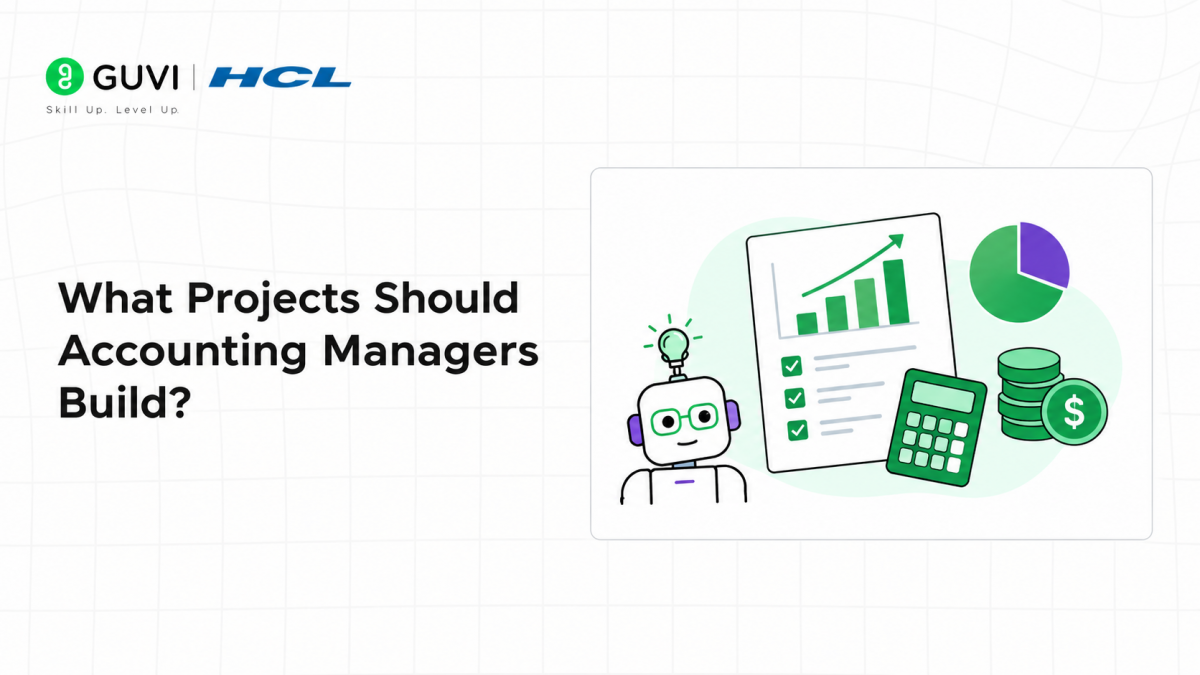
Choose projects that reflect the types of financial problems you already understand.
| Project | Skills Demonstrated |
|---|---|
| Expense Forecasting | Python, regression, forecasting |
| Budget Variance Analysis | Data cleaning, visualization, business analysis |
| Fraud Detection | Classification, model evaluation |
| Cash Flow Prediction | Time-series analysis, forecasting |
| Financial Performance Dashboard | SQL, Excel, Power BI |
You can begin with a dashboard or exploratory analysis and progress to predictive models as your skills improve.
For instance, a budget variance project could start by comparing actual and planned expenses. A more advanced version could investigate recurring patterns and build a model to estimate future spending.

Use public or synthetic datasets. Never publish confidential company accounts, audit records, employee details, or client financial information.
Pro Tip: Build projects around business questions you have encountered in accounting. Explain what the problem means to an organization, how you prepared the data, why you selected a particular method, and how the findings could support a decision. This makes your work more meaningful than simply displaying charts or model outputs.
How Long Does the Career Transition Take?
The time required depends on your current technical knowledge, the hours you can dedicate to learning, and the complexity of your target roles. The following is an illustrative study plan, not a guarantee of job readiness.
- Months 1–2: Learn Python fundamentals, SQL, and basic data handling.
- Months 3–4: Practice statistics, data cleaning, exploratory analysis, and visualization.
- Months 5–6: Learn introductory machine learning and build small projects.
- Months 7–9: Develop more complete projects, strengthen your portfolio, and prepare for interviews.
If you are new to programming, you may need more time. Focus on building a strong understanding of the concepts and completing projects independently rather than rushing to finish a course.
Accounting managers already work with financial trends, budgeting, forecasting, and risk assessment. These skills can help them identify meaningful business problems in Data Science, especially when combined with Python, SQL, statistics, and machine learning.
Should You Start With Data Analytics Before Data Science?
For accounting managers with limited programming experience, Data Analytics can be a useful starting point.
It introduces you to SQL, data cleaning, visualization, and business problem-solving. These skills are also useful in Data Science.
You could begin by analyzing expense trends or creating a financial dashboard. Once you are comfortable working with data, you can progress to Python, statistics, and machine learning.
However, Data Analytics is not a mandatory step. If you already have strong programming and statistical foundations, you can start learning Data Science directly.
Choose the route that matches your current abilities and the requirements of your target jobs.
What Career Opportunities Can Accounting Managers Explore?
Your options depend on your technical skills, previous experience, and employer requirements.
Potential roles include:
- Financial Data Analyst: Analyzes financial information and prepares insights for business decisions.
- Risk Analyst: Uses data to assess financial or operational risks.
- Fraud Analytics Specialist: Investigates suspicious patterns and supports fraud prevention.
- Data Scientist: Develops statistical and machine learning models to solve analytical problems.
- Financial Forecasting Specialist: Uses historical data and analytical methods to estimate future performance.
Some roles may value your accounting management experience, while others may expect substantial technical experience. Review job descriptions and target positions that align with your demonstrated abilities.
Conclusion
Moving from accounting manager to data scientist is a realistic career goal if you are prepared to develop the necessary technical skills. Your experience with financial reporting, budgeting, risk, and business decisions can help you understand the problems that data science aims to solve.
Start by learning Python and SQL, strengthen your statistical knowledge, and gradually explore machine learning. Build projects that connect your accounting expertise with practical data analysis, and use them to demonstrate your capabilities to employers.
Your previous experience remains valuable. The goal is to combine it with technical knowledge to solve more complex, data-driven business problems.
FAQs
1. Can an accounting manager become a data scientist?
Yes. An accounting manager can transition into Data Science by learning Python, SQL, statistics, and machine learning and demonstrating these skills through practical projects.
2. Does an accounting manager need a computer science degree?
Not necessarily. Requirements vary by employer, but you need the technical knowledge and practical skills expected for the roles you pursue.
3. Is Python necessary for an accounting manager entering Data Science?
Python is an important tool for many Data Science roles. It supports data preparation, statistical analysis, visualization, and machine learning.
4. Can I move into Data Science without leaving my accounting job immediately?
Yes. You can learn alongside your current job, practice with public datasets, and build projects gradually before applying for suitable roles.
5. What is a good first Data Science project for an accounting manager?
Expense analysis or cash flow forecasting can be useful starting points because they connect familiar financial concepts with data tools. You can progress to more advanced predictive projects as your skills improve.
6. Should accounting managers learn Data Analytics before Data Science?
Data Analytics can provide a useful foundation if you are new to programming and data tools. However, it is not compulsory if you already have the technical foundations required to study Data Science.
Success Stories

About the Author
HCL GUVI
This article was selected and published as part of the HCL GUVI AI Blogathon 2026, an initiative designed to encourage students, AI enthusiasts, and aspiring tech writers to simplify complex AI concepts through impactful technical content. The contest recognized high-quality, original, and insightful AI-focused blogs, with selected authors receiving publication opportunities on the HCL GUVI blog platform along with official author credits and recognition.
View all posts by HCL GUVI
Connect with me @





Did you enjoy this article?