


Data Science Articles
Can a Senior Accountant With 2–3 Years of Experience Switch to Data Analytics?
CA to Data Analyst: Is It a Good Career Move?
How to Write a Data Analyst Resume With BPO Experience That Gets Your Skills Noticed
Data Analyst Jobs for BPO Professionals - Best Guide to Roles You Can Apply For

Get In Touch For Details! Request More Information
Which Data Analytics Certifications Help Accountants and Finance Professionals?
Oct 13, 2026 3 Min Read 28 Views
(Last Updated)
Accountants and finance professionals already work with financial statements, budgets, reconciliations, and performance reports. A data analytics certification can help them extend these skills into data interpretation, dashboard development, and evidence-based decision-making. However, the right certification depends on whether you want to strengthen your current finance role, explore finance analytics, or transition into a Data Analyst position.
Table of contents
- TL;DR
- Quick Answer
- Why Should Accountants Learn Data Analytics?
- Which Data Analytics Certifications Are Worth Considering?
- ACCA Certificate in Data Analytics for Finance Professionals
- AICPA & CIMA Data Analytics Certificates
- Microsoft Certified: Power BI Data Analyst Associate
- Google Data Analytics Certificate
- What Skills Should You Build Alongside Certification?
- How Can You Apply Certification Skills to Finance Analytics?
- Conclusion
- FAQs
- Which data analytics certification is best for accountants?
- Can accountants transition into Data Analyst jobs?
- Is Power BI useful for finance professionals?
- Should beginners learn SQL before earning a certification?
- Does a data analytics certification guarantee a job?
- What jobs can finance professionals explore after learning analytics?
- Should I learn Python or Power BI first?
TL;DR
- Finance-specific certifications connect data analytics with accounting, financial planning, and business decisions.
- Microsoft Power BI certification is useful for professionals who want to develop dashboard and reporting skills.
- Google’s Data Analytics Certificate provides a broader foundation for beginners.
- Your certification should match your career goals and existing technical knowledge.
- Practical projects help demonstrate skills beyond the certificate itself.
Quick Answer
| The best data analytics certification for accountants depends on the intended career path. ACCA’s Certificate in Data Analytics for Finance Professionals focuses on applying analytics to finance, while Microsoft’s Power BI Data Analyst certification develops tool-specific skills. Beginners can also consider Google’s Data Analytics Certificate to build foundational knowledge. |
Why Should Accountants Learn Data Analytics?
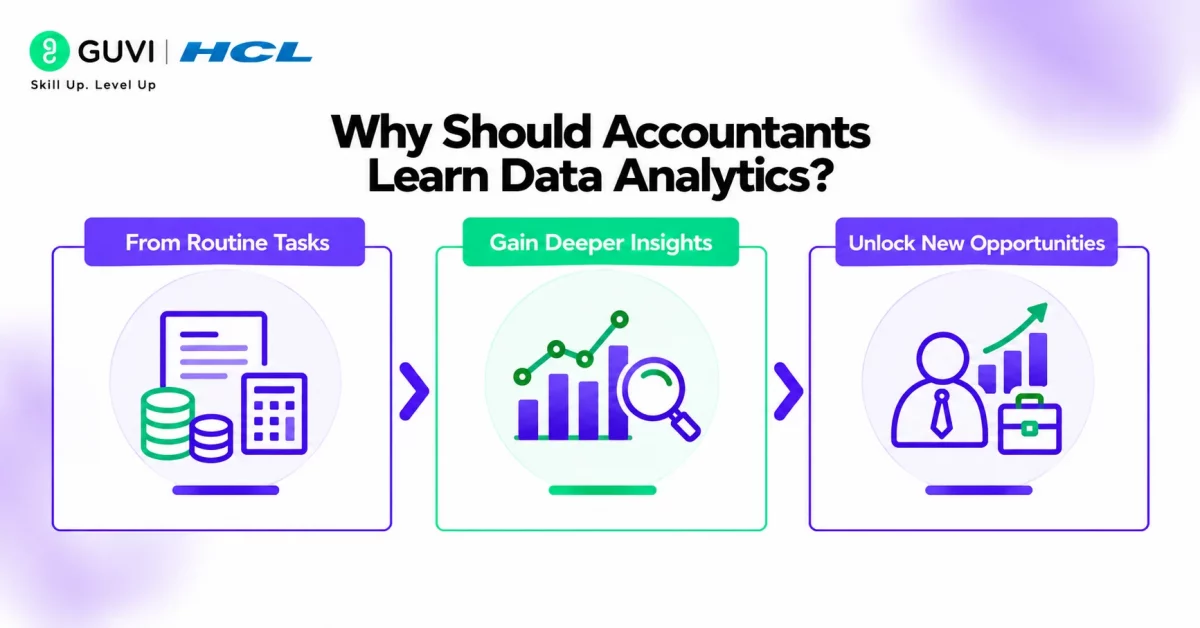
Traditional accounting responsibilities often involve recording transactions, reconciling figures, preparing reports, and ensuring financial accuracy. Data analytics extends this work by helping professionals identify patterns, investigate variances, and communicate business insights.
For example, an accountant may prepare a monthly expense report. With analytical skills, they can investigate which expense categories increased, compare spending across departments, and identify unusual patterns requiring further review.
These capabilities can support career development in financial planning and analysis (FP&A), finance analytics, business intelligence, and data analysis.
Which Data Analytics Certifications Are Worth Considering?
1. ACCA Certificate in Data Analytics for Finance Professionals
This certification is specifically designed for finance professionals who want to understand data analytics and apply it to business decisions.
The programme covers data sources, analytics techniques, data modelling, visualisation, and the role of tools such as Python and SQL. It also addresses ethical data use.
Best for: Accountants, finance professionals, and business professionals who want to incorporate analytics into their existing work.
Why consider it: Its finance-oriented examples make the learning relevant to financial decision-making rather than focusing exclusively on technical tools.
2. AICPA & CIMA Data Analytics Certificates
AICPA & CIMA offer data analytics certificates designed for accounting and finance professionals. Their learning options cover core analytics concepts, data processing and analysis, and data visualisation and communication.
The content includes data preparation, data cleansing, modelling, and communicating findings. These capabilities are useful when financial professionals need to turn large amounts of information into reliable business insights.
Best for: Accountants and finance professionals seeking structured analytics learning connected to their profession.
Why consider it: The programme connects technical concepts with financial planning, business performance, and decision-making.
3. Microsoft Certified: Power BI Data Analyst Associate
Microsoft’s Power BI Data Analyst certification, associated with the PL-300 exam, focuses on preparing, modelling, visualising, and analysing data using Power BI. It also covers data management and security.
For finance professionals, these skills can support interactive financial dashboards, budget-versus-actual reports, expense analysis, and performance monitoring.
Best for: Accountants who want to improve reporting or pursue finance analytics, business intelligence, or Data Analyst roles involving Power BI.
Why consider it: It provides a practical, tool-specific credential for demonstrating Power BI knowledge.
4. Google Data Analytics Certificate
Google’s Data Analytics Certificate introduces foundational data analysis and visualisation skills. Its curriculum includes spreadsheets, SQL, R, and Tableau. It is designed for learners who do not necessarily have prior analytics experience.
This option can help accountants build a broader understanding of the analytical process before specialising in a particular tool or business domain.
Best for: Beginners who want to explore a data analytics career path or build foundational technical skills.
Why consider it: It provides a structured starting point for learning how to work with data, investigate questions, and communicate findings.

What Skills Should You Build Alongside Certification?
A certificate is more valuable when you can demonstrate the skills it represents.
- Excel: Learn pivot tables, lookup functions, formulas, and variance analysis to investigate financial information.
- SQL: Practise retrieving, filtering, joining, and aggregating records from databases.
- Power BI: Learn to build dashboards, model financial data, and communicate performance trends.
- Statistics: Understand percentages, distributions, averages, and variability to interpret results accurately.
- Financial analysis: Practise budget-versus-actual comparisons, expense trends, revenue analysis, and forecasting.
Python may also be useful for automation and more advanced analytical work, depending on your target role.
How Can You Apply Certification Skills to Finance Analytics?
Create projects that demonstrate how you use data to answer finance-related questions.
For example, build a budget variance dashboard comparing planned and actual expenses. Use sample financial data to identify significant differences across departments and months.
You could also develop a revenue trend analysis, expense classification report, or cash-flow dashboard using public or synthetic datasets.
For each project, explain the business question, data preparation, tools used, findings, and recommendations. Avoid publishing confidential financial information from your employer.
Finance professionals can use analytics to investigate not only what happened but also why it happened. Comparing revenue, expenses, and historical performance can help identify patterns that deserve further investigation and support better-informed financial decisions.
Conclusion
The best data analytics certification for accountants depends on their career goals. ACCA and AICPA & CIMA offer finance-oriented learning, Microsoft Power BI certification focuses on a specific analytics tool, and Google’s Data Analytics Certificate provides broader foundational training.
Before enrolling, identify whether you want to improve financial reporting, move towards finance analytics, or pursue Data Analyst jobs. Choose one relevant certification, practise the required skills, and build projects that demonstrate your ability to analyse financial information.
FAQs
1. Which data analytics certification is best for accountants?
ACCA’s Certificate in Data Analytics for Finance Professionals is a relevant option for accountants seeking finance-focused analytics training. Other choices depend on their technical and career goals.
2. Can accountants transition into Data Analyst jobs?
Yes. Accountants can pursue Data Analyst roles by developing technical skills, practising data analysis, and demonstrating their abilities through relevant projects.
3. Is Power BI useful for finance professionals?
Yes. Power BI can help finance professionals create dashboards, analyse financial performance, and present information clearly.
4. Should beginners learn SQL before earning a certification?
Learning basic SQL can help, but the ideal starting point depends on the programme. Beginners can choose foundational training before pursuing more specialised credentials.
5. Does a data analytics certification guarantee a job?
No. A certification demonstrates learning, but employers may also assess practical skills, relevant experience, and problem-solving ability.
6. What jobs can finance professionals explore after learning analytics?
Potential options include Finance Analyst, FP&A Analyst, Finance Analytics Analyst, Business Intelligence Analyst, and Data Analyst, depending on the candidate’s skills and experience.
7. Should I learn Python or Power BI first?
Start with Power BI if your immediate goal is financial reporting and dashboards. Consider Python when you need automation or more advanced analysis.
Success Stories

About the Author
HCL GUVI
This article was selected and published as part of the HCL GUVI AI Blogathon 2026, an initiative designed to encourage students, AI enthusiasts, and aspiring tech writers to simplify complex AI concepts through impactful technical content. The contest recognized high-quality, original, and insightful AI-focused blogs, with selected authors receiving publication opportunities on the HCL GUVI blog platform along with official author credits and recognition.
View all posts by HCL GUVI
Connect with me @







Did you enjoy this article?