


Data Science Articles
Can a Senior Accountant With 2–3 Years of Experience Switch to Data Analytics?
How to Write a Data Analyst Resume With BPO Experience That Gets Your Skills Noticed
Which Data Analytics Certifications Help Accountants and Finance Professionals?
Data Analyst Jobs for BPO Professionals - Best Guide to Roles You Can Apply For

Get In Touch For Details! Request More Information
CA to Data Analyst: Is It a Good Career Move?
Oct 13, 2026 3 Min Read 16 Views
(Last Updated)
A CA-to-Data-Analyst career move allows you to combine your financial knowledge with technical skills to solve business problems. But is this career move right for you? The answer depends on your interests, current experience, willingness to learn new tools, and long-term career goals.
Table of contents
- TL;DR
- Quick Answer
- Why Should a CA Consider a Career in Data Analytics?
- What Skills Does a CA Need to Become a Data Analyst?
- Excel and Advanced Spreadsheet Analysis
- SQL for Working With Databases
- Power BI for Financial Dashboards
- Python for Advanced Analysis
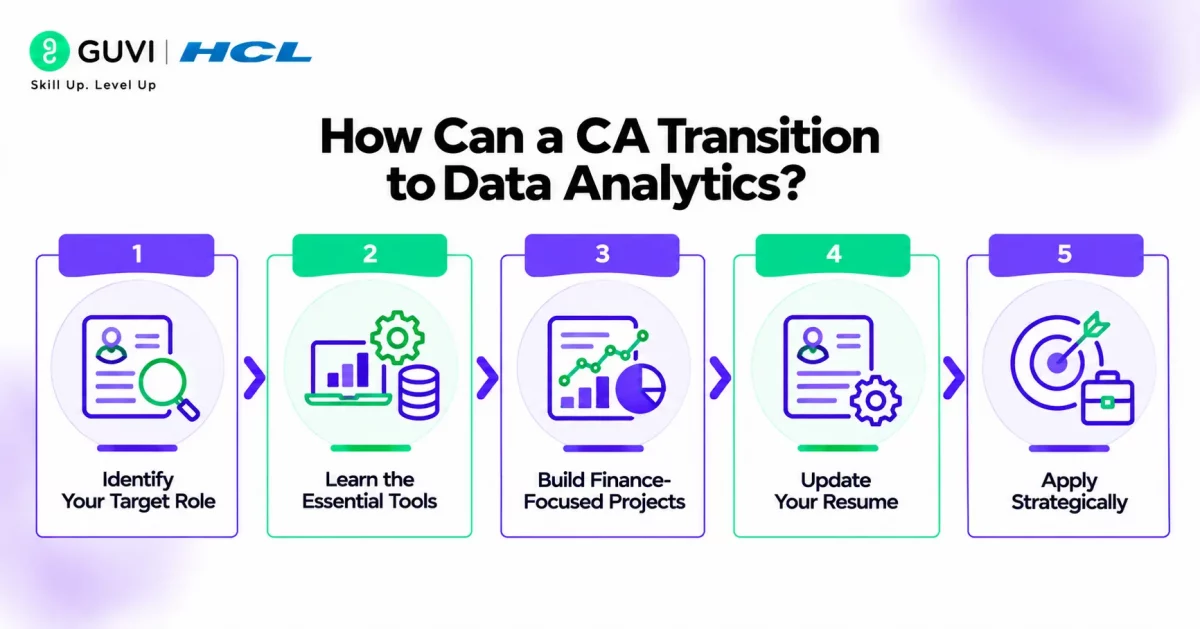
- How Can a CA Transition to Data Analytics?
- Step 1: Identify Your Target Role
- Step 2: Learn the Essential Tools
- Step 3: Build Finance-Focused Projects
- Step 4: Update Your Resume
- Step 5: Apply Strategically
- Is Switching From CA to Data Analyst Worth It?
- Conclusion
- FAQs
- Can a CA become a Data Analyst without a technical degree?
- Is data analytics a good career option for Chartered Accountants?
- Which tools should a CA learn first for data analytics?
- Can an accountant become a financial data analyst?
- Does a CA need Python to become a Data Analyst?
- What projects should a CA include in a data analytics portfolio?
- Should a CA leave accounting completely to pursue data analytics?
TL;DR
- CAs already have valuable financial analysis, reporting, and problem-solving skills.
- Excel, SQL, Power BI, and data visualization are useful skills to develop.
- Finance analytics, financial data analysis, and business intelligence can be practical starting points.
- You do not necessarily need to abandon accounting expertise to enter data analytics.
- Building relevant projects and demonstrating practical skills is essential for a successful career transition.
Quick Answer
| Yes, moving from CA to Data Analyst can be a good career move if you enjoy interpreting data and making evidence-based business decisions. Your accounting knowledge can help you understand financial trends, budgets, profitability, and risks. However, you must develop technical skills such as SQL and Power BI and demonstrate that you can transform raw data into actionable insights. The AICPA & CIMA Data Analytics Certificates offer learning opportunities designed for accounting and finance professionals. |
Why Should a CA Consider a Career in Data Analytics?
Traditional accounting involves examining financial transactions, preparing statements, ensuring compliance, and evaluating financial performance. Data analytics builds on these activities by helping professionals investigate larger datasets, identify patterns, and communicate insights.
For example, instead of simply reporting that a company’s expenses increased, a data analyst might examine departmental spending, compare monthly trends, and identify the categories contributing most to the increase.
Your CA background can be useful in areas such as:
- Financial analysis: Understanding revenue, expenses, profitability, and cash flow.
- Risk assessment: Identifying unusual transactions and investigating financial inconsistencies.
- Budgeting and forecasting: Comparing actual results against budgets and examining historical trends.
- Business decision-making: Explaining how financial information affects operational and strategic decisions.
These skills can give you an advantage when applying for analytics roles involving financial data. However, accounting expertise alone does not replace the technical skills required for most data analyst positions.
What Skills Does a CA Need to Become a Data Analyst?
You do not need to master every analytics tool before applying for entry-level roles. Start with the skills most relevant to your target position.
1. Excel and Advanced Spreadsheet Analysis
Excel is a practical starting point because many accounting and finance workflows already involve spreadsheets.
Develop your ability to use pivot tables, lookup functions, conditional formulas, data cleaning techniques, and financial reporting templates. These skills can help you organize financial records and identify trends efficiently.
2. SQL for Working With Databases
SQL allows you to retrieve, filter, combine, and summarize data stored in databases.
For example, you might use SQL to calculate monthly revenue, compare customer payments, or identify overdue invoices. Start with SELECT statements, filtering, aggregation, joins, and grouping before progressing to more advanced queries.
3. Power BI for Financial Dashboards
Power BI helps you turn financial datasets into interactive dashboards and reports.
4. Python for Advanced Analysis
Python can help automate repetitive tasks, clean larger datasets, and perform more advanced analysis. Libraries such as pandas are useful for manipulating tabular data.
How Can a CA Transition to Data Analytics?
Step 1: Identify Your Target Role
Review job descriptions for financial data analyst, business intelligence analyst, and related positions. Identify recurring requirements and prioritize the skills that match your interests.
Step 2: Learn the Essential Tools
Start with Excel, then learn SQL and Power BI. Add Python when your target roles require programming or more advanced data manipulation.
Follow a structured learning path rather than switching between unrelated courses.
Step 3: Build Finance-Focused Projects
Create two or three projects that connect accounting knowledge with practical analytics.
Examples include:
- A budget-versus-actual dashboard showing spending variances.
- A profitability analysis comparing products or business units.
- A receivables dashboard tracking overdue invoices and payment patterns.
Use sample or publicly available datasets. Explain the business question, how you prepared the data, what you discovered, and how your findings could support a decision.

Step 4: Update Your Resume
Highlight relevant accounting experience alongside your new technical skills.
Instead of listing only financial reporting responsibilities, explain how you analyzed variances, investigated discrepancies, automated reports, or improved reporting accuracy when those activities genuinely reflect your experience.
Include your analytics projects and the tools you used. Do not claim professional SQL or Power BI experience if you have only practised them independently.
Step 5: Apply Strategically
Target roles that value financial knowledge and analytical ability. Prepare to explain your projects, demonstrate your technical skills, and discuss how you would investigate a business problem using data.
Is Switching From CA to Data Analyst Worth It?
- It may be a good move if you enjoy investigating trends, working with datasets, building dashboards, and using evidence to solve business problems. It can also suit professionals who want to combine finance expertise with technology.
- It may not be the right move if you dislike learning technical tools or prefer work focused primarily on taxation, auditing, compliance, and traditional accounting responsibilities.
You should also consider the transition costs. Depending on your existing experience and technical proficiency, you may need time to build projects, learn new tools, and compete for roles that require practical analytics experience.
Data analytics is relevant to accounting and finance beyond routine reporting. The AICPA & CIMA data analytics learning resources cover topics such as data processing, visualization, and communicating insights, helping finance professionals develop a more data-driven approach to business decisions.
Conclusion
Moving from CA to Data Analyst can be a worthwhile career transition if you want to combine financial expertise with technical analysis. Your accounting background provides a useful foundation, but you still need to learn tools such as SQL and Power BI and demonstrate your abilities through practical projects.
Start with finance-focused analytics, build a portfolio, and target roles that value your existing knowledge. You do not have to discard your CA expertise; you can use it as a differentiator while developing the skills required for a finance data career.
FAQs
1. Can a CA become a Data Analyst without a technical degree?
Yes. A technical degree is not always mandatory. However, you need relevant analytical skills, practical tool knowledge, and projects that demonstrate your ability to work with data.
2. Is data analytics a good career option for Chartered Accountants?
It can be a good option for CAs who enjoy analyzing financial trends, investigating discrepancies, and supporting business decisions with data.
3. Which tools should a CA learn first for data analytics?
Start with advanced Excel, SQL, and Power BI. Learn Python later if your target roles require programming or advanced data manipulation.
4. Can an accountant become a financial data analyst?
Yes. Accounting knowledge can help you understand financial datasets, reporting requirements, budgets, and profitability. You must also develop the technical skills required by employers.
5. Does a CA need Python to become a Data Analyst?
Not necessarily. Some finance-focused roles prioritize Excel, SQL, and Power BI. Python becomes more useful when the work involves automation, larger datasets, or advanced analysis.
6. What projects should a CA include in a data analytics portfolio?
Useful projects include budget variance dashboards, profitability analysis, cash flow reporting, and accounts receivable analysis. Each project should explain the business problem, analytical approach, and findings.
7. Should a CA leave accounting completely to pursue data analytics?
Not necessarily. You can explore hybrid roles in financial planning and analysis, finance business intelligence, and financial analytics that combine accounting knowledge with data skills.
Success Stories

About the Author
HCL GUVI
This article was selected and published as part of the HCL GUVI AI Blogathon 2026, an initiative designed to encourage students, AI enthusiasts, and aspiring tech writers to simplify complex AI concepts through impactful technical content. The contest recognized high-quality, original, and insightful AI-focused blogs, with selected authors receiving publication opportunities on the HCL GUVI blog platform along with official author credits and recognition.
View all posts by HCL GUVI
Connect with me @








Did you enjoy this article?