


VLSI Design Articles
Why Chips Fail: A Basic Guide to Chip Defects and IC Failure Analysis
Fun Facts About the Semiconductor Industry
Why Are Semiconductor Chips Expensive? Manufacturing Cost Explained
Instruction Set Architecture: How ISA Shapes Modern Chip Design


Get In Touch For Details! Request More Information
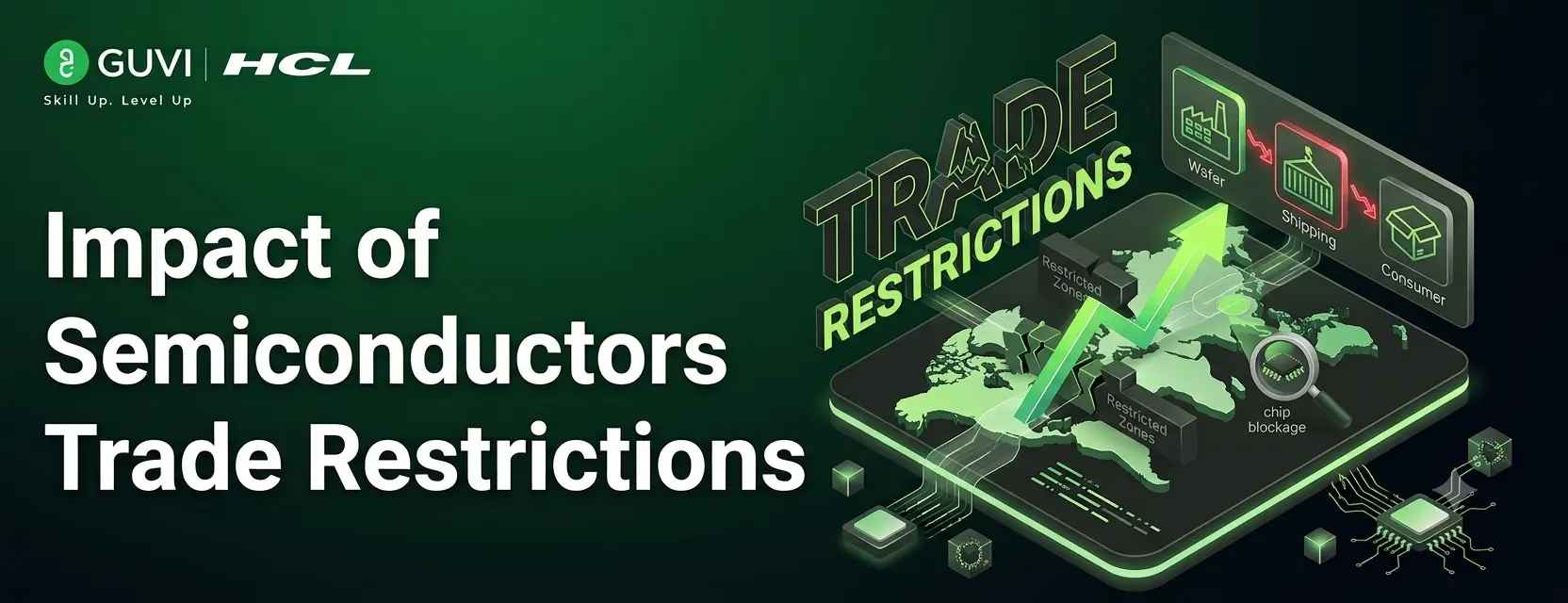
Semiconductor Trade Restrictions Explained: How Chip Export Curbs Shape the Global Economy
Aug 06, 2026 6 Min Read 372 Views
(Last Updated)
Table of contents
- TL;DR Summary
- Introduction
- What Are Semiconductor Trade Restrictions?
- Semiconductor Trade Restrictions Explained in Simple Words
- Why This Matters to You
- Why Do Countries Restrict Chip Exports?
- National Security and AI Competition
- Supply Chain Resilience
- Economic Leverage
- How Semiconductor Trade Restrictions Affect the Global Economy
- They Increase Supply Chain Costs
- They Slow Down Chip Exports
- They Reshape the Semiconductor Industry
- They Affect Inflation and Consumer Prices
- They Influence Jobs and Skills Demand
- Global Semiconductor Market: Open Trade vs Restricted Trade
- Open Chip Trade vs Restricted Chip Trade
- How Businesses Are Responding
- Supplier Diversification
- Product Redesign
- Local Manufacturing and Talent Building
- Compliance Teams Become Strategic
- Industries Most Affected by Chip Export Curbs
- Automotive and Electric Vehicles
- Artificial Intelligence and Cloud Computing
- Consumer Electronics
- Defense and Aerospace
- Telecom and 5G Infrastructure
- Business Scenarios That Show the Economic Impact
- Scenario 1: An EV Manufacturer Faces Chip Delays
- Scenario 2: A Cloud Company Expands AI Infrastructure
- Common Mistakes to Avoid
- Mistake 1: Thinking Semiconductor Trade Restrictions Affect Only China and the U.S.
- Mistake 2: Treating Chips Like Ordinary Components
- Mistake 3: Ignoring Compliance Until Shipment
- Mistake 4: Assuming Local Manufacturing Solves Everything Immediately
- Conclusion
- Frequently Asked Questions
- What are Semiconductor Trade Restrictions?
- Why do countries restrict chip exports?
- How do Semiconductor Trade Restrictions affect the global economy?
- Which industries are most affected by chip trade restrictions?
- Do chip export restrictions increase prices?
- How do trade restrictions affect the global semiconductor market?
- Are Semiconductor Trade Restrictions good or bad?
- Can India benefit from semiconductor trade shifts?
TL;DR Summary
Semiconductor Trade Restrictions are government rules that limit the export of advanced chips, chipmaking tools, software, and related technologies to specific countries or companies. These restrictions affect chip exports, reshape the semiconductor industry, increase supply-chain costs, and influence the global semiconductor market. While they are often introduced for national security reasons, they can also disrupt electronics, automotive, AI, defense, telecom, and consumer goods industries that depend on reliable chip access.
Introduction
Semiconductor Trade Restrictions are now one of the biggest economic issues in technology, manufacturing, and global trade. Chips power smartphones, EVs, cloud servers, defense systems, medical devices, telecom networks, and AI infrastructure.
The impact is huge because the semiconductor industry is not built in one country. Design, fabrication, testing, packaging, equipment, and raw materials are spread across multiple economies.
That means when chip exports are restricted, the effect does not stop at one border. It can influence prices, production timelines, company revenues, national security strategies, and even career demand in VLSI and chip design.
What Are Semiconductor Trade Restrictions?
Semiconductor Trade Restrictions are policy controls that limit who can buy, sell, manufacture, or access advanced semiconductor technologies. These controls may apply to chips, manufacturing equipment, design software, technical services, intellectual property, or companies placed on restricted trade lists.
In simple terms, they decide which countries or companies can access critical chip technology.
Semiconductor Trade Restrictions Explained in Simple Words
Think of chips as the “engines” of the digital economy. If a country restricts chip exports, it is like limiting access to the engines needed to build AI systems, electric vehicles, satellites, data centers, and smart devices.
These restrictions usually cover:
- Advanced AI chips
- Semiconductor manufacturing equipment
- Chip design software
- High-bandwidth memory and advanced logic chips
- Technical support and services
- Exports to specific countries, companies, or end uses
Why This Matters to You
Even if you are not directly working in semiconductors, these restrictions can affect the products and services you use.
For example, a delay in chip supply can increase the waiting period for cars, raise electronics prices, slow cloud expansion, and change hiring demand in chip design, embedded systems, VLSI, and electronics manufacturing.
Why Do Countries Restrict Chip Exports?
Countries use semiconductor restrictions mainly to protect national security, control strategic technologies, and reduce dependence on rival economies. The U.S. Bureau of Industry and Security introduced major controls in October 2022 covering advanced computing chips and semiconductor manufacturing items for China, citing national security and foreign policy reasons.
National Security and AI Competition
Advanced chips are essential for AI training, supercomputing, cybersecurity, weapons systems, and surveillance technologies.
That is why governments treat high-end semiconductors as strategic assets, not just commercial products.
Supply Chain Resilience
The 2020–2022 chip shortage showed how fragile global supply chains can be. The U.S. Department of Commerce reported that median chip inventory among consumers fell from 40 days in 2019 to less than 5 days in 2021.
When inventories are that low, even a small disruption can stop production lines.
Economic Leverage
Chip restrictions also give countries bargaining power. A nation that controls chip design tools, advanced fabrication equipment, or high-end chip exports can influence global technology access.
This is why the global semiconductor market is closely linked to diplomacy, trade policy, and industrial strategy.
How Semiconductor Trade Restrictions Affect the Global Economy
Semiconductor Trade Restrictions affect the economy by changing where chips are made, who can buy them, how much they cost, and how fast companies can innovate.
The global semiconductor market reached $791.7 billion in 2025, growing 25.6% from 2024, according to the Semiconductor Industry Association.
1. They Increase Supply Chain Costs
A semiconductor chip may cross borders multiple times before it becomes part of a finished product.
When restrictions enter the picture, companies may need to:
- Find alternate suppliers
- Redesign products
- Apply for export licenses
- Shift manufacturing locations
- Hold more inventory
- Pay higher logistics and compliance costs
These costs often move downstream to electronics, cars, cloud services, telecom equipment, and industrial machinery.
2. They Slow Down Chip Exports
Chip exports are highly sensitive to policy changes because companies must comply with licensing rules, entity lists, product classifications, and end-use checks.
For businesses, this means revenue uncertainty. For countries, it can mean slower adoption of AI, cloud computing, and advanced manufacturing.
3. They Reshape the Semiconductor Industry
Trade restrictions are pushing countries to build domestic chip ecosystems.
The OECD notes that semiconductor value chains have strong regional concentration and growing trade dependencies, which makes the industry vulnerable to disruptions in specific countries or production stages.
This is why countries are investing in local fabs, packaging facilities, design centers, and talent development.
4. They Affect Inflation and Consumer Prices
When chip supply becomes restricted, product availability can fall and prices can rise.
The automotive sector is a strong example. During the chip shortage, AlixPartners estimated that the auto industry could lose 7.7 million vehicles of production and $210 billion in revenue in 2021.
That kind of disruption affects dealers, consumers, suppliers, workers, and national GDP.
5. They Influence Jobs and Skills Demand
Restrictions create uncertainty, but they also create new opportunities.
As countries localize chip design and manufacturing, demand grows for skills such as:
- VLSI design
- Digital verification
- Embedded systems
- Physical design
- Semiconductor testing
- Electronics manufacturing
- Hardware security
For learners, this is an important signal: the semiconductor industry is becoming a long-term career ecosystem, not just a niche electronics field.
Global Semiconductor Market: Open Trade vs Restricted Trade
The semiconductor industry works best when innovation, manufacturing, and trade remain predictable. But national security concerns are changing how companies plan global operations.
Open Chip Trade vs Restricted Chip Trade
| Factor | Open Semiconductor Trade | Restricted Semiconductor Trade |
| Chip availability | Wider access to global suppliers | Access depends on licenses and policy rules |
| Cost structure | Lower sourcing and compliance costs | Higher compliance, redesign, and inventory costs |
| Innovation speed | Faster collaboration across regions | Slower cross-border R&D and technology transfer |
| Supply chain design | Efficiency-focused | Resilience-focused |
| Business risk | Market-driven risk | Market + geopolitical risk |
| Talent demand | Broad electronics and software skills | Higher demand for local VLSI and hardware talent |
How Businesses Are Responding
Companies are not waiting for policy uncertainty to settle. They are redesigning supply chains and building resilience into procurement, engineering, and manufacturing.
Supplier Diversification
Businesses are reducing dependency on one country, one foundry, or one packaging partner.
This does not mean abandoning global trade. It means building backup options before disruption happens.
Product Redesign
Some companies redesign products to use chips that are easier to source.
For example, an automotive company may replace a restricted microcontroller with an available alternative, but this requires testing, certification, and engineering time.
Local Manufacturing and Talent Building
Governments and companies are investing in domestic chip capacity.
India is also moving in this direction. According to India’s Press Information Bureau, India’s semiconductor market was around $38 billion in 2023, $45–50 billion in 2024–25, and is expected to reach $100–110 billion by 2030.
Compliance Teams Become Strategic
Export compliance is no longer just legal paperwork.
Companies now need teams that understand product classification, chip architecture, end-use risk, customer screening, and country-specific trade rules.

Industries Most Affected by Chip Export Curbs
Semiconductor Trade Restrictions affect many industries because chips are embedded in almost every modern product.
Automotive and Electric Vehicles
EVs need power chips, sensors, microcontrollers, battery management systems, and infotainment processors.
A shortage or restriction can delay vehicle production and increase prices.
Artificial Intelligence and Cloud Computing
AI models need high-performance GPUs, memory, networking chips, and data center infrastructure.
When access to advanced chips becomes restricted, AI development can become slower and more expensive.
Consumer Electronics
Smartphones, laptops, wearables, gaming consoles, and smart home devices depend on stable chip exports.
A supply disruption can affect launch timelines and retail prices.
Defense and Aerospace
Defense systems use advanced chips for radar, communication, navigation, drones, and secure computing.
This is one reason governments apply stricter controls to advanced semiconductor technologies.
Telecom and 5G Infrastructure
5G networks need radio frequency chips, baseband processors, power amplifiers, and networking silicon.
Restrictions can slow telecom rollout in affected markets.
A missing chip worth just a few dollars can delay the production of a car worth lakhs of rupees. In semiconductor supply chains, the smallest component can become the biggest bottleneck.
Business Scenarios That Show the Economic Impact
Scenario 1: An EV Manufacturer Faces Chip Delays
An EV company depends on chips for battery control, infotainment, safety systems, and power electronics.
If trade restrictions delay chip exports, the company cannot simply replace those chips overnight. It must test alternatives, update software, certify safety systems, and renegotiate supplier contracts.
The result can be delayed vehicle deliveries, higher working capital, and reduced quarterly revenue.
Scenario 2: A Cloud Company Expands AI Infrastructure
A cloud provider planning new AI data centers needs GPUs, memory, networking silicon, and power management components.
If access to advanced chips is restricted, expansion costs rise. Customers using AI tools may face higher prices or limited compute availability.
This shows how semiconductor restrictions can indirectly affect startups, developers, enterprises, and AI learners.
Common Mistakes to Avoid
Mistake 1: Thinking Semiconductor Trade Restrictions Affect Only China and the U.S.
Many people assume chip restrictions are only about U.S.–China competition. That is too narrow.
The semiconductor industry is global, so restrictions can affect suppliers, customers, logistics providers, equipment makers, and design teams in many countries.
A company in India, Germany, Taiwan, South Korea, Japan, or Singapore may still be affected if its products contain controlled technology or serve restricted end users.
The better approach is to view restrictions as a global supply-chain issue, not a two-country issue.
Mistake 2: Treating Chips Like Ordinary Components
A chip is not like a screw, cable, or plastic part that can be easily replaced.
Each chip may need board-level redesign, firmware changes, thermal testing, certification, and reliability validation.
This is why even a small semiconductor disruption can delay a car, medical device, telecom system, or industrial machine.
Businesses should map critical chips early instead of waiting for a shortage or policy shock.
Mistake 3: Ignoring Compliance Until Shipment
Export compliance should start during product planning, not after the product is ready to ship.
Companies need to know whether a chip, tool, software component, or technical service falls under export control rules.
Waiting until shipment can lead to blocked orders, delayed revenue, legal risk, and customer dissatisfaction.
A smarter approach is to involve compliance, engineering, sourcing, and sales teams from the beginning.
Mistake 4: Assuming Local Manufacturing Solves Everything Immediately
Building local semiconductor capacity is important, but it takes time.
A strong chip ecosystem needs fabs, design talent, EDA tools, testing facilities, packaging units, raw materials, equipment suppliers, and skilled engineers.
Countries cannot become fully self-reliant overnight.
The practical goal is resilience: reduce single-point dependency while continuing trusted global partnerships.
If this topic makes you curious about how chips are actually designed, verified, and prepared for real-world systems, learning VLSI can give you a practical entry point into the semiconductor industry. You can explore IIT Delhi Certified VLSI Design Program or start with the VLSI Design and Verification Course to build industry-relevant chip design skills step by step.
Conclusion
Semiconductor Trade Restrictions affect much more than chip exports. They influence global supply chains, product prices, AI growth, automotive production, national security, and job creation. For businesses, the lesson is clear: semiconductor strategy is now business strategy. For learners, this shift creates strong opportunities in VLSI, embedded systems, chip design, verification, and electronics manufacturing. The next step is to understand both the technology and the trade forces shaping the global semiconductor market.
Frequently Asked Questions
1. What are Semiconductor Trade Restrictions?
Semiconductor Trade Restrictions are government rules that limit the export or transfer of chips, chipmaking tools, software, or technical services to specific countries, companies, or end uses.
2. Why do countries restrict chip exports?
Countries restrict chip exports to protect national security, control advanced technologies, prevent military misuse, and reduce dependence on geopolitical rivals.
3. How do Semiconductor Trade Restrictions affect the global economy?
They affect the global economy by increasing supply-chain costs, slowing chip exports, disrupting manufacturing, raising product prices, and reshaping investment in the semiconductor industry.
4. Which industries are most affected by chip trade restrictions?
Automotive, AI, cloud computing, telecom, defense, aerospace, medical devices, and consumer electronics are among the most affected industries.
5. Do chip export restrictions increase prices?
Yes, they can. When supply becomes limited or companies must redesign products and find new suppliers, those extra costs can move into final product pricing.
6. How do trade restrictions affect the global semiconductor market?
They shift the global semiconductor market from efficiency-based sourcing to resilience-based sourcing, encouraging countries and companies to invest in local manufacturing and diversified supply chains.
7. Are Semiconductor Trade Restrictions good or bad?
They can protect national security, but they can also raise costs, slow innovation, and disrupt industries. The impact depends on how targeted, coordinated, and predictable the rules are.
8. Can India benefit from semiconductor trade shifts?
Yes. India can benefit if it builds strong capabilities in chip design, VLSI, packaging, manufacturing support, electronics systems, and semiconductor talent development.
Success Stories
















Did you enjoy this article?