


VLSI Design Articles
Why Chips Fail: A Basic Guide to Chip Defects and IC Failure Analysis
Fun Facts About the Semiconductor Industry
Why Are Semiconductor Chips Expensive? Manufacturing Cost Explained
Instruction Set Architecture: How ISA Shapes Modern Chip Design

Get In Touch For Details! Request More Information

Top 5 VLSI Certification Courses in India for Beginners in 2026
Aug 20, 2026 4 Min Read 22394 Views
(Last Updated)
VLSI (Very Large Scale Integration) certification courses teach you to design and verify integrated circuits using tools like Verilog and industry EDA software. The right course can take you from zero chip design knowledge to job ready in six to nine months.
Table of contents
- TL;DR
- What is VLSI Design?
- 💡 Did You Know?
- Why Beginners Should Consider a VLSI Certification
- Top 5 VLSI Certification Courses for Beginners
- 1) HCL GUVI's VLSI Design flagship course
- 2) Advanced VLSI Design by Maven Silicon
- 3) IISc-TalentSprint VLSI chip design course
- 4) Coursera VLSI Design Specialization
- 5) Synopsys Purple Certification
- How to Choose the Right Course for You
- Concluding Thoughts…
- FAQs
- Which field of VLSI is best?
- Is VLSI a high-paid job?
- Does Google hire VLSI engineers?
- What is the full form of VLSI?
- What are the three types of VLSI?
- Does Google hire VLSI engineers?
- How long does it take to become job-ready in VLSI design?
TL;DR
- VLSI certification courses train you in RTL design, verification, and physical design using tools like Verilog, VHDL, and industry EDA software
- The best options for beginners in 2026 include HCL GUVI’s VLSI Design programme, Maven Silicon’s Advanced VLSI Design course, and the IISc TalentSprint chip design programme
- Fees range from around ₹15,000 for entry-level Coursera specializations to ₹2,80,000 for IISc’s flagship programme
- Entry-level VLSI engineers in India earn between ₹3.5 LPA and ₹7.1 LPA on average, with experienced professionals crossing ₹25 LPA
- Look for hands-on EDA tool access, a strong verification module, and placement support before you enroll
What is VLSI Design?
VLSI (Very Large Scale Integration) design refers to the process of crafting complex integrated circuits (ICs) by embedding millions or billions of transistors onto a single microchip. This intricate design process underpins nearly all modern electronic devices, including smartphones, laptops, AI processors, and IoT devices.
VLSI design is the backbone of semiconductor manufacturing, enabling the development of high-performance and energy-efficient chips critical for technological advancements.
💡 Did You Know?
India’s semiconductor sector is projected to create over 1 million direct and indirect jobs by 2027 as the government’s Semiconductor Mission draws in investment from Micron, Tata Electronics, and other global chipmakers.Why Beginners Should Consider a VLSI Certification
A four-year engineering degree gives you theory. It rarely gives you hands-on time with the EDA tools companies actually use, like Cadence Virtuoso or Synopsys Design Compiler. A focused certification fills that gap in months, not years, and most programs end with a portfolio project you can show recruiters.
Top 5 VLSI Certification Courses for Beginners
Here’s a quick side-by-side look before you dive into details.
| Course | Provider | Duration | Fees (approx) | Best For |
|---|---|---|---|---|
| VLSI Design Flagship Course | HCL GUVI | 6 months | ₹90,000 | Beginners wanting an end-to-end, job-ready path |
| Advanced VLSI Design | Maven Silicon | 6 to 9 months | ₹75,000 | Learners focused on RTL and verification |
| VLSI Chip Design Programme | IISc Bangalore + TalentSprint | 10 months | ₹2,80,000 | Working professionals wanting an IISc credential |
| VLSI Design Specialization | Coursera | Self-paced | ₹15,000 to ₹20,000 | Students exploring VLSI before committing further |
| Purple Certification | Synopsys | Varies | ₹2,00,000 | Engineers wanting a globally recognised tool credential |
For beginners, acquiring VLSI certifications is a crucial step to building foundational skills in chip design and securing lucrative roles in the booming semiconductor industry. Hence, now we will be discussing the top 5 certification courses that every beginner should have a look into before starting your journey into mastering VLSI design.
1) HCL GUVI’s VLSI Design flagship course
HCL GUVI’s flagship VLSI Design course is crafted for both beginners and professionals aiming to build a career in chip design and semiconductor technology. This interactive program provides hands-on experience with industry-standard tools and methodologies. The course is highly recommended for learners like you seeking practical insights and a structured learning path in VLSI design.
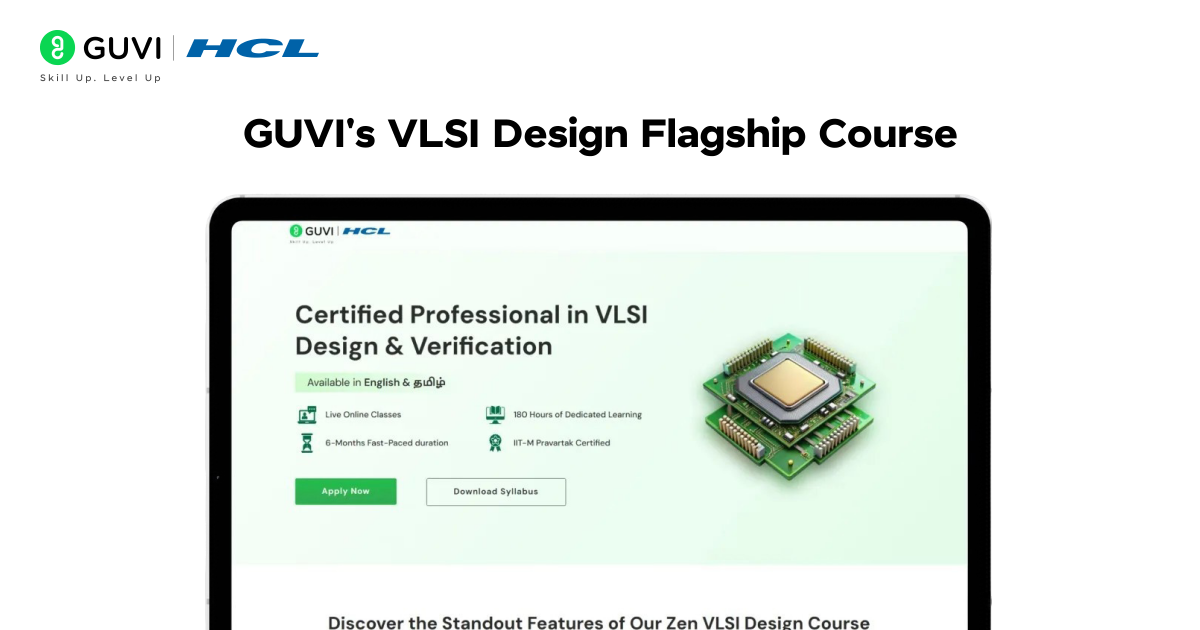
Course Content: The course covers foundational topics like digital logic design, RTL (Register Transfer Level) coding, and synthesis. It progresses into advanced areas such as functional verification, static timing analysis, and ASIC design methodologies. HCL GUVI emphasizes project-based learning, ensuring students apply concepts in real-world scenarios using tools like Verilog and SystemVerilog.
Certification: Yes, participants receive a HCL GUVI certification in VLSI Design, recognized in the semiconductor industry.
Price: ₹90,000
Course Link: HCL GUVI’s VLSI Design course
Already building your VLSI portfolio? Pair it with a strong resume — Create Your Free Resume
2) Advanced VLSI Design by Maven Silicon
Maven Silicon offers a specialized Advanced VLSI Design course tailored for aspirants keen on mastering RTL coding and functional verification. This program bridges the gap between theoretical concepts and practical application in chip design.
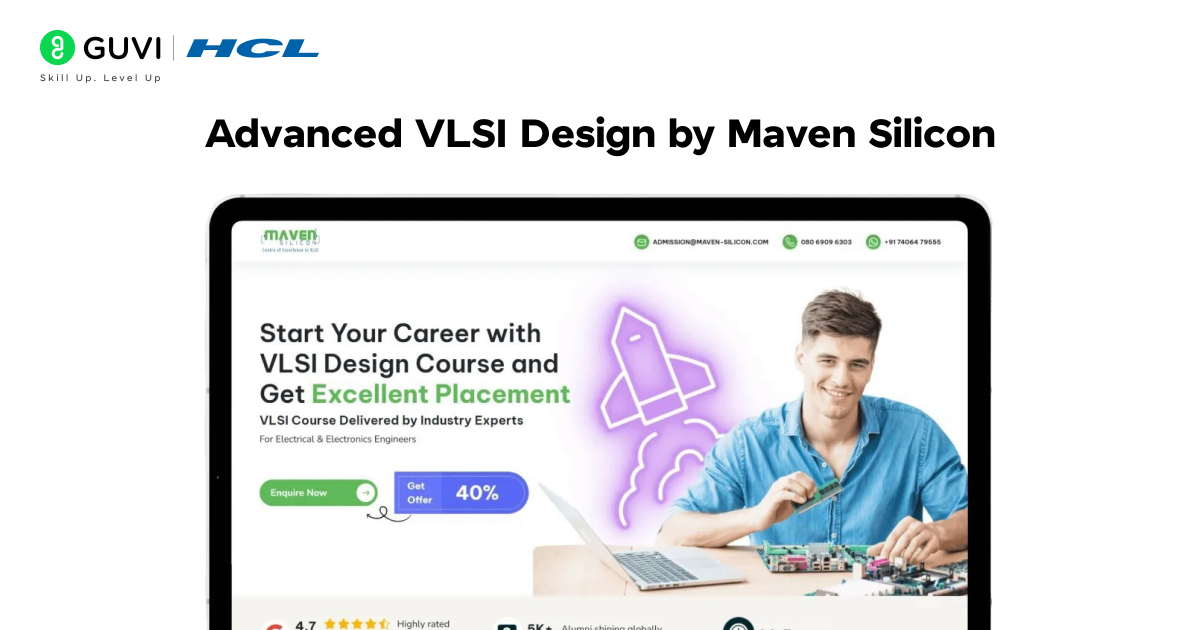
Course Content: The course begins with the fundamentals of digital electronics and gradually dives into RTL synthesis, UVM (Universal Verification Methodology), and functional verification. You will get hands-on experience with advanced simulation tools like Mentor Graphics QuestaSim and Synopsys VCS. The curriculum includes real-world case studies to enhance your problem-solving skills.
Certification: Yes, Maven Silicon provides an industry-recognized Advanced VLSI Design certification.
Price: ₹75,000
Course Link: Advanced VLSI Design by Maven Silicon
3) IISc-TalentSprint VLSI chip design course
This program is a collaboration between IISc Bangalore and TalentSprint, aimed at professionals and students interested in semiconductor design. It blends academic rigor with practical industry insights, making it ideal for those aspiring to work in chip design.
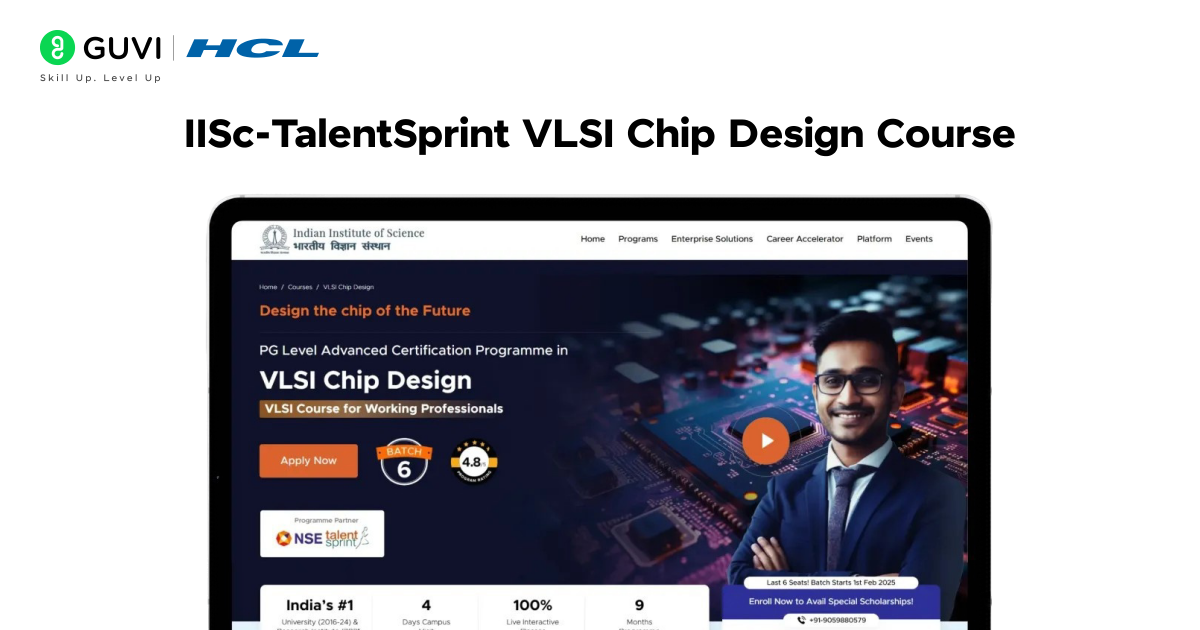
Course Content: The course covers semiconductor fundamentals, CMOS design, and HDL programming. It delves into chip fabrication processes, power analysis, and layout design. You will be working with advanced tools like Cadence Virtuoso and Synopsys Design Compiler to gain hands-on experience.

Certification: Yes, a joint certification from IISc and TalentSprint is awarded.
Price: ₹2,80,000 (Scholarships available)
Course Link: IISc-TalentSprint VLSI chip design course
4) Coursera VLSI Design Specialization
Coursera’s VLSI Design Specialization is a beginner-friendly program that introduces learners to the fundamentals of VLSI systems. Offered by leading universities, it’s a flexible, self-paced course perfect for students and professionals seeking an introduction to chip design.
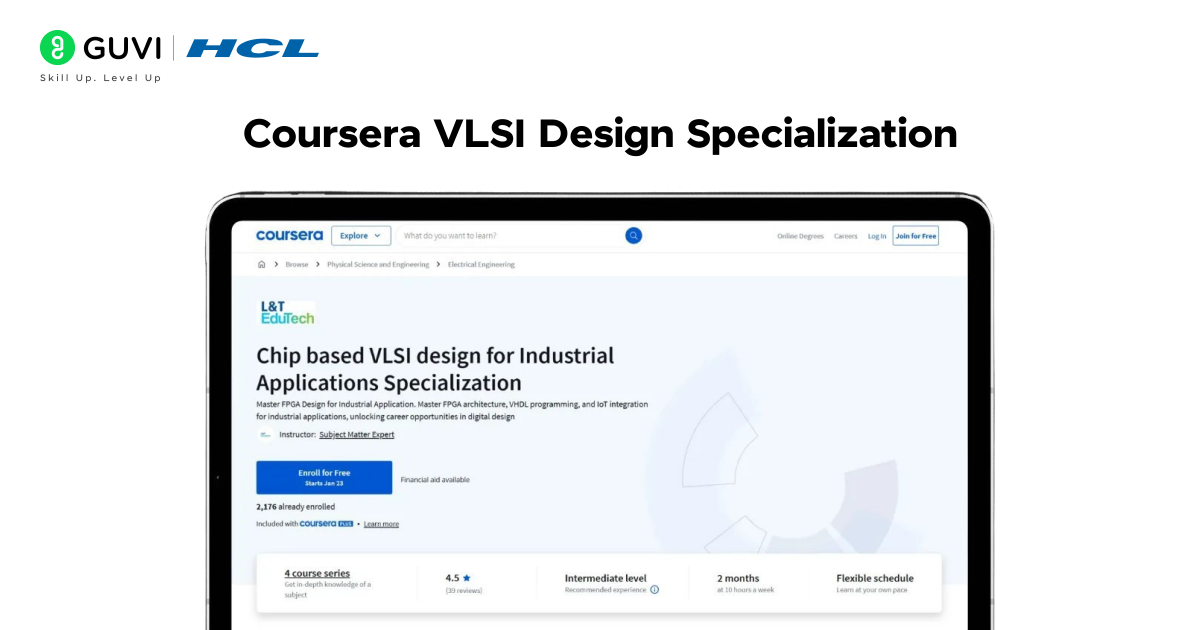
Course Content: The specialization includes modules on digital logic design, CMOS fundamentals, and HDL programming. It also explores VLSI fabrication techniques and verification methodologies. You can choose additional electives on analog design or advanced CMOS processes.
Certification: Yes, a Coursera specialization certificate is provided upon completion.
Price: ₹15,000
Course Link: Coursera VLSI Design Specialization
5) Synopsys Purple Certification
The Synopsys Purple Certification program is a professional-grade training course aimed at VLSI engineers and designers. This certification is recognized globally and focuses on using Synopsys tools for high-performance chip design.
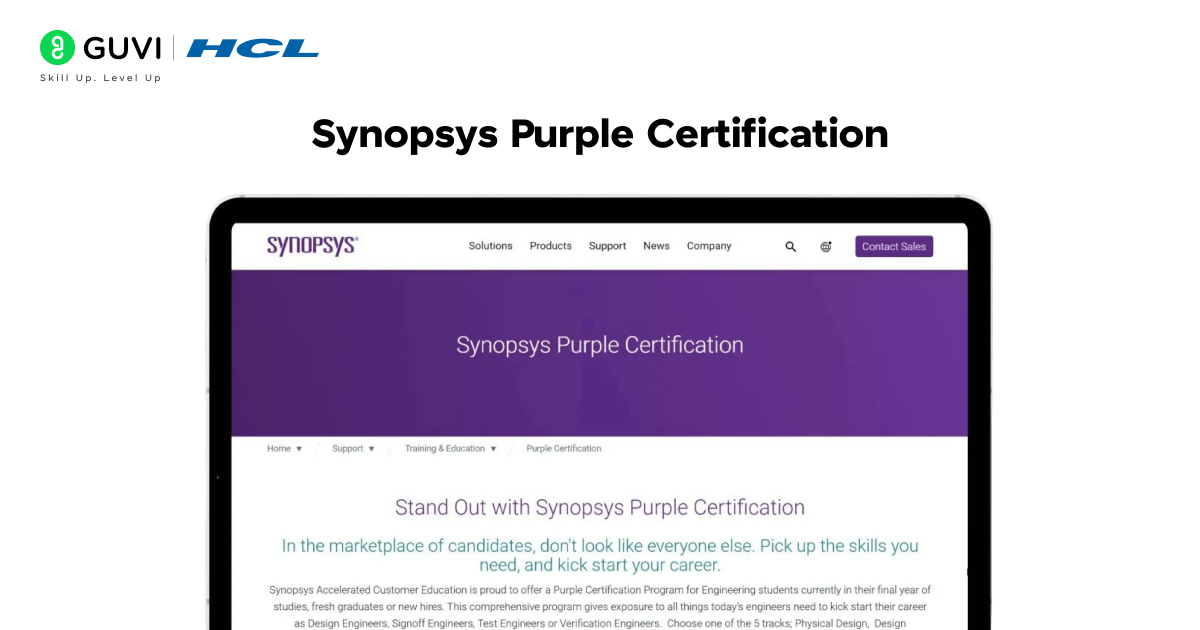
Course Content: The program covers topics like RTL synthesis, timing analysis, and DFT (Design for Testability). It also includes advanced modules on low-power design and multi-core architecture. You will get hands-on experience with Synopsys tools like Design Compiler and PrimeTime.
Key Features:
- Industry-recognized certification from Synopsys.
- Focus on advanced chip design and testing techniques.
- Hands-on training with Synopsys EDA tools.
- Opportunities to work on real-world VLSI design challenges.
- Access to Synopsys’ global network of experts.
Price: ₹2,00,000
Course Link: Synopsys Purple Certification
Targeting top tech companies? Make your VLSI resume count — Create a Free ATS-Friendly Resume
How to Choose the Right Course for You
- Check the EDA tool access. A course that only teaches theory without letting you run Verilog or VHDL simulations won’t prepare you for interviews
- Look at the verification content. Verification roles are hiring faster than pure design roles right now, so a course with a solid UVM module is worth the extra weight
- Match the fee to your goal. If you just want to test your interest, start with Coursera. If you want a job-ready portfolio, GUVI or Maven Silicon make more sense
- Confirm placement or mentorship support. Programs like IISc-TalentSprint and GUVI include dedicated career guidance, which shortens your job search
Concluding Thoughts…
VLSI design remains one of the strongest career bets in Indian tech right now, backed by government investment and a genuine skills shortage. Whether you pick GUVI’s flagship program, Maven Silicon’s verification-heavy course, or a lighter Coursera specialization to start, the key is choosing a program that gets you hands-on with real EDA tools, not just slides. Start with the fundamentals, build a portfolio as you go, and you’ll be interview-ready faster than you expect.
FAQs
1. Which field of VLSI is best?
The best field in VLSI depends on your interests. Popular areas include Physical Design, Verification, RTL Design, and Analog Design. Physical Design and Verification are in high demand.
2. Is VLSI a high-paid job?
Yes, VLSI offers high-paying jobs. Entry-level engineers earn ₹5–8 LPA in India, while experienced professionals can earn ₹15–30 LPA or more.
3. Does Google hire VLSI engineers?
Yes, Google hires VLSI engineers, primarily for roles in hardware design and chip development for its devices and data centers.
4. What is the full form of VLSI?
The full form of VLSI is Very Large Scale Integration.
5. What are the three types of VLSI?
The three types of VLSI are Digital VLSI, Analog VLSI, and Mixed-Signal VLSI.
6. Does Google hire VLSI engineers?
Yes, Google hires VLSI engineers for hardware design and chip development roles supporting its devices and data centre infrastructure.
7. How long does it take to become job-ready in VLSI design?
Most certification courses take 6 to 10 months to complete, though your job readiness also depends on how much you practice with EDA tools beyond the course curriculum.
Success Stories

About the Author
Lukesh S
A professional content writer who has experience in freelancing and now working as a Technical Content Writer at HCL GUVI having sound knowledge in Blog Writing and Creative Writing!
View all posts by Lukesh S
Connect with me @







Did you enjoy this article?