


VLSI Design Articles
Why Chips Fail: A Basic Guide to Chip Defects and IC Failure Analysis
Fun Facts About the Semiconductor Industry
Why Are Semiconductor Chips Expensive? Manufacturing Cost Explained
Instruction Set Architecture: How ISA Shapes Modern Chip Design

Get In Touch For Details! Request More Information
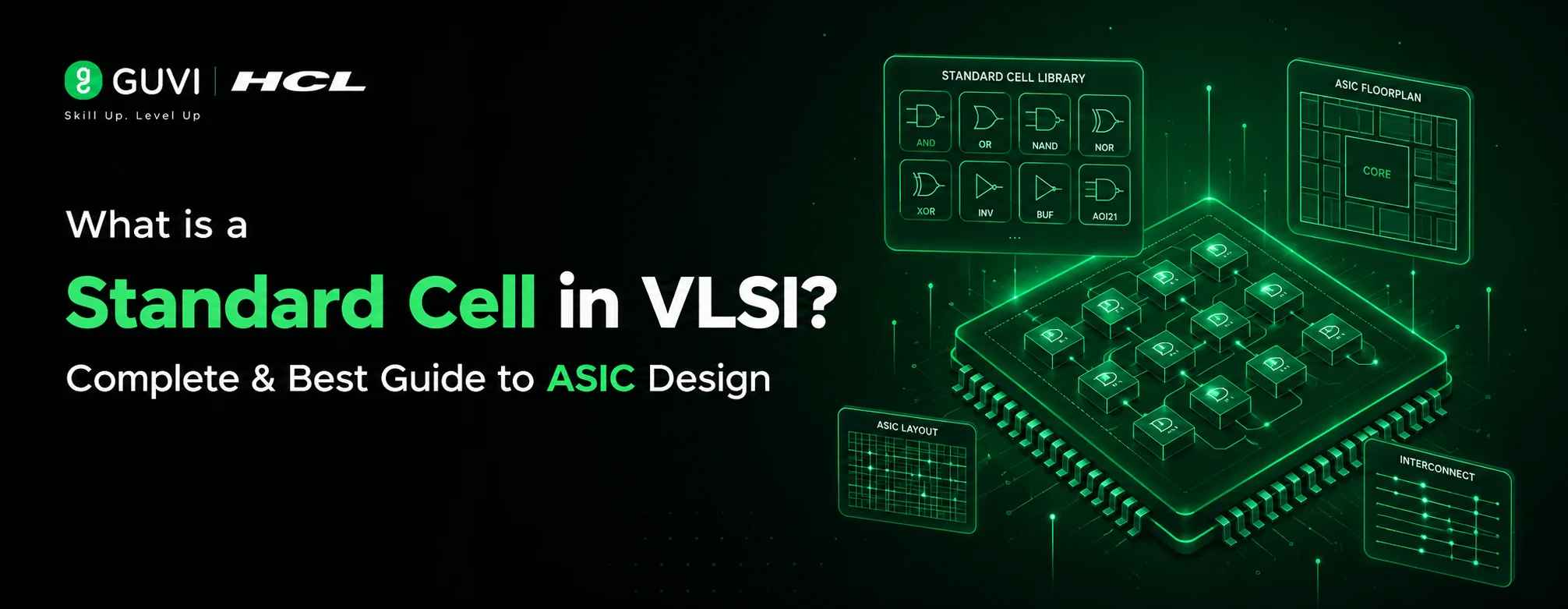
What is a Standard Cell in VLSI? Complete & Best Guide to ASIC Design
Aug 03, 2026 4 Min Read 274 Views
(Last Updated)
Table of contents
- TL;DR Summary
- Introduction
- Understanding the Basics of Standard Cell Design
- What Defines a Standard Cell in VLSI?
- Key Characteristics of Standard Cells
- Components of a Standard Cell Library
- How Standard Cells Enable Digital IC Design?
- Design Reusability
- Automated Design Flow
- Predictable Performance
- Cost Efficiency
- Comparison: Standard Cell vs Full Custom Design
- Real-World Applications of Standard Cell Technology
- Consumer Electronics
- Automotive Systems
- IoT Devices
- Common Mistakes When Working with Standard Cell in VLSI
- Ignoring Library Constraints
- Overlooking Power Considerations
- Inadequate Timing Analysis
- Poor Floorplanning Decisions
- Neglecting Design for Testability
- Advance Your Career with HCL GUVI's VLSI Training
- Conclusion
- Frequently Asked Questions
- What is the difference between a standard cell and a macro cell?
- How are standard cells characterized?
- Can standard cells be modified for specific applications?
- What role does a standard cell library play in synthesis?
- Are standard cells used in FPGA design?
- How do standard cells impact power consumption?
- Which companies develop standard cell libraries?
TL;DR Summary
- A standard cell in VLSI is a pre–designed, reusable logic gate (like AND, OR, NOT) with fixed height and standardized interfaces used in ASIC design.
- These cells form the building blocks of complex digital circuits in modern chips.
- Understanding standard cells is crucial for anyone pursuing a career in semiconductor design, particularly through programs like GUVI’s VLSI Design Course, which provides hands-on training in industry-standard methodologies.
Introduction
In the ever-evolving world of semiconductor technology, designing integrated circuits efficiently is paramount to innovation.
One fundamental concept that underpins modern digital IC design is the standard cell in VLSI. But what exactly is a standard cell, and why is it so important in ASIC development?
The global standard cell IP market is valued at $1.8B and growing at 12% CAGR.
Standard cells serve as the foundational building blocks in Application-Specific Integrated Circuit (ASIC) design. Each standard cell represents a basic logic function (such as AND, OR, NOT gates) with predefined electrical characteristics and physical dimensions.
Understanding standard cell in VLSI is essential for anyone entering the field of VLSI design. They form the backbone of cell-based design methodologies that dominate today’s semiconductor industry, enabling faster time-to-market and lower design costs than full-custom approaches.
Understanding the Basics of Standard Cell Design
What Defines a Standard Cell in VLSI?
A standard cell in VLSI is a pre-designed logic gate or simple digital circuit with:
- Fixed height (typically matching the manufacturing process grid)
- Variable width based on complexity
- Standardized power (VDD) and ground (VSS) rails
- Uniform placement abutment rules
- Pre-characterized timing and power models
These cells are created by foundries or specialized IP companies and compiled into standard cell libraries that designers use to build complex integrated circuits.
Wondering where standard cells fit in the chip manufacturing process? Read our Semiconductor Value Chain Explained guide to see how ASIC design connects with fabrication, packaging, testing, and final chip production.
Key Characteristics of Standard Cells
Standard cells share several defining characteristics:
- Uniform Height: All cells in a library have the same height to facilitate efficient placement and routing
- Power Distribution: Consistent power and ground rail placement across all cells
- Abutment Rules: Cells can be placed directly adjacent to each other without gaps
- Performance Models: Pre-characterized for timing, power consumption, and noise behavior
- Process Compatibility: Designed specifically for a particular manufacturing process node
The height of standard cells is typically a multiple of the manufacturing grid (e.g., 0.5μm for older processes)
Components of a Standard Cell Library
A standard cell library contains more than just basic logic gates. Modern libraries include various specialized cells:
Logic Gates
- Basic combinational cells: AND, OR, NOT, NAND, NOR, XOR
- Complex combinational cells: Multiplexers, decoders, adders
Sequential Elements
- Flip-flops (D, JK, T types)
- Latches
- Scan flip-flops for testing
Specialized Functions
- Clock buffers and inverters
- Power management cells
- Input/Output cells
- Test structures
Each cell in the library undergoes rigorous characterization to ensure predictable behavior under various operating conditions, including temperature, voltage, and process variations.
Technical Insight
Each cell in the library undergoes rigorous characterization to ensure predictable behavior under various operating conditions, including temperature (-40°C to +125°C), voltage (±10% variation), and process variations (slow, fast, typical corners).
The first standard cell library was developed in the late 1970s by companies pioneering ASIC design.
Standard cells are used to design many different integrated circuits. Explore the Types of Semiconductor Chips guide to learn how processors, memory chips, analog ICs, SoCs, and ASICs are built using these design methodologies.
How Standard Cells Enable Digital IC Design?
The cell-based design approach revolutionized the semiconductor industry by enabling:
Design Reusability
Instead of designing every transistor individually, engineers can leverage thousands of pre-verified cells, dramatically reducing design time.
Automated Design Flow
Electronic Design Automation (EDA) tools can efficiently place and route standard cells using algorithms optimized for uniform cell structures.
Predictable Performance
Pre-characterized cells provide reliable timing and power estimates, enabling accurate design closure.
Cost Efficiency
Shared development costs across multiple designs make standard cells economically advantageous for most applications.
Interested in building digital chips? Discover which VLSI Domain Is Easiest to learn for Beginners and find the right specialization based on your interests and career goals.
Standard cells occupy approximately 60-80% of a typical ASIC layout.
Comparison: Standard Cell vs Full Custom Design
| Aspect | Standard Cell Design | Full Custom Design |
| Development Time | Weeks to months | Months to years |
| Design Cost | Lower | Significantly higher |
| Performance | Good | Potentially optimal |
| Flexibility | Moderate | Maximum |
| Risk | Lower (proven cells) | Higher (untested design) |
| Skill Requirements | Moderate | Expert-level |
While full-custom design offers ultimate performance optimization, standard cell methodology provides the right balance of efficiency and performance for most modern digital ICs.

Real-World Applications of Standard Cell Technology
Standard cell technology powers virtually every digital device we use daily:
Consumer Electronics
Smartphones, tablets, and laptops rely heavily on standard cell-based ASICs for their processors, graphics units, and connectivity modules.
Automotive Systems
Modern vehicles contain dozens of standard cell-based chips that manage engine control, infotainment, and safety systems such as ABS and airbags.
IoT Devices
Low-power standard cells enable battery-operated sensors and communication chips essential for smart home devices and wearables.
Common Mistakes When Working with Standard Cell in VLSI
1. Ignoring Library Constraints
Many beginners fail to properly understand library limitations such as voltage ranges, temperature specifications, and timing constraints, leading to design failures.
2. Overlooking Power Considerations
Using high-drive cells unnecessarily can dramatically increase power consumption without proportional performance benefits.
3. Inadequate Timing Analysis
Assuming pre-characterized timing values will perfectly match final silicon behavior without considering on-chip variation effects.
4. Poor Floorplanning Decisions
Not accounting for standard cell placement density requirements can result in routing congestion and timing violations.
5. Neglecting Design for Testability
Failing to incorporate scan chains and test structures during standard cell integration makes manufacturing testing extremely difficult.
Advance Your Career with HCL GUVI’s VLSI Training
If you’re passionate about semiconductor design and want to master standard cell and VLSI concepts along with other industry-relevant skills, consider enrolling in HCL GUVI’s comprehensive VLSI Design Course.
Our program covers everything from basic digital design principles to advanced physical design techniques, preparing you for real-world challenges in the semiconductor industry.
Our curriculum includes hands-on experience with industry-standard EDA tools, practical projects that simulate real ASIC design flows, and mentorship from experienced VLSI professionals.
Explore our VLSI Design Course to begin your journey in one of the most innovative fields in technology.
Conclusion
Standard cells represent one of the most significant innovations in modern semiconductor design, enabling the rapid development of complex digital integrated circuits.
By understanding what a standard cell in VLSI is and how these building blocks function within the broader ASIC design ecosystem, you’re equipped with fundamental knowledge crucial for any career in digital IC design.
As semiconductor nodes continue to shrink and design complexity increases, mastery of standard cell concepts becomes even more critical for aspiring VLSI engineers.
Frequently Asked Questions
1. What is the difference between a standard cell and a macro cell?
A standard cell has fixed height and variable width, designed for automatic placement and routing. A macro cell is typically larger, irregularly shaped, and often manually placed, including embedded memories or analog circuits.
2. How are standard cells characterized?
Standard cells are characterized through extensive simulation at various process corners, voltages, and temperatures to generate timing, power, and noise models used by EDA tools during design.
3. Can standard cells be modified for specific applications?
While base standard cells shouldn’t be modified (defeating their standardization purpose), designers can combine them creatively or request foundry-specific variants for unique requirements.
4. What role does a standard cell library play in synthesis?
Synthesis tools use standard cell libraries to map high-level RTL descriptions into optimized gate-level representations, selecting appropriate cells to meet timing and area constraints.
5. Are standard cells used in FPGA design?
FPGAs use configurable logic blocks (CLBs) rather than traditional standard cells, though some modern FPGAs incorporate standard cell-based hard IP blocks for specific functions.
6. How do standard cells impact power consumption?
Standard cell choice directly impacts both dynamic and static power consumption. Libraries often include multiple versions of cells (high-speed, low-power), allowing designers to optimize for specific power targets.
7. Which companies develop standard cell libraries?
Major semiconductor foundries like TSMC, Intel, and GlobalFoundries develop standard cell libraries for their processes. Third-party vendors like Synopsys and Cadence also offer specialized libraries.
Success Stories

About the Author
Hashmithaa
Hi, I’m Hashmithaa — a content writer with a love for words. Writing isn’t just what I do; it’s how I connect, communicate, and create meaning in a noisy digital world. And if my words help someone make a better decision, learn something new, or feel more confident, then I’ve done my job well.
View all posts by Hashmithaa
Connect with me @













Did you enjoy this article?