


Full Stack Development Articles
Claude for Architecture and Engineering Documentation
Freelancing as a Python Developer: Getting Your First Client


Get In Touch For Details! Request More Information

What is Back-End Architecture? A Complete Guide for Beginners
Sep 03, 2026 5 Min Read 1047 Views
(Last Updated)
Ever wondered what happens behind the scenes when you log in, shop, or stream? While the front-end shows the interface, back-end architecture powers everything. It handles requests, manages data, and ensures systems run smoothly, securely, and at scale, yet most beginners don’t fully understand how it’s structured.
In this guide, you’ll learn what back-end architecture is, why it matters, how it works, and the different architectural patterns used in real-world applications.
Quick Answer: Back-end architecture refers to the server-side structure of an application that manages data, business logic, APIs, and communication between the database and the front-end. It includes components like servers, databases, application logic, and APIs that ensure smooth functionality, scalability, and performance of web and mobile applications. A well-designed back-end architecture improves security, speed, and system reliability, making it critical for modern software development.
Table of contents
- What is Back-End Architecture?
- Core Components of Back-End Architecture
- Server
- Database
- APIs (Application Programming Interfaces)
- Business Logic
- Middleware
- How Back-End Architecture Works
- Step-by-step flow
- Example: Login system flow
- Types of Back-End Architecture
- Monolithic Architecture
- Microservices Architecture
- Serverless Architecture
- Common Back-End Tech Stack
- Programming Languages
- Frameworks
- Databases
- Tools & Platforms
- Key Design Principles in Back-End Architecture
- How to Learn Back-End Architecture
- Conclusion
- FAQs
- What is back-end architecture in simple terms?
- What is the difference between back-end development and back-end architecture?
- Why is back-end architecture important?
What is Back-End Architecture?
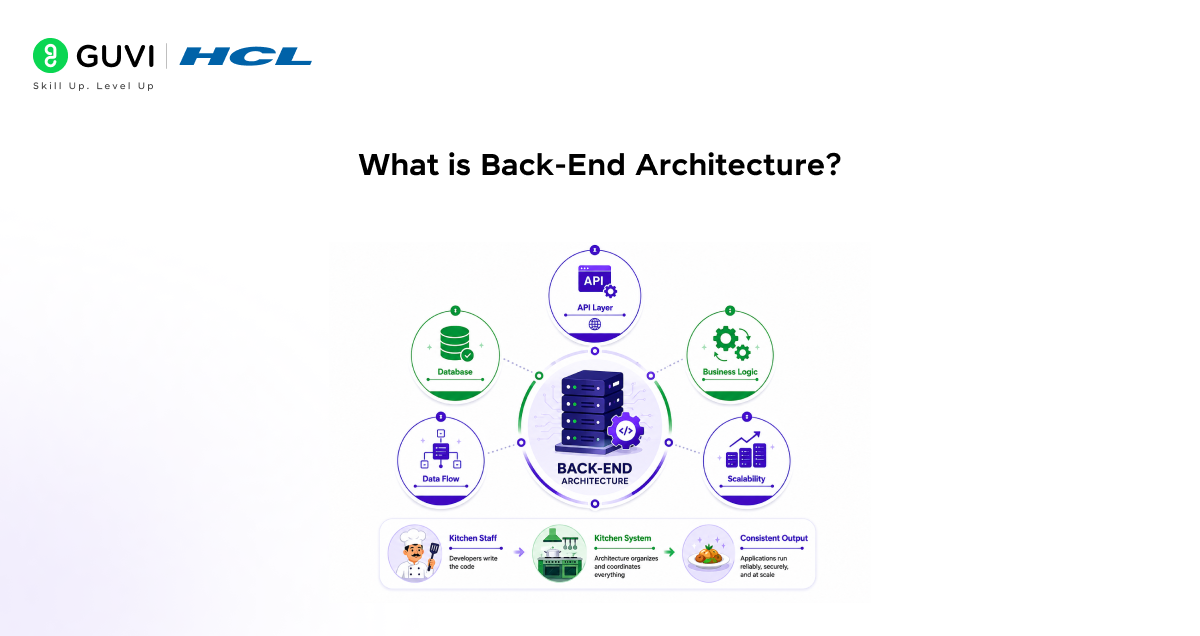
Back-end architecture refers to the structured design of server-side systems that manage data flow, business logic, APIs, and database interactions to ensure an application functions reliably, securely, and at scale. It differs from back-end development, which focuses on writing the code and implementing features, while architecture defines how these components are organized and scale over time.
A useful analogy is a restaurant kitchen: while chefs (developers) cook dishes, the kitchen layout (architecture) ensures efficiency, coordination, and consistent output.
Core Components of Back-End Architecture
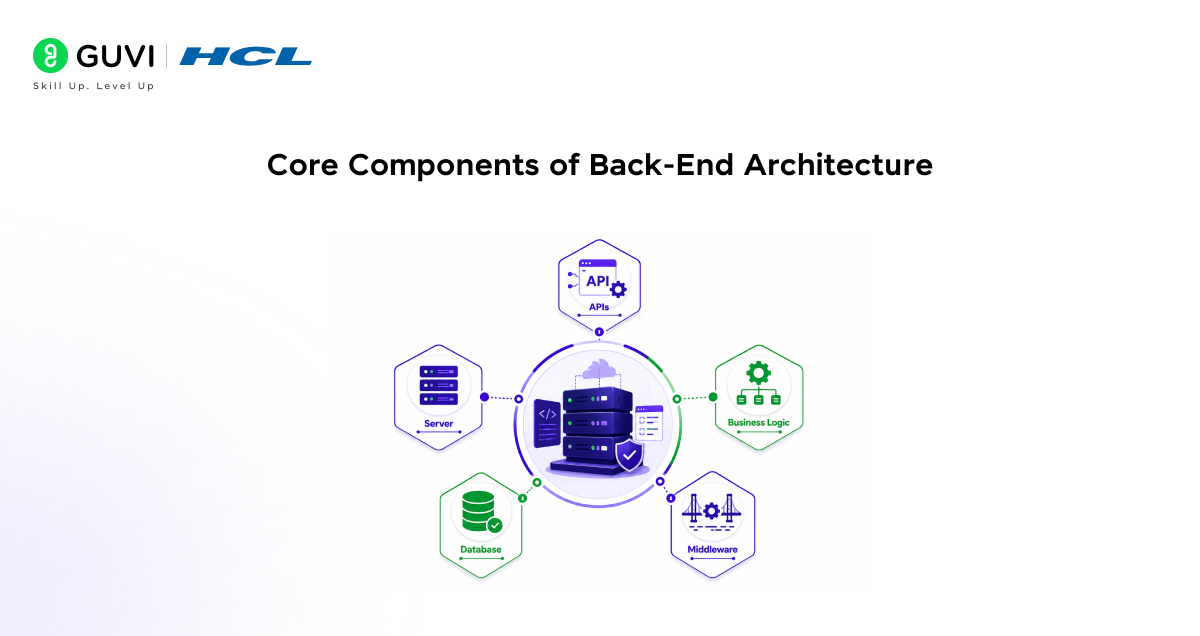
1. Server
A server is the system that receives client requests, processes them, and returns the correct response. In back-end architecture, it acts as the entry point for application traffic and ensures requests are routed to the right service or logic layer.
Web server vs application server
| Type | Role | Examples |
| Web Server | Handles HTTP requests, serves static files, manages routing/proxying | Nginx, Apache |
| Application Server | Runs business logic, processes dynamic requests, connects with databases | Node.js runtime, Tomcat, Gunicorn |
In many modern systems, both work together: the web server handles incoming traffic and forwards dynamic requests to the application server.
2. Database
A database stores, organizes, and retrieves application data. It ensures that user information, transactions, content, and system records are persisted reliably and can be queried efficiently.
SQL vs NoSQL
| Type | Structure | Best For |
| SQL | Structured, table-based, relational | Complex queries, transactions, consistency |
| NoSQL | Flexible, document/key-value/column/graph-based | Large-scale, unstructured, rapidly changing data |
SQL databases such as MySQL and PostgreSQL are ideal when relationships and ACID compliance matter. NoSQL databases such as MongoDB or Cassandra are useful when flexibility, horizontal scaling, or high-volume distributed workloads are more important.
Build strong back-end systems and full-stack applications with real-world expertise. Join HCL GUVI’s Full Stack Development Course to master server-side architecture, databases, APIs, and deployment through structured learning, hands-on projects, and expert mentorship.
3. APIs (Application Programming Interfaces)
APIs define how the front-end communicates with the back-end. They expose endpoints through which client applications send requests and receive data or actions in a standardized format, usually JSON.
REST vs GraphQL
| Type | Approach | Strength |
| REST | Multiple endpoints for different resources | Simple, widely adopted, cache-friendly |
| GraphQL | Single endpoint with query-based data fetching | Flexible, reduces over-fetching and under-fetching |
APIs act as the communication bridge between front-end and back-end. For example, when a user clicks “Login,” the front-end sends credentials through an API, and the back-end validates them, fetches user data, and returns the result.
4. Business Logic
Business logic is the decision-making layer of the application. It contains the rules, workflows, and processing steps that determine how data should be handled based on application requirements.
This is where actions such as validating form inputs, calculating discounts, checking permissions, processing payments, or generating recommendations happen. It ensures the application behaves according to defined rules rather than simply storing and returning data.
5. Middleware
Middleware is a processing layer that sits between the incoming request and the final application logic. It handles cross-cutting concerns before the request reaches the main code or before the response is sent back.
Common middleware tasks include:
- Authentication and Authorization
- Logging and monitoring
- Request parsing
- Rate limiting
- Error handling
- Session or token validation
Middleware improves modularity because shared concerns do not need to be repeated inside every route or function.
How Back-End Architecture Works
Back-end architecture follows a request-response cycle where each component has a clear role in processing user actions.
Step-by-step flow
User request → Server → Business logic → Database → Response
Here is how it works in practice:
A user performs an action on the front-end, such as submitting a form or clicking a button. That request is sent to the server through an API. The server receives it and routes it to the correct handler. The business logic layer then validates the request, applies rules, and decides what operation is needed. If data is required, the application queries the database. Once the database returns the result, the back-end formats the response and sends it back to the front-end, which then updates the user interface.
Example: Login system flow
When a user enters an email and password:
- The front-end sends the credentials to the login API.
- The server receives the request and passes it through middleware for parsing and security checks.
- The business logic validates the input and checks whether the user exists.
- The database is queried to fetch the stored user record.
- The entered password is compared with the hashed password in the database.
- If valid, the system generates a session or JWT token.
- The server sends a success response back to the front-end.
- The front-end logs the user in and loads the protected dashboard.
This flow shows that back-end architecture is not just about storing data. It is about coordinating servers, APIs, logic, middleware, and databases so the application works securely and at scale.
Types of Back-End Architecture
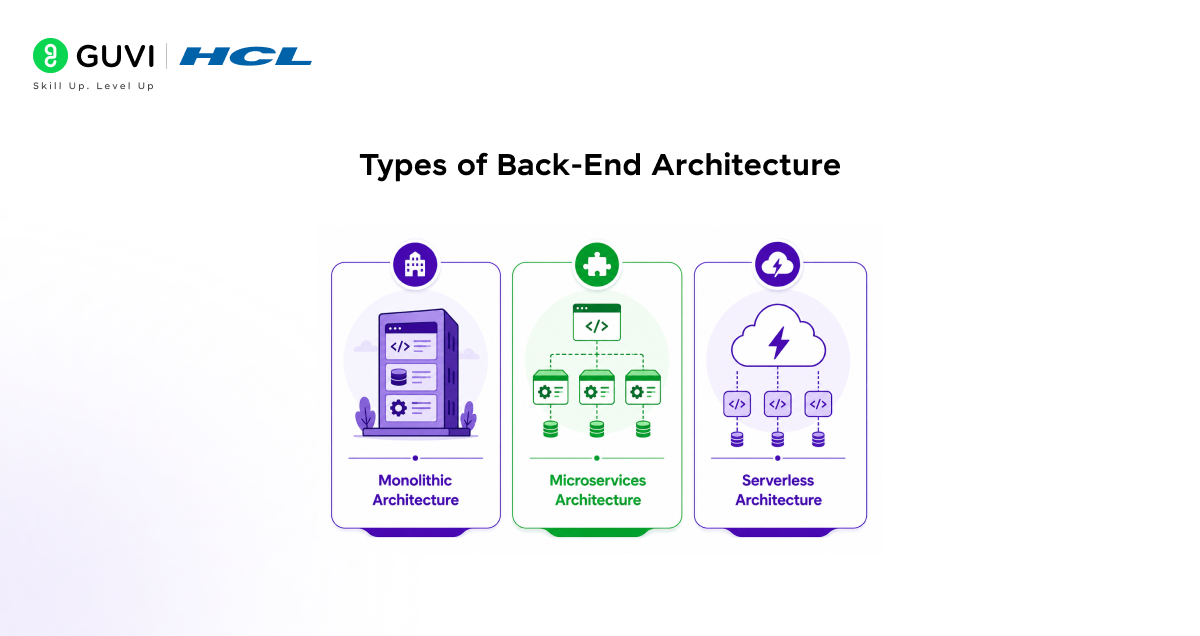
1. Monolithic Architecture
Definition: Monolithic architecture is a traditional approach where the entire application is built as a single, unified codebase. All components such as user interface logic, business rules, and data access layers are tightly integrated and deployed together as one unit.

Pros:
- Simple to develop, test, and deploy in early stages
- Easier debugging due to a single codebase
- Lower initial infrastructure complexity
Cons:
- Difficult to scale specific components independently
- Codebase becomes hard to manage as the application grows
- Slower deployment cycles due to tight coupling
2. Microservices Architecture
Definition: Microservices architecture breaks the application into smaller, independent services, each responsible for a specific function. These services communicate through APIs and can be developed, deployed, and scaled independently.
Pros:
- High scalability and flexibility
- Independent deployments enable faster release cycles
- Fault isolation improves system resilience
Cons:
- Increased system complexity and operational overhead
- Requires robust API management and service coordination
- Debugging across distributed services can be challenging
3. Serverless Architecture
What it is (Functions-as-a-Service): Serverless architecture allows developers to run backend code as stateless functions without managing servers. In a Functions-as-a-Service model, cloud providers automatically handle infrastructure, scaling, and execution, triggering functions based on events like HTTP requests or database updates.
When to use:
- Event-driven applications (e.g., file uploads, notifications)
- Applications with variable or unpredictable traffic
- Rapid prototyping and cost-optimized workloads
- When minimizing infrastructure management is a priority
Serverless is ideal for teams that want to focus purely on logic while offloading scalability and infrastructure concerns to cloud platforms.
Common Back-End Tech Stack
1. Programming Languages
Back-end systems rely on languages that can efficiently handle concurrency, data processing, and server-side execution.
- Python: Known for readability and rapid development; widely used in web apps, AI-driven backends, and APIs.
- Java: Strongly typed and highly scalable; preferred in enterprise systems requiring robustness and long-term stability.
- Node.js: Event-driven, non-blocking I/O model; ideal for real-time applications and high-concurrency workloads.
- Go: Lightweight, fast, and built for concurrency; commonly used in microservices and cloud-native systems.
2. Frameworks
Frameworks provide structure, reusable components, and built-in tools to accelerate development.
- Django: A Python-based framework with built-in ORM, authentication, and admin panel; promotes rapid, secure development.
- Spring Boot: Java framework designed for enterprise-grade applications with strong dependency injection and microservices support.
- Express.js: Minimalist Node.js framework; flexible for building APIs and lightweight backend services.
3. Databases
Databases form the persistence layer, optimized based on use case and data structure.
- MySQL: Relational database with strong consistency and structured schema support.
- PostgreSQL: Advanced SQL database with support for complex queries, JSON, and high reliability.
- MongoDB: NoSQL document database designed for flexible schemas and horizontal scalability.
4. Tools & Platforms
Modern back-end systems depend on infrastructure and automation tools for deployment and scaling.
- Docker: Containerization platform that packages applications with dependencies for consistent deployment.
- Kubernetes: Orchestrates containerized applications, managing scaling, load distribution, and resilience.
- CI/CD Tools: Automate build, testing, and deployment pipelines, enabling faster and more reliable releases.
Key Design Principles in Back-End Architecture
- Scalability (Horizontal vs Vertical)
| Type | Approach | Limitation |
| Vertical Scaling | Increase power of a single server (CPU, RAM) | Hardware limits, costly |
| Horizontal Scaling | Add multiple servers and distribute load | Requires distributed system design |
Modern architectures prefer horizontal scaling for handling large-scale traffic efficiently.
- Fault Tolerance
Systems must continue operating even when components fail. Techniques include redundancy, failover mechanisms, and distributed replication to prevent single points of failure.
- Load Balancing
Load balancers distribute incoming traffic across multiple servers to prevent overload and ensure high availability. This improves response time and system stability under heavy load.
- Caching Strategies
Caching stores frequently accessed data in memory (e.g., Redis) to reduce database load and latency. Effective caching can significantly improve performance and reduce response times.
- Database Optimization
Includes indexing, query optimization, normalization/denormalization, and partitioning. Efficient database design reduces latency and ensures faster data retrieval under load.
How to Learn Back-End Architecture
- Start with One Language
Choose a primary language such as Python or Node.js to understand core backend concepts like routing, APIs, and database integration.
- Build Real-World Projects
Work on projects such as authentication systems, REST APIs, or e-commerce backends to gain practical experience.
- Learn System Design Basics
Understand concepts like scalability, load balancing, caching, and distributed systems to move beyond basic development.
- Practice API Development
Design and build REST or GraphQL APIs, focusing on clean architecture, versioning, and performance.
- Explore Cloud Platforms
Use platforms like AWS or Azure to learn deployment, serverless computing, and infrastructure management, which are essential for modern backend systems.
Conclusion
Back-end architecture is the foundation that powers every modern application. From managing databases to handling complex logic and scaling systems for millions of users, it plays a critical role in delivering seamless digital experiences.
Understanding these concepts not only makes you a better developer but also prepares you for real-world system design challenges.
FAQs
1. What is back-end architecture in simple terms?
Back-end architecture is the structure of server-side systems that handle data, logic, APIs, and databases to make applications work smoothly, securely, and at scale.
2. What is the difference between back-end development and back-end architecture?
Back-end development focuses on writing code and building features, while back-end architecture defines how components are structured, connected, and scaled for performance and reliability.
3. Why is back-end architecture important?
Back-end architecture ensures scalability, security, and performance, enabling applications to handle high traffic, process data efficiently, and deliver a seamless user experience.
Success Stories

About the Author
Vaishali
I'm a seasoned writer with four years of experience across technical, non-technical, and just about every genre or niche you can imagine. Adaptable and curious, I enjoy exploring new topics and making information engaging and easy to understand. Fueled by a steady stream of tea, I approach each project with creativity, reliability, and genuine enthusiasm for storytelling.
View all posts by Vaishali
Connect with me @


































Did you enjoy this article?