


Java Articles
Kafka Streams Tutorial: Build Your First Data Pipeline
What is ArrayList in Java: A Complete Guide
What is HashMap in Java: How It Works, Methods, and Examples


Get In Touch For Details! Request More Information
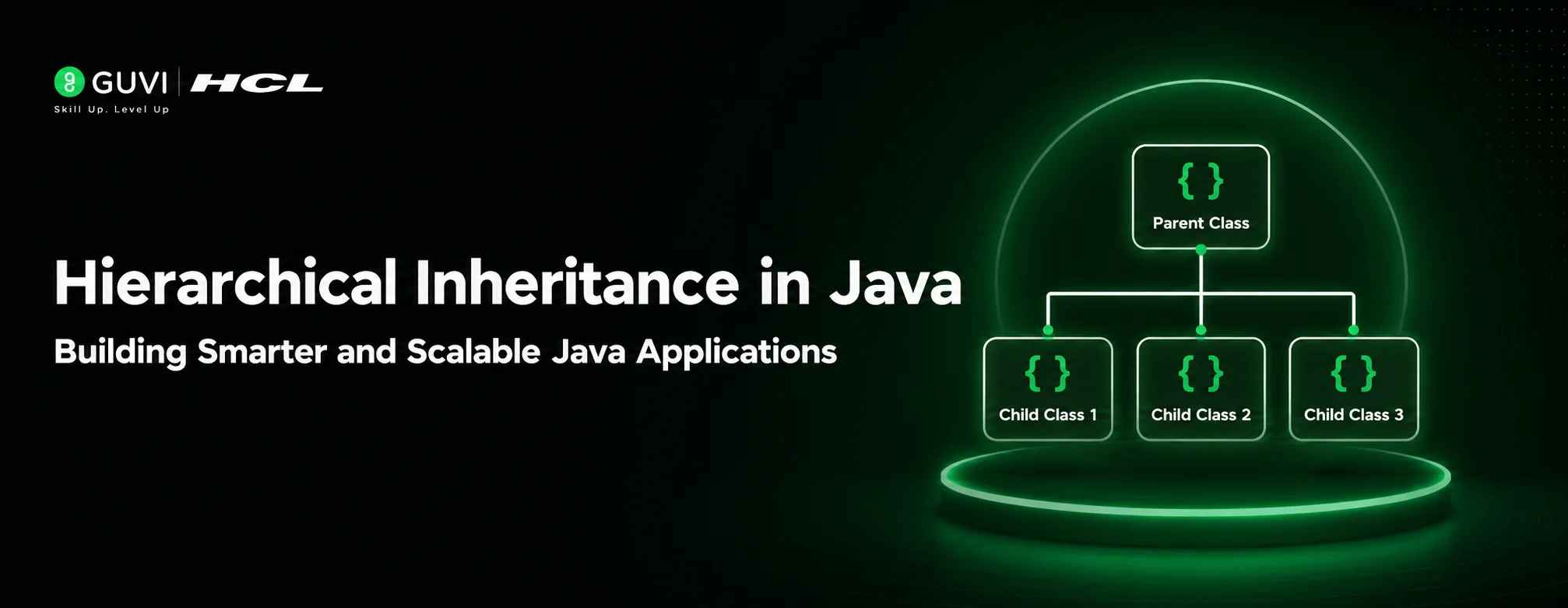
Hierarchical Inheritance in Java: Building Smarter and Scalable Java Applications
Sep 10, 2026 7 Min Read 1847 Views
(Last Updated)
When developers first learn Object-Oriented Programming, inheritance usually feels simple: one class inherits from another, reuses properties, and extends functionality. Many applications have more than one object with similar behavior, but with distinct capability. This is where hierarchical inheritance is helpful in java.
To master concepts in java OOP, and ace out interviews, projects, and coding assessment, learning about hierarchical inheritance is a must. It is an important part of the development of enterprise level applications that are maintainable, reusable, and scalable for professionals.
Here in this blog, we will discuss hierarchical inheritance in java in a practical and industry oriented manner. We will not just define the concept, but also understand how it works inside, where it is used in real applications, what are common mistakes made by the developer, pros and cons of it, and some best practices with examples that make sense.
Quick Answer:
Hierarchical inheritance is a type of inheritance where multiple child classes inherit from a single parent class. It helps developers reuse common code while allowing each subclass to have its own unique features.
Table of contents
- What is Hierarchical Inheritance in Java?
- Why Hierarchical Inheritance Matters in Real Projects
- Understanding Hierarchical Inheritance with an Example
- Java Example
- How Hierarchical Inheritance Works Internally
- Key Characteristics of Hierarchical Inheritance
- One Parent Multiple Children
- Code Reusability
- Logical Organization
- Supports Method Overriding
- Real-World Applications of Hierarchical Inheritance
- Banking Systems
- E-Commerce Platforms
- Gaming Applications
- Hierarchical Inheritance vs Other Types of Inheritance
- Difference Between Hierarchical and Multilevel Inheritance
- Hierarchical Inheritance
- Multilevel Inheritance
- Advantages of Hierarchical Inheritance in Java
- Reduces Code Duplication
- Easier Maintenance
- Better Scalability
- Supports Polymorphism
- Cleaner Architecture
- Disadvantages of Hierarchical Inheritance
- Tight Coupling
- Risk of Over-Engineering
- Reduced Flexibility
- Parent Class Complexity
- Common Mistakes Developers Make
- Using Inheritance Everywhere
- Creating Large Parent Classes
- Ignoring Access Modifiers
- Access Modifiers in Hierarchical Inheritance
- Private
- Protected
- Public
- Using Constructors in Hierarchical Inheritance
- The Role of super Keyword
- Access Parent Constructor
- Access Parent Variable
- Access Parent Method
- Method Overriding in Hierarchical Inheritance
- Hierarchical Inheritance and Runtime Polymorphism
- Hierarchical Inheritance in Frameworks
- Spring Framework
- Java Swing
- Hibernate
- Interview Questions on Hierarchical Inheritance
- A Practical Mini Project Sample
- Parent Class
- Developer Class
- HR Class
- Tester Class
- Main Method
- Why Students Should Master Hierarchical Inheritance
- Wrapping it up:
- FAQs
- Is hierarchical inheritance supported in Java?
- Why is hierarchical inheritance important?
- What is the difference between Hierarchical and single inheritance?
- Is the hierarchical inheritance capable of polymorphism?
What is Hierarchical Inheritance in Java?
In Java, hierarchical inheritance is a type of inheritance where multiple child classes inherit from a single parent class.
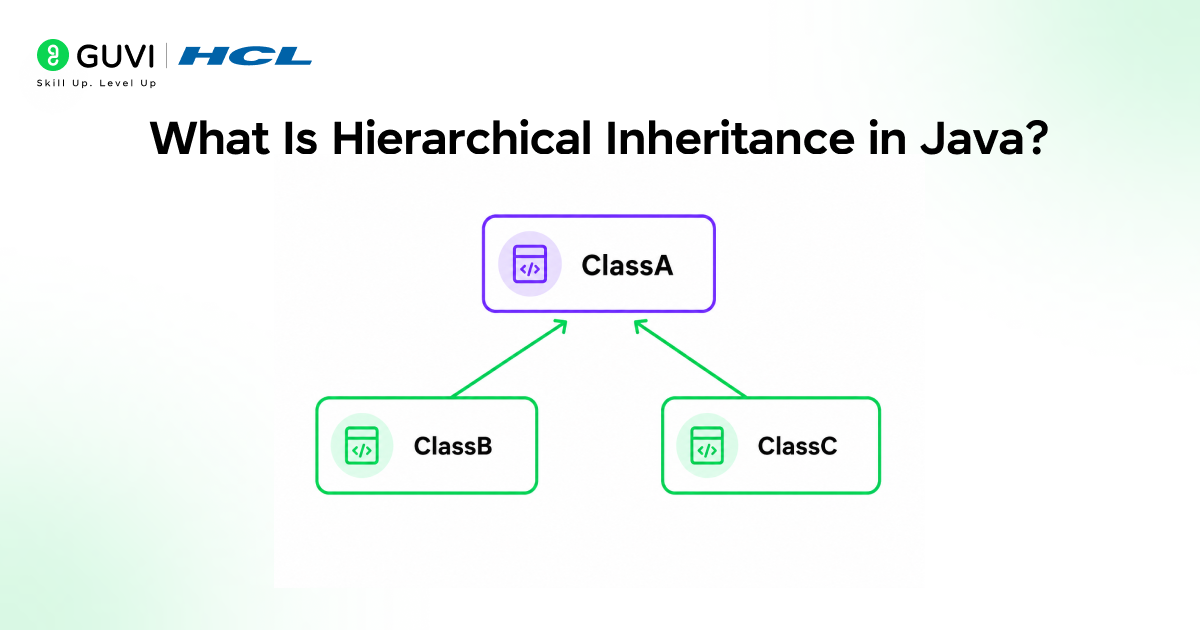
Instead of one child extending one parent, several subclasses share the same superclass.
This is the general format:
| class Parent { Common properties and methods. } class Child1 is a subclass of Parent { // unique features } class Child2 inherits Parent { // unique features } class Child3 is a subclass of Parent { // unique features } |
The parent class acts as a template with shared behavior and each child class has its own specialized behavior.
It does this to ensure that developers do not repeat code and are consistent with related classes.
You can also check out: Ultimate Roadmap to Become a Java Full Stack Developer
Why Hierarchical Inheritance Matters in Real Projects
Many beginners think that inheritance is only an academic concept but hierarchical inheritance is very much used in production systems.
Why it’s important:
- Reduces redundant code
- Improves maintainability
- Encourages code reusability
- Simplifies debugging
- Designs well-organized application structure
- Makes scaling easier
Imagine building an HR management system without inheritance. Every employee type would need separate definitions for:r:
- Name
- Employee ID
- Salary
- Attendance
- Login functionality
This soon becomes routine and unmanageable.
In hierarchical inheritance, any common behaviour remains in the parent class, and the child classes only add in their special duties.
Understanding Hierarchical Inheritance with an Example
Let’s move beyond textbook examples and build something more practical.
Suppose you’re creating a ride-booking application similar to Uber.
All users have:
- Name
- Mobile number
- Location
- Login functionality
However, there are different types of users and they act differently:
- Drivers accept rides
- Customers book rides
- Admins control the platform
We make one base class, rather than writing the same properties many times.
Java Example
| class User { String name; String mobile; void login() { System.out.println(“User logged in”); } } class Driver extends user { void acceptRide() { System.out.println(“Ride accepted”); } } class Customer extends User { void bookRide() { System.out.println(“Ride booked”); } } class Admin is an extension of User { void manageSystem() { System.out.println(“System managed”); } } |
Main Class
| public class Main { public static void main(String[] args){ Driver d = new Driver(); d.name = “Arjun”; d.login(); d.acceptRide(); Create a new Customer c. c.name = “Rahul”; c.login(); c.bookRide(); Admin a = new Admin(); a.name = “Priya”; a.login(); a.manageSystem(); } } |
Output
| User logged in Ride accepted User logged in Ride booked User logged in System managed |
This is one of the most basic and useful examples of hierarchical inheritance in java.
You can also check out: Master These 15 Star Patterns in Java to Ace Your Interview
How Hierarchical Inheritance Works Internally
Many students learn the inheritance syntax without knowing what Java does in the background.
Here’s what happens internally:
- The parent class is created first in Java
- Child classes inherit accessible members
- Memory is allocated for inherited variables
- Methods are provided to subclasses
- JVM calls methods at runtime.
Each child object has:
- Its own variables
- Inherited parent variables
- Access to parent methods.
This is because classes are subclasses of one another and can thus access the functionality of their superclasses directly.
Hierarchical inheritance is extensively used inside major Java frameworks such as Spring Framework, Hibernate, and Java Swing to organize reusable components efficiently. In Java GUI systems especially, deep inheritance hierarchies allow common behaviors and properties to be defined once in parent classes and then reused across hundreds of specialized UI components. This approach significantly reduces code duplication, improves maintainability, and helps large-scale enterprise applications remain easier to extend and manage over time.
Key Characteristics of Hierarchical Inheritance
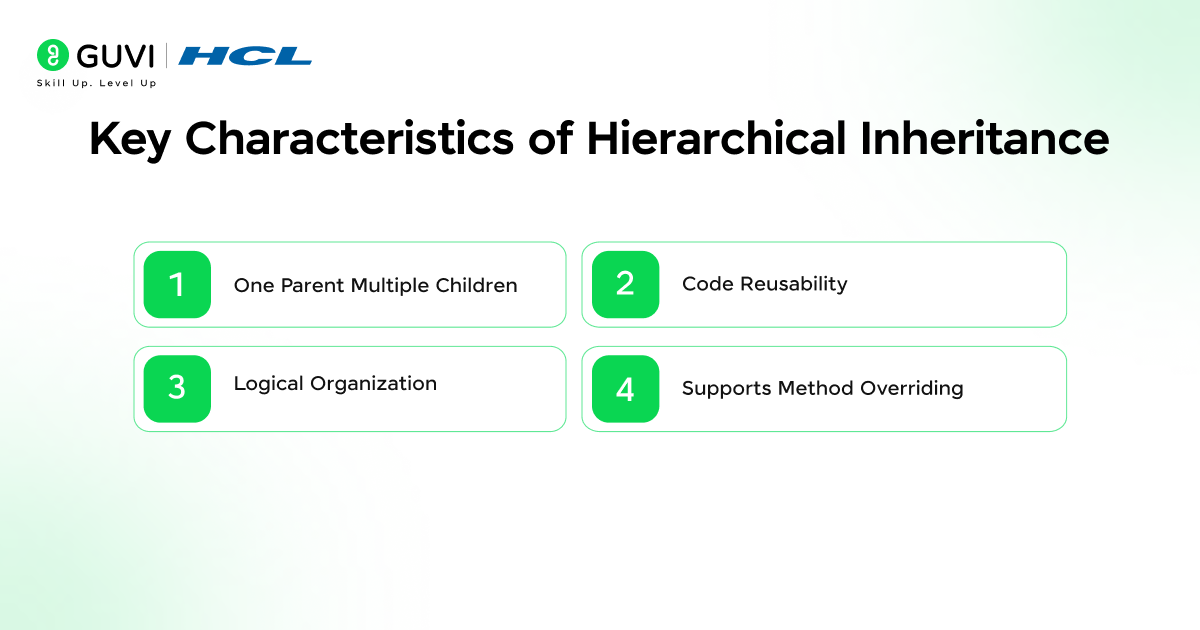
1. One Parent Multiple Children
The defining feature of hierarchical inheritance is that several subclasses share a single superclass.
Example:
| Animal | ——————- | | | Dog Cat Lion |
2. Code Reusability
Shared functionality is stored only once in the parent class.
Without inheritance:
| class Dog { void eat() {} } class Cat { void eat() {} } |
With inheritance:
| class Animal { void eat() {} } |
Now every subclass automatically gets the eat() method.
3. Logical Organization
Hierarchical inheritance results in clearer software design.
The objects in an application are easier to understand because they are grouped under one superclass.
4. Supports Method Overriding
Inherited methods may be customized by each child class.
Example:
| class Animal { void sound() { System.out.println(“Animal sound”); } } class Dog is DogType’s special case.class Dog is a special case of Animal. void sound() { System.out.println(“Bark”); } } |
This is important for runtime polymorphism.
You can also check out: Java Interview Questions for Freshers with Clear & Concise Answers
Real-World Applications of Hierarchical Inheritance
Many enterprise applications make use of hierarchical inheritance to a great degree. Some of which are:
Banking Systems
In banking applications, different account types share common operations like:
- Deposit
- Withdraw
- Check balance
So developers create a parent class called Account.
Superclass:
| Account |
Child classes like:
- SavingsAccount
- CurrentAccount
- SalaryAccount
inherit these common features while adding their own functionality.
For example:
- Savings accounts calculate interest
- Current accounts support overdraft
- Salary accounts handle salary credits
This reduces duplicate code and makes the banking system easier to maintain.
E-Commerce Platforms
Online shopping platforms also use hierarchical inheritance.
A parent Product class can contain common features like:
- Product ID
- Price
- Add to cart
Different product categories inherit from it:
- Electronics
- Clothing
- Grocery
Each category adds its own behavior.
For example:
- Electronics include warranty details
- Clothing includes size selection
- Grocery products track expiry dates
This helps platforms manage thousands of products efficiently
Gaming Applications
Games often have multiple characters sharing common abilities like:
- Health
- Movement
- Attack
So developers create a parent Character class.
Child classes such as:
- Warrior
- Mage
- Archer
inherit common gameplay mechanics while adding special abilities.
For example:
- Warriors use shield defense
- Mages cast spells
- Archers use long-range attacks
This makes game development faster and more organized.
Hierarchical Inheritance vs Other Types of Inheritance
| Inheritance Type | Structure |
| Single Inheritance | One child inherits one parent |
| Multilevel Inheritance | Child becomes parent for another class |
| Hierarchical Inheritance | Multiple children inherit one parent |
| Hybrid Inheritance | Combination of inheritance types |
Difference Between Hierarchical and Multilevel Inheritance
These are two words that students frequently mix up.
Hierarchical Inheritance
| Vehicle | ————- | | Car Bike |
Several subclasses have a common parent class.
Multilevel Inheritance
| Vehicle | Car | ElectricCar |
Inheritance takes place level to level.
Advantages of Hierarchical Inheritance in Java
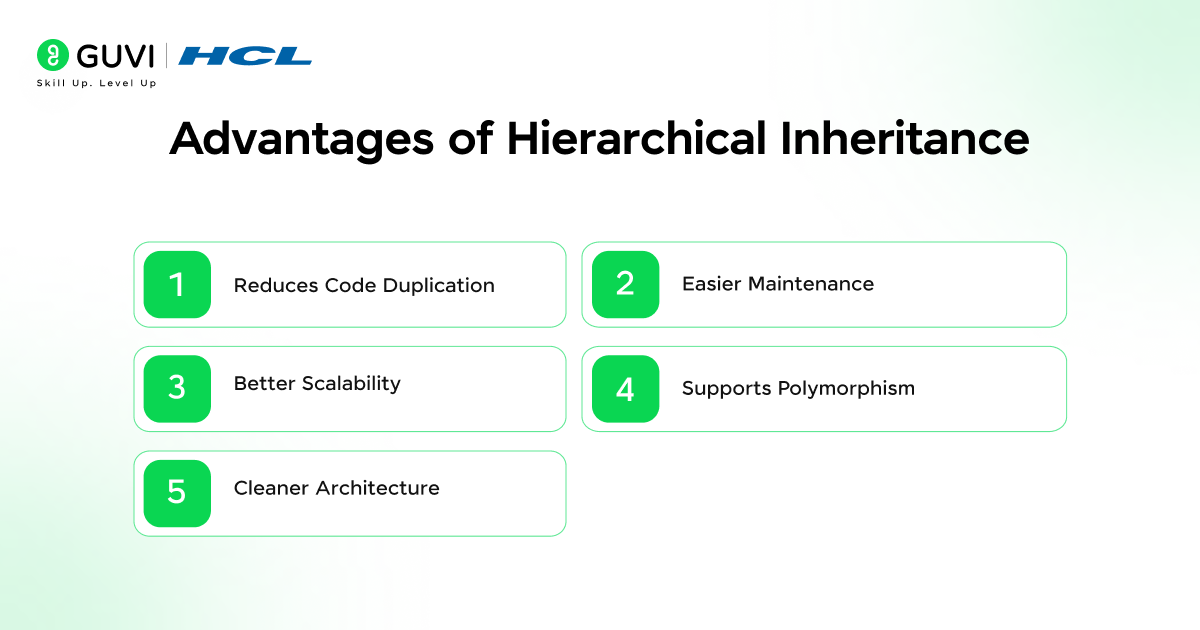
1. Reduces Code Duplication
One superclass can provide functionality to many subclasses.
This means that repetitive coding is greatly diminished.
2. Easier Maintenance
Changes made to the parent class will automatically be reflected in the subclasses.
Example:
All child classes inherit the login validation logic if it is changed in the User class.
3. Better Scalability
New subclasses are easily added.
Example:
| class Vendor is a subclass of class User { } |
No need to re-code common logic.
4. Supports Polymorphism
Hierarchical inheritance works perfectly with dynamic method dispatch.

Example:
| Animal a = new Dog(); a.sound(); |
This enhances flexibility in large systems.
5. Cleaner Architecture
Modules are created and applications become easier to navigate.
This is a very helpful in enterprise software.
You can also check out: Java Developer Resume Tips for 2026
Disadvantages of Hierarchical Inheritance
While hierarchical inheritance is useful, it comes with its drawbacks.
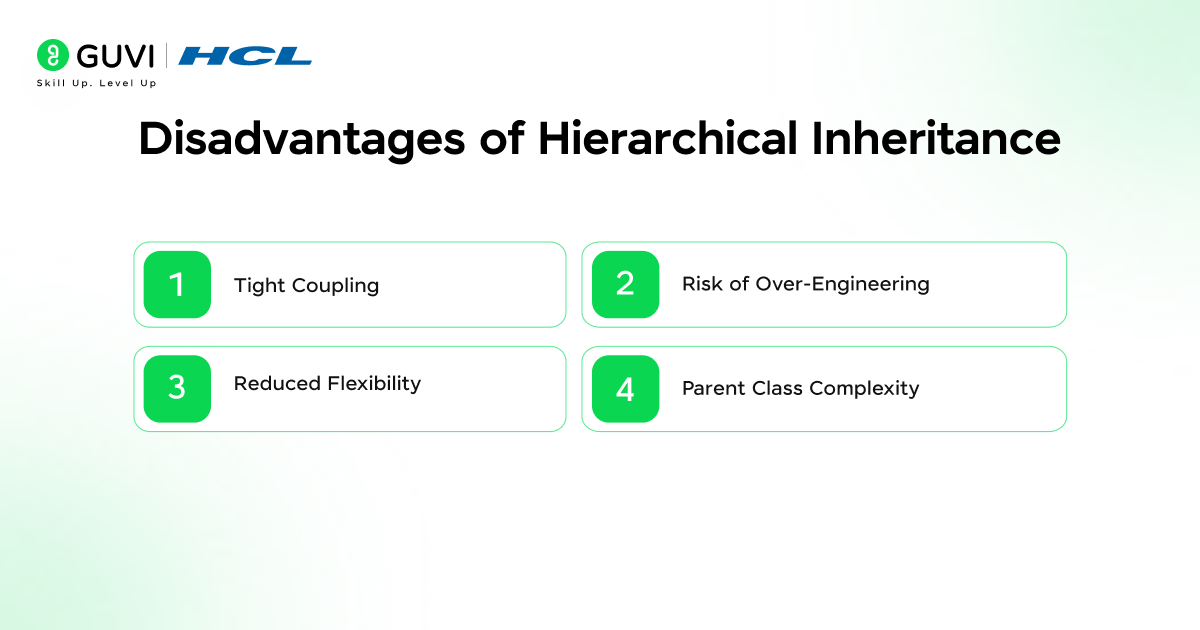
1. Tight Coupling
Child classes rely strongly on the parent class.
Subclasses could break if the parent changes incorrectly.
2. Risk of Over-Engineering
Some developers end up building needless inheritance hierarchy.
Example:
| Vehicle -> Car -> SportsCar -> RacingSportsCar |
This can become difficult to maintain.
3. Reduced Flexibility
Java only supports single inheritance with classes.
Classes in a subclass may not have more than one parent class.
4. Parent Class Complexity
When too many subclasses depend on one parent, the superclass becomes bloated.
This is known as the “God Class” problem.
Common Mistakes Developers Make
Using Inheritance Everywhere
Not all relationships should be implemented as inheritance.
Bad example:
| class Laptop extends Battery |
A laptop “has a” battery. It does not “is a” battery.
This should use composition instead.
Creating Large Parent Classes
The superclass has too many unrelated methods.
Good parent classes should be concise and general.
Ignoring Access Modifiers
Using private variables without getters can block subclass access.
Understanding:
- private
- protected
- public
is critical with regard to inheritance.
Access Modifiers in Hierarchical Inheritance
Private
Accessible only inside the same class.
| private int salary; |
It is not available for direct application of subclasses.
Protected
Accessible inside subclasses.
| protected int salary; |
Commonly used in inheritance.
Public
Accessible everywhere.
| public int salary; |
Using Constructors in Hierarchical Inheritance
Constructors are also involved in inheritance.
Example:
| class Employee { Employee() { System.out.println(“Employee constructor”); } } class Manager is a subclass of Employee { Manager() { System.out.println(“Manager constructor”); } } |
Output
| Employee constructor Manager constructor |
The execution order is: parent constructor, then child constructor(s).
You can also check out: OOPs Concepts in Java: 4 Basic Concepts Developers Must Know
The Role of super Keyword
The super keyword provides a way for subclasses to access parents’ members.
Access Parent Constructor
| super(); |
Access Parent Variable
| Super.salary |
Access Parent Method
| super.display(); |
Method Overriding in Hierarchical Inheritance
Overriding provides classes with a way to provide specialized implementations.
Example:
| class Employee { void work() { System.out.println(“Employee working”); } } class Developer is an extension of Employee { @Override void work() { System.out.println(“Writing code”); } } class Tester is a subclass of Employee { @Override void work() { System.out.println(“Testing application”); } } |
Each subclass is unique in their behavior yet have a common structure.
Hierarchical Inheritance and Runtime Polymorphism
This is where Java becomes powerful.
Example:
| Employee e; e = new Developer(); e.work(); e = new Tester(); e.work(); |
Same reference variable.
Different behavior.
This is Runtime Polymorphism.
Hierarchical Inheritance in Frameworks
The hierarchical inheritance is widely used in modern java frameworks.
Spring Framework
Example hierarchy:
| Controller | RestController |
Java Swing
Hierarchical inheritance is used for GUI components.
Example:
| Component | Container | JPanel |
Hibernate
Inheritance mapping is frequently used in entity models.
Interview Questions on Hierarchical Inheritance
1. What is Hierarchical Inheritance in java?
Hierarchical inheritance occurs when multiple child classes inherit from a single parent class.
2. Is it possible to do multiple inheritance in Java?
Java does not support multiple inheritance using classes because it creates ambiguity problems.
However, Java supports multiple inheritance using interfaces.
3. What is the difference between hierarchical inheritance and multilevel inheritance?
Hierarchical inheritance involves multiple subclasses sharing one parent, while multilevel inheritance forms a chain of inheritance.
4. Is it possible to have constructors inherited?
No, constructors are not inherited, but parent constructors are called on creation of objects.
5. What is the best access modifier to use for inheritance?
It is generally used due to the fact that subclasses can access protected members directly.
You can also check out: How to Run Java in Visual Studio Code?
A Practical Mini Project Sample
Let’s create a tiny little structure of employees.
Parent Class
| class Employee { String name; void login() { System.out.println(name + ” logged in”); } } |
Developer Class
| class Developer is an extension of the Employee class { void code() { System.out.println(name + ” writes code”); } } |
HR Class
| class HR is a subclass of Employee { void recruit() { System.out.println(name + ” recruits employees”); } } |
Tester Class
| class Tester is a subclass of the class Employee { void testSoftware() { System.out.println(name + ” tests applications”); } } |
Main Method
| public class Company { public static void main( String[] args ) { Create developer dev = new Developer(); dev.name = “Karan”; dev.login(); dev.code(); HR hr = new HR(); hr.name = “Meera”; hr.login(); hr.recruit(); Tester tester = new Tester(); tester.name = “Ajay”; tester.login(); tester.testSoftware(); } } |
Why Students Should Master Hierarchical Inheritance
If you are learning Java for placements or software development, then hierarchical inheritance is not an option.
It appears in:
- Coding interviews
- Java certifications
- Framework development
- Enterprise applications
- Android development
- Backend systems
Most important of all, knowledge of inheritance will enhance your object-oriented design thinking.
You stop writing disconnected classes and begin designing scalable systems.
Ready to build dynamic web applications and launch your career as a full-stack developer? Join the HCL GUVI Zen Class java Full Stack Development Couse and master in-demand technologies like Java, Spring Boot, HTML, CSS, JavaScript, and more through live sessions, real-world projects, and placement-focused training.
Wrapping it up:
Hierarchical inheritance in Java is far more than a classroom topic. It is an important concept used in actual applications to allow for a clean, reusable and expandable software architecture. By allowing multiple child classes to inherit from the same parent (base) class, developers are able to reduce duplication of code, make future maintenance easier, and organize their applications better.
Mastering Hierarchical Inheritance will allow students to develop strong core Object Oriented Programming skills and improve their ability to solve problems in interviews and projects, as well as for professionals. It will be a key design element when developing enterprise-scale applications that are easier to maintain and expand over time.
The key to using Hierarchical Inheritance successfully is to determine when to use inheritance and when not to make your class structure unnecessarily complicated. When you use Hierarchical Inheritance correctly, it will help convert poorly designed coding into orderly architecture.
FAQs
1. Is hierarchical inheritance supported in Java?
Yes, Java does support hierarchical inheritance which involves having more than one subclass inheriting from one superclass.
2. Why is hierarchical inheritance important?
It makes code reusability, avoid code duplication and make cleaner application architecture.
3. What is the difference between Hierarchical and single inheritance?
Single inheritance: One child class inherits one parent class.
Hierarchical inheritance: Multiple child classes inherit the same class.
4. Is the hierarchical inheritance capable of polymorphism?
Yes, runtime polymorphism can be used with hierarchical inheritance by method overriding.
Success Stories

About the Author
Vishalini Devarajan
An Aerospace Engineer turned content writer, I focus on making complex concepts easy to understand through well-structured, reader-friendly blogs. Whether it’s a technical topic or a non-technical one, I love creating content that is clear, engaging, and impactful.
View all posts by Vishalini Devarajan
Connect with me @



























Did you enjoy this article?