


Java Articles
Kafka Streams Tutorial: Build Your First Data Pipeline
What is ArrayList in Java: A Complete Guide
What is HashMap in Java: How It Works, Methods, and Examples
Spring Boot vs Traditional Spring: 5 Important Features That Changed Java Development


Get In Touch For Details! Request More Information
TCP IP Model: Layers, Functions, and How It Works
Jul 21, 2026 5 Min Read 743 Views
(Last Updated)
Many beginners learning networking struggle to understand how data actually travels from one device to another across the internet. The TCP IP model breaks that process down into four clear layers, each with a specific job, making it easier to understand how communication works at every level. Mastering the TCP IP model is a fundamental step for anyone pursuing a career in networking, cloud computing, or cybersecurity.
Table of contents
- Quick TL;DR
- What Is the TCP IP Model?
- Layers of the TCP IP Model
- How Does Each Layer Work?
- Layer 1: Network Access Layer
- Layer 2: Internet Layer
- Layer 3: Transport Layer
- Layer 4: Application Layer
- How Does the TCP IP Model Work?
- TCP IP Model vs OSI Model
- Common Mistakes When Learning the TCP IP Model
- Conclusion
- FAQs
- What is the TCP IP model in simple terms?
- How many layers does the TCP IP model have?
- What is the difference between TCP and UDP?
- What is the difference between the TCP IP model and the OSI model?
- What protocols are used at the Application layer of the TCP IP model?
- What does IP do in the TCP IP model?
- Why is the TCP IP model important for cloud computing?
- Is the TCP IP model still relevant in 2026?
Quick TL;DR
- The TCP IP model is a set of communication protocols that defines how data is transmitted across networks and the internet.
- It organises network communication into four layers: Network Access, Internet, Transport, and Application.
- Each layer has a specific role in breaking down, addressing, transmitting, and reassembling data packets.
- The TCP IP model is the foundation of modern internet communication and is essential knowledge for networking, cloud computing, and cybersecurity roles.
What Is the TCP IP Model?
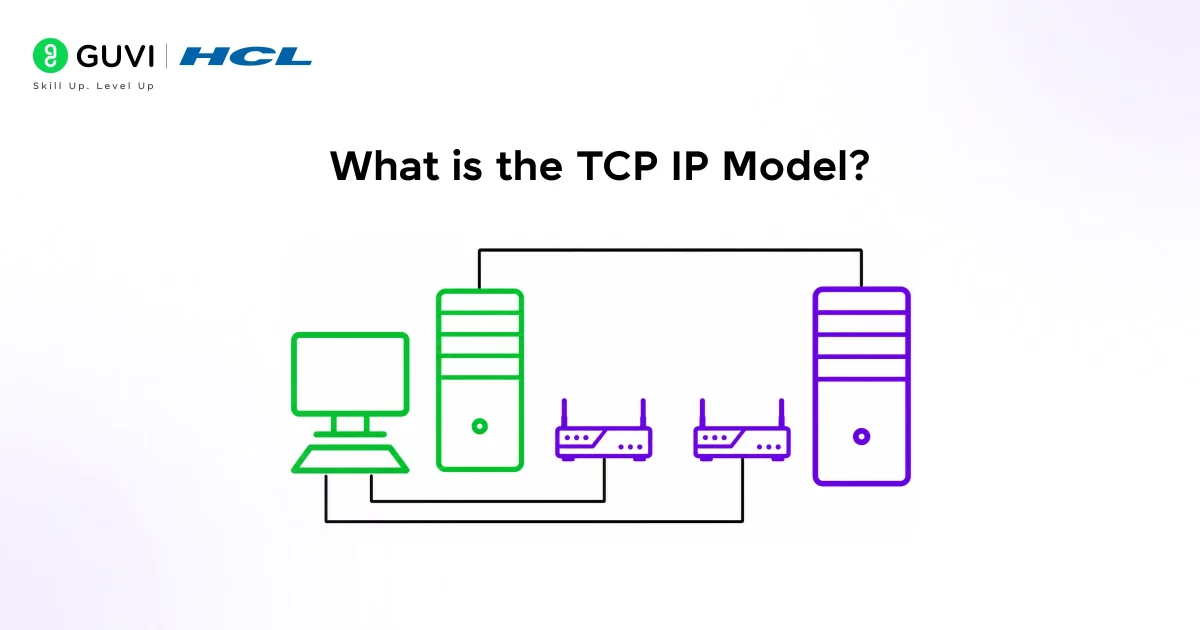
The TCP IP model, also known as the Internet Protocol Suite, is a conceptual framework that standardises how data is sent and received across interconnected networks. TCP stands for Transmission Control Protocol and IP stands for Internet Protocol.
Together, TCP and IP define the rules for:
- Breaking data into smaller packets
- Addressing and routing packets across networks
- Reassembling packets at the destination
- Ensuring reliable delivery and error checking
The TCP IP model was developed by the United States Department of Defense in the 1970s and became the foundation of the modern internet.
Want to build a strong foundation in networking, cloud computing, and Azure? Explore HCL GUVI’s Cloud Computing and Azure Course, designed for beginners with real-world projects and structured learning.
Read More: Network Architecture in Computer Network
Layers of the TCP IP Model
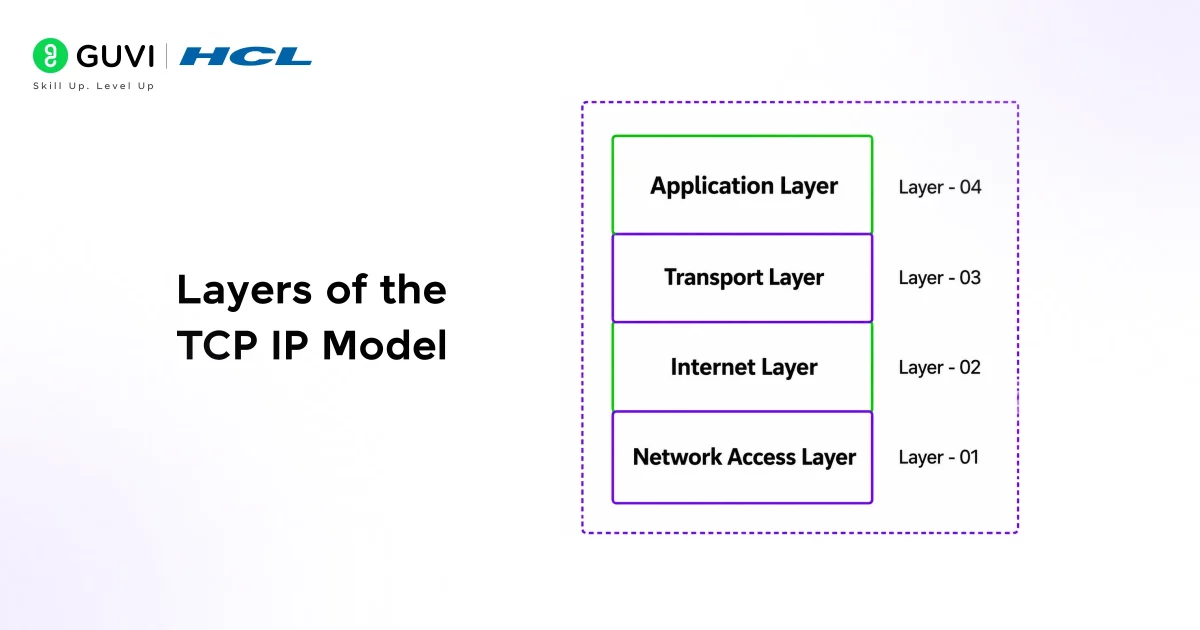
The TCP IP model has four layers. Each layer handles a specific part of the communication process and passes data to the layer above or below it.
| Layer | Name | Key Protocols | Function |
| 4 | Application | HTTP, HTTPS, FTP, SMTP, DNS | User-facing communication and data formatting |
| 3 | Transport | TCP, UDP | End-to-end communication and reliability |
| 2 | Internet | IP, ICMP, ARP | Addressing and routing packets across networks |
| 1 | Network Access | Ethernet, Wi-Fi, MAC | Physical transmission of data over hardware |
Now let’s understand what each layer does in detail.
How Does Each Layer Work?
Layer 1: Network Access Layer
The Network Access layer is the lowest layer of the TCP IP model. It handles the physical transmission of data between devices on the same network.
This layer deals with hardware components like network interface cards, cables, and wireless signals. Protocols at this layer include Ethernet for wired connections and Wi-Fi for wireless connections.
Layer 2: Internet Layer
The Internet layer is responsible for addressing and routing data packets from the source to the destination across multiple networks.
The most important protocol at this layer is IP (Internet Protocol), which assigns a unique IP address to every device. When you send data, IP ensures each packet knows where it is going and finds the best path to get there.
Layer 3: Transport Layer
The Transport layer manages end-to-end communication between two devices. It is responsible for breaking data into segments, ensuring they arrive correctly, and reassembling them at the destination.
This layer uses two main protocols:
- TCP (Transmission Control Protocol): Reliable, connection-oriented. Ensures all packets arrive in order. Used for web browsing, email, and file transfers.
- UDP (User Datagram Protocol): Fast, connectionless. Does not guarantee delivery. Used for video streaming, gaming, and voice calls.
Layer 4: Application Layer
The Application layer is the topmost layer and the one users interact with directly. It defines how applications communicate over a network.
Common protocols at this layer include:
- HTTP and HTTPS for web browsing
- SMTP and IMAP for email
- FTP for file transfers
- DNS for translating domain names into IP addresses
How Does the TCP IP Model Work?
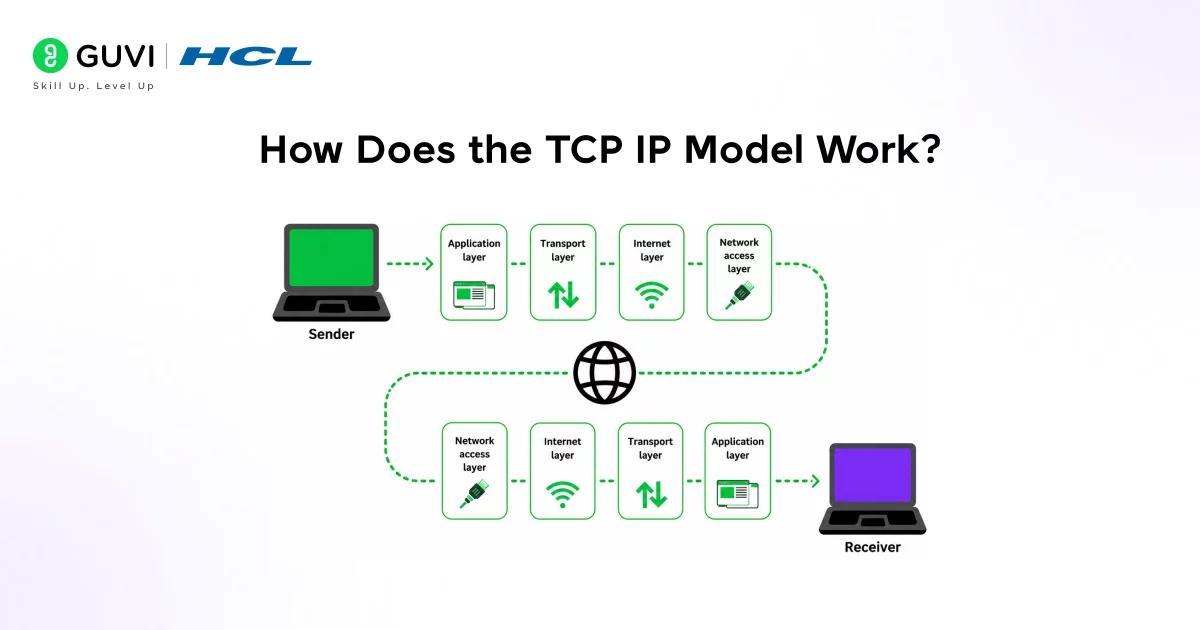
Now let’s understand how these layers work together when you open a website.
Step 1: You type a URL into your browser. The Application layer uses HTTP to format your request.
Step 2: The Transport layer breaks the request into smaller segments and adds port numbers. TCP ensures reliable delivery.
Step 3: The Internet layer adds source and destination IP addresses to each packet and determines the best route across the network.
Step 4: The Network Access layer converts the packets into electrical signals or radio waves and transmits them over the physical medium.
Step 5: At the destination server, the process reverses. Each layer strips its header, reassembles the data, and passes it up until the application receives your original request and sends back the webpage.
The TCP/IP model was first described in a 1974 research paper by :contentReference[oaicite:0]{index=0} and :contentReference[oaicite:1]{index=1}, who are often referred to as the “fathers of the internet.” Their work on the Transmission Control Protocol and Internet Protocol established the foundational communication system that enables networks to interconnect reliably across the globe. Today, the TCP/IP protocol suite remains the backbone of the modern internet, powering everyday activities such as browsing websites, sending emails, streaming videos, and enabling cloud-based services across devices and networks worldwide.
TCP IP Model vs OSI Model
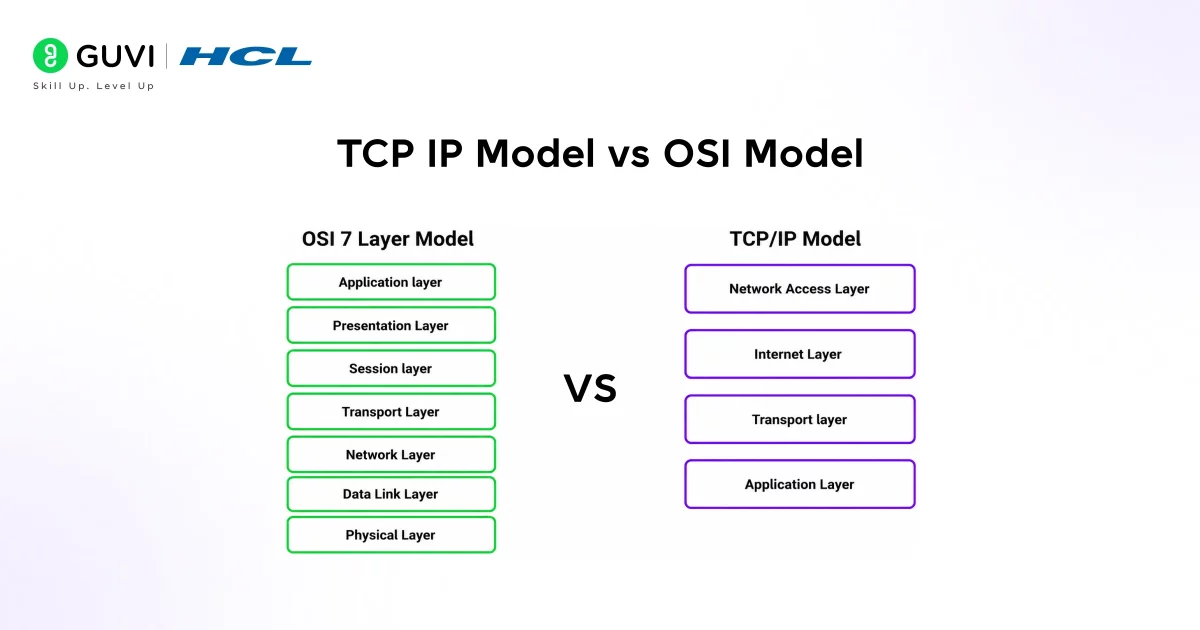
The OSI model is another networking framework often compared with the TCP IP model. The key difference is in the number of layers and level of detail.
| Feature | TCP IP Model | OSI Model |
| Number of layers | 4 | 7 |
| Developed by | US Department of Defense | ISO |
| Usage | Practical, used in real networks | Theoretical reference model |
| Application layer | Combines OSI layers 5, 6, 7 | Separate Session, Presentation, Application layers |
| Network Access layer | Combines OSI layers 1 and 2 | Separate Physical and Data Link layers |
| Protocol dependency | Protocol-specific | Protocol-independent |
The TCP IP model is what the internet actually uses. The OSI model is primarily used as a teaching tool to understand network concepts in more detail.
UDP (User Datagram Protocol) is a lightweight transport-layer protocol used where speed matters more than perfect reliability. Unlike TCP, it does not establish a connection or guarantee delivery of every packet, which reduces overhead and latency. This makes UDP especially suitable for real-time applications such as online gaming, live video streaming, and voice communication, where small data losses are preferable to delays caused by retransmission. Many modern streaming and interactive platforms use UDP-based technologies or hybrid protocols to ensure smooth, low-latency user experiences, even if occasional packet loss occurs.

Common Mistakes When Learning the TCP IP Model
1. Confusing TCP IP with just two protocols: Many beginners think TCP IP refers only to the TCP and IP protocols. In reality, TCP IP is a full suite of protocols spanning all four layers, including HTTP, DNS, UDP, ICMP, and many others.
2. Mixing up the TCP IP and OSI models: The TCP IP model has four layers while the OSI model has seven. Beginners often swap layer names between the two models during exams and interviews. Always clarify which model you are referring to before naming layers.
3. Not understanding the difference between TCP and UDP: TCP and UDP both operate at the Transport layer but serve different purposes. TCP guarantees delivery and order. UDP prioritises speed over reliability. Choosing the wrong one for an application is a common design mistake in networking projects.
4. Ignoring the role of IP addresses at the Internet layer: Beginners often skip over how IP addressing and routing actually work. Understanding subnets, routing tables, and how packets find their destination is essential for any networking or cloud role.
5. Treating the Application layer as only about web browsers: The Application layer covers all application-level protocols, not just HTTP. DNS, SMTP, FTP, and SSH all operate at this layer. Knowing which protocol belongs where is frequently tested in networking interviews.
Want to build a strong foundation in networking, cloud computing, and Azure? Explore HCL GUVI’s Cloud Computing and Azure Course, designed for beginners with real-world projects and structured learning.
Conclusion
As networking and cloud computing continue to power every layer of modern technology, understanding the TCP IP model remains a core skill for developers, cloud engineers, and cybersecurity professionals alike.
Knowing how each layer contributes to transmitting data across the internet gives you a clearer picture of how applications, APIs, and cloud services communicate behind the scenes. Start by tracing a simple web request through all four layers, then explore protocols like DNS, TCP, and HTTP individually.
FAQs
1. What is the TCP IP model in simple terms?
The TCP IP model is a set of rules that defines how data is sent and received across networks. It divides the communication process into four layers, each responsible for a specific part of the journey data takes from sender to receiver.
2. How many layers does the TCP IP model have?
The TCP IP model has four layers: Network Access, Internet, Transport, and Application. Each layer handles a distinct aspect of network communication.
3. What is the difference between TCP and UDP?
TCP is a connection-oriented protocol that guarantees reliable, ordered delivery of data. UDP is a connectionless protocol that prioritises speed over reliability. TCP is used for web browsing and email, while UDP is used for video streaming and online gaming.
4. What is the difference between the TCP IP model and the OSI model?
The TCP IP model has four layers and is the model used in real networks and the internet. The OSI model has seven layers and is primarily used as a theoretical reference framework for teaching networking concepts.
5. What protocols are used at the Application layer of the TCP IP model?
Common protocols at the Application layer include HTTP and HTTPS for web communication, SMTP and IMAP for email, FTP for file transfers, and DNS for resolving domain names into IP addresses.
6. What does IP do in the TCP IP model?
IP (Internet Protocol) operates at the Internet layer and is responsible for assigning addresses to devices and routing data packets from the source to the destination across multiple interconnected networks.
7. Why is the TCP IP model important for cloud computing?
Cloud computing relies entirely on network communication between servers, services, and users. Understanding the TCP IP model helps cloud engineers design secure architectures, troubleshoot connectivity issues, and configure networking components like VPCs, subnets, and load balancers correctly.
8. Is the TCP IP model still relevant in 2026?
Yes. The TCP IP model is the foundation of the internet and all modern network communication. Every website, cloud service, API, and connected device operates using the TCP IP protocol suite, making it as relevant today as it was when it was first designed.
Success Stories

About the Author
Vishalini Devarajan
An Aerospace Engineer turned content writer, I focus on making complex concepts easy to understand through well-structured, reader-friendly blogs. Whether it’s a technical topic or a non-technical one, I love creating content that is clear, engaging, and impactful.
View all posts by Vishalini Devarajan
Connect with me @























Did you enjoy this article?