


Career Articles
Accountant vs Data Analyst Salary in India After Switching Careers - Best Guide
Finance Managers: Could Data Science Be Your Next Career Move?
Insurance Claims Executive to Data Analyst: Is It a Good Switch?
Banking Executive (Loans, KYC) to Data Analyst: Skills and Career Path

Get In Touch For Details! Request More Information
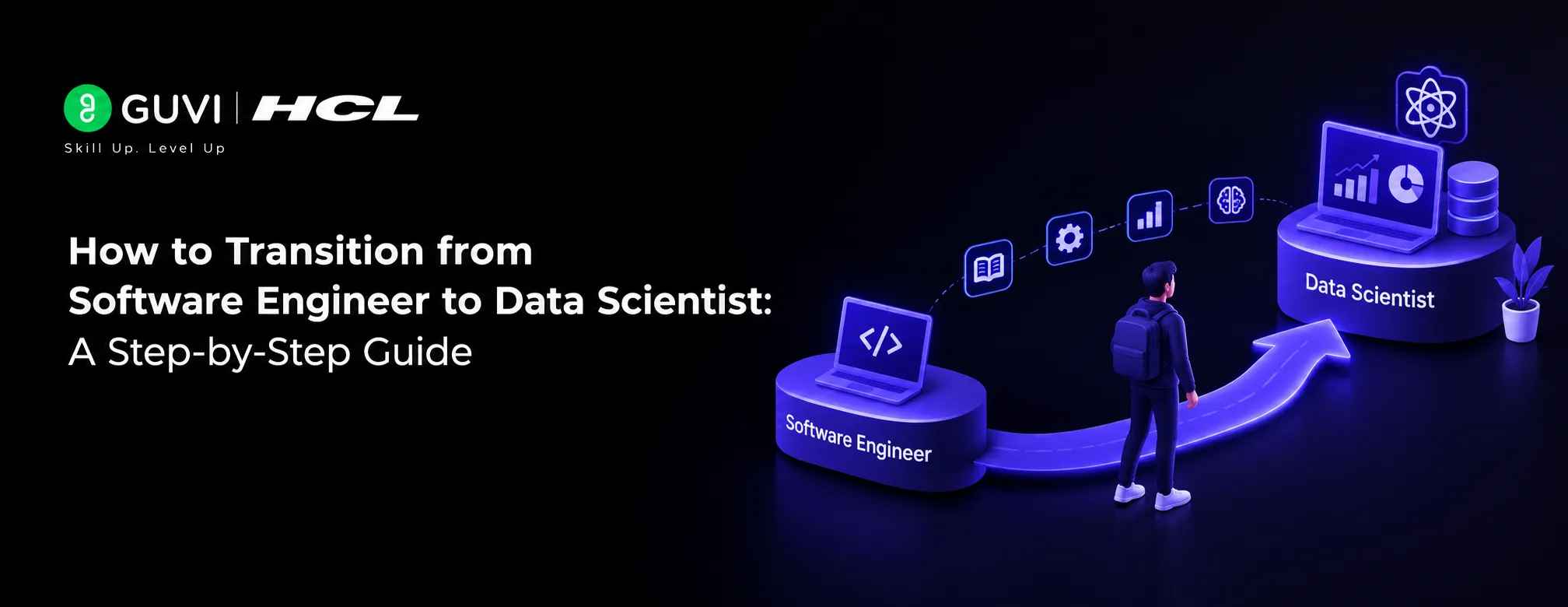
How to Transition from Software Engineer to Data Scientist: A Step-by-Step Guide
Oct 06, 2026 9 Min Read 9954 Views
(Last Updated)
Quick Answer: To move from software engineer to data scientist, build a foundation in math, statistics, Python, and SQL, then learn machine learning and data preprocessing. Create 3-4 portfolio projects, restructure your resume around them, and start applying. With focused effort, this takes around six months.
You’re a software engineer who’s good at your job. You ship clean code, debug at midnight, and know the system inside and out. But you’ve also been looking at data science roles and wondering if it’s the right next step.
Switching from software engineer to data scientist is one of the most common career pivots in tech right now, and you’re already starting with more of an edge than you think.
The tricky part isn’t whether you can do it. It’s knowing where to put your energy first, because a switch like this rewards a clear plan far more than raw effort. Let’s figure out what that looks like.
Table of contents
- Understanding the Core Differences
- Technical skill requirements comparison
- Day-to-day responsibilities
- Career trajectory differences
- Leveraging Your Software Engineering Background
- 1) Transferable programming skills
- 2) Software development best practices in data science
- 3) Version control and documentation
- How to Transition from Software Engineer to Data Scientist: Detailed Steps
- Building the Essential Foundation
- Developing Data Science Technical Skills
- Creating a Learning Roadmap
- Building a Project Portfolio
- Navigating the Career Transition
- Conclusion
- FAQs
- How long does it take to go from software engineer to data scientist?
- Do I need a master's degree to move from software engineer to data scientist?
- What skills should a software engineer learn for data science?
- Will a software engineer to data scientist switch increase my salary?
- What projects should I include in my data science portfolio?
Understanding the Core Differences
First, you need to understand what separates data scientists from software engineers. My extensive research about these two roles shows their differences run deeper than most people think.
Technical skill requirements comparison
Both roles need strong programming foundations. Data scientists require a broader skill set though. They need stronger backgrounds in mathematics and statistics than software engineers. Here are the key technical skills:
- Statistical analysis and probability
- Machine learning algorithms
- Data wrangling and preprocessing
- Advanced mathematics (multivariable calculus and linear algebra)
- Data visualization tools
Software engineers concentrate more on writing clean production code and understanding system architecture. They need deeper expertise in specific programming languages and software development practices.
Ready to build a career in data science and Generative AI? HCL GUVI’s Advanced Data Science & Generative AI Course gives you a structured 6-month learning journey with 16+ modules, 10+ hands-on projects, live industry mentorship, 1:1 doubt sessions, IITM Pravartak certification, and placement support. Turn your ambition into practical skills and take a confident step toward your career goals. Enroll today and start your data science journey!
Day-to-day responsibilities
These roles have substantially different daily work patterns. Software engineers dedicate most of their time to coding and building systems. We focus on creating precise, functional systems with definitive logic. Data scientists work more with ambiguity and probabilities.

A typical data scientist’s day includes:
- Collecting and cleaning data (about 70% of their time)
- Building predictive models
- Analyzing trends and patterns
- Presenting findings to stakeholders
Career trajectory differences
Both roles offer strong growth potential, but through different paths. Data scientists start as entry-level analysts or junior data scientists. They progress to senior roles like principal data scientist or chief data strategist. Advanced education is a great way to qualify for most positions, especially a master’s degree.
Software engineers begin as junior developers and advance to senior roles like lead developer or software architect. Both careers pay well. Data scientists earn an average of ₹11-16 lakhs annually, while software developers average ₹9-12 lakhs per year.
Software engineering openings outnumber data scientist positions by approximately 8-to-1. Both fields rank among the top jobs for salary and job satisfaction.
Leveraging Your Software Engineering Background
Software engineers have a major advantage when they move into data science. Here’s how you can use your software engineering background to speed up your data science experience.

1) Transferable programming skills
Programming expertise gives software engineers a great head start in data science. We have strong foundations in programming, algorithm design, and problem-solving that fit naturally into data science roles. These programming skills work especially well:
- Python and JavaScript proficiency
- Data structures and algorithms knowledge
- SQL and database management
- Library and framework familiarity
- Team collaboration experience
- Deadline management capabilities
2) Software development best practices in data science
Software engineering discipline can boost data science workflows. Clean, maintainable code is vital to us as software engineers. Data scientists with software skills work better independently and need fewer outside resources to handle data.
We bring production-ready code to the table. Many data scientists focus only on analysis, but our background helps us create flexible solutions. Large datasets don’t scare us – we know how to handle them efficiently and build tools that process data at scale.
3) Version control and documentation
Software engineers excel at version control in data science. Change tracking means more than just backing up work – it helps teams collaborate and maintain code quality. Data Version Control (DVC) is a vital tool to manage machine learning models and large datasets.
Documentation plays a critical role in data science projects. These key practices help:
- Write clear docstrings for functions and classes
- Maintain detailed README files
- Document infrastructure requirements
- Include model training procedures
Code documentation should grow with the project. We focus on explaining the ‘what’ and ‘why’ rather than just the ‘how’. This matters even more with complex data science pipelines where you need reproducible results.
Git and version control systems make us great at managing team data science projects. Branch strategies, merge conflicts, and clean commit histories are second nature. These skills help you get ahead when working with data science teams.
How to Transition from Software Engineer to Data Scientist: Detailed Steps

1. Building the Essential Foundation
Data science requires mastering skills beyond software engineering. My experience shows that knowing core requirements creates a focused learning path.
1.1) Mathematics and statistics prerequisites
Software engineering mainly uses discrete mathematics, but data science needs a broader mathematical foundation. During your transition, you will find these to be the most important mathematical concepts:
- Linear algebra for matrix operations and dimensionality reduction
- Probability theory for predictive modeling and risk analysis
- Statistical analysis for hypothesis testing and data interpretation
- Calculus for optimization algorithms and model fine-tuning
These concepts matter because we apply them daily. Linear algebra helps me with tasks like dimensionality reduction and solving systems of linear equations in machine learning algorithms.
1.2) Required programming languages
The transition from software engineering to data science needs a focus on specific programming languages. Here are the ones I use most:
| Language | Primary Use in Data Science |
| Python | Most accessible to more people, largest data science user base |
| R | Statistical computing and accessible visualizations |
| SQL | Data manipulation and database management |
Python leads as the gold standard because it has the largest data science support community. Most tools use Python as their foundation. R works great with Python, especially for statistical analysis and creating powerful visualizations.
1.3) Data science tools and frameworks
The data science ecosystem has various frameworks that speed up our work. These tools are a great way to get started:
- TensorFlow stands out as the most popular framework for machine learning projects.
- Pandas helps with data manipulation, and Scikit-learn implements machine learning algorithms.
These frameworks provide pre-tested and pre-optimized code that saves development time.
These tools work together beautifully. A typical machine learning project uses Pandas for data preprocessing, Scikit-learn for model development, and TensorFlow for deep learning implementations. This integrated approach creates efficient workflows and better results.
2. Developing Data Science Technical Skills
I’ll show you how to build the technical skills that will help you move from software engineering to data science. Let’s dive into how to put these skills to work.
2.1) Machine learning fundamentals
You will come to learn that machine learning has three main types: supervised learning, unsupervised learning, and reinforcement learning. What I love is that 82% of companies need people with machine learning skills, yet only 12% say they have enough machine learning professionals.
These algorithms will prove to be significant in learning:
- Linear and logistic regression for predictive modeling
- Decision trees and random forests for classification
- K-means clustering for pattern recognition
- Support vector machines for data classification
2.2) Data preprocessing and analysis
Data preprocessing will become your secret weapon when building models that work. Raw data often has missing values and outliers that can lead to wrong conclusions. Three critical preprocessing steps should shape your approach:
- Data Cleaning: Handling missing values, removing duplicates, and correcting errors
- Data Transformation: Converting data into suitable formats through normalization and standardization
- Data Integration: Combining multiple data sources while maintaining data integrity
Data cleaning takes about 70% of a data scientist’s time – a fact that surprised me. This preparation will give a solid foundation for our models to work with quality input data.
2.3) Model development and evaluation
Model development needs a systematic approach. The process starts by splitting data into training and testing sets, usually with a 70-30 split. This separation helps prevent overfitting and ensures the model works well on new data.
These metrics guide the model evaluation:
| Metric Type | Use Case |
| Accuracy | Overall correctness measurement |
| Precision | Positive prediction accuracy |
| Recall | Sensitivity to positive cases |
| F1-Score | Balance between precision and recall |
Model evaluation goes beyond accuracy. Business context and error costs matter too. To cite an instance, medical diagnosis models might need higher recall than precision to minimize false negatives.
Cross-validation proved most effective in ensuring consistent model performance. This technique helps verify that our model learns from data instead of just memorizing patterns.
3. Creating a Learning Roadmap
A well-laid-out learning path is vital for successfully switching careers into data science. This roadmap comes from a thoroughly researched personal journey and what works best in the industry.
3.1) Software Engineer to Data Scientist Roadmap for Less Than 4 Years of Experience
With under four years in software engineering, you’re not starting from zero. You can already write code, use Git, and work through problems in a team. What you’re missing is the math, the statistics, and the habit of working with messy data.
That’s why a move from software engineer to data scientist at this stage is realistic. You don’t need to learn how to program; you need to learn how to think in data.
What you already have going for you
- Comfort with at least one programming language
- Experience with version control and clean code practices
- A basic grasp of databases and SQL
- Practice at debugging and breaking problems into smaller parts
What you need to build
- Statistics and probability
- Linear algebra and calculus at a working level
- Data handling with Pandas
- Machine learning and model evaluation
You can build all of this in roughly six months if you study consistently. Here is how you can split that time.
| Month | Focus Areas | Steps to take |
|---|---|---|
| 1 | Math and statistics | Cover probability, hypothesis testing, linear algebra basics, and the calculus behind optimization |
| 2 | Python for data and SQL | Learn Pandas and NumPy, and practice SQL queries on real datasets. Add R later only if your target roles ask for it |
| 3 | Data cleaning and analysis | Handle missing values, outliers, and duplicates, then practice exploring data and building visualizations |
| 4 | Machine learning | Work through regression, decision trees, random forests, and clustering with Scikit-learn |
| 5 | Model evaluation and deep learning | Learn cross-validation, precision, recall, and F1-score, then try a simple neural network in TensorFlow |
| 6 | Portfolio projects | Build 3 to 4 projects and document each one on GitHub |
3.2) Software Engineer to Data Scientist Roadmap for 4+ Years of Experience
After four or more years in the industry, your biggest asset isn’t just coding. It’s knowing how real systems behave in production, how teams ship work, and how business problems turn into technical ones. Many entry-level data science candidates don’t have that.
The catch is time. You likely have a full-time job and less room to study than a fresher. So for a software engineer to move to data scientist at this level, the plan should be shorter and more focused, not a copy of the beginner path.
Where you can skip ahead
- Python, Git, and clean code habits you already use daily
- SQL and database work, which you can brush up on in a week or two
- Reading documentation and learning new tools quickly
- Working with APIs, pipelines, and deployment
Where you need to put your effort

- Statistics, especially hypothesis testing and probability
- The math behind machine learning, not just the library calls
- Judging whether a model is actually good, beyond accuracy
- Explaining results to people who don’t write code
Use your experience as an advantage
Look at your current work for data angles. If you’ve built dashboards, handled logs, or worked on recommendations or search, you already have raw material for a project that feels real instead of a tutorial copy.
Some engineers also move into data science inside their own company first. It’s often easier than starting fresh elsewhere, since people already trust your work.
A realistic plan is about four months of steady study, or five if work gets busy.
| Month | Focus Areas | Steps to take |
|---|---|---|
| 1 | Statistics and math, plus a quick Python data refresh | Cover probability, distributions, hypothesis testing, and linear algebra. Spend a few evenings on Pandas and NumPy, since your Python base is already strong |
| 2 | Machine learning core | Learn regression, tree-based models, and clustering with Scikit-learn, and understand why each model works instead of only how to run it |
| 3 | Evaluation and one deeper topic | Practice cross-validation, precision, recall, and F1-score, then pick one area such as deep learning, NLP, or time series based on the roles you want |
| 4 | Portfolio and job prep | Build 2 to 3 projects tied to your industry experience, put them on GitHub, and start reworking your resume |
3.3) Recommended courses and resources
Learning from multiple platforms gives you the best education. MIT Open Learning has excellent data science resources through their MicroMasters program. You can even use these credits toward a Master’s degree. Here are my top picks:
- Gain industry-relevant skills in machine learning, AI, and analytics through hands-on projects with HCL GUVI’s Zen Class Data Science Course, which offers personalized mentorship and a job-ready curriculum designed to unlock top-tier opportunities in the data-driven world.
- Professional Certificate Programs from Caltech University and IBM give you a solid curriculum and post-graduate validation.
- Google’s Machine Learning Crash Course comes with video lectures, case studies, and practice exercises.
- Codementor provides tutorials and practical guidance.
The numbers speak for themselves – 90% of people who completed quality bootcamps landed jobs within 12 months and got an average ₹5 Lakhs salary hike.
3.4) Skill assessment milestones
Regular progress checks help ensure you’re ready to make the switch. Your approach should focus on multiple skills:
- Technical Proficiency
- Solve coding challenges on platforms like GFG or LeetCode
- Create interactive dashboards using Tableau or Power BI
- Join virtual hackathons
- Portfolio Development
- Set up and maintain a GitHub repository
- Take part in Kaggle competitions
- Build projects that solve real business problems
Internships or entry-level positions are a great way to get hands-on experience with datasets and statistical techniques. This approach works because it combines structured learning with practical application. You build theoretical knowledge and real-world skills at the same time.
4. Building a Project Portfolio
Building a compelling project portfolio is often the quickest way to show your transition from software engineer to data scientist. Based on my research, here’s what works best for you.
4.1) Selecting project types
A strong portfolio needs variety to showcase different skills. Including 3-4 projects works best, as this number lets you show your capabilities without overwhelming reviewers. Here’s how you should structure your project selection:
| Project Type | Purpose | Example |
| Code-based | Show technical expertise | Data pipeline automation |
| Content-based | Demonstrate communication | Technical blog posts |
| Industry-specific | Target desired roles | E-commerce analysis |
This approach works because the projects align with our target industries. To name just one example, see how e-commerce positions need projects that analyze customer behavior and sales trends.
4.2) Implementation best practices
Your software engineering background will help you develop these significant practices:
- Document data sources and processing steps clearly
- Write clean, well-commented code with good documentation
- Include problem statements and methodology explanations
- Test website loading times in different browsers
The story behind the data matters. Each project should detail the complete narrative, including hypotheses, processes, setbacks, and conclusions. This shows potential employers your technical capabilities and problem-solving methods.
4.3) Portfolio presentation strategies
Your portfolio website should include these key elements that hiring managers want to see:
- Professional Introduction: A clear overview of who you are and your background
- About Section: Detailed background and expertise
- Contact Information: Professional contact details
- Project Showcase: Your best 3-4 projects with detailed documentation
GitHub works great for code hosting while a personal website handles presentation. Your portfolio stays responsive on all devices and uses SEO best practices. Technical reviewers can check the code while non-technical stakeholders can easily view your capabilities.
Each project includes detailed breakdowns of the following:
- Problem statement and objectives
- Data sources and preprocessing steps
- Techniques and tools used
- Results and business effect
Regular portfolio updates with new projects or improvements show your dedication to learning and staying current with industry trends.
5. Navigating the Career Transition
This final step in the transition from software engineering to data science involves becoming skilled at career changes. After helping many colleagues make this change, I’ll share proven strategies to land your dream data science role.
5.1) Resume Tips
Your resume should tell a compelling story of your transition. Experience shows that resumes fail because people use them as a “credential dump” instead of a strategic narrative.
The first step creates a “resume master” that’s twice your final length. This document includes all relevant experiences and various bullet points for each role. You can use this master document as foundation to create customized versions for each application.
Data science resumes stand out by showing impact through metrics and projects. The focus areas include:
- Quantifiable achievements from software engineering roles
- Data science projects with measurable outcomes
- Technical skills relevant to the specific position
- Collaborative projects showing team capabilities
Be very selective about what you include. Start with your highest-impact skills and experiences. Your communication skills should shine through concise, effective descriptions.
5.2) Interview preparation
Data science interviews have multiple facets, with HR, technical, and project-based rounds. Preparation should target three key areas that hiring managers review:
- Technical Capability: They want to verify your skills match the job requirements
- Company Interest: Show active interest in the company’s data challenges
- Cultural Fit: Demonstrate knowing how to work effectively within their teams
These items need review before each interview:
- Your submitted resume and project portfolio
- Technical concepts mentioned in the job description
- The company’s data science applications
- Common behavioral questions
First impressions form within two seconds of meeting. Professional presentation, appropriate dress code, and confident body language matter greatly.
5.3) Salary Jump Example: What a Software Engineer to Data Scientist Switch Can Look Like
For experienced engineers, the salary jump rarely comes with the first switch. It usually comes after you have real data science experience on your resume. This example is an illustration, not a guarantee.
Take an engineer with 6 years of experience, earning ₹22 LPA as an SDE-2 at a product company.
| Stage | Role | Total CTC |
|---|---|---|
| Before | SDE-2 | ₹22 LPA |
| First switch | Data Scientist | ₹22 to 24 LPA |
| After 2 years in data science | Senior Data Scientist | ₹28 to 32 LPA |
On the first move, the pay stays about the same, and a small dip is possible if the new role sits at a lower level. The real gain comes on the second move, when you apply with real data science experience.
Moving within your current company is often the safer first step. The pay may not rise, but you skip the risk of being hired as a beginner elsewhere.
5.4) Salary negotiations
Salary negotiation plays a significant role in data science positions. People rating their negotiation skills as ‘excellent’ can earn up to $50,000 more annually than those with ‘very poor’ skills. A systematic approach to negotiations works best:
| Phase | Action | Purpose |
| Research | Market value assessment | Establish baseline expectations |
| Preparation | Total compensation analysis | Understand full package value |
| Discussion | Professional counteroffer | Present value proposition |
One key insight is to avoid early salary discussions. Better responses include “I’m considering any competitive offers” or focusing on the total compensation package rather than just the salary number.
Many candidates don’t realize that negotiation is not only acceptable but expected. Companies rarely rescind offers because of negotiation attempts. The data shows 18% of data scientists have never asked for a higher salary, leaving money on the table.
Successful negotiations focus on:
- Understanding the total compensation package
- Asking role-specific questions about growth opportunities
- Maintaining professional courtesy throughout discussions
- Getting a full picture beyond base salary
Handling objections calmly and asking recruiters to review your counteroffer with their team. This approach helps secure better compensation packages while maintaining positive relationships with potential employers.
Conclusion
Switching careers is rarely a single decision. It is a series of small, deliberate steps. You don’t need to become an expert overnight; you need to keep moving. Your software engineering background already gives you a head start, so the real work is staying consistent, building things that prove what you know, and being patient with the learning curve.
Start with one skill, finish one project, and let that progress build your confidence for the next step.
FAQs
1. How long does it take to go from software engineer to data scientist?
About six months of focused learning is a realistic target. That covers math and statistics, Python, R and SQL, machine learning, deep learning, and a few portfolio projects.
2. Do I need a master’s degree to move from software engineer to data scientist?
Not always, though a master’s helps for many positions. A strong portfolio, relevant certifications, and Kaggle or GitHub work can also prove your skills.
3. What skills should a software engineer learn for data science?
Start with linear algebra, probability, statistics, and calculus. Then learn Python, R, SQL, and tools like Pandas, Scikit-learn, and TensorFlow.
4. Will a software engineer to data scientist switch increase my salary?
Not automatically. Average pay is around ₹11-16 lakhs for data scientists and ₹9-12 lakhs for software developers. Your offer depends on your skills, projects, and negotiation skills.
5. What projects should I include in my data science portfolio?
Include 3-4 projects: one code-based (like a data pipeline), one content-based (like a technical blog post), and one industry-specific (like an e-commerce analysis). Host the code on GitHub and explain the problem, data, tools, and results for each.
Success Stories











Did you enjoy this article?