


Artificial Intelligence and Machine Learning Articles
Dependency Parsing in NLP Explained
Coreference Resolution: How AI Tracks Pronouns


Get In Touch For Details! Request More Information
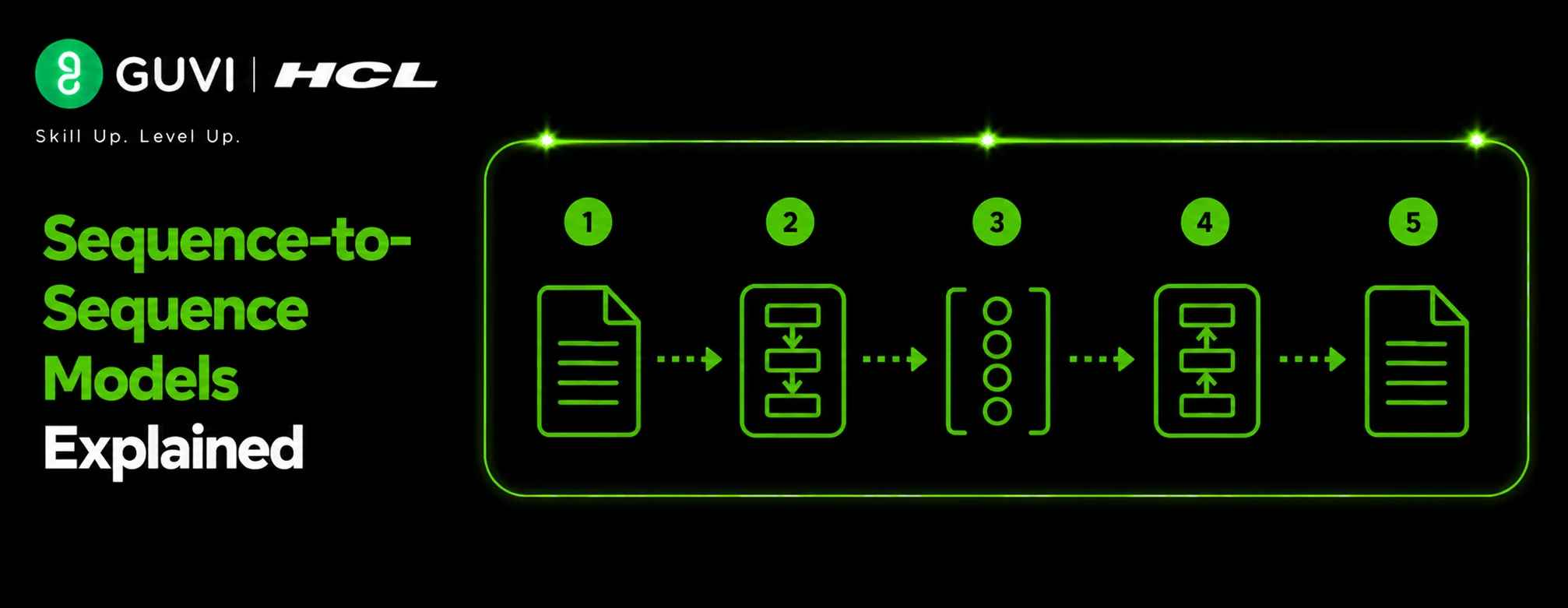
Sequence-to-Sequence Models Explained
Aug 25, 2026 3 Min Read 15 Views
(Last Updated)
Many NLP tasks require an AI system to take one sequence as input and produce another sequence as output. Sequence-to-Sequence (Seq2Seq) Models are designed for exactly this type of problem. They are widely used for tasks such as machine translation, text summarization, conversational AI, and text generation. This guide explains the basic Seq2Seq architecture, how the encoder and decoder work, and why attention became important for improving these models.
Table of contents
- TL;DR
- Quick Answer
- What Is a Sequence-to-Sequence Model?
- Encoder and Decoder
- Encoder
- Decoder
- How Seq2Seq Models Work
- Step 1: Input the Sequence
- Step 2: Encode the Input
- Step 3: Pass Information to the Decoder
- Step 4: Generate the Output
- Step 5: Continue Until Completion
- The Role of Attention
- Seq2Seq With Attention
- Common Seq2Seq Architectures
- RNN-Based Models
- LSTM-Based Models
- GRU-Based Models
- Transformer-Based Models
- Common Applications
- Machine Translation
- Text Summarization
- Conversational AI
- Question Answering
- Text Generation
- Key Concepts to Remember
- A Practical Seq2Seq Workflow
- Prepare the Data
- Tokenize the Sequences
- Encode the Input
- Generate the Output
- Apply Attention
- Train the Model
- Evaluate the Results
- Real-World Applications
- Language Translation
- Summarization
- Conversational Systems
- Text Transformation
- Best Practices
- Conclusion
- FAQs
- What are Sequence-to-Sequence Models?
- What are the main components of a Seq2Seq model?
- Can input and output sequences have different lengths?
- What is attention in Seq2Seq models?
- Where are Seq2Seq models used?
- Which architectures can be used for Seq2Seq modeling?
- Why are transformers important for Seq2Seq models?
TL;DR
- Seq2Seq models convert one sequence into another.
- They typically use an encoder and a decoder.
- The encoder processes the input sequence.
- The decoder generates the output sequence.
- Attention helps the decoder focus on relevant parts of the input.
Quick Answer
| Sequence-to-Sequence Models are neural network architectures that transform an input sequence into an output sequence, which may have a different length. A typical Seq2Seq model contains an encoder that processes the input and a decoder that generates the output. These models are useful for tasks where the input and output are both sequential, such as translating one language into another or summarizing a document. |
What Is a Sequence-to-Sequence Model?
A Seq2Seq model follows the basic structure:
Input Sequence → Encoder → Decoder → Output Sequence
For example:
English: “How are you?”
French: “Comment allez-vous ?”
The input and output contain different words and can have different lengths.
Encoder and Decoder
Encoder
The encoder processes the input sequence and creates a representation containing information about it.
For example, in a translation task, the encoder processes each word in the source sentence and captures its meaning and relationships.
Decoder
The decoder uses the encoded information to generate the output sequence one element at a time.
It predicts the next token based on the encoded input and the tokens it has already generated.
How Seq2Seq Models Work
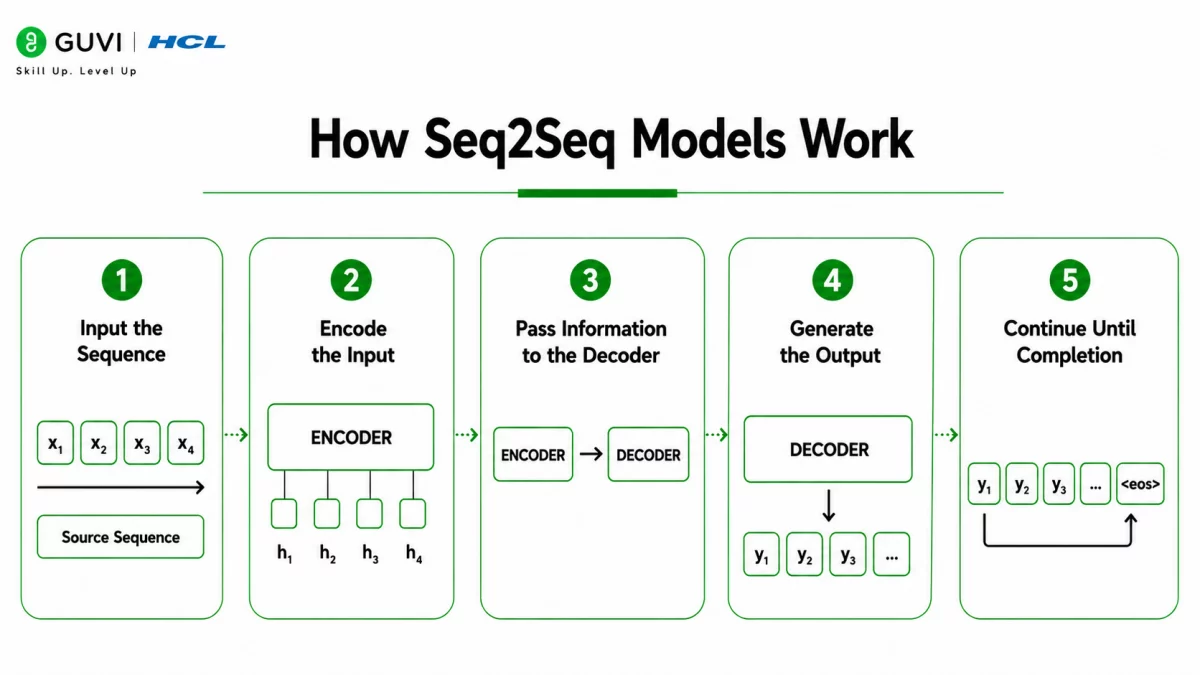
Step 1: Input the Sequence
The source sequence is provided to the encoder.
Step 2: Encode the Input
The encoder processes the sequence and creates representations of the input information.
Step 3: Pass Information to the Decoder
The decoder receives information from the encoder.
Step 4: Generate the Output
The decoder predicts output tokens sequentially.
Step 5: Continue Until Completion
The decoder continues generating tokens until it reaches an end-of-sequence condition.
The Role of Attention
Early Seq2Seq architectures often relied on a single representation of the input. This could become difficult when processing long sequences.
Attention addresses this limitation by allowing the decoder to focus on different parts of the input when generating each output token.
For example, while translating a sentence, the decoder can assign greater importance to the source words most relevant to the word it is currently generating.
Seq2Seq With Attention
A simplified workflow is:
Input → Encoder → Encoder Representations → Attention → Decoder → Output
Attention allows the decoder to dynamically access relevant encoder representations instead of relying only on one fixed representation.
Common Seq2Seq Architectures
RNN-Based Models
Early Seq2Seq systems commonly used recurrent neural networks to process sequences.
LSTM-Based Models
LSTMs helped handle longer dependencies more effectively than basic RNNs.
GRU-Based Models
GRUs provide another recurrent architecture that can be used in encoder-decoder systems.
Transformer-Based Models
Transformers use attention mechanisms instead of relying on recurrent processing and have become widely used for modern sequence-to-sequence tasks.
Common Applications
Machine Translation
Convert text from one language into another.
Text Summarization
Transform a long document into a shorter summary.
Conversational AI
Generate responses based on conversational input.
Question Answering
Transform a question and context into an appropriate answer.
Text Generation
Generate new sequences based on an input prompt or sequence.
Professionals interested in artificial intelligence, NLP, and deep learning can strengthen their expertise through HCL GUVI’s Artificial Intelligence and Machine Learning Course.
The introduction of attention mechanisms was a major development in Seq2Seq models because it reduced the need to compress an entire input sequence into a single fixed representation.

Key Concepts to Remember
- Seq2Seq maps one sequence to another.
- Encoder processes the input sequence.
- Decoder generates the output sequence.
- Encoder and decoder can work with sequences of different lengths.
- Attention helps the decoder focus on relevant input information.
- Transformers provide a powerful modern approach to sequence-to-sequence modeling.
A Practical Seq2Seq Workflow
1. Prepare the Data
Collect paired input and output sequences for the intended task.
2. Tokenize the Sequences
Convert text into tokens that the model can process.
3. Encode the Input
Pass the input sequence through the encoder.
4. Generate the Output
Use the decoder to predict output tokens sequentially.
5. Apply Attention
Allow the decoder to focus on relevant portions of the input when appropriate.
6. Train the Model
Compare generated outputs with target sequences and optimize the model.
7. Evaluate the Results
Measure performance using metrics suitable for the specific sequence-to-sequence task.
Real-World Applications
Language Translation
Translate sentences between different languages.
Summarization
Generate concise summaries from longer documents.
Conversational Systems
Generate responses based on user input.
Text Transformation
Convert one type of textual representation into another.
The HCL GUVI’s Artificial Intelligence eBook introduces artificial intelligence, machine learning, generative AI, and intelligent automation concepts, helping learners build a broader understanding of modern AI technologies.
Best Practices
- Use high-quality input-output sequence pairs.
- Choose an architecture appropriate for the sequence length and task.
- Use attention when the task requires detailed input alignment.
- Apply suitable tokenization and preprocessing.
- Evaluate outputs using task-specific metrics.
- Test the model on sequences it has not seen during training.
- Consider transformer-based architectures for modern large-scale applications.
Conclusion
Sequence-to-Sequence Models provide a flexible framework for transforming one sequence into another. Their encoder-decoder structure makes them useful for translation, summarization, conversational AI, and other NLP tasks. Attention mechanisms improve the architecture by allowing the decoder to focus on relevant input information, while transformer-based approaches have further expanded the capabilities of sequence-to-sequence modeling.
FAQs
1. What are Sequence-to-Sequence Models?
Sequence-to-Sequence Models are neural network architectures that transform an input sequence into an output sequence.
2. What are the main components of a Seq2Seq model?
The two primary components are the encoder and decoder. The encoder processes the input, while the decoder generates the output.
3. Can input and output sequences have different lengths?
Yes. Seq2Seq models can transform sequences of different lengths, which makes them useful for translation and summarization.
4. What is attention in Seq2Seq models?
Attention allows the decoder to focus on different parts of the input sequence when generating each output token.
5. Where are Seq2Seq models used?
They are used in machine translation, summarization, conversational AI, question answering, and text generation.
6. Which architectures can be used for Seq2Seq modeling?
Seq2Seq systems can use RNNs, LSTMs, GRUs, and transformers, among other architectures.
7. Why are transformers important for Seq2Seq models?
Transformers use attention-based processing to model relationships between sequence elements efficiently and have become a major architecture for modern sequence-to-sequence models
Success Stories

About the Author
HCL GUVI
This article was selected and published as part of the HCL GUVI AI Blogathon 2026, an initiative designed to encourage students, AI enthusiasts, and aspiring tech writers to simplify complex AI concepts through impactful technical content. The contest recognized high-quality, original, and insightful AI-focused blogs, with selected authors receiving publication opportunities on the HCL GUVI blog platform along with official author credits and recognition.
View all posts by HCL GUVI
Connect with me @






Did you enjoy this article?