


Artificial Intelligence and Machine Learning Articles
Dependency Parsing in NLP Explained
Spell Correction Algorithms in NLP


Get In Touch For Details! Request More Information
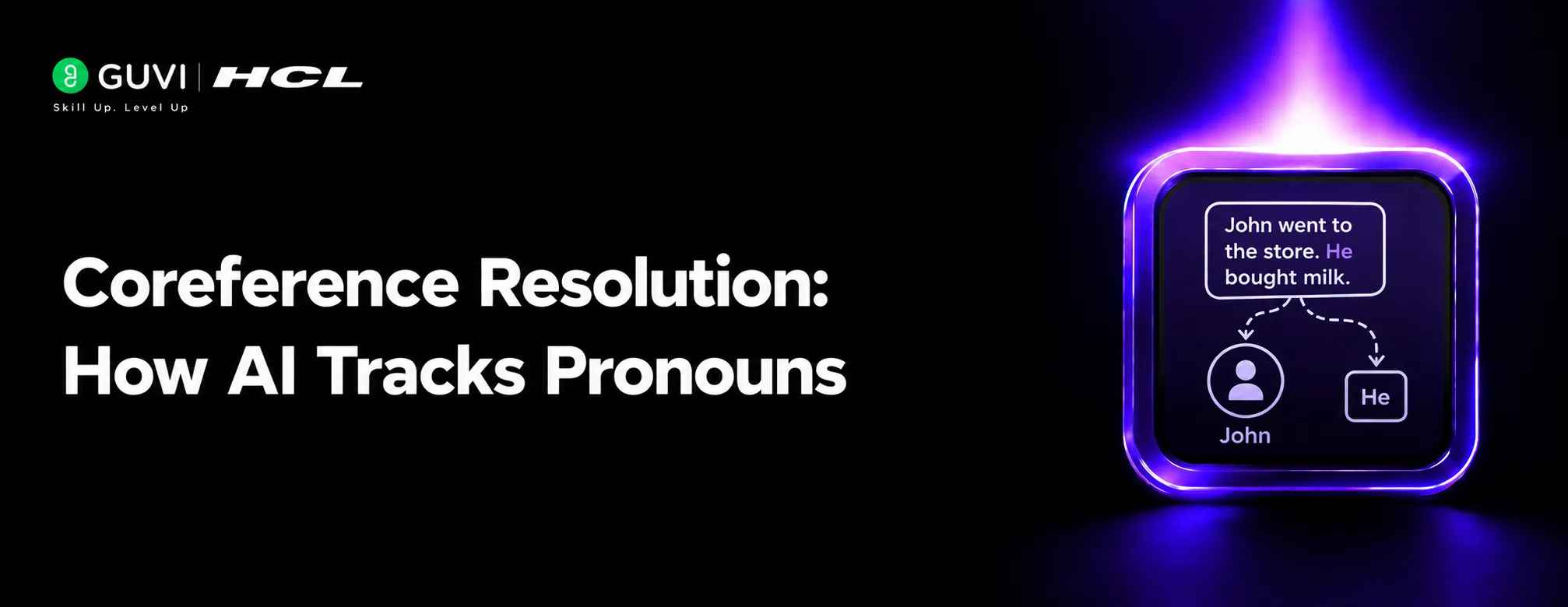
Coreference Resolution: How AI Tracks Pronouns
Aug 25, 2026 3 Min Read 18 Views
(Last Updated)
When someone says, “Sarah opened the laptop because she needed to work,” how does an AI system know that she refers to Sarah? Coreference Resolution helps NLP systems identify when different expressions in a text refer to the same person, object, or entity.
This capability is important because understanding individual words is not enough for many language applications. AI systems also need to connect references across sentences and determine what pronouns, names, and descriptions are actually referring to.
Table of contents
- TL;DR
- What Is Coreference Resolution?
- Why Is Coreference Resolution Important?
- How Does Coreference Resolution Work?
- What Are Mentions and Antecedents?
- How Does AI Resolve Pronouns?
- Coreference Resolution with Transformer Models
- What Are Coreference Chains?
- Where Is Coreference Resolution Used?
- A Simple Example
- Key Takeaways
- Conclusion
- FAQs
- What is Coreference Resolution in NLP?
- Why is Coreference Resolution important?
- What is a coreference chain?
- Can AI resolve pronouns automatically?
- What is the difference between NER and Coreference Resolution?
TL;DR
- Coreference Resolution identifies expressions that refer to the same entity.
- Pronouns such as “he,” “she,” “it,” and “they” are common examples.
- The task requires understanding context and relationships across text.
- Modern systems use machine learning and transformer-based language models.
- It improves information extraction, question answering, summarization, and document understanding.
What Is Coreference Resolution?
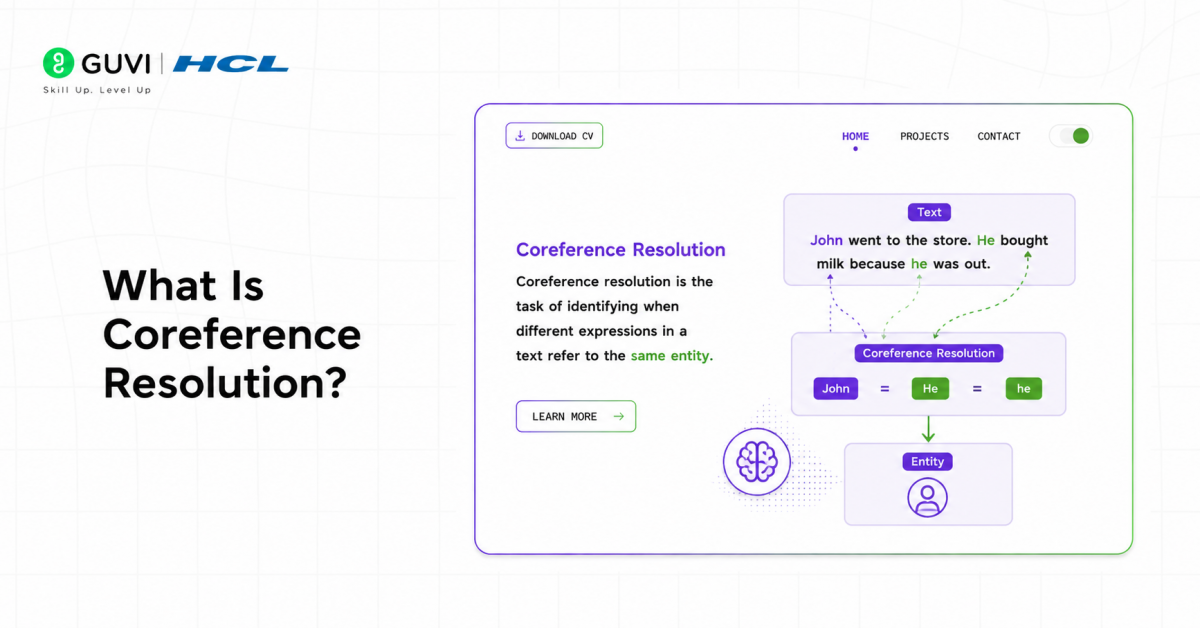
Coreference Resolution is the NLP task of determining which mentions in a text refer to the same real-world entity.
Consider:
“David bought a new laptop. He uses it every day.”
A coreference system should identify:
- “He” → David
- “it” → laptop
These references can then be grouped into the same coreference chain.
The goal is to help an AI system understand that different words or phrases can represent the same underlying entity.
Read More: 40 Interesting NLP Interview Questions and Answers
Build practical NLP skills with HCL GUVI’s Artificial Intelligence & Machine Learning Course. Learn language models, NLP techniques, and AI development through real-world projects.
Why Is Coreference Resolution Important?
Human readers naturally connect references while reading. Machines, however, need explicit methods to establish those connections.
Without coreference understanding, an NLP system might treat “the manager,” “she,” and a person’s name as completely separate entities.
Coreference Resolution can help AI:
- Maintain context across sentences.
- Identify relationships between entities.
- Improve document understanding.
- Extract more accurate information.
- Generate more coherent summaries.
This becomes especially important when processing long documents containing many people, organizations, and objects.
Coreference is not limited to pronouns. A person’s name, title, description, or shortened reference can all refer to the same entity.
How Does Coreference Resolution Work?
A typical coreference system identifies mentions and determines which mentions refer to the same entity.
A simplified workflow is:
- Process and tokenize the text.
- Identify potential entity mentions.
- Generate possible mention pairs or clusters.
- Compare contextual information.
- Calculate whether mentions refer to the same entity.
- Create coreference chains.
For example:
“The company launched a new product. The organization expects strong demand.”
The system may determine that “The company” and “The organization” refer to the same entity.
Pro Tip: Context is critical when resolving references. Looking only at the nearest preceding noun can produce incorrect results because the correct antecedent may appear several words or sentences earlier.
What Are Mentions and Antecedents?
A mention is a phrase that refers to an entity.
For example:
“John visited the store. He bought a phone.”
Here, “John” and “He” are mentions of the same entity.
The antecedent is the earlier expression that a later reference points to. In this example, “John” is the antecedent of “He.”
A coreference system connects these mentions into one entity chain.
How Does AI Resolve Pronouns?
Pronoun resolution is one of the most recognizable parts of Coreference Resolution.
Consider:
“Maria spoke with Anna because she had a question.”
Who does “she” refer to?
The answer cannot always be determined from grammar alone. The system may need to consider:
- Sentence structure
- Gender information when available
- Number agreement
- Semantic compatibility
- Context
- Broader document information
Some sentences remain genuinely ambiguous even for humans.
Warning: Coreference Resolution does not guarantee a single correct interpretation. Some references are ambiguous without additional context or world knowledge.
Coreference Resolution with Transformer Models
Modern NLP systems increasingly use transformer-based architectures to understand context.
Transformers can examine relationships between words across long sequences, allowing models to use surrounding context when determining whether two mentions refer to the same entity.
A model can consider:
- Words surrounding each mention
- Sentence-level context
- Relationships across paragraphs
- Semantic similarity
- Entity characteristics
This contextual representation makes transformer-based approaches powerful for complex coreference tasks.

What Are Coreference Chains?
A coreference chain groups all mentions that refer to the same entity.
For example:
“Microsoft released a new product. The company expects strong adoption. It will expand the service next year.”
A coreference chain might connect:
Microsoft → The company → It
This gives an NLP system a unified representation of the entity throughout the document.
Coreference chains are especially useful when extracting information from long documents.
Where Is Coreference Resolution Used?
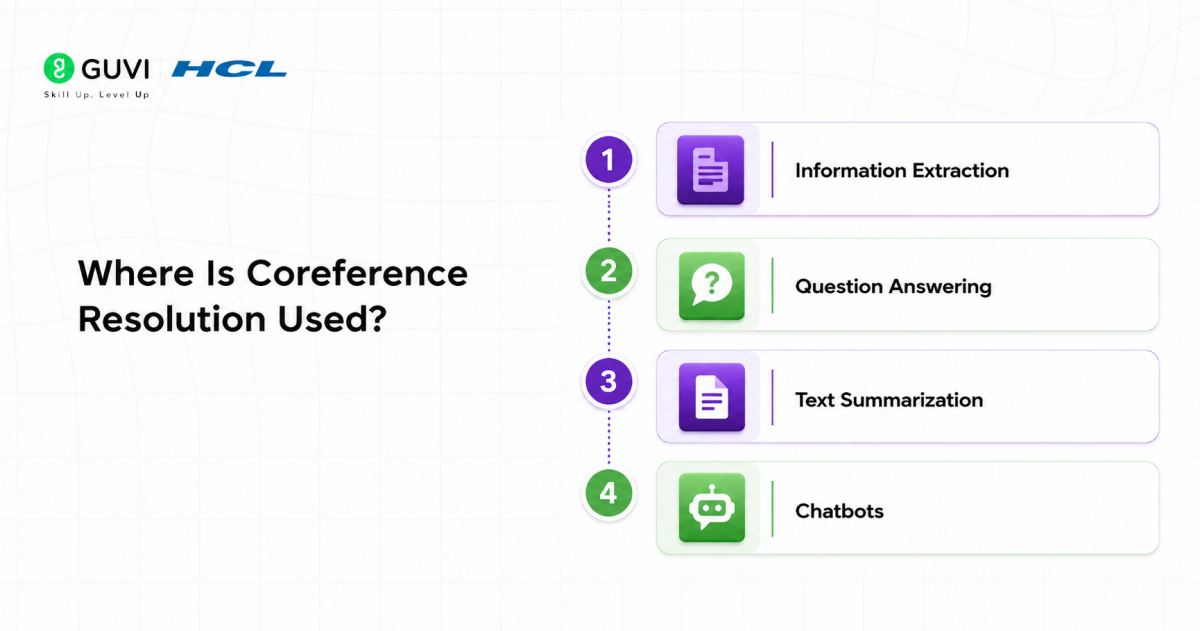
Coreference Resolution supports several real-world NLP applications.
- Information Extraction
It helps systems connect facts that are spread across different sentences.
For example, a system can associate a company’s name with later references such as “the organization” or “the company.”
- Question Answering
When a question depends on a pronoun or earlier mention, coreference understanding can help identify the correct entity.
- Text Summarization
A summarization system needs to understand who or what different references describe to produce coherent summaries.
- Chatbots
Conversational AI must track references across multiple turns.
For example:
User: “I bought a new laptop yesterday.”
User: “It is running slowly.”
The system needs to understand that “it” refers to the laptop.
- Document Analysis
Legal, financial, and business documents often contain repeated references to people and organizations. Resolving these references can improve structured document analysis.
A Simple Example
Consider:
“The engineer presented the project to the manager. She approved it immediately.”
A coreference system needs to determine what “She” and “it” refer to.
Depending on context, “She” might refer to the manager and “it” might refer to the project.
This demonstrates why understanding sentence structure alone is not always sufficient. An AI system needs contextual information to make reliable predictions.
Data Point: Coreference information becomes increasingly valuable as documents become longer because the same entity may be mentioned through many different expressions.
Key Takeaways
- Coreference Resolution connects different mentions that refer to the same entity.
- Pronouns are one of the most common forms of coreference.
- Coreference chains provide a unified view of an entity across text.
- Transformer models can use broader context to improve reference resolution.
- The technique supports chatbots, summarization, information extraction, and question answering.
- Ambiguity and long-distance references remain major challenges.
Build practical NLP skills with HCL GUVI’s Artificial Intelligence & Machine Learning Course. Learn language models, NLP techniques, and AI development through real-world projects.
Conclusion
Coreference Resolution helps AI move beyond recognizing individual words and toward understanding how ideas connect throughout a document. By linking names, pronouns, descriptions, and other mentions to the same entities, NLP systems can maintain context more effectively.
Modern transformer-based models have significantly improved the ability to resolve complex references, but ambiguity remains an inherent challenge in human language. When combined with entity recognition and other NLP techniques, Coreference Resolution provides an important foundation for deeper document and conversation understanding.
FAQs
What is Coreference Resolution in NLP?
Coreference Resolution identifies different words or phrases that refer to the same entity within a text.
Why is Coreference Resolution important?
It helps AI systems maintain context and understand relationships between entities across sentences and conversations.
What is a coreference chain?
A coreference chain is a group of mentions that all refer to the same underlying entity.
Can AI resolve pronouns automatically?
Yes. Modern NLP models can use grammatical and contextual information to predict what pronouns such as “he,” “she,” “it,” or “they” refer to.
What is the difference between NER and Coreference Resolution?
Named Entity Recognition identifies entities and their categories, while Coreference Resolution connects different mentions that refer to the same entity.
Success Stories

About the Author
HCL GUVI
This article was selected and published as part of the HCL GUVI AI Blogathon 2026, an initiative designed to encourage students, AI enthusiasts, and aspiring tech writers to simplify complex AI concepts through impactful technical content. The contest recognized high-quality, original, and insightful AI-focused blogs, with selected authors receiving publication opportunities on the HCL GUVI blog platform along with official author credits and recognition.
View all posts by HCL GUVI
Connect with me @








Did you enjoy this article?