


Artificial Intelligence and Machine Learning Articles
Finance Manager to Data Analytics: Career Growth, Salary and Seniority
How to Evaluate LLM Outputs in Production Deployments
AI/ML Skills Gap 2026: Why Companies Can't Find Job-Ready Talent
20 AI/ML Interview Questions Recruiters Can Use Without a Tech Background - Best Guide


Get In Touch For Details! Request More Information
Transformer Architecture Explained: A Complete Guide to Self-Attention
Jun 19, 2026 6 Min Read 1841 Views
(Last Updated)
What if a machine could read an entire paragraph at once and instantly understand which words matter the most and why? That’s exactly what Transformer Architecture is, a breakthrough that reshaped machine language processing. Earlier models tried to process language step by step, often losing important context along the way. This made them slow, inefficient, and sometimes inaccurate when dealing with long or complex sentences.
However, transformers have revolutionized everything, as they provided a mechanism that enables models to listen to everything within a sentence.
Transformers are faster and more efficient than traditional models because they process the entire sequence at a time, rather than reading text word by word. This shift has powered modern applications like chatbots, translation systems, and content generators. Understanding how this works is not just useful for researchers but also for developers, data analysts, and AI enthusiasts looking to apply deep learning in real-world scenarios.
In this blog, you’ll explore how Transformer Architecture works, step by step, simply and practically.
Quick answer:
The Transformer architecture is a neural network model for deep learning, particularly used in natural language processing (NLP), that performs processing of text (sentences) “simultaneously”, rather than one-by-one, which is common for traditional language models.
Table of contents
- What is Transformer Architecture?
- Why Transformers Were Needed
- How Transformers Learn Language
- Transformer Architecture Overview
- Input Embedding (Converting Words into Numbers)
- Positional Encoding
- Self-Attention Mechanism
- Multi-Head Attention
- Feed-Forward Neural Network
- Add & Norm Layers
- How Encoders Work in Transformer Architecture
- How Decoders Work in Transformer Architecture
- Advantages of Transformers
- Limitations of Transformers
- Wrapping it up:
- FAQs:
- What is Transformer Architecture in simple terms?
- Why are transformers better than RNNs?
- What is self-attention?
- What is the role of encoder and decoder?
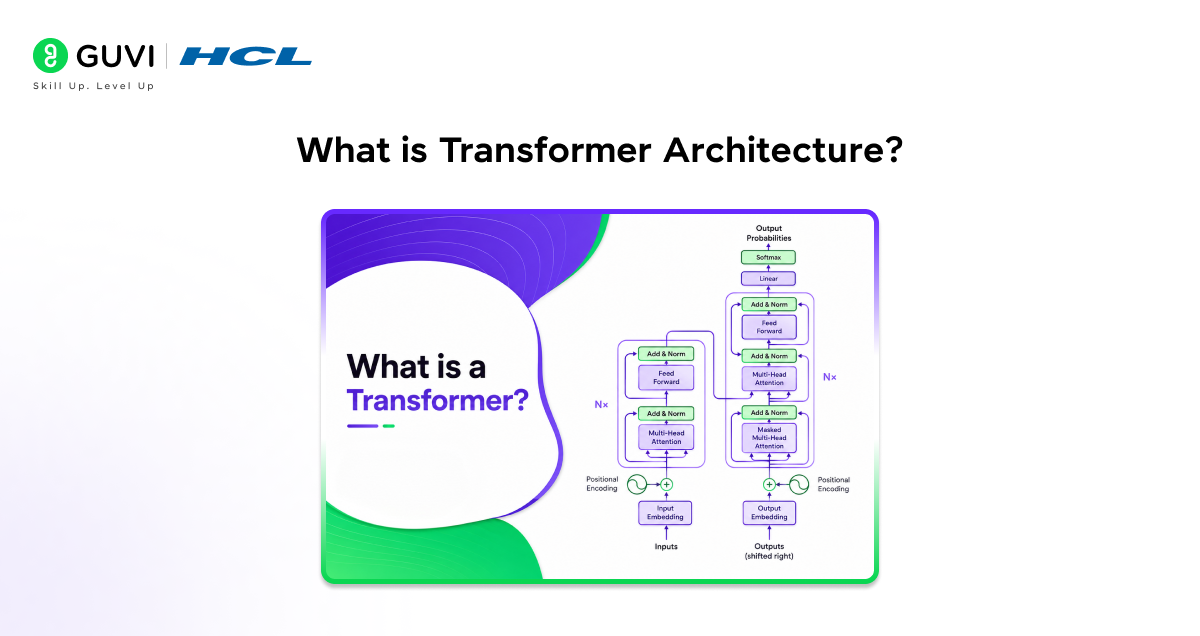
What is Transformer Architecture?
The Transformer Architecture is a neural network architecture based on sequential analysis, particularly in NLP (Natural Language Processing) tasks. Introduced in 2017 through the paper “Attention Is All You Need”, it eliminated the need for recurrent and convolutional layers, which were previously essential in sequence modeling.
Fundamentally, the transformer is excessively dependent on a phenomenon known as self-attention, where the model is able to consider connections between words in a sentence without considering their location.
Why Transformers Were Needed
RNNs and LSTMs were often used for language tasks in deep learning before transformers. They were, however, limited:
- They were slow in processing data sequentially.
- They struggled with far-range dependencies.
- They were unable to perform computations in parallel.
Transformers solved these issues by adding parallel processing and attention mechanisms.
How Transformers Learn Language
Transformers learn through self-supervised learning, which allows them to train on massive amounts of unlabelled text. Instead of requiring explicit input-output pairs, the model creates its own learning tasks based on the structure of the data.
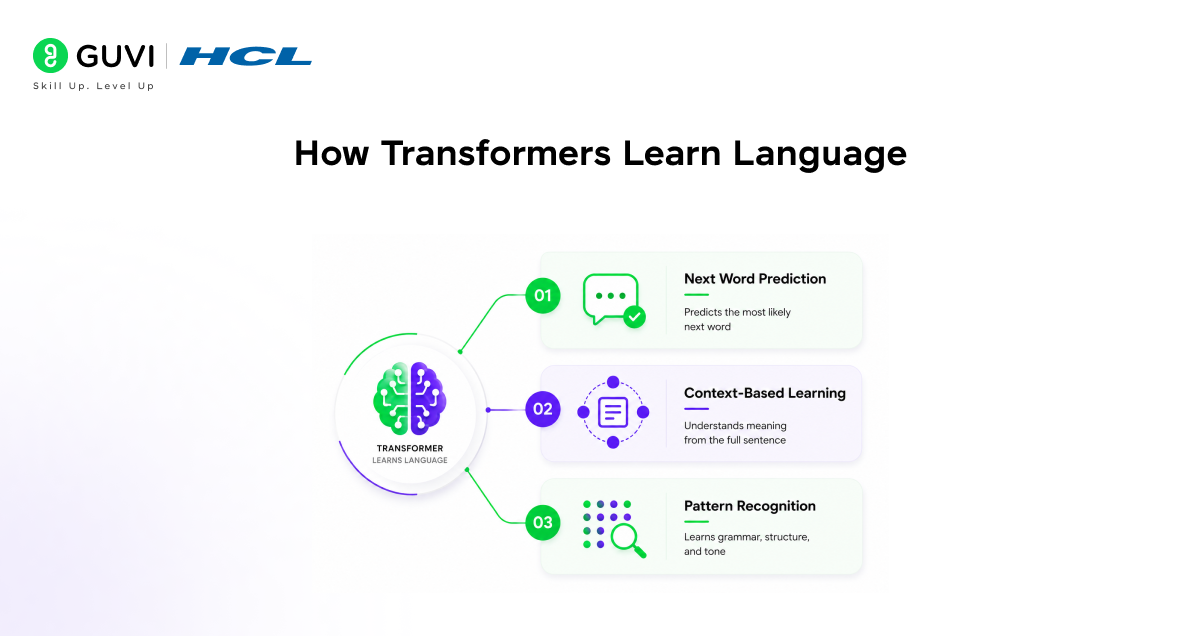
In this learning, there is probability estimation:
- Next Word Prediction
Given she is drinking a cup of ___, the model will give high probability to either tea or coffee on the basis of the patterns that it has learnt through data.
- Context-Based Learning
The model does not consider only the immediate words but the entire sentence. This helps them understand subtle meanings.
- Pattern Recognition at Scale
Transformers get to learn grammar, structure, and even tone by training on large volumes of data, indirectly.
For example, consider:
He had visited the bank.
The model makes decisions on whether the word bank is used in the context of finance or a river using the surrounding words.
The model gradually develops a probabilistic interpretation of language and not actual comprehension. It makes predictions of what is most likely to follow based on patterns that have been learned.
This ability allows transformers to perform tasks like translation, summarization, and conversation generation effectively, making them central to modern deep learning and NLP systems.
Transformer Architecture Overview
Transformer Architecture is built on the basis of two main components, the encoder and the decoder. All these components operate together to process input text and produce meaningful output.
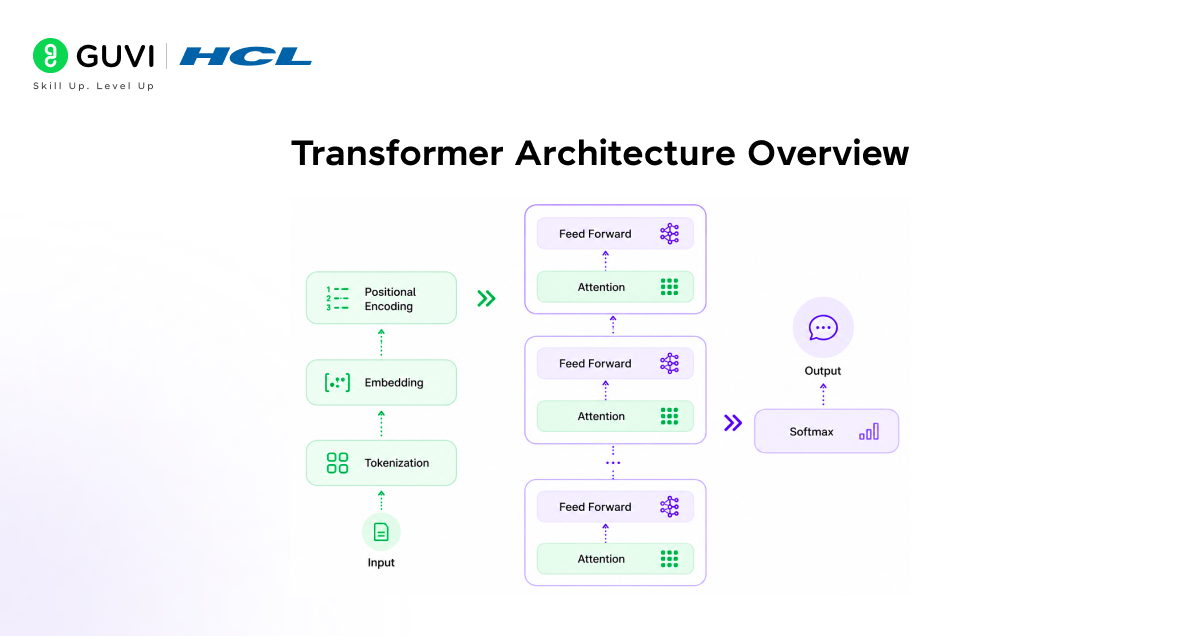
The workflow can be understood as follows:
- Encoder: Understanding the Input
The encoder reads the whole input sentence and transforms it into contextual representations, including word to word relationships.
- Decoder: Production of the Output
The decoder uses this encoded information to generate output step by step, such as translating a sentence.
- Layered Structure
Both encoder and decoder have several stacked layers with each successively refining the representation.
Each layer contains:
- A self-attention mechanism to understand relationships
- A feed-forward neural network to process information
Consider it as translation:
The encoder gets the entire meaning of a sentence, whereas the decoder writes word by word the translated version.
This design enables parallel processing, and transformers are quicker and more efficient compared to the old ones. It also allows a more convenient understanding of the context.
The Transformer Architecture processes all words in a sentence simultaneously instead of sequentially. Using self-attention, it identifies which words matter most for context, allowing the same word to have different meanings depending on the sentence. This makes transformers highly effective for modern NLP applications.
Input Embedding (Converting Words into Numbers)
Transformers do not work with text directly and words have to be translated into numerical values known as embeddings. This is initiated by the process of tokenization, in which sentences are divided into smaller parts known as tokens.
The transformational process involves:
- Tokenization
A sentence like, transformers are powerful, is converted into tokens, such as, [“Transformers”, “are”, “powerful”].
- Token IDs
The token is assigned a special numerical ID, which the model uses to work with.
- Embedding Matrix
These IDs are correlated to vectors of a matrix in which words are numerically represented.
Positional Encoding
Transformers have to handle all the words simultaneously; therefore, they require a mechanism that allows them to cognizantly understand word sequence. This is done by positional encoding which encodes position information into each word embedding.
Without positional encoding, sentences like:
“The cat chased the dog” and “The dog chased the cat”
would look identical to the model.
Positional encoding solves this using:
- Mathematical Patterns
The functions of sine and cosine produce special positional values of the words.
- Vector Addition
These positional values are added to word embeddings, which mixes meaning and position.
- Sequence Awareness
The model is now able to distinguish between word structure and word order.
Imagine like it is timestamps in a video.Without timestamps, you have information about what, but not when. This is the sequence information that is lacking and is supplied by positional encoding.
The mechanism makes sure that transformers understand not only the meaning of words but also the position of words in a sentence, which is essential to the proper language modeling in NLP tasks.
Self-Attention Mechanism
The self-attention mechanism is the most important part of the Transformer Architecture. It enables the model to find out the relationship between words in a sentence.
Intuition
Consider:
“The animal didn’t cross the street because it was tired.”
Here, “it” refers to “animal,” not “street.” Self-attention helps the model make this connection.
How it Works
- Query (Q), Key (K), Value (V)
Every word is translated into three vectors that represents what it wants (Q), what it provides (K), and the meaning itself (V).
- Attention Scores
The model relates queries and keys to the relevance between words.
- Softmax Function
- The scores are converted to probabilities, which dictate the extent to which a word receives attention.
- Weighted Output
The combination of values is done according to the scores of attention to generate context-sensitive representations.
This is because each word can gather info from all the others in the sentence.
The model does not process words sequentially but establishes relationships dynamically and thus it is much more successful at understanding context and meaning in deep learning systems.

Multi-Head Attention
The multi-head attention improves the self-attention mechanism since it enables the model to attend to various elements of a sentence at the same time. Rather than having one attention function, many attention heads are working in parallel.
Key ideas include:
- Multiple Perspectives
Each head is taught the relationships of a different kind, e.g. grammar, meaning or context.
- Parallel Processing
Heads work together, enhancing effectiveness and enriching knowledge.
- Combined Output
Combining the results of all heads creates a more detailed image.
In a sentence such as, she gave him a book, one head may be subject-verb relationship and the other object relationship.
This allows the model to identify more intricate patterns that a single attention mechanism might miss. Multi-head attention goes a long way in enhancing the model in understanding the language structure and context, hence it is an essential part of the modern Transformer Architecture.
Feed-Forward Neural Network
After the attention mechanisms process the relationships, the output passes through a feed-forward neural network. This process filters and processes the information further.
The feed-forward layer works as follows:
- Independent Processing
The representation of each word is performed individually to provide a similar transformation.
- Non-Linearity Introduction
Activation functions allow the model to capture complex patterns that do not correspond to a linear relationship.
- Feature Transformation
The network boosts significant features at the expense of irrelevant features.
Consider attention as a collection of information and the feed-forward network as a processing of the information.
This step is to make sure that the model not only recognizes relationships but also acquires deeper patterns. It is also very important in enhancing precision and allowing the model to carry out the complex tasks in the deep learning applications.
Add & Norm Layers
Add & Norm layers make training stable and efficient. They are a combination of residual connections and normalization.
Their role includes:
- Residual Connections
Information is not lost because the input of a layer is added to its output.
- Layer Normalization
Normalizes values to ensure constant gradients.
- Improved Training Stability
Helps higher models train efficiently with no deterioration in performance.
Residual connections act like shortcuts, allowing information to bypass layers if needed. This prevents vanishing gradients and ensures smoother learning.
Normalization makes the values fall within a manageable range, enhancing the rate of convergence.
These mechanisms collectively make the Transformer Architecture stable, scalable, and efficient enough to be able to work with large datasets and complicated NLP problems.
How Encoders Work in Transformer Architecture
Encoders transform input text into contextual embeddings through multiple layers. Each layer refines the representation of the input.
The process includes:
- Embedding + Positional Encoding
Breaks words into vectors and provides position information.
- Self-Attention Layer
Relationships amongst all words in the sentence.
- Feed-Forward Network
Refines and sorts information that is attended to.
- Add & Norm Layers
Maintain stability and do not lose information flow.
Each layer is built on the previous layer, enhancing the representation. By the final layer, each word vector contains rich contextual meaning influenced by all other words.
This will enable the encoder to form a deeper understanding of the sentence that is subsequently transmitted to the decoder to be further processed in other activities such as translation or text generation.
How Decoders Work in Transformer Architecture
The Decoders produce the output sequences based on encoder information and already generated words.
Key steps include:
- Masked Self-Attention
Ensures that the model does not view future words when being trained, so that there is proper sequence generation.
- Encoder-Decoder Attention
Concentrates on important sections of the input but produces output.
- Step-by-Step Generation
Generates words sequentially, based on the past results.
During training, the decoder uses actual target sequences. During inference, it predicts one word at a time.
This design enables coherent and context-aware outputs to be generated by transformers, which are very useful in other tasks such as translation, summarization, and generating text.
Advantages of Transformers
Transformers have some major benefits as compared to traditional ones:
- Parallel Processing: Quick training as compared to sequential models.
- Better Context Understanding: Long-range dependencies are captured well.
- Scalability: Works well with large datasets and models.
- Flexibility: Applicable to different non-text activities.
Limitations of Transformers
Transformers have some limitations, despite their advantages:
- High Computational Cost: Consumes a lot of processing capability and memory.
- Data Dependency: Requires massive amounts of data to train.
- Interpretability Issues: Poor internal communication.
- Long Sequence Challenges: Very long inputs can cause degradation in performance.
If learning about Transformer Architecture and self-attention got you curious, it’s time to move beyond theory.
With HCL GUVI’s AI & ML Course (in collaboration with IITM Pravartak), you don’t just learn theory you gain hands-on experience with projects, industry-relevant tools, and practical problem-solving skills.
Why consider it?
- Learn AI & ML from scratch to advanced
- Work on real-world projects
- Get a recognized certification backed by IITM Pravartak
- Build skills that are actually job-ready
Wrapping it up:
Transformer Architecture is a radically new approach to the processing of language by machines. Transformers allow computation and more contextual comprehension by substituting sequential processing with self-attention.
Embeddings and positional encoding, multi-head attention and decoder generation are all essential components of a powerful neural network. When combined, they enable the transformers to perform excellently in matters of translation to content generation.
Although issues such as computational cost are still being experienced, the benefits greatly exceed the constraints. Transformers have turned out to be the workhorse of recent deep learning and NLP, defining the future of AI.
Learning their functionality is not only helpful but a necessity to the person who seeks to understand AI on a further level.
FAQs:
1. What is Transformer Architecture in simple terms?
It is a neural network that understands language by analyzing relationships between all words at once using self-attention.
2. Why are transformers better than RNNs?
Transformers run in parallel so they’re quicker than RNNs. They’re also better at capturing long-range context in the data, yielding greater accuracy.
3. What is self-attention?
Self-attention is a component that determines which words in the input sequence are most relevant and helps guide the network to focus on those words.
4. What is the role of encoder and decoder?
The encoder’s job is to understand the information being presented to it; the decoder is responsible for generating an output (typically in a sequence) based upon that input.
Success Stories

About the Author
Vishalini Devarajan
An Aerospace Engineer turned content writer, I focus on making complex concepts easy to understand through well-structured, reader-friendly blogs. Whether it’s a technical topic or a non-technical one, I love creating content that is clear, engaging, and impactful.
View all posts by Vishalini Devarajan
Connect with me @














Did you enjoy this article?