


Artificial Intelligence and Machine Learning Articles
Coreference Resolution: How AI Tracks Pronouns
Spell Correction Algorithms in NLP


Get In Touch For Details! Request More Information
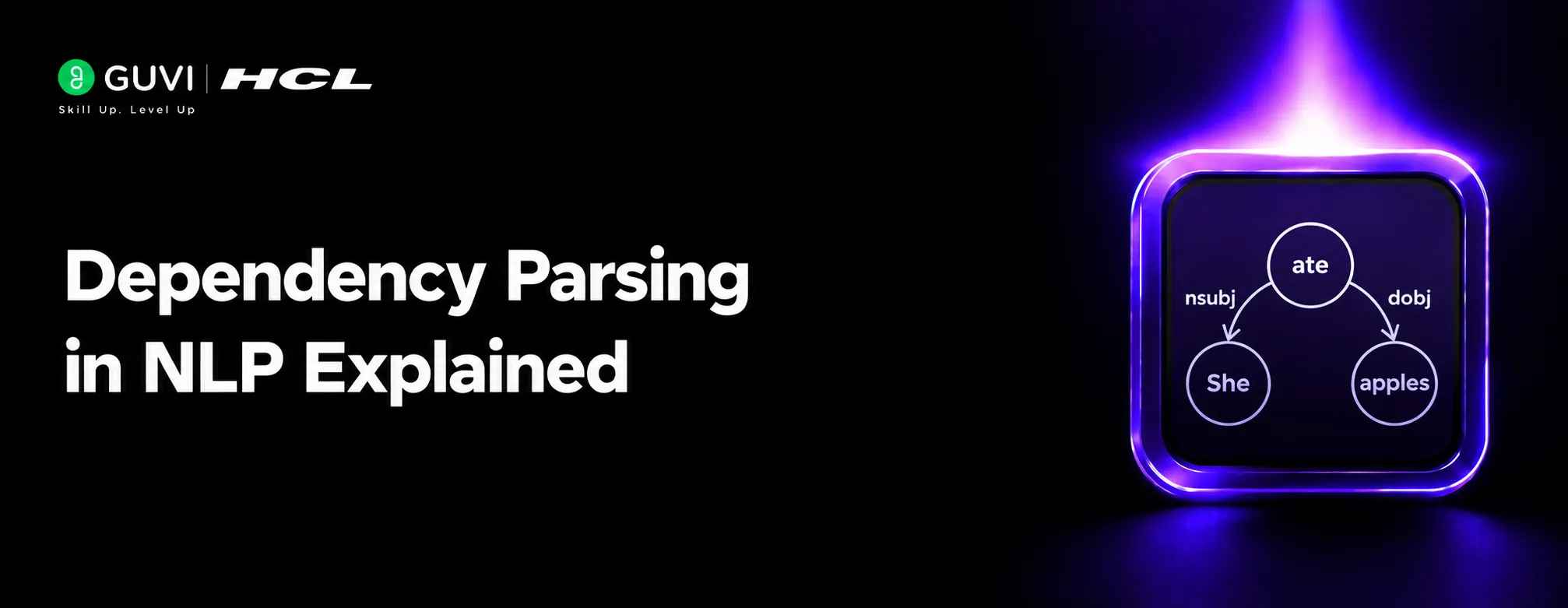
Dependency Parsing in NLP Explained
Aug 25, 2026 3 Min Read 21 Views
(Last Updated)
How can an NLP system understand that one word in a sentence depends on another? Dependency Parsing helps computers analyze the grammatical structure of a sentence by identifying relationships between words and representing those relationships as a dependency tree.
Instead of treating a sentence as a simple sequence of words, dependency parsing reveals how words connect to one another. This makes it useful for information extraction, question answering, sentiment analysis, machine translation, and other natural language processing tasks.
Table of contents
- TL;DR
- What Is Dependency Parsing?
- How Does Dependency Parsing Work?
- What Is a Dependency Tree?
- What Are Dependency Relations?
- Dependency Parsing vs Constituency Parsing
- How Do Modern Dependency Parsers Work?
- Where Is Dependency Parsing Used?
- Dependency Parsing in Modern NLP Pipelines
- A Simple Example
- Key Takeaways
- Conclusion
- FAQs
- What is Dependency Parsing in NLP?
- What is a dependency tree?
- What is the root in Dependency Parsing?
- What is Dependency Parsing used for?
- What is the difference between dependency and constituency parsing?
TL;DR
- Dependency Parsing identifies grammatical relationships between words.
- It represents sentence structure using a dependency tree.
- The main verb often acts as the central root of the sentence.
- Modern parsers commonly use machine learning and neural networks.
- Dependency Parsing supports tasks such as information extraction and semantic analysis.
What Is Dependency Parsing?
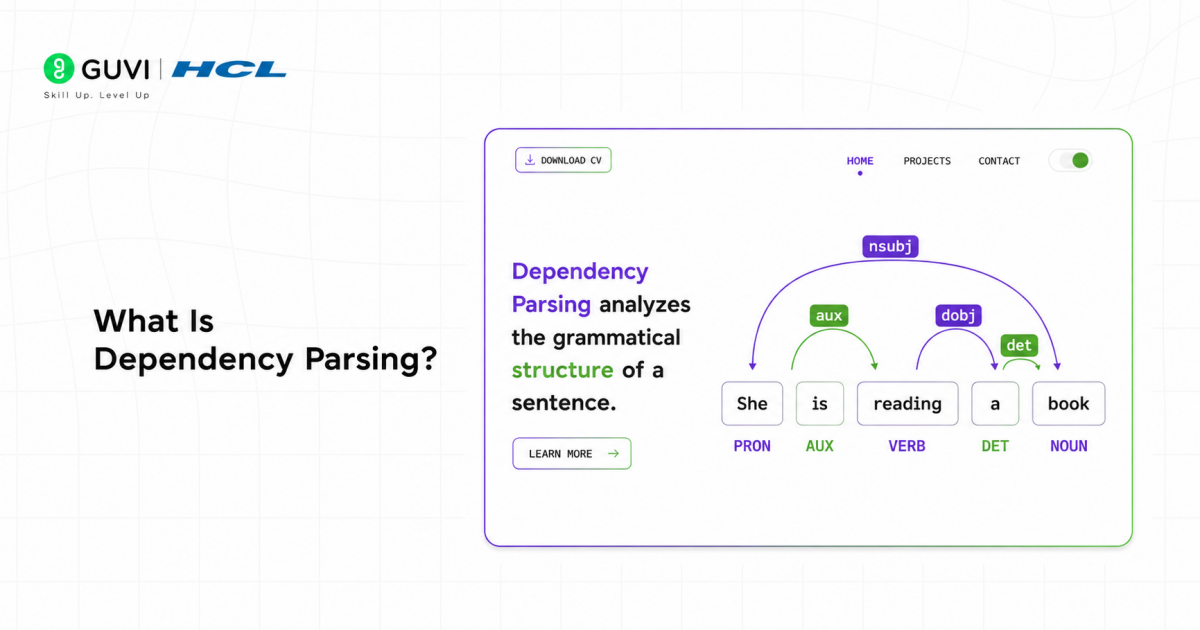
Dependency Parsing is an NLP technique that analyzes the grammatical structure of a sentence by identifying dependencies between words.
Consider the sentence:
“The developer built an application.”
A dependency parser can identify relationships such as:
- “developer” → subject of “built”
- “application” → object of “built”
- “The” → determiner of “developer”
- “an” → determiner of “application”
These relationships form a tree-like structure that shows how the words depend on each other.
Read More: 40 Interesting NLP Interview Questions and Answers
Master NLP and AI with HCL GUVI’s Artificial Intelligence & Machine Learning Course. Learn natural language processing, machine learning, and AI through hands-on projects.
How Does Dependency Parsing Work?
A dependency parser receives a sentence as input and determines the relationships between its words.
A simplified workflow is:
- Tokenize the sentence.
- Identify grammatical information such as parts of speech.
- Determine relationships between words.
- Assign dependency labels.
- Construct the dependency tree.
The output can indicate which word is the head and which word is the dependent.
For example:
“The student reads books.”
Here, “reads” can act as the root. “student” depends on “reads” as the subject, while “books” depends on “reads” as the object.
Dependency parsing focuses on relationships between individual words rather than grouping words primarily into larger phrases, making it useful for extracting relationships from natural language.
What Is a Dependency Tree?
A dependency tree is a graphical or structured representation of the relationships between words in a sentence.
Every word generally has a connection to another word, except the root of the sentence.
A simplified representation might look like:
reads
/ \
student books
|
The
The exact structure depends on the parser and the grammatical analysis.
The tree helps NLP systems understand which words are connected and what grammatical roles they play.
Pro Tip: When analyzing dependency trees, start with the root verb and then follow its subjects, objects, modifiers, and other dependents. This makes complex sentences easier to interpret.
What Are Dependency Relations?
Dependency relations describe the grammatical function of one word in relation to another.
Common dependency labels include:
- nsubj — nominal subject
- obj — object
- amod — adjectival modifier
- advmod — adverbial modifier
- det — determiner
- prep — prepositional relationship in some dependency schemes
- compound — compound word relationship
For example, in:
“The smart student solved the problem.”
“smart” can modify “student,” while “student” acts as the subject of “solved.”
These labels provide structured information that downstream NLP systems can use.
Dependency Parsing vs Constituency Parsing
Dependency Parsing and constituency parsing both analyze sentence structure, but they represent that structure differently.
| Feature | Dependency Parsing | Constituency Parsing |
| Main focus | Word-to-word relationships | Phrase structure |
| Representation | Dependency tree | Constituency tree |
| Root | Usually a central word | Usually sentence-level node |
| Useful for | Relationships and extraction | Phrase analysis |
Dependency parsing can be particularly useful when the goal is to identify relationships between specific words.
How Do Modern Dependency Parsers Work?
Early dependency parsers relied heavily on manually designed grammatical rules. Modern systems increasingly use machine learning and neural network architectures.
A neural dependency parser can learn patterns from annotated training data. The model learns which words are likely to be connected and which dependency labels should be assigned.
Modern NLP libraries and frameworks can provide pretrained dependency parsers, allowing developers to analyze sentences without building a parsing system from scratch.
Best Practice: Choose a parser trained for the language and domain you are working with. A general-purpose parser may perform differently on technical, legal, medical, or highly informal text.

Where Is Dependency Parsing Used?
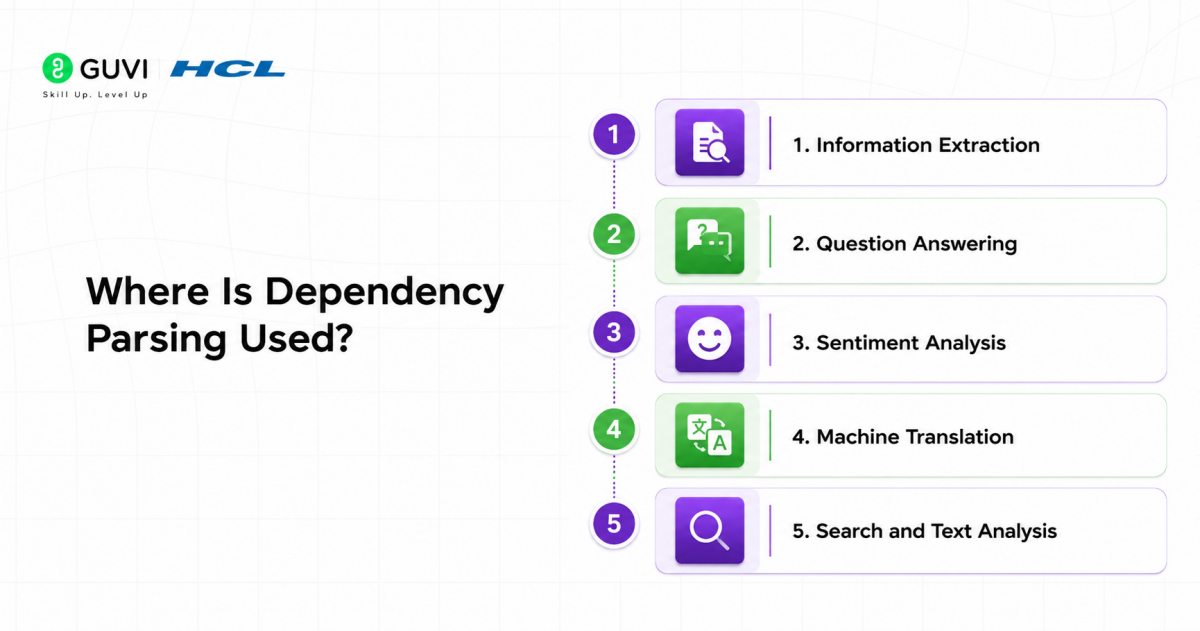
Dependency Parsing can support many NLP applications.
- Information Extraction
A system can use dependency relationships to identify who performed an action, what was affected, and how entities are related.
For example, from:
“Amazon acquired the startup.”
A system can identify:
- Subject — Amazon
- Action — acquired
- Object — startup
- Question Answering
Dependency structures can help systems understand relationships within questions and documents.
- Sentiment Analysis
Dependency relationships can help identify which words are affected by sentiment-bearing terms, particularly in more complex sentences.
- Machine Translation
Dependency information can provide structural clues that help translation systems understand grammatical relationships between words.
- Search and Text Analysis
Dependency relationships can improve semantic search and allow systems to identify more meaningful connections than simple keyword matching.
Dependency Parsing in Modern NLP Pipelines
Dependency parsing is often used as one component in a larger NLP pipeline.
A typical pipeline might look like:
Text → Tokenization → POS Tagging → Dependency Parsing → Information Extraction → Application
For example, an information extraction system could use dependency relationships to identify subject-action-object patterns before storing the extracted information in a structured database.
This makes parsing particularly valuable when unstructured text needs to be converted into structured information.
A Simple Example
Consider:
“The engineer designed a cloud platform.”
A dependency parser can identify:
- “designed” as the root.
- “engineer” as the subject.
- “platform” as the object.
- “cloud” as a modifier of “platform.”
- “The” as a determiner of “engineer.”
- “a” as a determiner of “platform.”
The resulting structure provides more information than simply knowing which words appear in the sentence.
Data Point: Dependency structures can reduce a sentence to meaningful grammatical relationships, making them useful for systems that need structured information from unstructured text.
Key Takeaways
- Dependency Parsing identifies grammatical relationships between words.
- A dependency tree represents those relationships structurally.
- Dependency labels describe roles such as subject, object, and modifier.
- Modern parsers commonly use machine learning and neural networks.
- Dependency Parsing supports information extraction, search, translation, and question answering.
- Parsing identifies grammatical structure but does not provide complete semantic understanding.
Master NLP and AI with HCL GUVI’s Artificial Intelligence & Machine Learning Course. Learn natural language processing, machine learning, and AI through hands-on projects.
Conclusion
Dependency Parsing gives NLP systems a structured way to understand how words relate to one another within a sentence. By identifying roots, heads, dependents, and grammatical relationships, it transforms unstructured text into a representation that downstream applications can process more effectively.
Although natural language ambiguity makes parsing challenging, modern neural approaches have made dependency analysis increasingly practical. When combined with tokenization, part-of-speech tagging, named entity recognition, and other NLP techniques, Dependency Parsing becomes a valuable component of intelligent language processing systems.
FAQs
What is Dependency Parsing in NLP?
Dependency Parsing is an NLP technique that identifies grammatical relationships between words and represents them using a dependency tree.
What is a dependency tree?
A dependency tree is a structured representation showing how words in a sentence depend on other words.
What is the root in Dependency Parsing?
The root is the central word in a dependency tree, and it is often the main verb of the sentence.
What is Dependency Parsing used for?
It is used for information extraction, question answering, sentiment analysis, machine translation, search, and other NLP applications.
What is the difference between dependency and constituency parsing?
Dependency parsing focuses on relationships between words, while constituency parsing focuses on how words form hierarchical phrases.
Success Stories

About the Author
HCL GUVI
This article was selected and published as part of the HCL GUVI AI Blogathon 2026, an initiative designed to encourage students, AI enthusiasts, and aspiring tech writers to simplify complex AI concepts through impactful technical content. The contest recognized high-quality, original, and insightful AI-focused blogs, with selected authors receiving publication opportunities on the HCL GUVI blog platform along with official author credits and recognition.
View all posts by HCL GUVI
Connect with me @








Did you enjoy this article?