


Artificial Intelligence and Machine Learning Articles
Finance Manager to Data Analytics: Career Growth, Salary and Seniority
How to Evaluate LLM Outputs in Production Deployments
AI/ML Skills Gap 2026: Why Companies Can't Find Job-Ready Talent
20 AI/ML Interview Questions Recruiters Can Use Without a Tech Background - Best Guide


Get In Touch For Details! Request More Information

Content-Based Filtering in Recommender Systems
Aug 25, 2026 4 Min Read 294 Views
(Last Updated)
Have you ever watched one movie and immediately received recommendations for similar movies? That experience is often powered by a recommender system that learns from the characteristics of items you already like. Content-Based Filtering is one of the most widely used approaches for making these personalized recommendations.
Unlike methods that depend heavily on other users’ behavior, Content-Based Filtering focuses on the characteristics of items and the preferences of an individual user. In this article, you’ll learn how it works, which algorithms support it, where it performs well, and where it falls short.
Table of contents
- TL;DR
- What Is Content-Based Filtering?
- How Does Content-Based Filtering Work?
- Which Techniques Are Used in Content-Based Filtering?
- What Is a User Profile in Content-Based Filtering?
- Where Is Content-Based Filtering Used?
- Content-Based Filtering vs Collaborative Filtering
- What Are the Advantages of Content-Based Filtering?
- What Are the Limitations?
- How Can Content-Based Filtering Be Improved?
- Conclusion
- FAQs
- What is Content-Based Filtering in recommender systems?
- How does Content-Based Filtering work?
- What algorithms are used in Content-Based Filtering?
- What is the main advantage of Content-Based Filtering?
- What is the main limitation of Content-Based Filtering?
TL;DR
- Content-Based Filtering recommends items based on their features and your previous preferences.
- It creates a profile of your interests and compares it with available items.
- Techniques such as TF-IDF, embeddings, and cosine similarity are commonly used.
- It works well when item information is rich and descriptive.
- Its main limitation is that recommendations can become too similar over time.
What Is Content-Based Filtering?
Content-Based Filtering is a recommendation technique that suggests items based on their attributes and a user’s previous interactions with similar items.
For example, if you frequently read articles about Python, machine learning, and cloud computing, a content-based system can analyze those topics and recommend other articles containing similar characteristics.
The system generally considers:
- Item features such as categories, keywords, descriptions, genres, or tags.
- User preferences derived from previously liked, viewed, purchased, or saved items.
- Similarity between the user’s profile and available items.
Read More: Building a Recommendation System in Python from Scratch
Learn recommendation systems, machine learning, and AI with HCL GUVI’s Artificial Intelligence & Machine Learning Course. Build practical skills through hands-on, industry-focused projects.
How Does Content-Based Filtering Work?
The basic process involves representing both users and items as feature profiles. The system then compares those profiles to identify items that are most relevant to a particular user.
A typical workflow looks like this:
- Collect information about items.
- Convert item attributes into numerical features.
- Build a user preference profile.
- Compare the user profile with item profiles.
- Rank items based on similarity.
- Recommend the highest-scoring items.
This approach allows recommendations to become personalized as the system collects more information about the user’s interests.
Content-Based Filtering can recommend an item even when there is little information about what other users liked, because its recommendations depend on item characteristics.
Which Techniques Are Used in Content-Based Filtering?
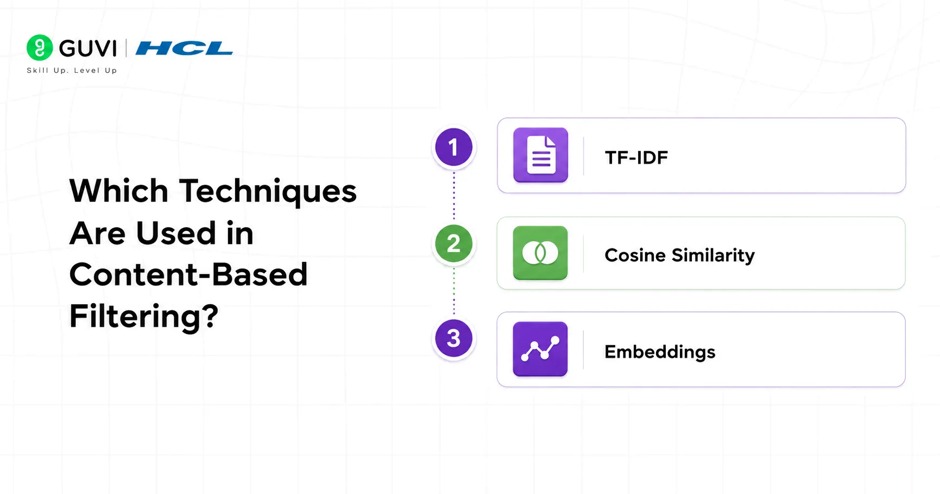
The quality of a content-based recommender depends heavily on how item features are represented. Different applications require different feature extraction techniques.
- TF-IDF
TF-IDF is useful when recommendations depend on text. It measures how important a word is within one document compared with a larger collection of documents.
For example, an article containing terms such as “neural networks,” “training data,” and “deep learning” can be represented using TF-IDF vectors.
- Cosine Similarity
Cosine similarity measures the angle between two vectors. In Content-Based Filtering, it can determine how closely an item matches a user’s preference profile.
A higher cosine similarity score generally indicates greater similarity between the two representations.
- Embeddings
Modern recommendation systems can represent text, products, images, or other content using embeddings. Embeddings capture semantic relationships and can identify similarities that simple keyword matching may miss.
Pro Tip: Use embeddings when simple keyword matching is not enough—for example, when two products use different words but describe similar concepts.
What Is a User Profile in Content-Based Filtering?
A user profile represents the interests of an individual user. The system creates this profile from signals such as ratings, clicks, purchases, reading history, or viewing behavior.
For instance, if a user repeatedly interacts with articles about cybersecurity and cloud computing, those topics can receive higher weights in the user’s profile.
The profile can contain:
- Preferred categories
- Frequently interacted topics
- Feature weights
- Historical ratings
- Recently viewed content
The profile can then be compared against item representations to generate personalized recommendations.
Where Is Content-Based Filtering Used?
Content-Based Filtering works across many recommendation scenarios because item features can be extracted from different types of content.
- Movie and Music Recommendations
A streaming platform can analyze genres, actors, directors, artists, themes, or other metadata to recommend content similar to what a user already enjoys.
- E-Commerce
Online stores can compare product categories, descriptions, brands, specifications, and other attributes to suggest related products.
- News and Articles
A news platform can analyze article topics, keywords, and embeddings to recommend stories that match a reader’s interests.

- Online Learning
Educational platforms can recommend courses based on subjects, skill levels, technologies, and topics that a learner has previously explored.
Best Practice: Keep item metadata accurate and detailed. A recommendation model cannot reliably identify meaningful similarities when the underlying item features are incomplete.
Content-Based Filtering vs Collaborative Filtering
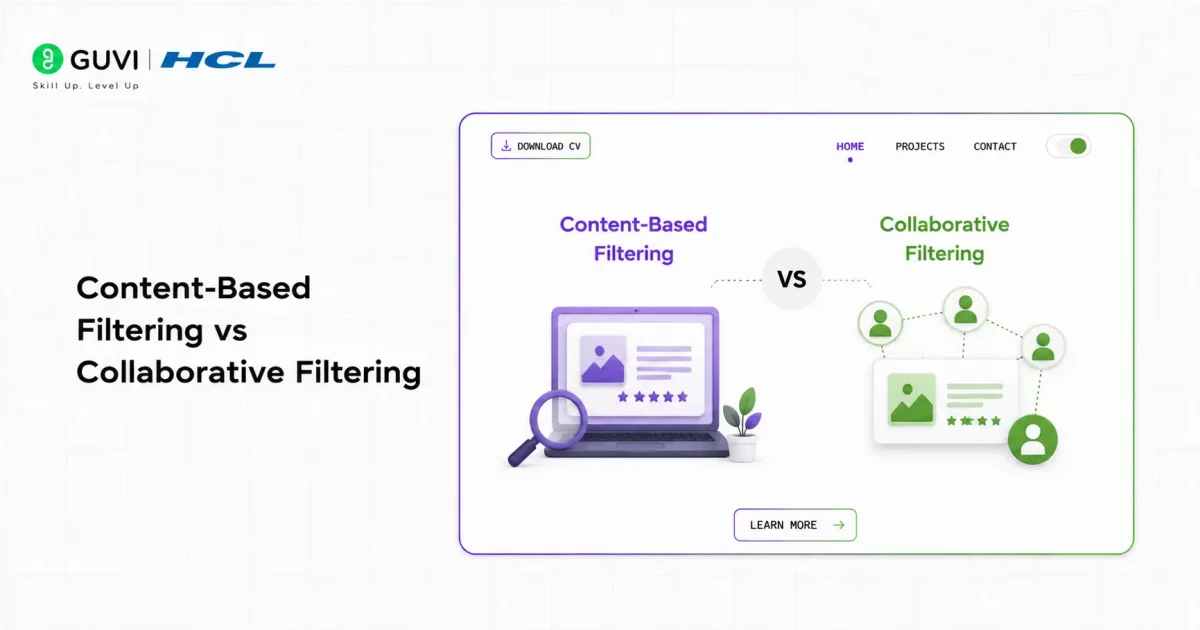
These two approaches solve recommendation problems differently. Content-Based Filtering focuses on item characteristics and individual preferences, while collaborative filtering learns from patterns across users.
| Factor | Content-Based Filtering | Collaborative Filtering |
| Main signal | Item features | User behavior |
| Personalization | Individual-focused | Behavior-focused |
| New item handling | Usually stronger | Often weaker |
| Need for item metadata | High | Lower |
| Similar-item recommendations | Strong | Depends on interaction data |
In practice, many modern recommendation systems combine both approaches. This is known as a hybrid recommender system.
What Are the Advantages of Content-Based Filtering?
Content-Based Filtering offers several practical advantages, particularly when detailed item information is available.
- Personalization: Recommendations are tailored to an individual’s interests rather than relying entirely on popular choices. This can make results more relevant for users with specific preferences.
- New-item support: A newly added item can be recommended if its features are known. The system does not necessarily need historical interactions from other users.
- User independence: Recommendations for one user do not depend directly on another user’s activity. This can be useful when user interaction data is limited.
These strengths make content-based approaches particularly useful for platforms with rich product or content metadata.
What Are the Limitations?
Content-Based Filtering is not perfect. Its biggest weakness is that it can struggle to introduce users to genuinely different types of content.
A user who frequently reads Python articles may continuously receive more Python articles. Although those recommendations may be relevant, they can become repetitive.
Other limitations include:
- Dependence on high-quality item features.
- Difficulty understanding subjective preferences.
- Limited ability to discover unexpected interests.
- Potentially narrow recommendation results.
- Challenges when user history is extremely limited.
Warning: High similarity does not always mean high recommendation quality. A system can repeatedly recommend nearly identical items while failing to introduce useful alternatives.
How Can Content-Based Filtering Be Improved?
A strong recommendation system should balance relevance with discovery. One useful approach is to combine content similarity with diversity and novelty signals.
You can improve a content-based system by:
- Using semantic embeddings instead of only keywords.
- Adding diversity constraints to recommendations.
- Updating user profiles regularly.
- Combining multiple item features.
- Using hybrid recommendation models.
- Measuring both relevance and recommendation diversity.
For example, an online learning platform could recommend courses related to Python while occasionally introducing adjacent subjects such as databases, cloud computing, or DevOps.
Learn recommendation systems, machine learning, and AI with HCL GUVI’s Artificial Intelligence & Machine Learning Course. Build practical skills through hands-on, industry-focused projects.
Conclusion
Content-Based Filtering remains an important approach in recommender systems because it provides personalized recommendations using information about items and individual user preferences. From movies and products to news and online courses, the same basic idea can be adapted to many applications.
Its real strength is control—you can understand which item features influence recommendations and improve the system by refining those features. For broader personalization, however, combining Content-Based Filtering with collaborative or hybrid methods can produce a more balanced recommendation experience.
FAQs
What is Content-Based Filtering in recommender systems?
Content-Based Filtering recommends items by comparing their characteristics with a user’s previous preferences and interactions.
How does Content-Based Filtering work?
It represents items and user preferences as features, calculates their similarity, and recommends items with the highest relevance scores.
What algorithms are used in Content-Based Filtering?
Common techniques include TF-IDF, cosine similarity, feature weighting, and modern embedding-based similarity methods.
What is the main advantage of Content-Based Filtering?
It can provide personalized recommendations using item information without requiring large amounts of data from other users.
What is the main limitation of Content-Based Filtering?
It can produce overly similar recommendations and may struggle to introduce users to new or unexpected interests.
Success Stories

About the Author
HCL GUVI
This article was selected and published as part of the HCL GUVI AI Blogathon 2026, an initiative designed to encourage students, AI enthusiasts, and aspiring tech writers to simplify complex AI concepts through impactful technical content. The contest recognized high-quality, original, and insightful AI-focused blogs, with selected authors receiving publication opportunities on the HCL GUVI blog platform along with official author credits and recognition.
View all posts by HCL GUVI
Connect with me @











Did you enjoy this article?