


Artificial Intelligence and Machine Learning Articles
Dependency Parsing in NLP Explained
Coreference Resolution: How AI Tracks Pronouns


Get In Touch For Details! Request More Information
Markov Decision Process (MDP) Explained
Aug 25, 2026 3 Min Read 19 Views
(Last Updated)
Many real-world problems involve making a series of decisions where each choice affects what happens next. Markov Decision Processes (MDPs) provide a mathematical framework for modeling these situations. They describe how an agent interacts with an environment, chooses actions, moves between states, and receives rewards. MDPs are a fundamental concept in reinforcement learning and are used to model sequential decision-making problems.
Table of contents
- TL;DR
- Quick Answer
- What Is an MDP?
- The Markov Property
- Components of an MDP
- States
- Actions
- Transition Probability
- Rewards
- Discount Factor
- How an MDP Works
- What Is a Policy?
- What Is a Value Function?
- MDPs and Reinforcement Learning
- Common Applications
- Robotics
- Games
- Recommendation Systems
- Resource Management
- Key Concepts to Remember
- A Practical MDP Workflow
- Define the States
- Define the Actions
- Define Transitions
- Assign Rewards
- Set the Discount Factor
- Define or Learn a Policy
- Evaluate the Policy
- Real-World Applications
- Autonomous Robots
- Game AI
- Recommendation Systems
- Resource Allocation
- Best Practices
- Conclusion
- FAQs
- What is a Markov Decision Process?
- What are the main components of an MDP?
- What is the Markov property?
- What is a policy in an MDP?
- What is the discount factor?
- How are MDPs related to reinforcement learning?
TL;DR
- MDPs model sequential decision-making.
- They consist of states, actions, transitions, rewards, and a discount factor.
- A policy determines which action an agent chooses.
- The Markov property focuses on the current state.
- MDPs form a foundation for reinforcement learning.
Quick Answer
| A Markov Decision Process (MDP) is a mathematical framework for representing sequential decision-making problems. An agent observes a state, chooses an action, receives a reward, and transitions to another state. The process continues over time, with the agent aiming to maximize its expected cumulative reward. |
What Is an MDP?
An MDP represents an environment in which an agent must repeatedly make decisions.
A simple cycle is:
State → Action → Reward → New State
For example, consider a robot navigating a warehouse:
- State: Robot’s current location
- Action: Move left, right, forward, or backward
- Reward: Positive reward for reaching the destination
- New State: Robot’s location after moving
The robot can use these interactions to make better decisions.
The Markov Property
The Markov property means that the current state contains the relevant information needed to determine future outcomes.
In simple terms:
Current State + Action → Future State
The agent does not need the complete history if the current state already captures the information necessary for decision-making.
Components of an MDP
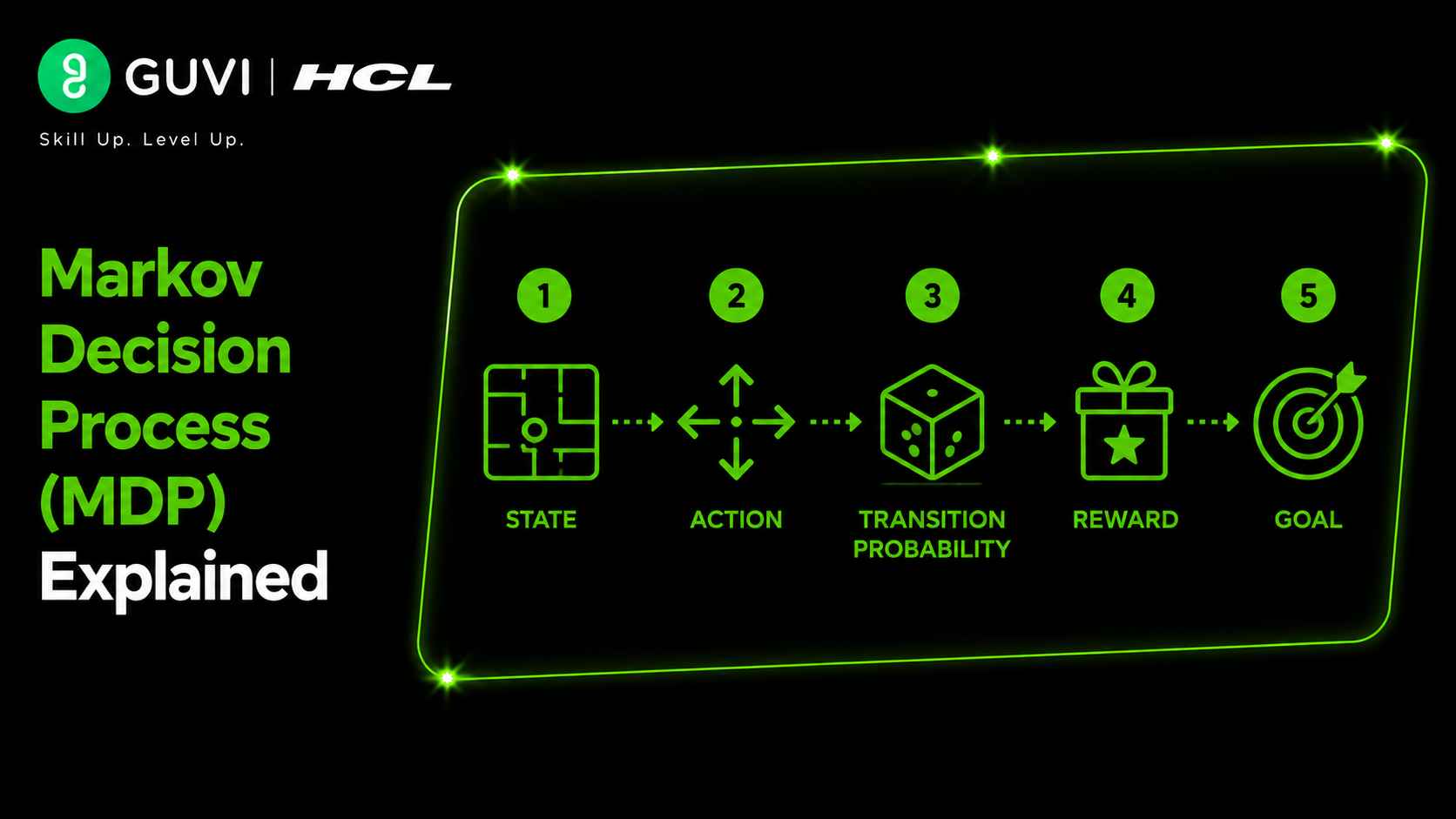
An MDP is commonly described using five main components.
1. States
A state represents the current situation of the agent and environment.
For example, in a game, a state could represent the player’s current position, health, and other relevant conditions.
2. Actions
Actions are the choices available to the agent.
Examples include:
- Move
- Stop
- Turn
- Attack
- Wait
3. Transition Probability
The transition function describes how likely an action is to move the agent from one state to another.
Some environments are deterministic, while others involve uncertainty.
4. Rewards
A reward provides feedback after an action.
For example:
- Reaching a goal → Positive reward
- Making an incorrect move → Negative reward
5. Discount Factor
The discount factor, represented by γ (gamma), determines how much the agent values future rewards compared with immediate rewards.
How an MDP Works
A typical interaction looks like:
Agent observes State → Chooses Action → Receives Reward → Enters New State
The agent repeats this process and attempts to make decisions that produce the greatest cumulative reward over time.
What Is a Policy?
A policy defines how an agent chooses actions based on its state.
For example:
If the robot is near the destination, move toward it.
A policy can be:
- Deterministic: The same state leads to the same action.
- Stochastic: Different actions can have different probabilities.
What Is a Value Function?
A value function estimates how beneficial a state is based on the expected rewards that can be obtained from that state in the future.
This helps an agent distinguish between states that are more or less desirable in the long term.
MDPs and Reinforcement Learning
MDPs provide a mathematical foundation for many reinforcement learning problems.
A simplified reinforcement learning workflow is:
Environment → State → Agent → Action → Reward → New State
The agent can learn a policy that aims to maximize cumulative rewards.
Common Applications
Robotics
MDPs can model navigation, movement, and interaction with environments.
Games
Game agents can use states, actions, and rewards to make sequential decisions.
Recommendation Systems
MDPs can model how current recommendations influence future user interactions.

Resource Management
They can represent decisions involving limited resources and changing conditions.
MDPs are closely connected to reinforcement learning because reinforcement-learning agents often learn how to choose actions within environments that can be represented using the MDP framework.
Key Concepts to Remember
- State: Current situation of the environment.
- Action: Choice available to the agent.
- Transition: Movement from one state to another.
- Reward: Feedback received after an action.
- Policy: Strategy for selecting actions.
- Value function: Expected long-term value of a state.
- Discount factor: Controls the importance of future rewards.
Professionals interested in artificial intelligence, machine learning, and reinforcement learning can strengthen their expertise through HCL GUVI’s Artificial Intelligence and Machine Learning Course.
A Practical MDP Workflow
1. Define the States
Identify all relevant situations the agent can encounter.
2. Define the Actions
Specify what actions are available in each state.
3. Define Transitions
Determine how actions can change the current state.
4. Assign Rewards
Specify rewards or penalties for different outcomes.
5. Set the Discount Factor
Determine how strongly future rewards should influence decisions.
6. Define or Learn a Policy
Create a strategy for selecting actions based on states.
7. Evaluate the Policy
Measure whether the policy produces desirable long-term outcomes.
Real-World Applications
Autonomous Robots
Model navigation decisions as robots move through changing environments.
Game AI
Represent game states and actions to help agents make strategic decisions.
Recommendation Systems
Model sequences of recommendations and their effects on future user behavior.
Resource Allocation
Represent how current resource decisions affect future availability.
The HCL GUVI’s Artificial Intelligence eBook introduces artificial intelligence, machine learning, generative AI, and intelligent automation concepts, helping learners understand modern AI technologies.
Best Practices
- Define states with enough information for meaningful decisions.
- Include relevant actions for each state.
- Design rewards around the actual objective.
- Consider long-term consequences.
- Choose an appropriate discount factor.
- Check whether the Markov property is reasonable for the problem.
- Evaluate policies across different possible situations.
Conclusion
Markov Decision Processes (MDPs) provide a structured way to represent sequential decision-making. By modeling states, actions, transitions, rewards, and future outcomes, MDPs help describe how an agent can make decisions over time. They form an important foundation for reinforcement learning and can be applied to robotics, games, recommendation systems, and resource-management problems.
FAQs
1. What is a Markov Decision Process?
An MDP is a mathematical framework for modeling sequential decision-making where an agent takes actions, receives rewards, and transitions between states.
2. What are the main components of an MDP?
The main components are states, actions, transition probabilities, rewards, and a discount factor.
3. What is the Markov property?
The Markov property means that the current state contains the relevant information needed to determine future outcomes without requiring the complete history.
4. What is a policy in an MDP?
A policy defines how an agent chooses actions based on its current state.
6. What is the discount factor?
The discount factor (γ) determines how much importance an agent gives to future rewards compared with immediate rewards.
7. How are MDPs related to reinforcement learning?
MDPs provide the mathematical framework for many reinforcement learning problems, where agents learn policies for selecting actions that maximize cumulative rewards.
Success Stories

About the Author
HCL GUVI
This article was selected and published as part of the HCL GUVI AI Blogathon 2026, an initiative designed to encourage students, AI enthusiasts, and aspiring tech writers to simplify complex AI concepts through impactful technical content. The contest recognized high-quality, original, and insightful AI-focused blogs, with selected authors receiving publication opportunities on the HCL GUVI blog platform along with official author credits and recognition.
View all posts by HCL GUVI
Connect with me @









Did you enjoy this article?