


Data engineers build the systems that collect, process, store, and deliver reliable data for analytics, AI, and business applications. Their work covers data pipelines, ETL/ELT, databases, cloud platforms, data quality, and performance monitoring. LinkedIn currently lists 10,000+ Data Engineer jobs in India, reflecting continued hiring demand for these skills.
This guide covers data engineer roles and responsibilities, including daily tasks, essential tools, required skills, salary trends, career progression, and the path to becoming job-ready.
TL;DR Summary
- A Data Engineer builds and maintains the systems that collect, store, and deliver reliable data — the infrastructure every analyst, data scientist, and AI model depends on.
- Core responsibilities: pipeline development (ETL/ELT), data storage & warehousing, data modelling, governance & quality, and performance monitoring.
- Must-know tools: Python, SQL, Apache Spark, Kafka, Airflow, dbt, and one cloud platform (AWS/GCP/Azure).
- India salary: ₹4–7 LPA (fresher) → ₹15–25 LPA (senior) → ₹30–50 LPA (Data Architect).
- Beginners can become job-ready in 6–9 months with Python, SQL, one big-data framework, and a real pipeline project.
Who Is a Data Engineer?
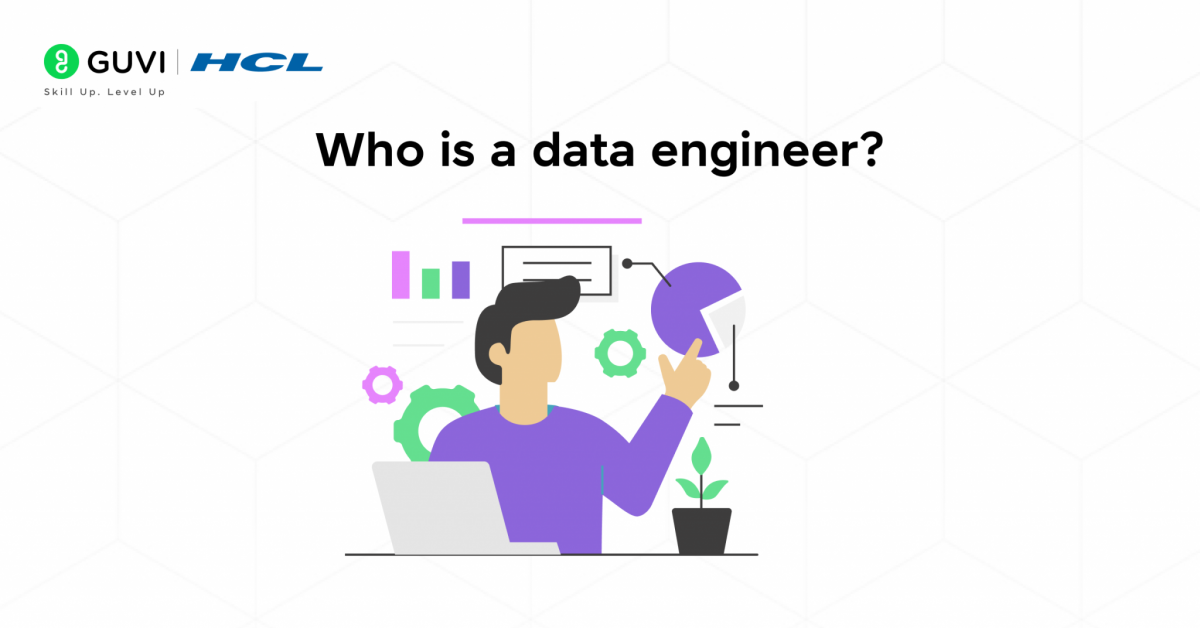
A Data Engineer designs, builds, and maintains the systems that collect, store, process, and distribute data. They create automated data pipelines and manage databases, data warehouses, and data lakes — turning raw, messy data into something clean, reliable, and accessible for data scientists, analysts, and business teams.
Think of a Data Engineer as the plumber of the data world. Data scientists analyse the water; data engineers build and maintain the pipes that get it to them, clean and on time.
Their work typically begins where a software engineer’s ends — once an application generates data, the data engineer takes over to collect, transform, store, and serve it at scale.
What Does a Data Engineer Do Daily?
- Morning: Checking pipeline health dashboards (Datadog, Grafana) for overnight job failures
- Mid-morning: Debugging an ETL job that broke because of an upstream schema change
- Afternoon: Writing and testing a new ingestion pipeline for a third-party API
- Late afternoon: Helping a data scientist optimise a slow query in Snowflake
- End of day: Reviewing data quality reports and triaging anomaly alerts
Roughly half the job is building; the other half is debugging, optimising, and supporting other teams. If that mix sounds appealing rather than tedious, keep reading — the self-assessment section below will help you confirm it.
Responsibilities by Experience Level (Quick View)
Not every Data Engineer does the same job. What you’re responsible for changes a lot between your first year and your fifth. Here’s the honest breakdown before you commit:
| Levels | What You’re Actually Responsible For |
|---|---|
| Fresher (0–2 yrs) | Writing SQL queries, building pipelines under supervision, fixing broken ingestion jobs, learning the tool stack |
| Mid-level (2–5 yrs) | Owning and designing pipelines end-to-end, optimising performance, choosing storage architecture, mentoring juniors |
| Senior (5–8 yrs) | Architecting large-scale systems, setting data standards across teams, leading migrations, making build-vs-buy calls |
| Lead / Architect (8+ yrs) | Defining enterprise data strategy, governance frameworks, tool evaluation, cross-functional and leadership collaboration |
The detailed breakdown below applies mainly to the Data Engineer (2–5 yr) level — this is the core of the role once you’re past the fresher stage.
Core Data Engineer Responsibilities (In Detail)
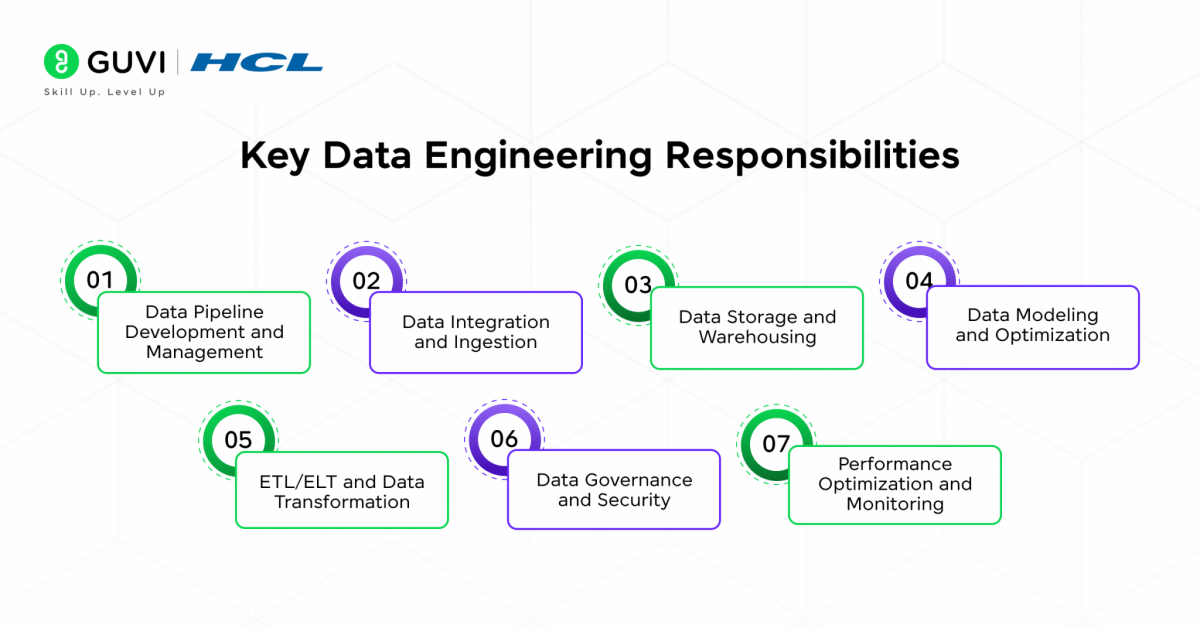
1. Data Pipeline Development and Management
A data pipeline automatically moves data from source to destination — cleaning, transforming, and loading it along the way.
Key tasks: Design ETL/ELT pipelines (Airflow, Beam, AWS Glue) · handle batch and real-time streaming · monitor pipeline health and debug failures · optimise for latency.
| ETL (Extract, Transform, Load) | ELT (Extract, Load, Transform) | |
|---|---|---|
| Process order | Transform before loading | Load raw data first, transform later |
| Best for | Structured data, legacy systems | Cloud warehouses, large-scale analytics |
| Examples | Informatica, Talend | dbt + Snowflake, BigQuery |
Tools: Apache Airflow, Apache Kafka, Apache Spark, AWS Glue, Azure Data Factory
2. Data Integration and Ingestion
Pulling data from dozens of sources — databases, APIs, IoT devices, SaaS tools, logs — into one unified system.
Key tasks: Extract from structured (MySQL, PostgreSQL), semi-structured (JSON, CSV), and unstructured (logs) sources · use streaming tools (Kafka, Kinesis) for real-time data · use batch tools (NiFi, Sqoop) for scheduled loads.
Real-world example: A fintech Data Engineer builds a pipeline ingesting transaction data from 12 payment gateways every 15 minutes, validating schema and flagging anomalies before loading clean data into Snowflake — automatically.
3. Data Storage and Warehousing
| Storage types | Examples | Best used for |
|---|---|---|
| Relational Databases | PostgreSQL, MySQL | Transactional data |
| NoSQL Databases | MongoDB, DynamoDB | Flexible, high-volume data |
| Data Warehouses | Snowflake, BigQuery, Redshift | Analytics, BI |
| Data Lakes | AWS S3, Azure Data Lake | Raw, large-scale storage |
| Data Lakehouses | Databricks Delta Lake, Apache Iceberg | Combined analytics + raw storage (2026 trend) |
4. Data Modelling and Architecture Design
Designs schemas that balance query performance with flexibility — star schemas and snowflake schemas for warehouses, normalised models for transactional systems, and clear documentation of data lineage.
5. Data Transformation (ETL/ELT Development)
Turns raw inputs into clean, analysis-ready datasets: cleansing, feature engineering, aggregation, and business-rule application.
Top tools: Apache Airflow (orchestration) · dbt (fastest-growing transformation tool in 2026) · Apache Spark · Fivetran/Airbyte (automated connectors)
6. Data Governance, Quality, and Security
With GDPR, HIPAA, and India’s DPDP Act in force, this is no longer optional.
Key tasks: Role-based access control · encryption at rest (AES-256) and in transit (TLS) · data lineage tracking · automated quality checks (Great Expectations, Monte Carlo, Soda) · PII anonymisation · access audit logs.
7. Performance Optimisation and System Monitoring
Key tasks: Optimise slow SQL (EXPLAIN plans, indexing) · monitor with Datadog/Prometheus/Grafana · auto-scaling and load balancing · containerisation (Docker, Kubernetes) · alerting for failures and latency spikes.
Top 5 Data Engineering Roles in 2026
| Job Roles | Core Skills Needed | Salary Range (LPA) |
|---|---|---|
| Data Engineer (core role) | SQL, Python, Spark, Kafka, Airflow, cloud | ₹7–15 LPA |
| Data Architect | Cloud architecture, data modelling, governance | ₹18–35 LPA |
| Big Data Engineer | Hadoop, Spark, HBase, HDFS, distributed systems | ₹10–22 LPA |
| Machine Learning Engineer | Python, TensorFlow/PyTorch, MLflow, SageMaker | ₹12–25 LPA |
| DataOps Engineer (emerging) | Airflow, dbt, Git, CI/CD, observability tools | ₹10–20 LPA |
Key Skills Required to Become a Data Engineer
Data engineers need a mix of programming, database, cloud, and data processing skills to build and maintain reliable data pipelines and large-scale data systems.
| Skills | Why it matters |
|---|---|
| Python | Used for automation, data processing, and pipeline scripting |
| SQL | Essential for querying, transforming, and managing structured data |
| Apache Spark | Helps process large datasets across distributed systems |
| AWS, Azure, or GCP | Used to build and manage cloud-based data infrastructure |
| Apache Kafka | Supports real-time data streaming and event processing |
| Airflow / dbt | Helps automate workflows and manage data transformations |
| Docker & Kubernetes | Useful for deploying and scaling data applications |
These skills help data engineers manage everything from data ingestion and transformation to storage, orchestration, and cloud deployment.
Read More about Skills Required to Become a Data Engineer
Once you know which skills matter, focus on applying them through projects and real-world data workflows. Explore GUVI’s Data Engineering course to build practical experience with the tools and technologies commonly used in data engineering roles.
Essential Data Engineering Tools (2026)
| Category | Tools |
|---|---|
| Pipeline Orchestration | Apache Airflow, Prefect, Dagster |
| Stream Processing | Apache Kafka, Apache Flink, AWS Kinesis |
| Batch Processing | Apache Spark, Hadoop MapReduce |
| Transformation | dbt, Apache Beam |
| Warehouses | Snowflake, BigQuery, Redshift |
| Data Lakes | AWS S3, Azure Data Lake, GCS |
| Data Quality | Great Expectations, Monte Carlo, Soda |
| Monitoring | Datadog, Prometheus, Grafana |
Career Path: Fresher to Senior
| Levels | Experience Levels | Salary Range (LPA) |
|---|---|---|
| Junior Data Engineer | 0–2 yrs | ₹4–7 LPA |
| Data Engineer | 2–5 yrs | ₹7–15 LPA |
| Senior Data Engineer | 5–8 yrs | ₹15–25 LPA |
| Lead / Principal Engineer | 8+ yrs | ₹25–40 LPA |
| Data Architect | 10+ yrs | ₹30–50 LPA |
You don’t need 10 years to start strong — a junior engineer with solid Python, SQL, and one cloud platform can land a first role in 6–9 months of structured learning.
Is Data Engineering Right for You?
Be honest with yourself here — this saves you months of wasted effort in the wrong direction.
This role is a good fit if you:
- Enjoy building and fixing systems more than analysing what’s already in them
- Don’t mind detail-heavy, sometimes repetitive debugging work
- Like the idea of your work being invisible but essential — nobody notices a pipeline until it breaks
- Are comfortable learning multiple tools (not just one language) over time
This probably isn’t the right fit if you:
- You want to generate insights and tell a story with data → look at Data Analyst instead
- You want to build predictive models and work closely with statistics → look at Data Scientist instead
- You want to build user-facing products, not backend infrastructure → look at Software/Backend Developer instead
How to Become a Data Engineer
To become a data engineer, start with SQL, Python, databases, and data modelling, then move on to ETL pipelines, cloud platforms, and big data tools such as Spark, Airflow, and Kafka. Build hands-on projects, practise working with real datasets, and learn how data moves from source systems to storage and analytics platforms.
For a clear learning path, recommended tools, project ideas, and career preparation steps, follow our Data Engineer Roadmap. It explains what to learn at each stage and how to progress toward job-ready data engineering skills.
Is Data Engineering a Good Career in India in 2026?
Yes — and the data backs it up:
- Strong hiring demand: LinkedIn currently shows 10,000+ Data Engineer jobs in India across major companies and industries.
- Major tech hubs: Bengaluru, Hyderabad, Chennai, and Pune continue to show a high concentration of data engineering openings.
- AI and analytics growth: Companies need data engineers to build reliable pipelines and prepare data for analytics and AI systems.
- Cloud skills matter: AWS, Azure, GCP, Snowflake, and Databricks are increasingly common in modern data engineering roles.
- Data governance is growing: India’s DPDP Rules are increasing focus on data security, access controls, retention, and breach management.
Best industries: Fintech, e-commerce, IT services, SaaS, healthcare tech, telecom, and consulting.
Data Engineer vs Data Scientist vs Data Analyst
One of the most searched comparisons by beginners — here’s the clearest version:
| Criteria | Date Engineer | Data Scientist | Data Analyst |
|---|---|---|---|
| Primary focus | Build data infrastructure | Extract insights from data | Report and visualise data |
| Key skills | Python, SQL, Spark, Kafka | Python, R, ML algorithms | SQL, Excel, Tableau |
| Daily tools | Airflow, dbt, Snowflake | Jupyter, TensorFlow, scikit-learn | Power BI, Looker, SQL |
| Output | Reliable data pipelines | Predictive models, insights | Dashboards, reports |
| Coding level | Very high | High | Medium |
| India salary (avg) | ₹7–15 LPA | ₹8–18 LPA | ₹4–10 LPA |
Data engineers enable the work of data scientists and analysts — without reliable pipelines, there’s no clean data to analyse in the first place.
Torn between the two? Read the full breakdown: Data Scientist vs Data Engineer: Full Comparison
Common Mistakes Aspiring Data Engineers Make
- Skipping SQL fundamentals to jump straight into Spark or Kafka — almost every role needs strong SQL first.
- Learning tools without understanding concepts — knowing Airflow commands isn’t the same as understanding orchestration.
- Building pipelines without planning for failure — no retry logic or alerting means production breaks nobody catches.
- Ignoring data quality — moving data without validating it causes expensive downstream errors.
- Avoiding the cloud — in 2026, AWS/GCP/Azure knowledge is non-negotiable for almost every employer.
If you’re ready to move from reading about this role to being job-ready for it, HCL GUVI’s Data Engineering Course covers Hadoop, Spark, and Kafka from scratch — with real-time and batch pipeline development, cloud platforms (AWS/GCP), live projects on industry datasets, and placement support.
Conclusion
Data engineering is one of the highest-demand, best-compensated tech careers in India in 2026 — covering everything from building pipelines to ensuring data quality and governance. Whether you’re a fresher exploring your first tech career or a software engineer considering a specialisation, the path is clear: start with Python and SQL, build one real pipeline project, and get one cloud certification. Those three steps alone put you ahead of most beginners entering the field.
FAQs
Can a fresher become a data engineer?
Yes, by learning Python, SQL, databases, one cloud platform, and building real pipeline projects with tools like Spark and Airflow.
What is the average data engineer salary in India?
Freshers: ₹4–7 LPA. Mid-level: ₹7–15 LPA. Senior engineers with cloud and big-data expertise: ₹20–30+ LPA.
What is ETL in data engineering?
Extract, Transform, Load — collecting data from sources, cleaning/transforming it, then loading it into a target system like a warehouse. Modern teams often use ELT (load first, transform later) instead.
Is data engineering harder than data science?
They require different skills — engineering leans on programming, databases, and scalable systems; science leans on statistics and ML. Difficulty depends on your background and interests, not a fixed ranking.
Is data engineering a good career in 2026?
Yes, companies increasingly need reliable data systems to power analytics and AI, and professionals with cloud and big-data skills remain in strong, growing demand.











![Top 10 Big Data Project Ideas [With Source Code]](https://www.guvi.in/blog/wp-content/uploads/2024/10/BigData_Project_Ideas-300x116.png)
