


Artificial Intelligence and Machine Learning Articles
How to Evaluate LLM Outputs in Production Deployments
AI/ML Skills Gap 2026: Why Companies Can't Find Job-Ready Talent
20 AI/ML Interview Questions Recruiters Can Use Without a Tech Background - Best Guide
How Industry-Backed AI/ML Bootcamps Are Changing the AI/ML Hiring Pipeline - Best Guide 2026


Get In Touch For Details! Request More Information

Precision and Recall in Machine Learning
Jun 15, 2026 6 Min Read 845 Views
(Last Updated)
Imagine you are building a spam filter for email. Your AI model flags 100 emails as spam. When you check, 80 are actually spam, but 20 are important work emails. At the same time, 30 spam emails slipped through to your inbox. Is your model good or bad?
This is where precision and recall come in. Precision tells you how many of your positive predictions are actually correct. Recall tells you how many of the actual positives you successfully found.
If you are building classification models, evaluating AI systems, or trying to understand why accuracy alone does not tell the whole story, understanding precision and recall is critical.
This guide explains what precision and recall are, how to calculate them, and how to use them to evaluate and improve your machine learning models.
Table of contents
- Quick TL;DR Summary
- Understanding the Confusion Matrix
- How to Calculate Precision and Recall
- The Precision-Recall Tradeoff
- When to Prioritize Precision
- When to Prioritize Recall
- Combining Precision and Recall: The F1 Score
- Precision and Recall for Imbalanced Datasets
- How to Improve Precision and Recall
- Conclusion
- FAQs
- What is the difference between precision and recall?
- When should I use precision versus recall?
- What is a good precision and recall score?
- How do I calculate precision and recall from a confusion matrix?
- What is the F1 score and when should I use it?
Quick TL;DR Summary
- This guide explains precision and recall, two essential metrics for evaluating classification models that measure different aspects of prediction quality beyond simple accuracy.
- You will learn how precision measures the accuracy of positive predictions while recall measures completeness of finding actual positives.
- The guide covers the confusion matrix, including true positives, false positives, true negatives, and false negatives, which form the foundation for calculating these metrics.
- Step-by-step examples show you how to calculate precision and recall, interpret them in real-world contexts, and understand the precision-recall tradeoff.
- You will understand when to prioritize precision versus recall based on your application, how to handle imbalanced datasets, and how F1 score helps balance both concerns.
What Are Precision and Recall?
Precision and recall are evaluation metrics used in machine learning and classification tasks to measure model performance. Precision represents the percentage of predicted positive results that are actually correct, while recall measures the percentage of actual positive cases that the model successfully identifies. Precision focuses on reducing false positives, whereas recall focuses on minimizing false negatives, making both metrics important for evaluating classification systems.
Both metrics answer different questions. Precision asks: when you predict positive, how often are you right? Recall asks: of all the positives that exist, how many did you find?
Understanding the Confusion Matrix
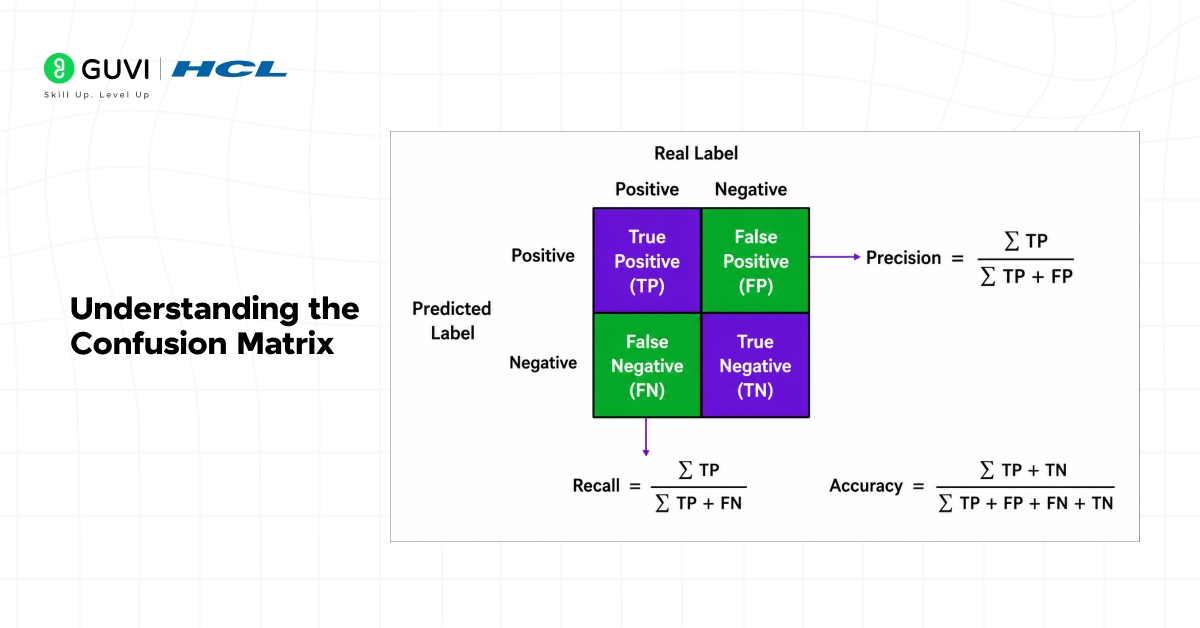
- True positives: Correct positive predictions
True positives (TP) are cases where your model predicted positive and the actual label is positive. In medical testing, this is correctly identifying a patient who has the disease. In spam detection, this is correctly flagging spam email. This is what you want.
- False positives: Incorrect positive predictions
False positives (FP) are cases where your model predicted positive but the actual label is negative. In medical testing, this is diagnosing a healthy patient as sick. In spam detection, this is flagging a legitimate email as spam. These are false alarms.
- False negatives: Incorrect negative predictions
False negatives (FN) are cases where your model predicted negative but the actual label is positive. In medical testing, this is missing a patient who actually has the disease. In spam detection, this is letting spam into the inbox. These are misses.
- True negatives: Correct negative predictions
True negatives (TN) are cases where your model predicted negative and the actual label is negative. In medical testing, this is correctly identifying a healthy patient. Your model correctly recognized these as negative.
- The confusion matrix organizes all outcomes
A confusion matrix is a table showing all four outcomes. Rows represent actual labels and columns represent predictions. The diagonal shows correct predictions. Off-diagonal cells show errors. This visualization makes it easy to see where your model succeeds and fails.
The terms precision and recall originally emerged from information retrieval research in the 1960s, when researchers were trying to evaluate the quality of early search engines and document retrieval systems. Precision measured how many retrieved documents were actually relevant, while recall measured how many relevant documents the system successfully found. Over time, these same evaluation concepts became fundamental metrics for machine learning classification, especially in areas like spam detection, medical diagnosis, fraud detection, and search ranking systems.
How to Calculate Precision and Recall
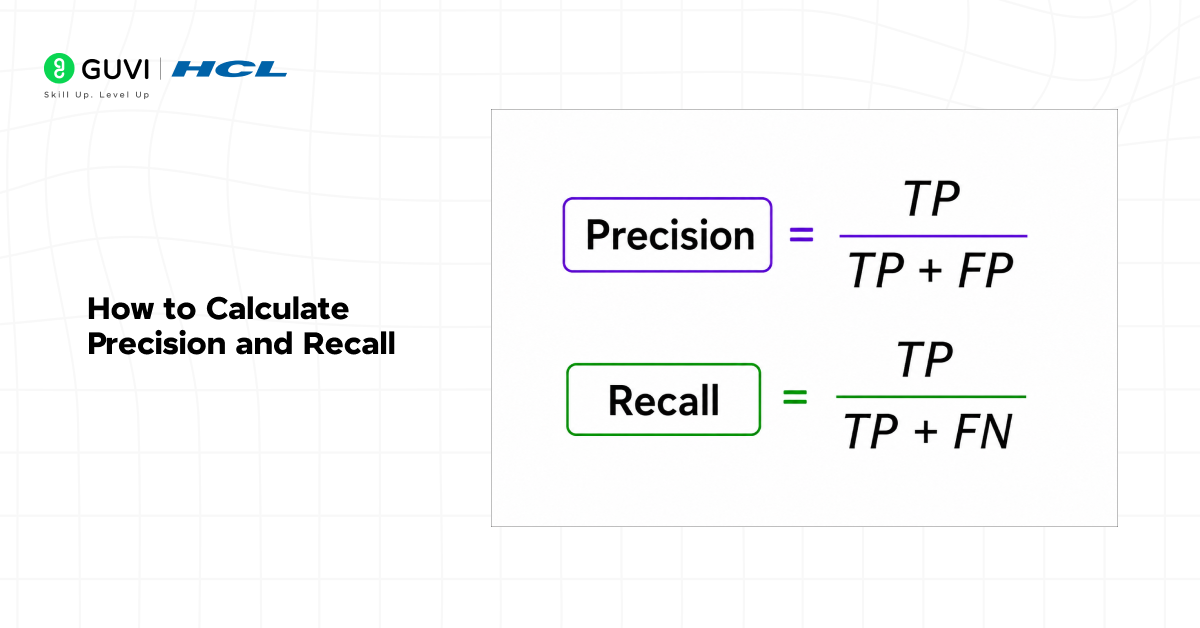
- Precision formula: TP divided by all positive predictions
Precision equals true positives divided by the sum of true positives and false positives. The formula is: Precision = TP / (TP + FP). The denominator represents everything your model predicted as positive. High precision means few false alarms.
- Recall formula: TP divided by all actual positives
Recall equals true positives divided by the sum of true positives and false negatives. The formula is: Recall = TP / (TP + FN). The denominator represents all items that are actually positive. High recall means you are finding most positives.
- Example calculation with concrete numbers
Your fraud detection model examines 1000 transactions. It flags 150 as fraudulent. Of these 150, only 120 are actually fraud (TP = 120, FP = 30). There were 200 fraudulent transactions total, so you missed 80 (FN = 80).
Precision = 120 / (120 + 30) = 0.80 or 80% Recall = 120 / (120 + 80) = 0.60 or 60%
- Interpreting the results
Your precision of 80% means that when you flag a transaction as fraud, you are right 80% of the time. Your recall of 60% means you are catching 60% of all fraud. You have relatively few false alarms but you are missing 40% of fraudulent transactions.
- Why both metrics matter
Precision alone does not tell you how many positives you missed. Recall alone does not tell you how many false alarms you created. A model that predicts everything as positive has 100% recall but terrible precision. You need both metrics to understand performance.
Read More: Machine Learning Pipeline Explained: Beginner to Pro Guide
The Precision-Recall Tradeoff
- Improving one often hurts the other
Most classification models output a probability score. You convert this to a prediction using a threshold. If you lower the threshold, you predict positive more often, which increases recall but decreases precision. If you raise the threshold, precision increases but recall decreases.
- Threshold adjustment changes the balance
In fraud detection, if you set a very low threshold, you flag almost everything as fraud. Your recall approaches 100% because you catch all fraud. But your precision drops because you flag many legitimate transactions. If you set a very high threshold, precision increases but recall drops.
- Understanding your application determines the balance
The right balance depends on consequences. In cancer screening, missing a case is more dangerous than a false alarm. You want high recall even if precision suffers. In spam filtering, false alarms that hide important emails are worse than missed spam. You want high precision.
- The tradeoff is fundamental
You cannot eliminate this tradeoff by changing thresholds. It exists because the two metrics measure different things. Precision cares about quality of positive predictions. Recall cares about quantity of positives you find. These goals naturally conflict.
The precision-recall curve visualizes how precision and recall change as the decision threshold of a classification model varies. By plotting this trade-off across different thresholds, researchers can evaluate how well a model balances finding positive cases against avoiding false positives. The area under the precision-recall curve provides a compact summary of model performance, making it especially valuable for imbalanced datasets where traditional accuracy metrics can be misleading.
When to Prioritize Precision
- Spam and content moderation
Incorrectly blocking legitimate content frustrates users more than letting some spam through. If your spam filter marks important emails as spam, users lose trust. Prioritize precision to ensure that items you flag are actually spam, even if some spam gets through.
- Legal and compliance systems
When flagging documents for legal review, false positives waste expensive lawyer time. Each flagged document must be manually reviewed. High precision reduces wasted effort, even if it means missing some relevant documents that require a second pass.

- Fraud detection in low-risk transactions
For small-value transactions, blocking legitimate purchases creates bad customer experience. Customers abandon purchases and complain. Some fraud loss is acceptable business cost. Prioritize precision to avoid frustrating legitimate customers.
When to Prioritize Recall
- Disease screening and early detection
Missing a cancer diagnosis has severe consequences. Additional testing to confirm a positive screening is acceptable. Medical screening tests prioritize recall to catch all potential cases, accepting many false positives that get filtered out by follow-up tests.
- Security threat detection
In cybersecurity, missing an actual threat can lead to data breaches and major damage. Investigating false alarms is less costly than missing real attacks. Security systems prioritize recall to catch threats, even if analysts must investigate many false alarms.
- Quality control in manufacturing
Missing defective products that reach customers damages reputation and creates safety issues. Flagging good products for additional inspection is a minor cost. Quality control systems prioritize recall to catch defects.
Combining Precision and Recall: The F1 Score
- F1 score balances both metrics
The F1 score is the harmonic mean of precision and recall. The formula is: F1 = 2 × (Precision × Recall) / (Precision + Recall). It ranges from 0 to 1, where 1 is perfect. You need both good precision and good recall for a high F1 score.
- When to use F1 score
Use F1 when you need a single metric that considers both precision and recall equally. It is useful for comparing models when you do not have a strong preference for one metric over the other. F1 score is common in machine learning competitions and research papers.
- F-beta score allows weighted preferences
The F-beta score adds a parameter beta that controls the tradeoff. F2 score weighs recall twice as much as precision. F0.5 score weighs precision twice as much as recall. Use F-beta when you have a clear preference but still want both metrics to matter.
- Limitations of F1 score
F1 score does not consider true negatives. For highly imbalanced datasets where the negative class dominates, F1 can be misleading. Always look at precision and recall separately in addition to F1 to understand model behavior.
Precision and Recall for Imbalanced Datasets
- Why accuracy fails for imbalanced data
In fraud detection, maybe 1% of transactions are fraudulent. A model that predicts everything as legitimate has 99% accuracy but is completely useless. It has 0% recall because it catches no fraud. Accuracy is misleading when classes are imbalanced.
- Precision and recall remain meaningful
Even with severe imbalance, precision and recall tell you what matters. If you catch 80% of fraud and 70% of your fraud alerts are real, you understand your model’s performance. These metrics focus on the minority class you care about.
- Strategies for imbalanced datasets
Common approaches include oversampling the minority class, undersampling the majority class, using class weights to penalize mistakes on the minority class more heavily, and choosing appropriate evaluation metrics like precision-recall curves. Always evaluate on precision and recall for imbalanced problems.
How to Improve Precision and Recall
- Collecting more training data
More data, especially for the positive class, helps your model learn better patterns. In imbalanced datasets, more positive examples are particularly valuable. Clean, accurate labels improve both metrics.
- Feature engineering for better signal
Adding features that distinguish positive from negative examples improves both metrics. Domain knowledge helps identify useful features. Removing noisy features that add randomness can also help.
- Threshold optimization for your use case
Do not blindly use 0.5 as your classification threshold. Analyze your precision-recall curve. Choose the threshold that matches your priorities. If recall matters most, lower the threshold. If precision matters most, raise it.
- Cost-sensitive learning
Assign different costs to false positives versus false negatives during training. If missing a positive is 10 times worse than a false alarm, tell your model. Many algorithms support class weights that encode these priorities.
To learn more about Precision and Recall in Machine Learning, do not miss the chance to enroll in this HCL GUVI’s AI and Machine Learning course covering machine learning fundamentals, feature engineering, deep learning, and practical implementation through hands-on projects and expert guidance with certification.
Conclusion
Precision and recall are essential metrics for evaluating classification models. Precision measures how many of your positive predictions are correct. Recall measures how many actual positives you found.
The two metrics trade off against each other. Improving one often hurts the other. The right balance depends on your application. Medical screening prioritizes recall. Spam filtering prioritizes precision.
For imbalanced datasets, precision and recall are far more informative than accuracy. They focus on the minority class you care about.
Always calculate and monitor both metrics. Use F1 score when you need a single number that balances both. Adjust your classification threshold based on the consequences of false positives versus false negatives.
FAQs
1. What is the difference between precision and recall?
Precision measures what percentage of your positive predictions are actually correct. Recall measures what percentage of actual positive cases you successfully found. Precision asks how many flagged items are real while recall asks how many real items you found.
2. When should I use precision versus recall?
Use precision when false positives are more costly, like in spam filtering where blocking legitimate emails is worse than missing spam. Use recall when false negatives are more costly, like in disease screening where missing a case is worse than a false alarm.
3. What is a good precision and recall score?
It depends on your application and class balance. For balanced datasets, above 80% for both is generally good. For imbalanced datasets, compare to the baseline. Context matters more than absolute numbers.
4. How do I calculate precision and recall from a confusion matrix?
Precision equals true positives divided by (true positives plus false positives). Recall equals true positives divided by (true positives plus false negatives). You need the counts from your confusion matrix to compute both metrics.
5. What is the F1 score and when should I use it?
F1 score is the harmonic mean of precision and recall, providing a single number that balances both metrics. Use it when you need to compare models and have no strong preference for precision over recall. It is common in machine learning competitions and research.
Success Stories

About the Author
Vishalini Devarajan
An Aerospace Engineer turned content writer, I focus on making complex concepts easy to understand through well-structured, reader-friendly blogs. Whether it’s a technical topic or a non-technical one, I love creating content that is clear, engaging, and impactful.
View all posts by Vishalini Devarajan
Connect with me @











Did you enjoy this article?