


Full Stack Development Articles
How to Switch from IT Support to Full Stack Development
How to Identify a Full Stack Development Program That Offers Real Project Experience
Is Full Stack Development a Practical Upskilling Choice for Software Professionals?
Full Stack Development Training for Employees in Service-Based IT Companies


Get In Touch For Details! Request More Information
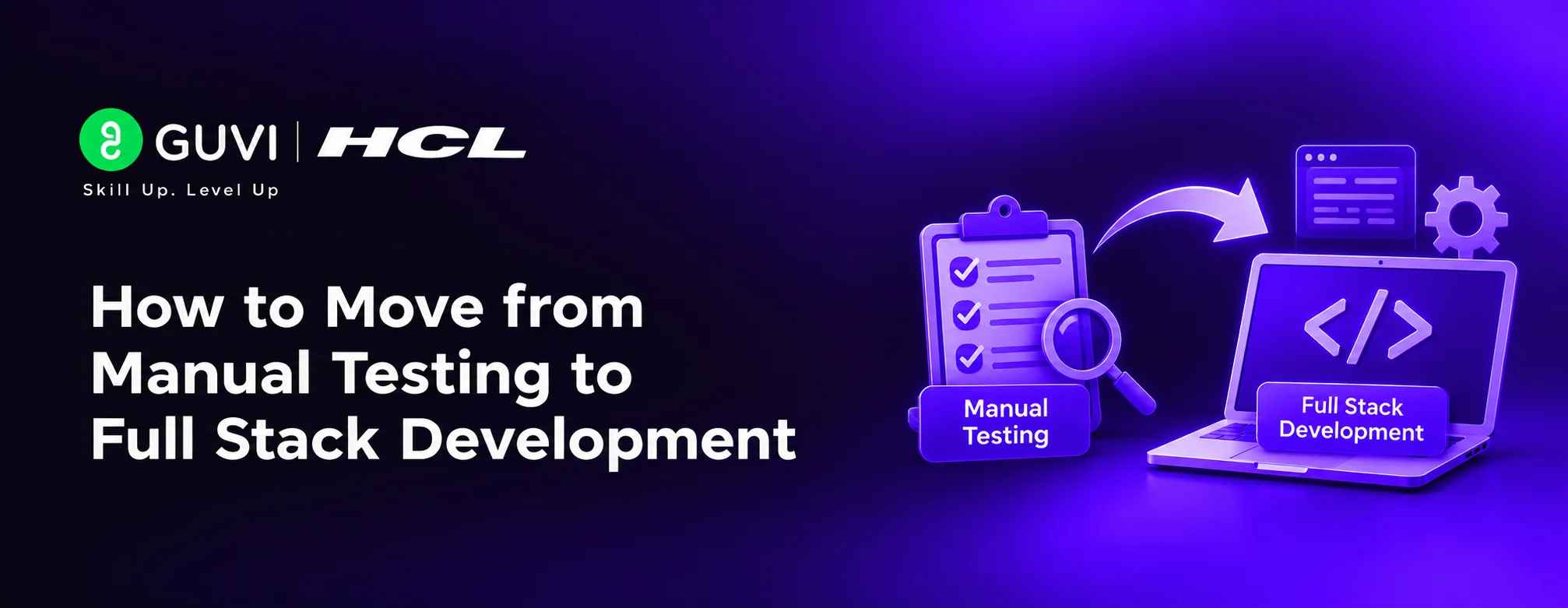
How to Move from Manual Testing to Full Stack Development
Nov 06, 2026 5 Min Read 26 Views
(Last Updated)
You find a tricky bug, write a perfect report, and the developer replies, “Fixed.” A week later you wonder how the fix actually works, and whether you could have made it yourself.
So is manual testing to full stack development a realistic move? Short answer: yes. You already think like someone who breaks software and know how a product should behave. What is missing is the building side: screens, servers, and data. With steady practice, the gap closes.
Below, we cover how manual testing to full stack development works, the full stack developer skills to learn, a 90 day plan, the pay difference, and mistakes to avoid in your testing to development career transition.
Table of contents
- TL;DR Summary
- What is Manual Testing to Full Stack Development?
- Why Testers Make Natural Developers
- One Feature, Seen From Both Sides
- Two Routes: Direct or Through Automation
- The Direct Route
- The Automation Route
- Full Stack Developer Skills to Learn
- JavaScript First
- React for the Front End
- Node.js and APIs
- SQL and Databases
- Git and Deployment
- From Finding Bugs to Preventing Them
- Your 90 Days Roadmap
- Days 1 to 30: Learn the Basics
- Days 31 to 60: Build Something Real
- Days 61 to 90: Test and Ship
- 💡 Did You Know?
- Set Realistic Expectations
- How to Present Your Testing Background
- What Happens to Your Pay and Career
- How HCL GUVI's Course Supports Testers Making the Switch
- Common Mistakes Testers Make When Switching
- Conclusion
- FAQs
- Can I move from manual testing to full stack development without coding experience?
- How long does manual tester to software developer take?
- Should I learn automation testing before manual testing to full stack development?
- Which full stack developer skills matter most for a tester?
- Will I start at a lower level after a testing to development career transition?
TL;DR Summary
- What it is: Manual testing to full stack development means moving from checking software to building it.
- Your edge in manual testing to full stack development: You spot edge cases, write clear reports, and know the product from the user’s side.
- Two routes for manual testing to full stack development: Go straight to development, or add test automation first as a bridge.
- Skills to add for manual testing to full stack development: JavaScript, React, Node.js, SQL and a database, and Git.
- Next step: Start manual testing to full stack development by writing a tiny app and testing it yourself.
What is Manual Testing to Full Stack Development?
Manual testing to full stack development is a career change from running test cases by hand to building complete web apps. A full stack developer handles what users see, the server that powers it, and the database behind it.
Testers already touch all three layers while checking features. Developers simply make decisions on each one. Here is how the two jobs compare.
| Area | Manual Testing | Full Stack Development |
|---|---|---|
| Main goal | Find problems before users do | Build features that work for users |
| Daily work | Test cases, bug reports, retesting | Code, APIs, database queries, reviews |
| Tools | Test management tools, Postman, SQL checks | Code editor, Git, React, Node.js, databases |
| Mindset | “How can this break?” | “How do I build this so it holds?” |
The habits overlap more than the tools do. If the job is new to you, start with what full stack development involves and the work it covers each day.
For manual testing to full stack development, HCL GUVI’s Full Stack Development course teaches live after work hours and begins with programming basics, so a tester with no coding background can start.
Why Testers Make Natural Developers
Testers bring habits that many new developers lack, which is why manual testing to full stack development works so well.
- Edge case thinking: You ask “what if the user does this?” before anyone else.
- Clear writing: A good bug report is already a good technical note.
This is why manual tester to software developer moves often go well.
One Feature, Seen From Both Sides
Take a login page, a common case in manual testing to full stack development. The same feature looks different to a tester and a developer.
- Screen: A tester checks that a wrong password shows an error. A developer builds the form and the message.
- API: A tester checks the response. A developer writes the route that sends it.
- Database: A tester checks that the account exists. A developer designs the table and the query.
Your tester eye is already trained on all three.
Two Routes: Direct or Through Automation
There are two ways to approach manual testing to full stack development.
1. The Direct Route
Learn to code and build full stack projects. This works well if you can study consistently and want developer roles quickly.
2. The Automation Route
Write code that tests the app you already know, then grow into building features. This path is gentler, since you stay in a familiar area. Read how to become an automation test engineer if you like this route, and keep your goal in mind: automation should be a bridge, not a stop.
| Direct Route | Automation Route | |
|---|---|---|
| Best for | People who can study regularly | People who need a role change inside their company first |
| First goal | Build a small full stack app | Automate tests for the app you know |
| Main risk | Feeling lost without familiar work | Staying in automation too long |
Full Stack Developer Skills to Learn
For manual testing to full stack development, learn these in order.
1. JavaScript First
One language is enough to build both sides of an app. This HTML and CSS guide for beginners helps you build the first pages.
2. React for the Front End
Components and state are the core ideas. Use your tester eye to check every screen you build.
3. Node.js and APIs
Build REST APIs with Node.js and Express. If you have checked APIs before, you already know what good responses and errors look like.
4. SQL and Databases
Testers often check data in tables, so you start ahead. Learn one SQL and one NoSQL option, and design your own tables.
5. Git and Deployment
Put your code on GitHub and your app online. See how to upload your project to GitHub, and read the full list of skills to become a full stack developer.
From Finding Bugs to Preventing Them
The biggest shift in manual testing to full stack development is mental. Testing finds problems after code exists. Development stops them from being written.
- Write tests for your own code: Your testing background becomes a real advantage here.
- Read the code behind a bug: Ask developers to walk you through a fix.
- Accept your own bugs: Everyone ships them. What matters is how fast you find and fix them.
Your 90 Days Roadmap
Here is a simple start for manual testing to full stack development.
Days 1 to 30: Learn the Basics
Study HTML, CSS, and JavaScript for a little each day. Build one small page every week.
Days 31 to 60: Build Something Real
Make a simple app, such as a bug tracker or a test case manager, with a database.
Days 61 to 90: Test and Ship
Write tests for your app, fix what breaks, and put it online. Then keep going with the full full stack developer roadmap and use these project ideas.

Plan for roughly 6 to 9 months in total. This guide on how long it takes to become a full stack developer helps you set a pace.
💡 Did You Know?
- In 1996, the first Ariane 5 rocket broke apart about 37 seconds after launch because of a software error, when a number was converted into a format too small to hold it.
Set Realistic Expectations
The switch rarely happens overnight, so plan for these points.
- You may start as a junior developer: Your product knowledge still helps you grow faster.
- Ask for coding work now: Offer to help automate repeat tests, so your team sees your progress.
- Find a mentor: A developer on your team can review your code and explain their choices.
How to Present Your Testing Background
Recruiters often file testers under quality only, so after manual testing to full stack development, your manual tester to software developer story needs clear proof.
- Show code: Put your apps and tests on GitHub.
- Use results: For example, “Built an app and wrote tests for its login flow” shows both skills.
This guide to a full stack developer portfolio shows what to include.
What Happens to Your Pay and Career
Pay is a big reason for manual testing to full stack development, and reported figures show why. For manual testers with 3 to 6 years of experience, the typical range is about ₹4.5 to ₹5 lakh a year. For full stack developers with the same experience, it is about ₹9.3 to ₹10.3 lakh a year.
Treat these as reported averages, not offers. Your city, company, and skills change the number, and no course can promise a raise. Over time, developers can grow toward senior developer and technical lead roles, as these career opportunities in full stack development show.
How HCL GUVI’s Course Supports Testers Making the Switch
Here is what the program offers for manual testing to full stack development.
- After work learning: 130+ hours of live online classes, in weekday or weekend batches.
- No coding needed to begin: The program starts with programming fundamentals.
- Mentors and recordings: Live sessions with one to one doubt solving, plus recordings of any class you miss.
- Front end: HTML, CSS, JavaScript, React, and Tailwind CSS.
- Back end and data: Node.js, Express.js, MongoDB, Mongoose, and REST APIs, tested with Postman.
- Also covered: DSA, system design, DevOps, and GenAI.
- Projects you build: An e-commerce web application, an order management system, a cloud deployment pipeline, and an AI powered document Q and A chatbot.
- Job search help: Mock interviews one to one, plus resume review and portfolio and GitHub guidance.
- Certificates: An IITM Pravartak certification and a complimentary MongoDB certification.
- Languages: English, Tamil, Hindi, and Telugu.
Ready to see where your testing skills can lead? Check the syllabus and choose a batch on the Full Stack Development course page.
Common Mistakes Testers Make When Switching
These mistakes slow down many manual testing to full stack development moves.
- Waiting to feel ready: Start your manual testing to full stack development journey now, even with a small app.
- Learning many languages: Pick JavaScript and finish one stack.
- Skipping DSA: Product company interviews often include coding rounds. Here are the reasons to learn data structures and algorithms.
- Ignoring your edge: In a manual tester to software developer move, your testing skill is a strength, so use it on your own code.
Conclusion
Manual testing to full stack development is a practical move because you already know how software fails. You add the code, test your own work, and show it in a portfolio.
Begin with the 90 day plan, build one small app, and keep your tester habits. A steady testing to development career transition beats a rushed one.
HCL GUVI’s Full Stack Development course lets you learn after work, build projects with mentor feedback, and finish with interview practice and two certificates. Pick your batch and start your manual testing to full stack development journey this week.
FAQs
1. Can I move from manual testing to full stack development without coding experience?
Yes. Begin with JavaScript basics, build small pages, and add one layer at a time. Reading specs and reproducing bugs already trains the patience that debugging needs.
2. How long does manual tester to software developer take?
Manual testing to full stack development takes about 6 to 9 months of steady study before you apply for junior roles. Keep a project in progress throughout.
3. Should I learn automation testing before manual testing to full stack development?
Only if you need a bridge. Automation keeps you in a familiar role while you learn code, but going straight to development is faster if you can study regularly.
4. Which full stack developer skills matter most for a tester?
Start with JavaScript, then React, Node.js, SQL and a NoSQL database, and Git. Add DSA basics before interviews, since coding rounds are common.
5. Will I start at a lower level after a testing to development career transition?
You may begin at a junior developer level, even with years of testing experience. With manual testing to full stack development, your product knowledge and testing habits can help you grow faster.
Success Stories

About the Author
Jebasta
I translate the language of data into stories that anyone can understand. As a writer with a data science background, I simplify analytics, AI, and decision-making so beginners and enthusiasts can confidently explore the world of data.
View all posts by Jebasta
Connect with me @























Did you enjoy this article?