


Data Science Articles
BPO Experience for Data Analyst Jobs Does It Count When Applying? - Best Guide
What's Career Growth After 5 Years in BPO? Are You Missing Out on a Data Analyst Career?
Can a BPO Team Leader Become a Data Analyst?
BPO vs Data Analyst Salary in India: What Changes After the Switch?

Get In Touch For Details! Request More Information
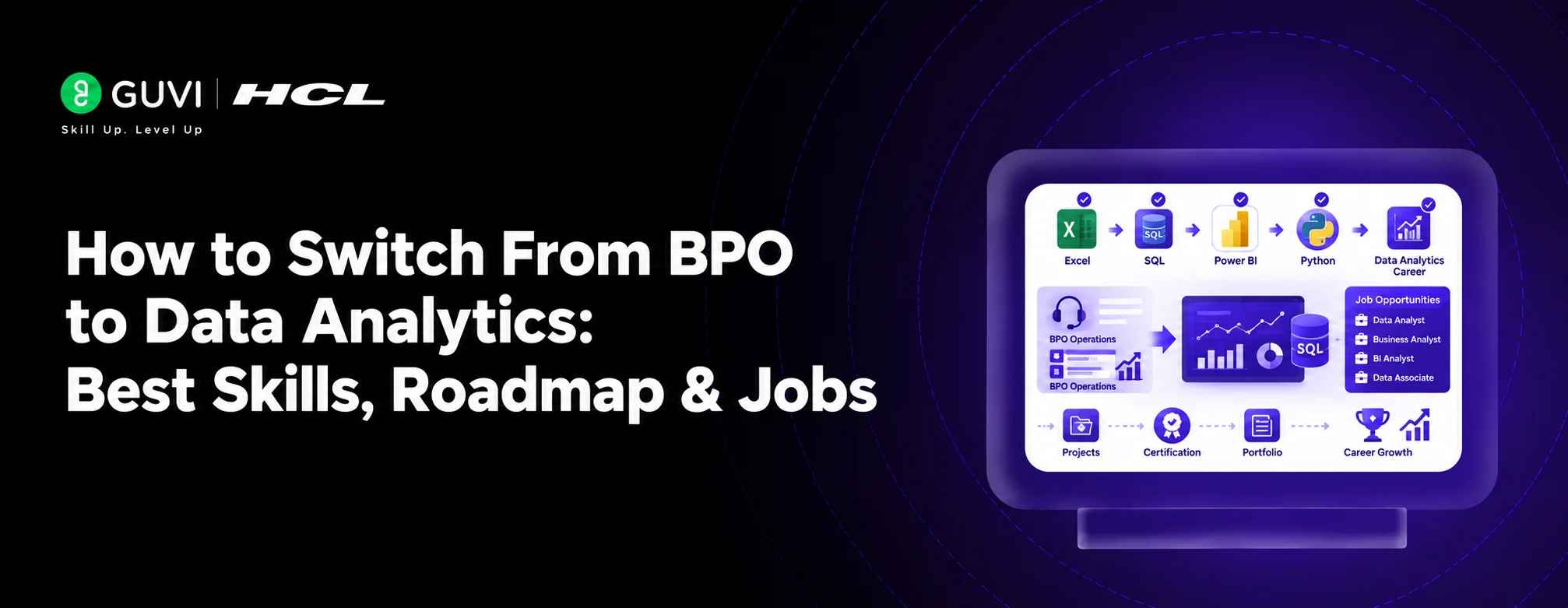
How to Switch From BPO to Data Analytics in 2026: Best Skills, Roadmap & Jobs
Oct 08, 2026 6 Min Read 42 Views
(Last Updated)
Switching from BPO to data analytics can feel like a big career jump, especially if your current role does not involve coding or technical tools. But you do not have to throw away everything you have learned so far.
Your experience with customers, operations, reports, KPIs, and business processes can become useful once you add the right data analytics skills.
The real challenge is knowing what to learn first, what your existing experience can offer, and how to prove that you are ready for a data analyst role.
In 2026, a practical starting point is to build skills in Excel, SQL, data visualisation, and Power BI, followed by Python and basic statistics.
If you are wondering how to switch from BPO to data analytics, this guide breaks the transition into manageable steps, from identifying your transferable skills to building projects and applying for your first analytics role.
Table of contents
- TL;DR
- Can you switch from BPO to data analytics?
- What skills do you need to make the switch from BPO to Data Analytics?
- Excel
- SQL
- Power BI
- Statistics
- Python
- What is the best roadmap to switch from BPO to data analytics?
- Step 1: Understand what a data analyst actually does
- Step 2: Build your foundation
- Step 3: Add Power BI and statistics
- Step 4: Learn Python
- Step 5: Build projects
- How can you use your BPO experience in data analytics?
- What projects should you build before applying for jobs?
- Mini Project Example
- Customer Support Analytics Project
- How can you prepare for data analyst jobs?
- Possible career paths from BPO
- Turn Your BPO Experience Into a Data Career
- Conclusion
- FAQs
- Can a BPO employee become a data analyst?
- Is coding required to switch from BPO to data analytics?
- Which skill should I learn first for a BPO-to-data-analytics switch?
- Can my BPO experience help me become a data analyst?
- How many projects should I build for a data analyst job?
- Do I need a data analytics certification?
- Can I switch to data analytics without a technical degree?
- How long does it take to switch from BPO to data analytics?
TL;DR
- You can switch from BPO to data analytics without starting your career from zero.
- Your experience in customer service, operations, reporting, quality, or process management can help you understand business problems.
- Start by learning Excel and SQL, then add Power BI, statistics, and Python.
- Build two or three practical projects using business-related datasets and create a portfolio that shows what you can actually do.
- The goal is not to learn every data tool. It is to connect your existing business experience with technical skills and demonstrate that you can turn data into useful insights.
Can you switch from BPO to data analytics?
Yes, you can switch from BPO to data analytics if you build the required technical skills and can demonstrate them through practical work. You do not necessarily need to come from a computer science background.
The bigger question is what you bring with you from BPO.
If your work involves tracking customer complaints, preparing reports, monitoring productivity, handling quality metrics, or analysing process performance, you may already be familiar with the business side of analytics.
What you may be missing is the technical layer.
| What you may already know from BPO | What you need to add |
| Customer behaviour | Data analysis |
| KPIs and targets | SQL |
| Operational reports | Excel |
| Process metrics | Power BI |
| Quality metrics | Statistics |
| Business communication | Data storytelling |
| Domain knowledge | Python basics |
This is why you should treat the transition as a skill upgrade, not necessarily a complete restart.
Many BPO roles already involve metrics such as average handling time, customer satisfaction, service levels, resolution rates, and productivity. These are the kinds of business metrics that can become the foundation for analytics projects.
What skills do you need to make the switch from BPO to Data Analytics?
You do not need to learn every programming language or analytics tool before applying. Start with the skills that help you perform common analyst tasks.
1. Excel
Excel is a practical first step because you may already have some exposure to spreadsheets and reports.
Go beyond basic data entry. Learn formulas, PivotTables, lookups, data cleaning, charts, and basic dashboard creation.
The objective is to take a messy spreadsheet and turn it into information that someone can use.
2. SQL
Next, learn SQL. It helps analysts retrieve and work with data stored in databases.
Start with:
- SELECT and WHERE
- GROUP BY and ORDER BY
- Aggregate functions
- JOINs
- CASE statements
- Subqueries
- CTEs
- Basic window functions
You do not need to become a database administrator. You need enough SQL to answer business questions using data.
3. Power BI
Once you understand basic analysis, learn one visualisation tool well.
Power BI lets you connect data, create models, build interactive reports, and share insights.
For a BPO professional, imagine converting a monthly operations report into a dashboard showing average handling time, customer satisfaction, resolution rates, or team performance.
That is a much stronger portfolio story than simply saying, “I completed a Power BI course.”
4. Statistics
You do not need advanced mathematics to start.
Focus on practical concepts such as:
- Mean and median
- Percentages
- Distributions
- Correlation
- Outliers
- Basic probability
- Hypothesis testing
The important part is understanding what the numbers mean and when a conclusion may be misleading.
5. Python
Python can come after your core analytics skills.
For an entry-level transition, focus on Python for data work rather than trying to become a software developer. Learn the basics and then move into libraries such as Pandas for data manipulation and visualisation tools for analysis.
Data analysts typically use SQL, spreadsheets, BI tools, statistics, and Python as core skills, though exact requirements vary by role.
What is the best roadmap to switch from BPO to data analytics?
| Stage | Skill | What to build | Why it matters |
| 1 | Excel | KPI report | Reporting foundation |
| 2 | SQL | Business queries | Database analysis |
| 3 | Power BI | BPO dashboard | Portfolio proof |
| 4 | Statistics | KPI analysis | Better decisions |
| 5 | Python | Customer analysis | Advanced analysis |
| 6 | Projects | 2-3 projects | Demonstrate skills |
| 7 | Job prep | Resume & interviews | Become job-ready |
The simplest approach is to build your skills in stages instead of trying to learn everything together.
Step 1: Understand what a data analyst actually does
Before enrolling in a course or watching dozens of tutorials, look at actual data analyst job descriptions.
Notice the tools companies ask for. More importantly, look at the responsibilities.
An analyst may be expected to clean data, query databases, create dashboards, identify trends, prepare reports, and explain findings to business teams.
This gives you a clear target.
Step 2: Build your foundation
Start with Excel and SQL.
For example, take a customer-support dataset and answer questions such as:
- Which issue generates the most complaints?
- Which month has the highest ticket volume?
- Which team has the best resolution rate?
- Does response time affect customer satisfaction?
Now you are learning tools while thinking like an analyst.
Step 3: Add Power BI and statistics
Once you can work with data, start presenting it.
Build a Power BI dashboard around your dataset. Add useful KPIs, filters, trends, and charts.
Then use basic statistics to check whether the patterns you see actually mean something.
Step 4: Learn Python
Once the basics are comfortable, use Python to clean and analyse larger datasets.
You do not need to rush this step. A strong SQL, Excel, Power BI foundation is more useful than knowing five tools superficially.
Step 5: Build projects
This is where your transition becomes more credible.
Instead of saying:
“I worked in BPO and completed a data analytics course.”
You want your profile to communicate:
“I have BPO experience and have used SQL, Excel, and Power BI to analyse customer and operational data.”
That difference matters.
Learning Excel, SQL, Power BI, statistics, and Python separately can take time, especially when you are balancing a full-time BPO job. A structured learning path can help you follow these skills in the right order, practise them through projects, and gradually build the confidence needed for a career switch.
If your immediate goal is to move into data analytics, a Data Science & Analytics learning path can help you build those core skills. If you want to progress further into machine learning and Generative AI, a broader Data Science & GenAI path may be a better fit.
The choice ultimately depends on where you want your career to go: analytics first, or a broader data science and AI role.
How can you use your BPO experience in data analytics?
Your BPO experience can become a domain advantage if you know how to connect it with data.
Consider a customer-support professional who has spent three years tracking call volumes, handling complaints, monitoring service levels, and preparing team reports.

That person already understands the business questions.
For example, they may know why customer satisfaction drops during certain periods or why a particular process creates more escalations. Learning analytics gives them the technical ability to investigate those questions using data.
You can position your experience around transferable skills such as:
- KPI monitoring
- Reporting
- Customer behaviour
- Process improvement
- Quality analysis
- Problem-solving
- Stakeholder communication
- Operations knowledge
Do not hide your BPO experience from your resume. Instead, translate it into analytics-relevant language where it is accurate.
For example, if you genuinely prepared performance reports, describe the reporting work and the metrics you handled. Do not claim that you performed advanced data analysis if you did not.
What projects should you build before applying for jobs?
Build projects that connect your previous experience with the type of analytics work you want to do.
Here are some practical ideas:
| Project | What you can demonstrate |
| Customer Support Dashboard | Excel, Power BI, KPI analysis |
| Call Centre Performance Analysis | SQL, data cleaning, reporting |
| Customer Churn Analysis | Python, statistics, visualisation |
| Employee Performance Dashboard | Power BI, business metrics |
| Complaint Trend Analysis | SQL, Excel, data storytelling |
A customer-support dashboard is particularly relevant for someone coming from BPO.
Imagine a dataset containing customer complaints, resolution time, agent information, issue categories, and satisfaction scores. Your project could identify the most common issues, compare team performance, and highlight areas where customer satisfaction is falling.
The project then tells a story: business problem → data → analysis → insight → recommendation.
That is the kind of thinking you want to demonstrate during interviews.
Mini Project Example
Customer Support Analytics Project
Business problem: Customer satisfaction is falling.
Data: Tickets, agents, resolution time, issue type and CSAT.
Tools: SQL & Power BI.
Analysis: Identify whether resolution time, issue category or team performance is linked to lower satisfaction.
Recommendation: Identify processes or issue categories requiring intervention.
If you are coming from BPO, don’t build random projects just to fill your portfolio. Build projects around problems you already understand.
How can you prepare for data analyst jobs?
Once your skills and projects are ready, start preparing for the actual hiring process.
First, update your resume around relevant skills rather than simply listing every responsibility from your BPO role.
Second, create a portfolio with two or three strong projects. Each project should explain the problem, dataset, tools used, analysis, key findings, and recommendations.
Third, practise explaining your projects without relying on technical jargon. A hiring manager may care less about whether you remember every Power BI feature and more about whether you can explain why you chose a particular metric or chart.
Finally, prepare for practical questions in Excel, SQL, Power BI, statistics, and business scenarios.
The transition becomes easier when you stop thinking of yourself as “a BPO employee trying to enter IT” and start building evidence that you can perform analytics work.
Possible career paths from BPO
BPO → MIS Analyst → Data Analyst
BPO → Operations Analyst → Data Analyst
BPO → Reporting Analyst → Data Analyst
BPO → Business Analyst → Data Analyst
BPO → Workforce Analyst → Data Analyst
Turn Your BPO Experience Into a Data Career
You already understand customers, operations, KPIs, and business processes. Adding data analytics skills can help you turn that experience into opportunities in data-focused roles.
If you’re starting with analytics, build a strong foundation in Excel, SQL, data visualisation, statistics, and Python. If you want to take the next step into machine learning and Generative AI, you can build on those skills with advanced data science concepts.
HCL GUVI offers learning paths for both goals: Data Science & Analytics for an analytics-focused transition and Data Science & GenAI for those aiming towards broader data science and AI roles.
Conclusion
A Switch from BPO to data analytics does not mean your previous career suddenly becomes irrelevant. In fact, your understanding of customers, operations, KPIs, and business processes can become useful once you add the technical skills needed to work with data.
Start small: learn Excel, build SQL skills, move into Power BI, understand basic statistics, and then add Python. Most importantly, build projects that connect your previous experience with real business questions.
If your goal is to make the transition in 2026, do not wait until you feel like a “perfect” data analyst. Start building the skills and evidence that show you can already think and work like one.
FAQs
1. Can a BPO employee become a data analyst?
Yes. A BPO employee can become a data analyst by building skills in Excel, SQL, Power BI, statistics, and Python and demonstrating them through relevant projects. Previous experience in customer service, operations, reporting, quality, and KPI tracking can also provide useful business context.
2. Is coding required to switch from BPO to data analytics?
Not necessarily. Entry-level analytics work can begin with Excel, SQL, visualisation, and statistics. Python is useful as you progress, but you do not need to become a software developer to start learning data analytics.
3. Which skill should I learn first for a BPO-to-data-analytics switch?
Start with Excel and SQL. Then learn Power BI, basic statistics, and Python. This sequence gives you a practical foundation without trying to learn everything simultaneously.
4. Can my BPO experience help me become a data analyst?
Yes. Experience with KPIs, customer behaviour, reporting, operations, quality, and process metrics can provide useful business context. The key is to combine that experience with technical analytics skills.
5. How many projects should I build for a data analyst job?
There is no fixed number, but two or three well-explained projects are more useful than a large collection of unfinished projects. Focus on showing the complete process from business question to recommendation.
6. Do I need a data analytics certification?
A certification can support your learning, but it should not be your only proof of ability. Employers also need evidence that you can work with data, solve problems, build dashboards, and explain your findings.
7. Can I switch to data analytics without a technical degree?
Yes, depending on the role and employer. A non-technical background does not automatically prevent a career switch. You will need to compensate by building relevant technical skills, projects, and a clear portfolio.
8. How long does it take to switch from BPO to data analytics?
There is no fixed timeline because it depends on your starting point, learning schedule, and target role. A structured learning plan can help you progress faster, but becoming job-ready requires consistent practice and project work.
Success Stories

About the Author
Hashmithaa
Hi, I’m Hashmithaa — a content writer with a love for words. Writing isn’t just what I do; it’s how I connect, communicate, and create meaning in a noisy digital world. And if my words help someone make a better decision, learn something new, or feel more confident, then I’ve done my job well.
View all posts by Hashmithaa
Connect with me @








Did you enjoy this article?