


Career Articles
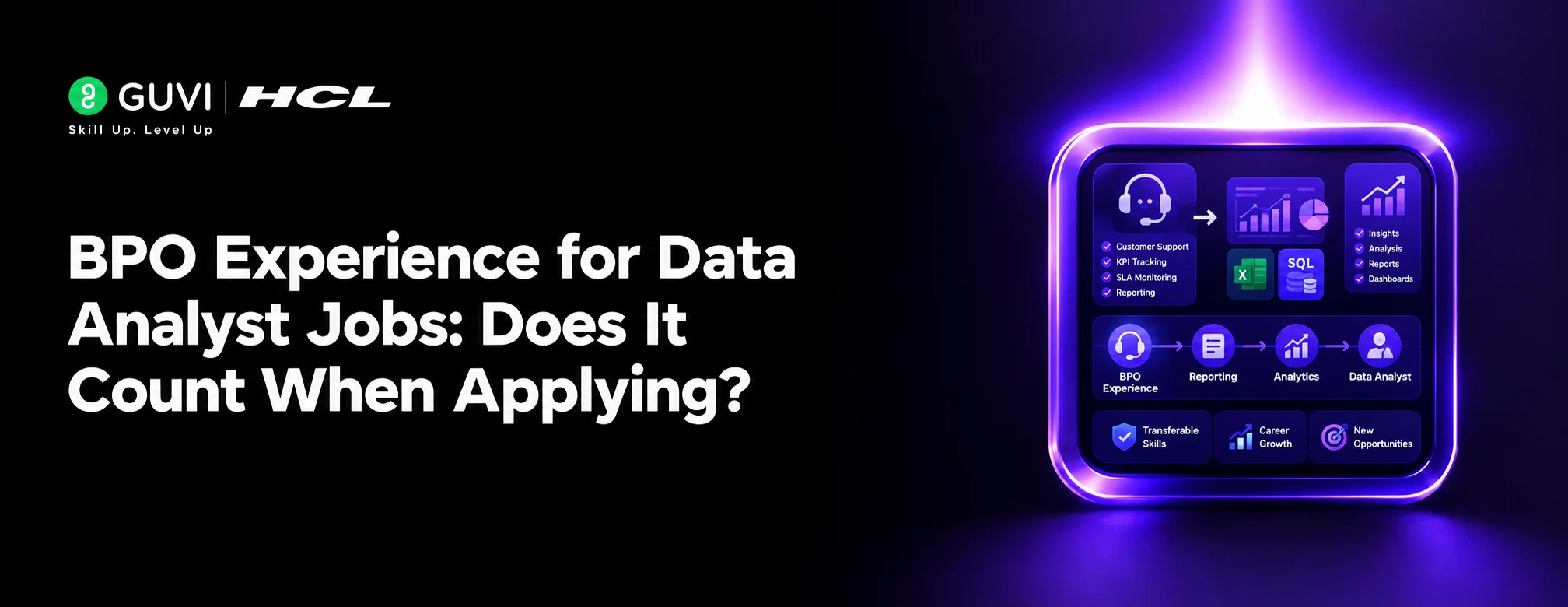
BPO Experience for Data Analyst Jobs Does It Count When Applying? - Best Guide
Can a BPO Team Leader Become a Data Analyst?
BPO vs Data Analyst Salary in India: What Changes After the Switch?
How to Switch From BPO to Data Analytics in 2026: Best Skills, Roadmap & Jobs

Get In Touch For Details! Request More Information
What’s Career Growth After 5 Years in BPO? Are You Missing Out on a Data Analyst Career?
Oct 08, 2026 5 Min Read 45 Views
(Last Updated)
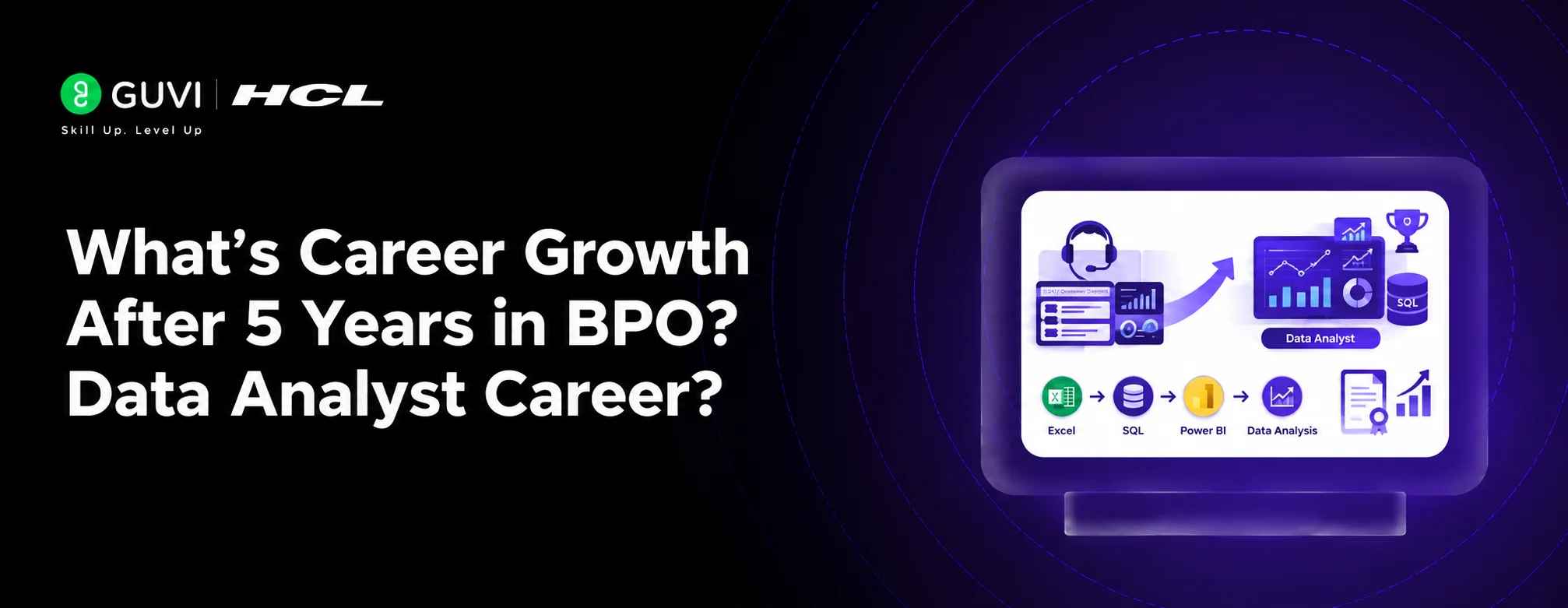
Five years in BPO is a long time. By now, you have probably handled difficult customers, chased targets, worked with KPIs, managed escalations, and maybe even taken on senior responsibilities. But here’s the real question: has your career grown as much as your experience has?
If your role, salary, and skills have started feeling stuck, simply adding another two or three years may not change much. Career growth after 5 years in BPO often comes down to what you choose to do next.
You could grow within operations, move into quality or MIS, or build towards roles like Business Analyst or Data Analyst. And if you already work with Excel, reports, customer data, or performance metrics, you may have a stronger starting point than you realise.
Table of contents
- TL;DR
- Are You Actually Stuck After 5 Years in BPO?
- What Career Options Do You Have After BPO?
- Why Can Data Analytics Be a Smart Move After BPO?
- Which BPO Skills Can You Carry Into a Data Analyst Role?
- What Could a BPO-to-Data-Analyst Transition Actually Look Like? A Step-by-Step Plan of Action
- What Could This Look Like in Practice?
- Wrapping Up
- Frequently Asked Questions
- Will I have to take a salary cut when switching from BPO to Data Analytics?
- Do I need a technical degree to become a Data Analyst after BPO?
- Should I try switching internally before applying elsewhere?
- How should I show my BPO experience on a Data Analyst resume?
- Is Data Analytics the only good career option after BPO?
- Is it too late to switch from BPO to IT after 5 years?
TL;DR
- Five years in BPO gives you valuable experience, but more experience alone may not lead to better career growth.
- Your next options can include operations, quality, training, MIS, Business Analysis, and Data Analytics.
- If you already work with Excel, reports, KPIs, or customer data, you have some transferable skills for analytical roles.
- Moving into Data Analytics will still require skills such as SQL, Power BI, and data interpretation.
- The key is to choose your next direction now and build the skills needed to move towards it.
Are You Actually Stuck After 5 Years in BPO?
Not necessarily. The concern starts when your experience keeps growing, but your role, salary, and skills barely move with it.
Look out for a few signs:
- Your work has become repetitive, with little new to learn.
- Salary growth has slowed despite your experience.
- Promotions bring more responsibility, but few new skills.
- You keep postponing a switch because starting over feels risky.
That last point matters even more now. A Business Outreach report on AI-led job disruption in India cites projections that India’s BPO workforce could fall from nearly 2.5 million to below 1.8 million by 2031 as AI handles more routine tasks.
Your BPO experience still matters. But career growth after BPO may increasingly depend on what new skills you add to it.
What Career Options Do You Have After BPO?
After nearly five years in BPO, you do not have to choose between staying in the same role and starting an entirely new career. Several paths can build on the experience you already have. Lets take a look at some of them:
| Career option | Why it could fit your BPO experience |
| Operations/Team Lead | A natural progression if you enjoy managing people, targets, escalations, and day-to-day delivery. |
| Quality/Process Excellence | Suits professionals who are good at spotting recurring issues and improving how processes work. |
| Training/L&D | Worth exploring if coaching new hires, explaining processes, or helping teammates is already part of your role. |
| MIS/Reporting | A good fit if you enjoy working with reports, performance numbers, Excel sheets, and operational trends. |
| Business Analyst | Can suit you if understanding processes, identifying gaps, and solving business problems interests you. |
| Data Analyst | Particularly relevant if the reporting, KPI, and data side of your current BPO role interests you more than routine operations. |
So, a switch from BPO to IT does not necessarily mean becoming a developer or discarding five years of experience. In fact, roles such as Data Analyst are among the tech career options for career switchers where your existing business and problem-solving experience can still be useful.
The right move depends on what you enjoy doing and, more importantly, which new skills you are willing to build.
Why Can Data Analytics Be a Smart Move After BPO?
If you have spent years in BPO, you may already work with data more often than you realise. That makes Data Analytics a practical option to explore rather than a completely unrelated career switch. If the role is still new to you, understanding what a Data Analyst does can also help you see how much of your current experience may already be relevant.
- You already work around business data: Customer satisfaction scores, ticket volumes, resolution times, SLAs, productivity reports, and quality scores are all forms of operational data.
- You understand what the numbers mean: Years of dealing with customers and processes give you context that someone learning analytics from scratch may not yet have.
- You can build technical skills on top of that experience: Excel, SQL, Power BI, and basic statistics can help you move from simply tracking numbers to analysing patterns and drawing insights.
- Your non-IT background does not have to be a barrier: Professionals exploring Data Science from a non-IT background can combine their existing domain knowledge with new technical skills.
So, you are not throwing away five years of experience. You are adding a new skill layer to what you already know.
Which BPO Skills Can You Carry Into a Data Analyst Role?
Your BPO experience will not automatically qualify you for a Data Analyst role, but you may already have several skills that give you a useful head start.
| Skills you already bring | Skills you need to add |
| Business and process understanding: You know how workflows operate and where common problems occur. | Advanced Excel: Learn to clean, organise, analyse, and work efficiently with business data. |
| Performance metric familiarity: You may already track targets, resolution times, quality scores, and productivity. | SQL: Learn to retrieve, filter, and analyse data stored in databases. |
| Problem-solving: Handling escalations and recurring issues helps you identify causes and patterns. | Power BI or Tableau: Build dashboards and present data in an easy-to-understand format. |
| Communication: You already explain issues and coordinate with customers, managers, and teams. | Basic statistics: Understand trends, averages, distributions, and relationships within data. |
| Customer and operational context: You understand the business situations behind many of the numbers. | Python: Useful for more advanced analysis and automation, depending on the roles you target. |
What Could a BPO-to-Data-Analyst Transition Actually Look Like? A Step-by-Step Plan of Action
Once you have decided that Data Analytics is a direction worth exploring, the next question is simple: where do you begin? Rather than learning random tools, follow a clear sequence that takes you from understanding the role to building skills, proving them through projects, and eventually applying for relevant opportunities.
- Understand the role first: Look at Data Analyst job descriptions and note the skills, tools, and responsibilities that appear repeatedly.
- Identify your current advantage: List the reporting, KPIs, Excel work, process analysis, or data-related tasks you already handle in your BPO role.
- Close the technical gaps: Strengthen Excel and data interpretation before adding SQL, Power BI or Tableau, basic statistics, and Python where relevant.
- Practise with familiar data: Work with customer support, sales, operations, or performance datasets. Familiar business problems make it easier to learn how analysis is actually used.
- Build proof of your skills: Create 2–3 practical projects that show you can clean data, analyse trends, build dashboards, and explain what the numbers mean.
- Reposition your BPO experience: Instead of presenting yourself only through calls, tickets, or team management, highlight reporting, metrics, process improvements, and decisions you influenced with data.
- Start applying strategically: Explore internal MIS, reporting, operations analytics, or Data Analyst openings alongside external roles. An adjacent move can sometimes be a practical bridge into analytics.

What Could This Look Like in Practice?
Customer Support Executive → Data Analyst: Someone who already tracks complaint volumes and resolution times could build SQL and Power BI skills, then create projects analysing recurring complaints, response times, and customer trends.
BPO Team Lead → Operations/Data Analyst: A team lead familiar with productivity, staffing, and performance metrics could build analytical skills and target roles involving workforce data, operational efficiency, dashboards, and performance analysis.
The important part is that you are not trying to erase five years of experience. You are changing how that experience is used and presented.
Your everyday BPO metrics can double as analytics practice material. Ticket volumes, resolution times, customer ratings, and agent performance can all be turned into Excel or Power BI portfolio projects.
Wrapping Up
Five years in BPO can give you valuable experience, but career growth after 5 years in BPO depends on what you build on top of it. If your role and skills have already started feeling repetitive, waiting another few years could make the eventual switch harder, not easier.
If Data Analytics is the direction you want to pursue, HCL GUVI’s Advanced Data Science and Generative AI Program offers mentor-led learning with expert faculty, placement support, access to a 1,000+ hiring network, and the flexibility to learn in English, Hindi, Tamil, or Telugu. If you are still exploring the field and want to begin with the fundamentals, the self-paced Data Science and Analytics course can be a practical starting point.
The longer you stay in the same place without building new skills, the harder your next move may feel. If you’re already thinking about a change, now is a good time to start preparing for it.
Frequently Asked Questions
1. Will I have to take a salary cut when switching from BPO to Data Analytics?
Not always. It depends on your current pay, analytical skills, location, and the role you target. According to Glassdoor’s Data Analyst salary data, base pay in India typically ranges from ₹5–10 LPA, with an average of around ₹6 LPA. Instead of assuming you need to start at fresher-level pay, look for roles where your BPO experience plus analytical skills can work in your favour.
2. Do I need a technical degree to become a Data Analyst after BPO?
Not necessarily. What matters is showing that you can actually work with data. Strong Excel, SQL, visualization skills, and a few solid projects can help demonstrate that, even if your degree is from a non-technical field.
3. Should I try switching internally before applying elsewhere?
It can be a smart first move. If your company has openings in MIS, reporting, workforce analytics, or similar teams, your existing process knowledge can help. But don’t wait indefinitely for an internal opportunity if you’re ready to look outside.
4. How should I show my BPO experience on a Data Analyst resume?
Don’t make five years of experience sound like just calls and tickets. Highlight work involving KPIs, reports, dashboards, customer trends, process improvements, and operational data wherever applicable.
5. Is Data Analytics the only good career option after BPO?
Not at all. Other career options after BPO include operations, quality, training, MIS/reporting, and Business Analysis. Data Analytics is worth considering if you genuinely enjoy working with numbers, reports, patterns, and business problems.
6. Is it too late to switch from BPO to IT after 5 years?
No. In fact, those five years can give you business and process knowledge that a complete beginner may not have. A switch from BPO to IT is more about adding the right skills to your experience than wiping the slate clean.
Success Stories













Did you enjoy this article?