


Artificial Intelligence and Machine Learning Articles
Finance Manager to Data Analytics: Career Growth, Salary and Seniority
How to Evaluate LLM Outputs in Production Deployments
AI/ML Skills Gap 2026: Why Companies Can't Find Job-Ready Talent
20 AI/ML Interview Questions Recruiters Can Use Without a Tech Background - Best Guide

Get In Touch For Details! Request More Information
First-Order Logic in AI: A beginner’s Guide
Aug 19, 2026 7 Min Read 1050 Views
(Last Updated)
Intelligent systems need more than pattern recognition. They need to reason to make inferences from what they know, derive conclusions, and apply general rules to specific situations. For an AI to understand that “Socrates is mortal” because “all humans are mortal” and “Socrates is human”, it needs a formal language capable of expressing both general rules and specific facts, and a mechanism to connect them.
That language is first-order logic.
First-order logic (FOL), also called predicate logic or first-order predicate calculus, is the foundational formal language for knowledge representation and reasoning in artificial intelligence. It extends propositional logic with predicates, quantifiers, and variables, enabling AI systems to represent and reason about objects, their properties, and the relationships between them.
This article explains what first-order logic is, how its components work, how inference is performed, and why it remains a cornerstone of AI knowledge representation despite the rise of machine learning.
Table of contents
- TL;DR
- Why FOL? The Limits of Propositional Logic
- Propositional Logic and Its Ceiling
- What FOL Adds
- Core Components of First-Order Logic
- Terms
- Predicates (Atomic Formulas)
- Logical Connectives
- Quantifiers: The Heart of First-Order Logic
- The Universal Quantifier (∀)
- The Existential Quantifier (∃)
- Nested Quantifiers and Scope
- Knowledge Representation in FOL
- Representing Facts
- Representing Rules
- Representing Definitions
- Inference in FOL: Deriving New Knowledge
- Universal Instantiation and Modus Ponens
- Unification
- Resolution in AI
- Horn Clauses and Logic Programming
- What Are Horn Clauses?
- Prologue and Backward Chaining
- Forward Chaining
- FOL in Modern AI Applications
- Expert Systems and Knowledge-Based AI
- Semantic Web and Ontologies
- Formal Verification
- Natural Language Understanding
- Conclusion
- FAQs
- What is the difference between FOL and propositional logic?
- What is the difference between ∀ and ∃ in FOL?
- What are Horn clauses, e,s, and why are they important in AI?
- What is resolution in first-order logic?
- Is first-order logic still relevant in modern deep learning?
TL;DR
- First-order logic extends propositional logic with predicates, quantifiers, variables, functions, and constants.
- The universal quantifier (∀) states that a property holds for all objects; the existential quantifier (∃) states it holds for at least one.
- FOL inference uses unification and resolution to derive new facts from a knowledge base.
- Horn clauses and backward chaining are the computationally efficient subsets used in logic programming systems like Prologue.
- FOL underpins expert systems, semantic web technologies, ontologies, and formal verification in AI.
What Is First-Order Logic (FOL)?
First-Order Logic (FOL) is a formal logical system used to represent knowledge about objects, their properties, and the relationships between them. It extends propositional logic by introducing predicates, constants, variables, functions, and quantifiers, allowing complex real-world facts and general rules to be expressed precisely. FOL serves as a foundational framework in artificial intelligence for building knowledge bases, representing structured information, and performing logical reasoning to infer new facts from existing knowledge.
Why FOL? The Limits of Propositional Logic
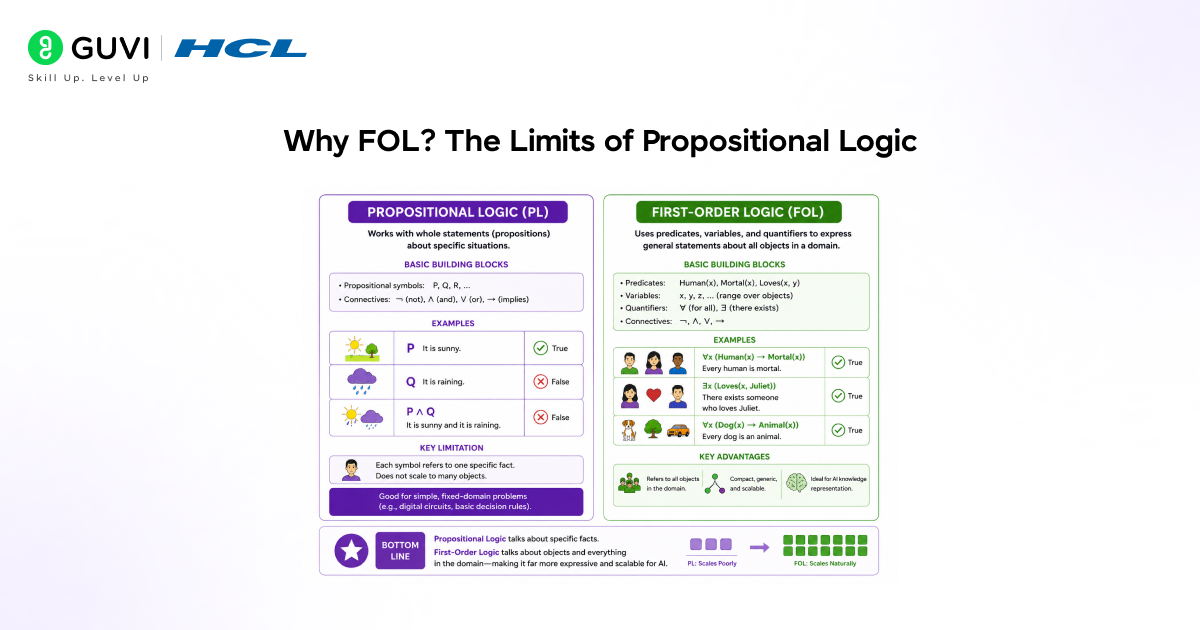
To understand why FOL is necessary, it helps to understand what propositional logic cannot do.
Propositional Logic and Its Ceiling
Propositional logic represents facts as atomic proposition statements that are either true or false and combines them using logical connectives: AND (∧), OR (∨), NOT (¬), implies (→), and biconditional (↔).
Propositional logic is complete and decidable, but it has a critical limitation: it cannot express generalizations. To say “all humans are mortal” in propositional logic, you would need a separate proposition for every individual human. With seven billion humans, this requires seven billion propositions, and the system still cannot handle any new individual not listed explicitly.
This is propositional logic’s fundamental ceiling: it represents specific facts about specific objects, but cannot express general rules about classes of objects.
What FOL Adds
First-order logic solves this by introducing:
- Predicates: Relations and properties that apply to objects Human(x), Mortal(x), Loves(x, y).
- Variables: Placeholders that range over objects in the domain x, y, z.
- Quantifiers: Operators that state how widely a predicate applies ∀ (for all) and ∃ (there exists).
- Constants: Specific named objects in the domain Socrates, Paris, 42.
- Functions: Mappings from objects to objects FatherOf(x), CapitalOf(Country).
With these additions, “all humans are mortal” becomes a single sentence: ∀x Human(x) → Mortal(x). This one sentence applies to every individual in the domain, past, present, and future, without listing them explicitly.
Core Components of First-Order Logic
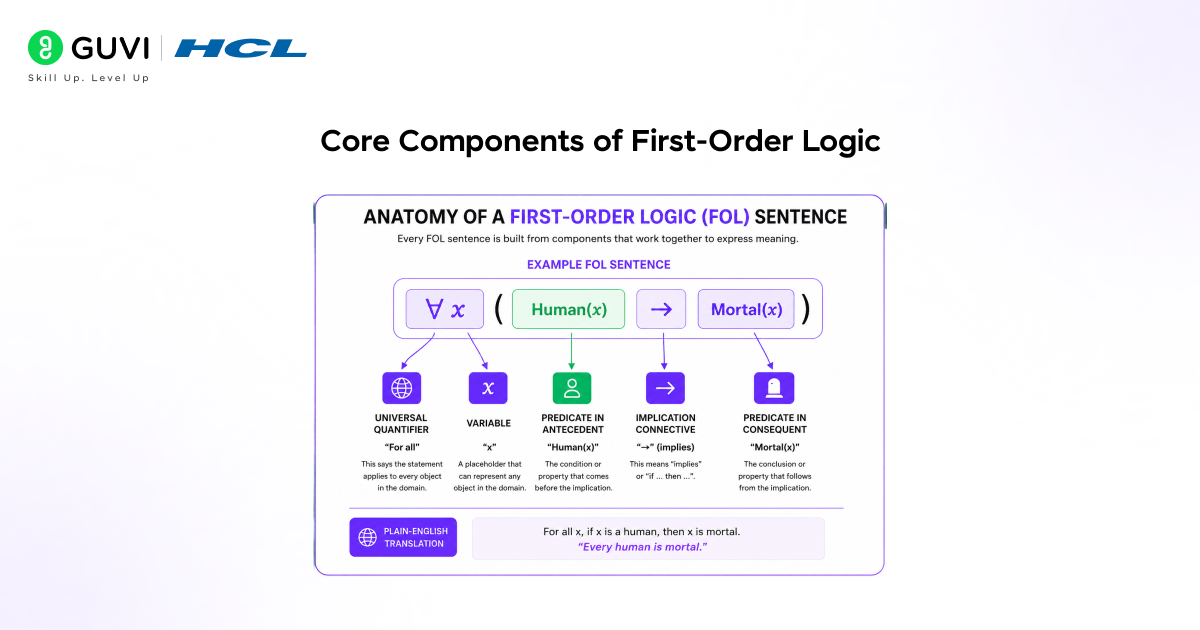
A first-order logic sentence is composed of terms and formulas. Understanding each component is the foundation for reading, writing, and reasoning in FOL.
Terms
Terms are the objects that FOL sentences are about. There are three types:
• Constants: Named, specific objects in the domain. Socrates, London, 7.
• Variables: Placeholders for unspecified objects, typically written in lowercase: x, y, z.
• Functions: Expressions that map one or more terms to an object: MotherOf(Alice), Add(3, 4).
Predicates (Atomic Formulas)
Predicates express properties of or relations between terms. An atomic formula is a predicate applied to one or more terms:
Human(Socrates) → “Socrates is human.”
Loves(Romeo, Juliet) → “Romeo loves Juliet”
GreaterThan(7, 3) → “7 is greater than .3”
Predicates have an arity, ty the number of arguments they take. Humans have arity 1 (a property). Loves has arity 2 (a relation between two objects). Predicates evaluate to true or false for any given combination of arguments.
Logical Connectives
FOL inherits the logical connectives of propositional logic:
- ¬ (NOT): Negation ¬Human(x) means “x is not human”.
- ∧ (AND): Conjunction Human(x) ∧ Greek(x) means “x is human and Greek”.
- ∨ (OR): Disjunction Student(x) ∨ Teacher(x) means “x is a student or a teacher”.
- → (IMPLIES): Implication Human(x) → Mortal(x) means “if x is human, then x is mortal”.
- ↔ (IFF): Biconditional Bachelor(x) ↔ (Male(x) ∧ Unmarried(x)) means “x is a bachelor if and only if x is male and unmarried”.
Quantifiers: The Heart of First-Order Logic
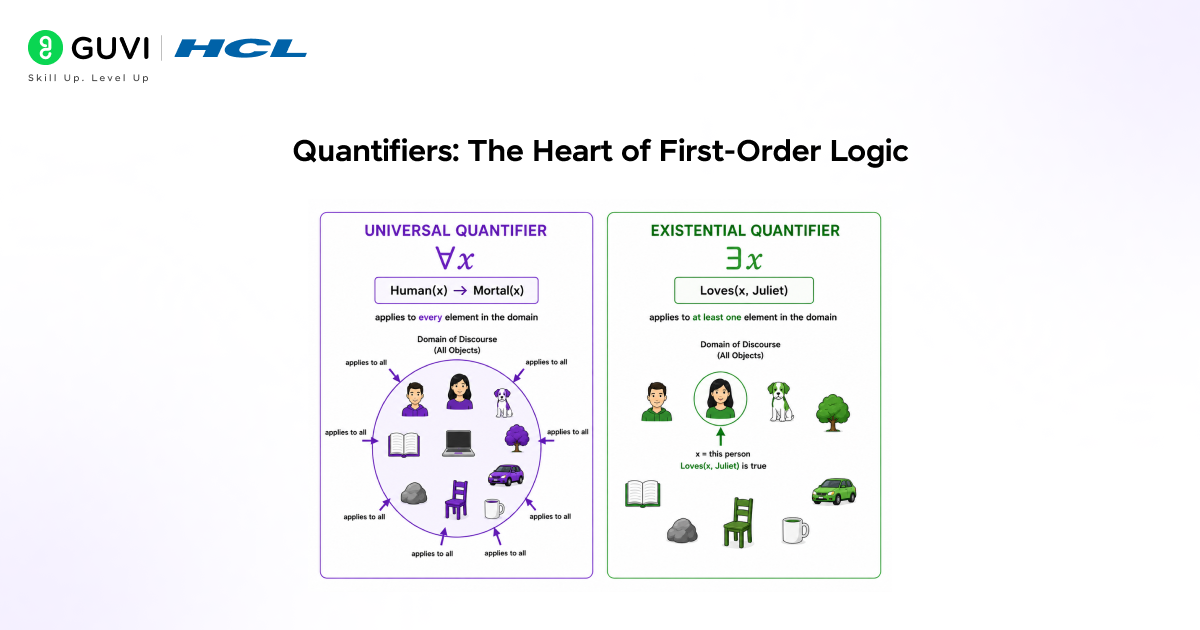
Quantifiers are what fundamentally distinguish first-order logic from propositional logic. They allow FOL sentences to make statements about all objects in a domain or about at least one object without naming them individually.
The Universal Quantifier (∀)
The universal quantifier ∀x (“for all x”) states that the formula that follows holds for every object in the domain. It is typically used with implication to express general rules:
∀x Human(x) → Mortal(x)
This reads: “For every x, if x is human, then x is mortal.” This single sentence encodes a general rule that applies to every individual in the domain, past, present, and future, without listing them.
Combining universal quantifiers: ∀x ∀y Loves(x, y) states that every object loves every other object. This can also be written ∀x, y Loves(x, y).
The Existential Quantifier (∃)
The existential quantifier ∃x (“there exists an x”) states that the formula that follows holds for at least one object in the domain. It is typically used with a conjunction to express existence claims:
∃x Human(x) ∧ Philosopher(x)
This reads: “There exists at least one x such that x is human and x is a philosopher.” It asserts the existence of a philosopher without naming them.
Nested Quantifiers and Scope
Quantifiers can be nested, and their order matters. The scope of a quantifier is the part of the formula it governs. Consider:
∀x ∃y Loves(x, y) → “Everyone loves someone”
∃y ∀x Loves(x, y) → “Someone is loved by everyone”
These are logically different statements. The first says each person has at least one person they love (the loved person may vary). The second says there is one specific person whom everyone loves. Quantifier order is a frequent source of errors in FOL and must be interpreted carefully.
First-Order Logic (FOL) was formalized during the late 19th and early 20th centuries through the work of pioneering logicians such as Gottlob Frege, Giuseppe Peano, and Bertrand Russell. Their goal was part of the ambitious logicist program, which sought to express all of mathematics using precise formal logic. Today, First-Order Logic remains one of the most influential knowledge representation systems in artificial intelligence, computer science, and mathematical reasoning, providing a powerful framework for representing facts, relationships, and logical inference.
Knowledge Representation in FOL
The primary purpose of FOL in AI is knowledge representation, encoding what an AI system knows about a domain in a form that supports automated reasoning. A collection of FOL sentences representing the knowledge of a domain is called a knowledge base (KB).
Representing Facts
Specific facts about named individuals are represented as ground atomic formulas predicates applied to constants, with no variables:
Human(Socrates)
Greek(Socrates)
Teacher(Socrates, Plato)
Representing Rules
General rules that apply across classes of objects are represented using universally quantified implications:
∀x Human(x) → Mortal(x)
∀x ∀y (Teacher(x, y) → Knows(y, x))
Representing Definitions
Biconditionals capture definitions — necessary and sufficient conditions:
∀x Bachelor(x) ↔ (Male(x) ∧ Unmarried(x) ∧ Adult(x))
A well-designed knowledge base contains facts, rules, and definitions that together capture the essential structure of the domain. Building such a knowledge base — knowledge engineering — is a significant intellectual task that requires deep domain expertise and careful formalization.
Inference in FOL: Deriving New Knowledge
A knowledge base is useful only if an AI can conclude it. FOL provides a set of inference rules and formal procedures that derive new true sentences from existing ones. Two foundational mechanisms are universal instantiation and resolution.
Universal Instantiation and Modus Ponens
Universal Instantiation allows any universally quantified variable to be replaced by a specific constant from the domain. Combined with Modus Ponens, this produces specific conclusions from general rules:
1. Given: ∀x Human(x) → Mortal(x)
2. Given: Human(Socrates)
3. Apply Universal Instantiation: Human(Socrates) → Mortal(Socrates)
4. Apply Modus Ponens: Mortal(Socrates)
This is the fundamental reasoning pattern: a general rule plus a specific fact produces a specific conclusion. It is how AI inference engines derive new knowledge from a knowledge base.

Unification
Unification is the process of finding a substitution, a mapping from variables to terms that makes two FOL expressions identical. It is the mechanism that allows general rules to be applied to specific situations.
For example, to apply ∀x Human(x) → Mortal(x) to Socrates, the unification algorithm finds the substitution {x/Socrates} that makes Human(x) match Human(Socrates). Unification is a key sub-process in both resolution and backward chaining.
Resolution in AI
Resolution is the complete and sound inference rule that underpins automated theorem proving and logic programming. It operates on clauses, disjunctions of literals, and derives new clauses by cancelling complementary literals.
Given two clauses:
Clause 1: ¬Human(x) ∨ Mortal(x) (from Human(x) → Mortal(x))
Clause 2: Human(Socrates)
Resolution cancels the complementary literals Human(Socrates) and ¬Human(x) (with substitution x/Socrates) to produce:
Mortal(Socrates)
Resolution is the inference rule used in automated theorem provers and logic programming systems. It is refutation-complete if a set of clauses is unsatisfiable; resolution will always discover this fact. Combined with unification, it provides a decision procedure for a large and practically useful subset of FOL.
Horn Clauses and Logic Programming
Full FOL is semi-decidable: while valid inferences can always be proved given enough time, the inference procedure may not terminate for invalid queries. For practical AI applications, a computationally tractable subset is needed.
What Are Horn Clauses?
A Horn clause is a clause with at most one positive literal. In practical terms, Horn clauses correspond to:
- Facts: Single positive literals with no variables. Human(Socrates).
- Rules: A single positive conclusion implied by one or more positive conditions. Mortal(x) ← Human(x). (“x is mortal if x is human”)
- Goals/queries: Negative clauses representing what the system is trying to prove.
The restriction to Horn clauses makes inference decidable and efficient. Resolution on Horn clauses terminates and is linear in the number of inference steps, compared to the exponential complexity of full FOL resolution.
Prologue and Backward Chaining
Prologue is the most widely used logic programming language, built directly on Horn clause FOL with resolution-based inference. In Prologue:
- Facts and rules are entered into a knowledge base.
- Queries are posed as goals to be proved.
- The inference engine uses backward chaining, starting from the goal and working backward to find facts that satisfy it with depth-first search and unification.
Backward chaining is well-suited for question-answering: given a goal, the system identifies which rules could prove it, then recursively tries to prove the premises of those rules. This goal-directed approach focuses inference on what is relevant to the query rather than deriving all possible conclusions.
Forward Chaining
Forward chaining takes the opposite approach: starting from known facts and applying rules to derive all possible conclusions, until the goal is reached or no new facts can be derived. It is the approach used in production rule systems and many expert systems. Forward chaining is data-driven, where new facts trigger rule applications, which may generate more facts, propagating through the knowledge base until no further inferences are possible.
FOL in Modern AI Applications
Although deep learning has become the dominant paradigm in AI, first-order logic and its computational implementations remain essential in domains requiring explainability, formal guarantees, and structured reasoning.
Expert Systems and Knowledge-Based AI
Classical expert systems such as MYCIN (medical diagnosis), DENDRAL (chemical structure analysis), and CLIPS-based industrial systems encode domain expertise as FOL rules and facts in a knowledge base. An inference engine applies these rules to patient data, sensor readings, or case information to produce diagnoses, recommendations, or decisions with traceable reasoning chains.
Semantic Web and Ontologies
The Semantic Web uses OWL (Web Ontology Language), a formal language grounded in description logics, a decidable fragment of FOL, to define ontologies: structured knowledge bases that describe classes, properties, and relationships in a domain. These ontologies enable automated reasoning over linked data on the web, powering applications in healthcare (SNOMED CT, ICD-10), life sciences (Gene Ontology), and enterprise knowledge management.
Formal Verification
Safety-critical software and hardware systems in aviation, medical devices, and autonomous vehicles use formal verification tools that express system specifications and correctness properties in FOL and related logics. Automated theorem provers verify that a system meets its specification by constructing formal proofs providing mathematical guarantees that no amount of testing can match.
Natural Language Understanding
Semantic parsing systems translate natural language sentences into FOL representations, enabling precise reasoning over the meaning of text. A sentence like “Every student who passed the exam will graduate” can be parsed into: ∀x (Student(x) ∧ Passed(x, Exam)) → WillGraduate(x), a representation that supports logical inference rather than statistical pattern matching.
If you want practical experience working with activation functions, neural networks, and deep learning models, HCL GUVI’s AI and ML programs can help you understand how concepts like sigmoid, backpropagation, and gradient descent are implemented using frameworks such as TensorFlow and PyTorch through hands-on projects.
Conclusion
First-order logic is one of the most powerful and enduring formalisms in artificial intelligence. By combining predicates, variables, quantifiers, and inference rules into a unified framework, FOL provides the expressive power needed to represent general knowledge about the world and the formal machinery needed to derive new conclusions from it.
From the classical expert systems of the 1970s to modern semantic web ontologies, formal verification tools, and neurosymbolic AI architectures that combine FOL with deep learning, first-order logic continues to play an indispensable role wherever AI must reason rigorously, explain its conclusions, or operate under formal correctness guarantees.
Understanding FOL is understanding the logical foundation of knowledge-based AI. Its concepts, predicates, quantifiers, unification, resolution, Horn clauses, and inference appear across logic programming, automated planning, semantic web technologies, and the hybrid AI systems being developed today. For anyone serious about artificial intelligence, first-order logic is not just historical background; it is active, foundational knowledge.
FAQs
1. What is the difference between FOL and propositional logic?
Propositional logic represents facts as atomic true/false propositions and cannot express generalizations. FOL adds predicates, variables, and quantifiers,s enabling general rules like “all humans are mortal” that apply to every object in a domain without listing them individually.
2. What is the difference between ∀ and ∃ in FOL?
The universal quantifier ∀x states that the formula holds for every object in the domain. The existential quantifier ∃x states that the formula holds for at least one object. Their order in nested statements matters: ∀x ∃y Loves(x, y) (everyone loves someone) differs from ∃y ∀x Loves(x, y) (someone is loved by everyone).
3. What are Horn clauses, e,s, and why are they important in AI?
Horn clauses are FOL clauses with at most one positive literal, corresponding to facts and if-then rules. They are important because inference over Horn clauses is computationally tractable and decidable, forming the basis of logic programming languages like Prologue and production rule systems used in expert systems.
4. What is resolution in first-order logic?
Resolution is a complete and sound inference rule that derives new clauses by cancelling complementary literals between existing clauses. Combined with unification, it allows automated theorem provers to systematically determine whether a conclusion follows from a set of FOL sentences, underpinning both logic programming and formal verification.
5. Is first-order logic still relevant in modern deep learning?
Yes. FOL remains essential in domains requiring explainable reasoning, formal correctness guarantees, and structured knowledge, including expert systems, semantic web ontologies, formal software verification, and neurosymbolic AI that combines logical reasoning with neural network learning.
Success Stories

About the Author
Vishalini Devarajan
An Aerospace Engineer turned content writer, I focus on making complex concepts easy to understand through well-structured, reader-friendly blogs. Whether it’s a technical topic or a non-technical one, I love creating content that is clear, engaging, and impactful.
View all posts by Vishalini Devarajan
Connect with me @
















Did you enjoy this article?