


Artificial Intelligence and Machine Learning Articles
AI/ML Skills Gap 2026: Why Companies Can't Find Job-Ready Talent
20 AI/ML Interview Questions Recruiters Can Use Without a Tech Background - Best Guide
How Industry-Backed AI/ML Bootcamps Are Changing the AI/ML Hiring Pipeline - Best Guide 2026
From IT Support to AI Engineer: A Realistic Career Switch Guide 2026

Get In Touch For Details! Request More Information
Propositional Logic in AI: The Formal Foundation of Machine Reasoning
Aug 18, 2026 7 Min Read 942 Views
(Last Updated)
Intelligent behaviour requires the ability to reason. Before a machine can solve problems, make decisions, or understand language, it needs a structured way to represent what it knows and derive what follows from that knowledge.
Propositional Logic provides exactly that structure. As the most fundamental layer of AI logic systems, it defines how facts are expressed, how they are combined using logical connectives, and how inference rules allow new truths to be derived from existing ones. Every more advanced AI reasoning framework, from predicate logic to Bayesian networks, is built on top of the principles that propositional calculus establishes.
In this article, we explore how Propositional Logic works, what makes it central to knowledge representation in artificial intelligence, how truth tables and inference rules operate in practice, and where its boundaries lie.
Table of contents
- TL;DR
- What Is a Proposition? The Basic Unit of Propositional Logic
- Examples of Valid Propositions
- Non-Propositions
- Logical Connectives: Building Complex Statements from Simple Propositions
- The Five Core Logical Connectives
- Truth Tables: Mapping Every Logical Possibility
- Why Truth Tables Matter in AI Logic Systems
- The Implication Edge Case
- Tautologies, Contradictions, and Contingencies
- Inference Rules: How AI Systems Derive New Knowledge
- The Core Inference Rules of Propositional Logic
- Knowledge Representation Using Propositional Logic in AI
- A Practical Example: Medical Diagnosis System
- Forward Chaining vs. Backward Chaining
- Propositional Logic vs. Predicate Logic: Understanding the Boundary
- What Propositional Logic Can Represent
- What Propositional Logic Cannot Represent
- Real-World Applications of Propositional Logic in Artificial Intelligence
- Limitations of Propositional Logic You Should Understand
- Conclusion
- FAQs
- What is the difference between Propositional Logic and Predicate Logic?
- What are inference rules, and why do they matter in AI?
- How do truth tables relate to AI decision making?
- Can Propositional Logic handle uncertainty or probability?
- Where is Propositional Logic still used in modern AI systems?
TL;DR
- Propositional Logic represents facts as true-or-false statements called propositions.
- Logical connectives (AND, OR, NOT, IMPLIES, BICONDITIONAL) combine propositions into compound statements.
- Truth tables define the exact output of any logical expression for every possible input combination.
- Inference rules like Modus Ponens allow AI systems to derive new facts from known ones.
- Propositional Logic is the foundational layer of knowledge representation and symbolic reasoning in AI.
What Is Propositional Logic in AI?
Propositional Logic, also known as propositional calculus or Boolean logic, is the simplest formal system for representing and reasoning about knowledge in artificial intelligence. It uses declarative statements called propositions, along with logical connectives and inference rules, to help AI systems derive conclusions from known facts. It forms the foundation of symbolic reasoning and knowledge representation across many AI logic systems.
What Is a Proposition? The Basic Unit of Propositional Logic
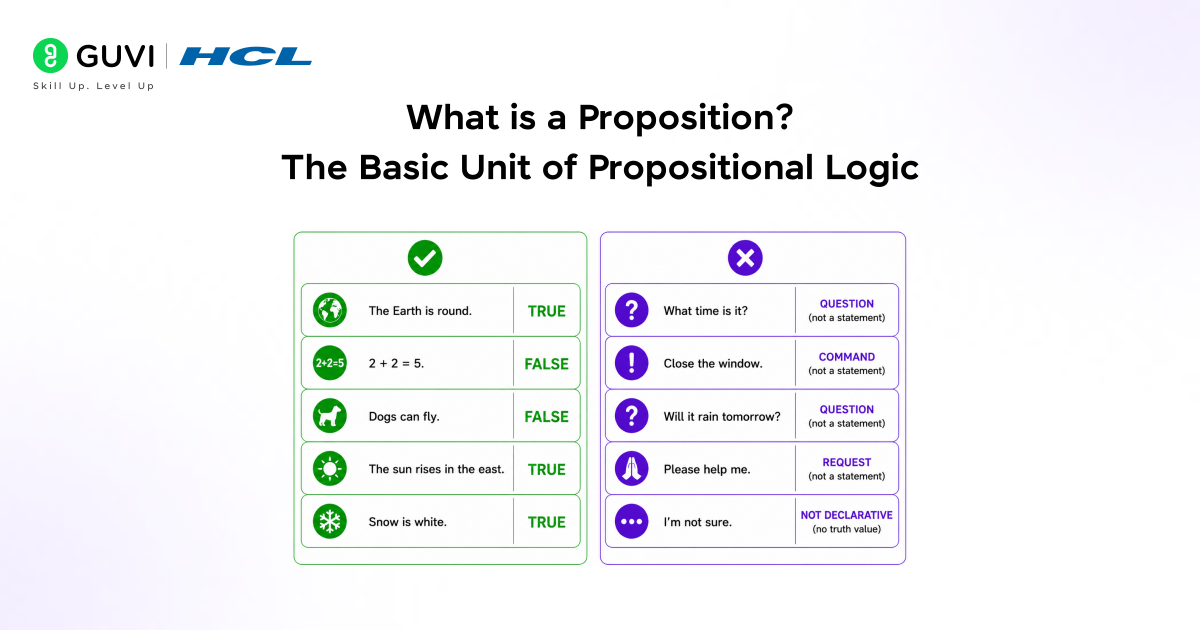
A proposition is a declarative statement that is either definitively true or definitively false, never both, never neither. This binary nature is what makes propositional calculus compatible with digital computation, which operates on the same true/false, 1/0 foundation of Boolean logic.
Examples of Valid Propositions
• “The temperature is above 30°C.” is definitely true or false at a given moment.
• “The system has detected an intrusion.” true or false based on sensor data.
• “File X exists in the database.” is a verifiable binary fact.
Non-Propositions
• Questions: “What is the temperature?” is not a declarative statement.
• Commands: “Increase the temperature.” is an instruction, not a truth claim.
• Opinions without verifiable grounding: “This design is beautiful.” not binary.
In AI logic systems, propositions are typically represented by symbolic variables: P, Q, R, or more descriptive labels like IsRaining, HasPower, SystemOnline. Each variable holds exactly one truth value at any given point in the reasoning process.
Logical Connectives: Building Complex Statements from Simple Propositions
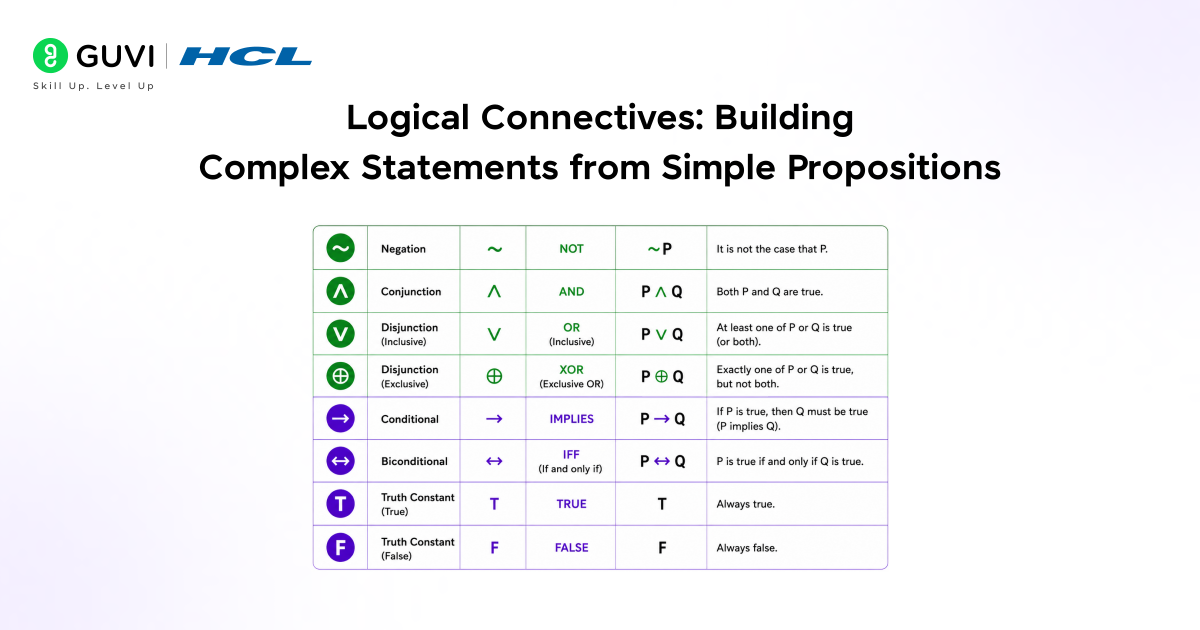
Individual propositions are the atoms of Propositional Logic. Logical connectives are the operators that combine those atoms into compound statements, as the molecular structures of knowledge representation. Understanding how each connective behaves is essential to building correct AI reasoning systems.
The Five Core Logical Connectives
1. Negation (NOT) — ¬P
Negation inverts the truth value of a proposition. If P is true, ¬P is false. If P is false, ¬P is true. In AI systems, negation models the absence of a condition or the opposite of a known fact.
Example: If P = “The sensor is active”, then ¬P = “The sensor is not active.”
2. Conjunction (AND) — P ∧ Q
A conjunction is true only when both propositions are true simultaneously. A single false component makes the entire conjunction false. These models have conditions that must all be satisfied together.
Example: “The door is locked, and the alarm is active” — both must hold for the compound statement to be true.
3. Disjunction (OR) — P ∨ Q
Disjunction is true when at least one of the propositions is true. It is false only when both propositions are false. This model’s alternative conditions or fallback logic in AI systems.
Example: “The backup is running, or the primary system is online,” at least one must hold.
4. Implication (IF…THEN) — P → Q
Implication — also called material conditional — is the most important connective for inference in AI. It is false only when P is true, and Q is false. In all other cases, the implication holds. This model’s rules: if a condition is met, a consequence follows.
Example: “IF the temperature exceeds 80°C THEN the cooling system activates.”
5. Biconditional (IF AND ONLY IF) — P ↔ Q
A biconditional is true when both propositions have the same truth value — both true or both false. It models mutual dependency: P is true exactly when Q is true, and false exactly when Q is false.
Example: “The system is in safe mode IF AND ONLY IF all error flags are cleared.”
Truth Tables: Mapping Every Logical Possibility
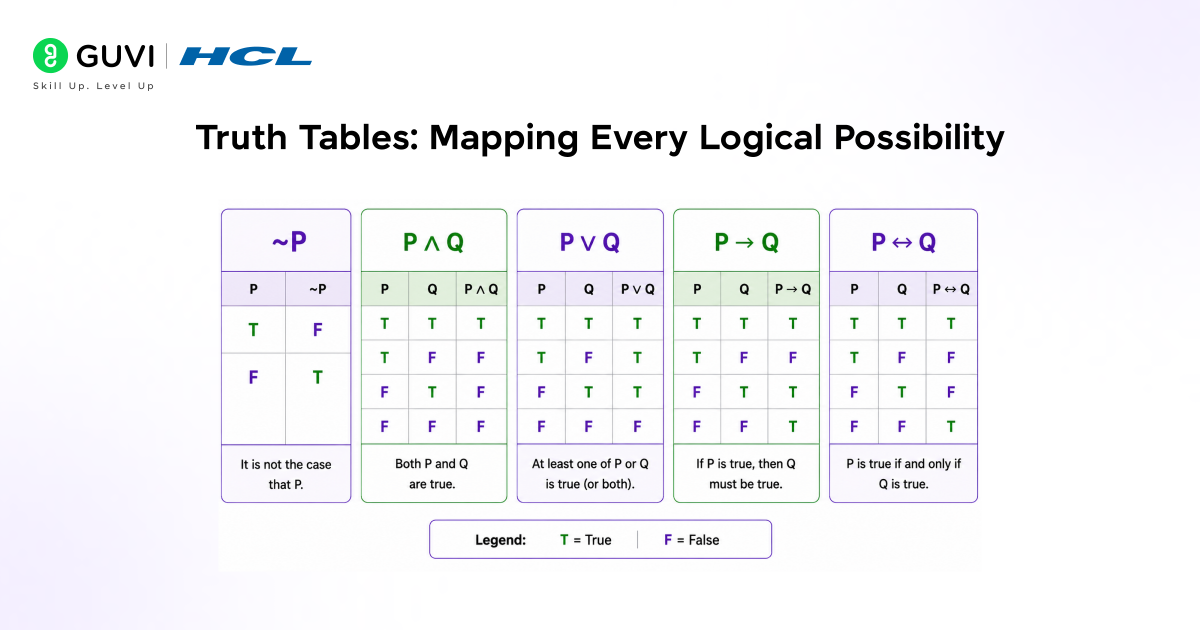
A truth table is a systematic grid that lists every possible combination of truth values for a set of propositions and shows the resulting truth value of a compound expression for each combination. Truth tables are the foundational verification tool of propositional calculus; they leave nothing to interpretation.
Why Truth Tables Matter in AI Logic Systems
- They allow designers to verify that a logical rule produces the correct output for every possible input state.
- They expose hidden edge cases, particularly the counterintuitive behaviour of implication when P is false.
- They serve as the mathematical proof that two logical expressions are equivalent, enabling simplification.
- They underpin the construction of digital circuits, expert system rules, and constraint satisfaction logic.
The Implication Edge Case
The most frequently misunderstood entry in any truth table is implication when P is false. If P is false, the implication P → Q is true regardless of whether Q is true or false. This is called vacuous truth.
In practical AI terms: if the condition that triggers a rule is never met, the rule is considered satisfied by default. An AI rule that says “IF the sensor fails THEN alert the operator” is not violated simply because the sensor has not failed; the implication holds vacuously.
Tautologies, Contradictions, and Contingencies
- Tautology: A formula that is true under every possible assignment of truth values. Example: P ∨ ¬P (the Law of Excluded Middle). Always true regardless of what P is.
- Contradiction: A formula that is false under every possible assignment. Example: P ∧ ¬P. P cannot be simultaneously true and false.
- Contingency: A formula whose truth value depends on the truth values of its component propositions, true in some cases, false in others.
Inference Rules: How AI Systems Derive New Knowledge
Truth tables verify logical relationships exhaustively. Inference rules are the mechanisms by which AI logic systems derive new knowledge from what is already known without checking every possible truth value combination from scratch. They are the engine of symbolic reasoning.
The Core Inference Rules of Propositional Logic
1. Modus Ponens (Affirming the Antecedent)
If P → Q is known, and P is known to be true, then Q must be true.
Example: IF the fire alarm sounds THEN evacuate the building. The alarm sounds. Therefore: evacuate.
Modus Ponens is the most widely used inference rule in AI expert systems and rule-based engines. It is the forward-chaining backbone of diagnostic systems, recommendation engines, and automated decision trees.
2. Modus Tollens (Denying the Consequent)
If P → Q is known, and Q is known to be false, then P must be false.
Example: IF the system is online THEN the dashboard is accessible. The dashboard is inaccessible. Therefore, the system is not online.
Modus Ponens is fundamental to backward-chaining AI systems, those that start from a goal and work backwards to determine which conditions must not hold.
3. Hypothetical Syllogism (Chain Rule)
If P → Q and Q → R are both known, then P → R can be concluded.
Example: IF disk is full THEN writes fail. IF writes fail, then data is lost. Therefore: IF disk is full THEN data is lost.
4. Disjunctive Syllogism (Process of Elimination)
If P ∨ Q is known, and P is known to be false, then Q must be true.
Example: Either the hardware failed, or the software crashed. The hardware is intact. Therefore, the software crashed.
5. Conjunction Introduction
If P is known and Q is known separately, then P ∧ Q can be asserted.
This rule is used in AI knowledge bases to combine independently verified facts into a unified compound statement that can then trigger further rules.
Knowledge Representation Using Propositional Logic in AI
One of the primary applications of Propositional Logic in artificial intelligence is encoding domain knowledge into a form that a reasoning engine can operate on. This is the discipline of knowledge representation, translating real-world facts and rules into formal logical statements.
A Practical Example: Medical Diagnosis System
Consider a simplified medical expert system. The following knowledge base is encoded in Propositional Logic:
• F = “Patient has a fever”
• C = “Patient has a cough”
• S = “Patient has a sore throat”

• I = “Patient likely has an infection”
• R = “Recommend antibiotic treatment”
Rules:
• F ∧ C → I (fever and cough together suggest infection)
• I ∧ S → R (infection with sore throat triggers antibiotic recommendation)
If the system observes F = true, C = true, and S = true, it applies Modus Ponens twice to derive R = true. The recommendation is generated automatically from the encoded knowledge — no human reasoning required at inference time.
Forward Chaining vs. Backward Chaining
- Forward chaining: Starts from known facts and applies inference rules to derive new conclusions until a goal is reached. Used in monitoring and alerting systems.
- Backward chaining: Starts from a goal and works backwards to determine which facts must be true for the goal to hold. Used in diagnostic and planning systems.
Both strategies rely on the same core propositional calculus; they differ only in the direction of reasoning.
The MYCIN expert system, developed at Stanford University in the 1970s, was designed to diagnose serious blood infections.
It encoded more than 600 medical rules using logic structures closely related to Propositional Logic.
In controlled evaluations, MYCIN performed at a level comparable to—and sometimes better than—human specialists, making it one of the earliest examples of AI systems achieving expert-level decision making.
Propositional Logic vs. Predicate Logic: Understanding the Boundary
A common point of confusion is where Propositional Logic ends and predicate logic, also called first-order logic, begins. Understanding this boundary clarifies what propositional calculus can and cannot represent.
What Propositional Logic Can Represent
• Fixed, named facts: “Server A is online.” “Sensor 3 has failed.”
• Rules connecting named facts: “IF server A is online THEN service B is available.”
• Logical relationships between a finite, predefined set of propositions.
What Propositional Logic Cannot Represent
- Generalizations over sets: “All sensors in zone 2 have failed.” requires quantifiers.
- Relationships between objects: “Sensor X is adjacent to Sensor Y,” requires variables and predicates.
- Statements about categories: “Every patient with a fever should be monitored.” Propositional logic requires a separate proposition for every individual patient.
When AI systems need to reason about objects, categories, and relationships, not just named facts,s predicate logic with its quantifiers (∀ for all, ∃ there exists) and variable-binding is required. Propositional Logic is expressive and powerful within its domain, but it is the foundation layer, not the complete structure.
Real-World Applications of Propositional Logic in Artificial Intelligence
Despite its relative simplicity compared to more expressive logic systems, Propositional Logic powers a wide range of real-world AI applications where the domain of interest can be modelled with finite, binary facts.
- Hardware Circuit Design: Digital logic circuits are direct physical implementations of propositional calculus. AND gates, OR gates, and NOT gates implement the three primitive connectives. Every processor executes Boolean logic at the hardware level.
- SAT Solvers: Satisfiability (SAT) solvers determine whether a propositional formula has any assignment of truth values that makes it true. They are used in hardware verification, software model checking, planning, and cryptographic analysis.
- Expert Systems and Rule Engines: Business rule management systems and medical expert systems encode domain expertise as propositional rules and apply forward or backward chaining to automate decision making.
- Constraint Satisfaction Problems: Problems like scheduling, configuration, and planning can be encoded as propositional satisfiability problems and solved using efficient SAT solver algorithms.
- Game AI and Puzzle Solving: Logic puzzles, planning problems in game environments, and state-transition modelling can all be expressed and solved using propositional logic and its inference machinery.
Limitations of Propositional Logic You Should Understand
Propositional Logic is a powerful foundation, but every AI practitioner needs to understand where it reaches its limits.
- Limited expressiveness: It cannot represent generalizations, quantification over objects, or relationships between entities. Real-world reasoning almost always requires predicate logic or richer formalisms.
- Scalability challenges: With n propositions, truth tables have 2^n rows. For large knowledge bases with hundreds or thousands of propositions, exhaustive truth table verification becomes computationally intractable.
- No handling of uncertainty: Propositional Logic is strictly binary; every statement is true or false. It cannot represent degrees of belief, probability, or uncertainty. For probabilistic reasoning, frameworks like Bayesian networks are required.
- No temporal reasoning: Standard propositional calculus has no built-in concept of time. Statements that change truth value over time require extensions like temporal logic.
- Knowledge engineering is labour-intensive: Manually encoding large knowledge bases as propositional rules is time-consuming and error-prone. Machine learning approaches can extract patterns from data without requiring manual rule specification.
If you want to learn more about building skills for Claude Code and automating your procedural knowledge, do not miss the chance to enroll in HCL GUVI’s Intel & IITM Pravartak Certified Artificial Intelligence & Machine Learning courses. Endorsed with Intel certification, this course adds a globally recognized credential to your resume, a powerful edge that sets you apart in the competitive AI job market.
Conclusion
Propositional Logic is where AI reasoning begins. Its propositions, logical connectives, truth tables, and inference rules form the formal vocabulary that allows machines to represent knowledge and derive conclusions systematically. Before an AI system can reason about the world, it must first be able to express facts precisely, and Propositional Logic provides the most fundamental framework for doing exactly that.
From digital circuits executing Boolean logic at the hardware level to expert systems applying Modus Ponens to medical knowledge bases, from SAT solvers verifying software correctness to rule engines automating business decisions, propositional calculus is embedded in the infrastructure of modern artificial intelligence.
Its limitations are real. It cannot generalize, it cannot handle uncertainty, and it does not scale without care. But these limitations are not failures; they are the boundaries that define where more expressive formalisms begin. Understanding Propositional Logic deeply is not just academically useful. It is the essential first step toward understanding how any AI logic system thinks.
FAQs
1. What is the difference between Propositional Logic and Predicate Logic?
Propositional Logic deals with fixed, named propositions that are either true or false. Predicate logic extends this by introducing variables, predicates, and quantifiers (∀ for all, ∃ there exists), allowing generalizations over objects and categories. Propositional Logic is simpler and forms the foundation; predicate logic is more expressive and required for most real-world AI reasoning tasks.
2. What are inference rules, and why do they matter in AI?
Inference rules are formal mechanisms for deriving new true statements from known true statements. They allow AI systems to extend their knowledge base without re-evaluating every possible truth value combination. Rules like Modus Ponens (if P → Q and P, then Q) are the core reasoning engine of expert systems, rule-based engines, and symbolic AI systems.
3. How do truth tables relate to AI decision making?
Truth tables enumerate every possible combination of truth values for a set of propositions and show the resulting output of a logical expression. In AI, they verify that decision rules behave correctly under all possible conditions, expose edge cases (such as the vacuous truth of implication), and confirm the logical equivalence of different rule formulations.
4. Can Propositional Logic handle uncertainty or probability?
No. Propositional Logic is strictly binary; every proposition is either true or false. It has no native mechanism for representing degrees of belief, confidence levels, or probabilistic outcomes. For uncertainty-aware reasoning, AI systems use Bayesian networks, fuzzy logic, or probabilistic logic extensions built on top of the propositional framework.
5. Where is Propositional Logic still used in modern AI systems?
Propositional Logic remains foundational across multiple modern AI domains: SAT solvers underpin hardware and software verification; Boolean logic governs all digital circuit design; rule-based expert systems in medicine, law, and business use propositional rules; planning and constraint satisfaction problems are frequently encoded as satisfiability problems; and automated theorem provers use propositional calculus as a core reasoning layer.
Success Stories

About the Author
Vishalini Devarajan
An Aerospace Engineer turned content writer, I focus on making complex concepts easy to understand through well-structured, reader-friendly blogs. Whether it’s a technical topic or a non-technical one, I love creating content that is clear, engaging, and impactful.
View all posts by Vishalini Devarajan
Connect with me @







Did you enjoy this article?