


Career Articles
Best Full Stack Development Training Programs for Career Switchers
Best Full Stack Developer Courses for Working Professionals in India
From Manual Operations to Fullstack Development : A Career Transition Guide
How Can a Software Maintenance Engineer Move into Modern Application Development?

Get In Touch For Details! Request More Information
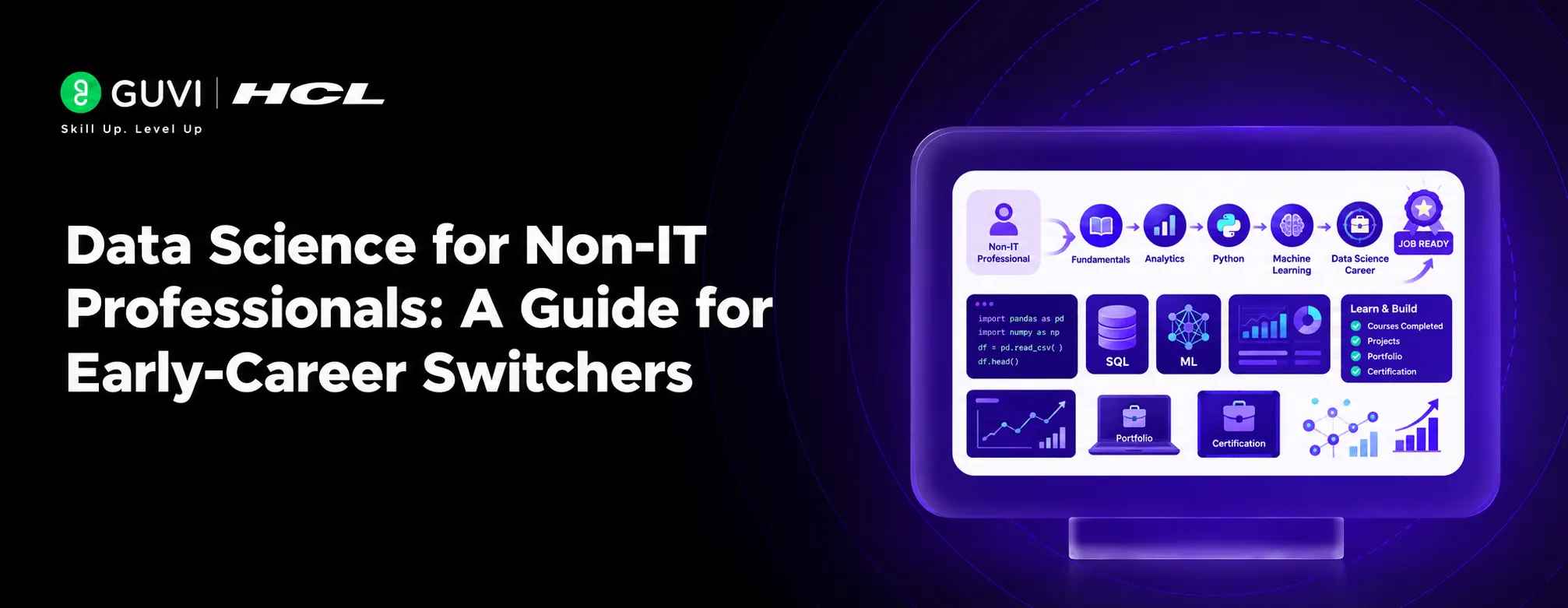
Data Science for Non-IT Professionals: A Guide for Early-Career Switchers
Nov 18, 2026 7 Min Read 41306 Views
(Last Updated)
Thinking about moving into Data Science but worried that your non-IT background will hold you back?
You may be early in your career, working in finance, sales, marketing, operations, or another non-tech role and wondering if making the switch is even realistic.
The answer is yes, but you will need to bridge some technical gaps. The advantage is that you aren’t necessarily starting from zero. Your experience with numbers, business problems, Excel, reporting, customer behaviour, or decision-making can give you a useful foundation. What you’ll need to add are skills such as Python, SQL, statistics, data visualization, and machine learning.
So, what does a move into Data Science for non-IT professionals actually look like? We’ll break down the skills you need, what you can learn over six months, the roles and salaries you can target, and what it realistically takes to make the transition.
Table of contents
- TL;DR:
- Can You Switch to Data Science From a Non-Tech Background?
- Build on what you already know
- Bridge the technical gap
- Prove your skills through projects
- Can You Get a Data Science Job Without Prior IT Experience?
- Can You Learn Data Science Without Coding Experience?
- What Skills Do You Need to Switch to Data Science?
- How Can You Switch to Data Science in 6 Months?
- Where Can You Learn and Practice Data Science for Non-IT Professionals?
- How Much Math Do You Need for Data Science for Non-IT Professionals?
- Which Skills From Your Current Career Can Help in Data Science?
- What Roles Can You Target After Switching to Data Science?
- Explore Our Learner's Journey From a Non-Tech Background to Data Science
- How Can You Build a Data Science Portfolio Without Prior Experience?
- Choose problems you already understand:
- Build 2-3 end-to-end projects
- Explain the business outcome
- Can Commerce Students Build a Career in Data Science?
- Final Thoughts
- Frequently Asked Questions
- Should I quit my current job before switching to Data Science?
- Will I have to take a pay cut when moving from non-IT to Data Science?
- Is it better to switch internally or apply to a new company for a Data Science role?
- Which industries are easier to target when switching to Data Science?
- Should early-career non-IT professionals choose Data Analytics before Data Science?
- How do I explain a non-tech background in a Data Science interview?
- Can a commerce graduate switch to Data Science without an IT degree?
TL;DR:
- Non-IT professionals can switch to Data Science without a Computer Science degree.
- Start with Python, SQL, statistics, visualization, and machine learning.
- A focused 6-month plan can help you build foundations, projects, and a portfolio.
- Your existing domain experience in finance, banking, marketing, sales or operations can be an advantage during the transition.
- Early-career switchers can explore roles such as Data Analyst, BI Analyst, Business Analyst, and Junior Data Scientist.
- Focus on practical projects and demonstrable skills, not just course completion.
Can You Switch to Data Science From a Non-Tech Background?
Yes. Moving from non-IT to Data Science is possible without going back for a Computer Science degree. The transition is mainly about identifying what you already bring to the table and building the technical skills you’re missing.
1. Build on what you already know
Experience in finance, marketing, sales, operations, or other business functions gives you domain knowledge and transferable skills such as analytical thinking, reporting, Excel, and problem-solving.
For example, a finance associate may already understand financial statements and transaction records, while an MIS Executive may have experience tracking business performance through Excel reports.
2. Bridge the technical gap
You don’t need a CS degree, but you will need to learn core Data Science skills such as Python, SQL, statistics, visualization, and eventually machine learning.
If you’ve primarily worked with Excel, start by understanding how Python and SQL can help you process and analyse larger datasets.
3. Prove your skills through projects
Since you may not have prior Data Science work experience, practical projects become especially important. They show employers that you can apply your new technical skills to real business problems.
For example, a marketing professional can build a customer segmentation project, while someone from banking can explore a loan risk analysis project.
Also, find out: Is Data Science A Good Career Choice In 2026?
Can You Get a Data Science Job Without Prior IT Experience?
Yes, you can apply for Data Science and analytics roles without previous IT employment, provided you can demonstrate the technical skills required for the position.
For early-career switchers, Data Analyst, BI Analyst and Business Analyst roles may be more accessible starting points, while Junior Data Scientist roles generally require stronger programming, statistics and machine learning knowledge.
Can You Learn Data Science Without Coding Experience?
Yes, you can learn Data Science without prior coding experience. However, you will need to learn programming as part of the transition.
Start with Python fundamentals, including variables, loops, functions and data structures, before moving on to libraries such as Pandas and NumPy. Regular coding practice and small projects will help you build confidence.
What Skills Do You Need to Switch to Data Science?
Building the right technical foundation is an important part of data science for non-IT professionals. You don’t need to learn every tool at once. Focus first on the core skills you’ll actually use, then build towards more advanced concepts.
- Python: Learn the fundamentals first, followed by libraries such as Pandas and NumPy for cleaning, manipulating, and analysing data. For example, you can use Python to analyse monthly sales records or financial transactions.
- SQL: You’ll need SQL to retrieve, filter, join, and analyse data stored in relational databases. This is particularly useful when working with customer records, transaction information or business databases.
- Statistics: Focus on practical concepts such as probability, distributions, hypothesis testing, correlation, and regression. These concepts help you identify patterns and understand relationships within datasets.
- Data visualization: Learn tools such as Power BI or Tableau and understand how to turn analysis into dashboards and clear business insights. You can use these tools to present campaign performance, financial trends or operational metrics.
- Machine learning: Once your foundations are strong, move into concepts such as regression, classification, clustering, model evaluation, and feature engineering.
- Business and communication skills: Don’t underestimate what you already know. Understanding business problems and explaining insights clearly can be particularly valuable when you’re moving from a non-tech role.
You might like: The Ultimate Beginner’s Guide to Data Science in Hindi
According to the World Economic Forum’s Future of Jobs Report 2025, AI and Big Data rank first among the fastest-growing skills employers expect to need by 2030. This makes learning data-related skills such as Python, SQL, statistics and data visualisation a valuable step for Gen Z students and early-career professionals preparing for technology-driven roles.
How Can You Switch to Data Science in 6 Months?
A successful career switch from non-IT to Data Science is possible in stages. You first build the foundations, then practise working with data, move into projects, and finally start preparing for relevant roles.
If you’re an early-career professional managing your current job alongside learning, here’s a six-month plan to help you make this transition step by step.
| Timeline | What to Learn | How to Learn & Practise | Your Goal |
| Month 1 | Python fundamentals + basic statistics | Follow a beginner Python course, practise small coding problems, and revise statistics using simple datasets | Analyse a basic CSV dataset using Python |
| Month 2 | SQL + Pandas + NumPy | Practise SQL queries regularly and use Pandas/NumPy to clean and manipulate datasets | Query, clean, and explore structured data independently |
| Month 3 | EDA + Power BI/Tableau | Download public datasets and practise finding patterns, creating charts, and building dashboards | Complete your first end-to-end EDA project |
| Month 4 | Machine learning fundamentals | Learn one concept at a time, then implement regression and classification models on datasets | Build and evaluate 2–3 basic ML models |
| Month 5 | Applied Data Science | Pick problems related to your existing field and build projects around them | Complete 1–2 portfolio-worthy projects |
| Month 6 | Portfolio + interview preparation | Polish your projects, document your approach, practise SQL/Python questions, update your resume, and begin applying | Have 2–3 strong projects you can confidently explain |
For example, if you’re working in finance, you can use financial datasets for your first analysis project. If you’re in marketing, try analysing customer behaviour or campaign performance. This helps you connect what you’re learning with the work you already understand.
Remember that six months is a suggested learning timeline, not a guaranteed job-transition period. Your progress will depend on your current knowledge, practice time and the technical requirements of the roles you’re targeting.
Where Can You Learn and Practice Data Science for Non-IT Professionals?
You don’t need expensive tools or dozens of resources to follow this plan. A few focused platforms are enough to start learning and applying the concepts.
- Build your foundations: Start with HCL GUVI’s Python tutorials and DBMS and SQL tutorials to strengthen your programming and database basics.
- Practice consistently: Use HCL GUVI CodeKata platform for regular coding practice. For hands-on Data Science work, Google Colab or Jupyter Notebook lets you write and test Python code, while Kaggle gives you access to real datasets for analysis and projects.
- Prefer a more structured path? If you’re comparing different ways to learn, there are several courses for beginners that cover the foundations in a structured sequence. HCL GUVI’s Complete Data Science Mastery Program brings the core concepts together in a shorter, guided learning format if you don’t want to piece together your learning entirely on your own.
How Much Math Do You Need for Data Science for Non-IT Professionals?
You don’t need advanced mathematics to start learning Data Science for non-IT professionals. What you do need is a working understanding of applied statistics and a few mathematical concepts that help you analyse data and understand how models work.
Focus on:
- Descriptive statistics and probability: Mean, variance, distributions, sampling, and probability.
- Hypothesis testing and regression: Useful for testing assumptions, identifying relationships, and making predictions.
- Basic linear algebra: Vectors and matrices, mainly to understand how machine learning models work with data.
- Applied calculus: Basic concepts such as derivatives and gradients. You don’t need to spend your time solving complex calculus problems by hand.
For example, if you’re working in sales, understanding averages and distributions can help you compare sales performance. If you’re in finance, probability and regression can help you understand risk and financial trends.
Which Skills From Your Current Career Can Help in Data Science?
A non-tech background to Data Science switch doesn’t mean leaving everything you’ve learned behind. Some of your existing experience can actually help you solve data problems in a business context.
| Previous Career | Existing Skills | How They Help in Data Science |
| Finance or accounting | Working with numbers, financial data, forecasting and identifying anomalies | Financial analysis, risk analysis and predictive modelling |
| Banking or KYC | Customer records, transaction monitoring and compliance processes | Customer risk analysis and transaction pattern identification |
| Marketing or sales | Customer behaviour, segmentation, campaign metrics and revenue trends | Customer analytics, campaign analysis and sales forecasting |
| Operations | Processes, KPIs, efficiency metrics and performance data | Operational analysis and demand forecasting |
| Commerce or economics | Statistical reasoning, business analysis, market trends and quantitative thinking | Business analytics and financial data analysis |
For instance, if you’ve worked as a Marketing Executive, you may already understand customer acquisition and conversion rates. These concepts can help you approach customer segmentation and predictive analytics projects more effectively.

The important thing is to connect your existing experience with the technical skills you’re developing.
What Roles Can You Target After Switching to Data Science?
Your first role after a career switch doesn’t necessarily have to be Data Scientist. As an early-career non-IT professional, the right entry point depends on your existing experience, transferable skills, and how far you’ve developed your technical skills.
| Role | Why It Can Work for a Career Switcher | Skills to Prioritize | Salary in India* |
| Data Analyst | A practical starting point if you’ve already worked with Excel, reports, business metrics, or numbers | Excel, SQL, Python, Power BI/Tableau, statistics | ₹₹6.4 – 7.1 LPA |
| Business Analyst | Can suit professionals who already understand business processes, customers, operations, or stakeholder requirements | Excel, SQL, data analysis, visualization, business communication | ₹ 9.5 – 10.5 LPA |
| BI Analyst | Worth exploring if you enjoy dashboards, reporting, and turning business data into usable insights | SQL, Power BI/Tableau, data modelling, Excel | ₹ 9.5 – 10.5LPA |
| Junior Data Scientist | A more technical transition that requires stronger programming, statistics, ML, and project experience | Python, SQL, statistics, machine learning, data visualization | ₹6.7–7.4 LPA |
These are broad India salary ranges reported by AmbitionBox across different experience levels, not starting salaries guaranteed to career switchers. Your offer can vary based on your previous experience, domain knowledge, technical skills, location, company, and the role you’re entering.
For example, an MIS professional with strong Excel and SQL skills may initially explore Data Analyst or BI Analyst positions. Someone with stronger programming, statistics and machine learning knowledge can consider Junior Data Scientist opportunities.
Explore Our Learner’s Journey From a Non-Tech Background to Data Science
A non-coding background doesn’t automatically rule out a career in Data Science. Panchal, for example, started without prior programming experience and learned the required programming skills with support from the HCL GUVI’s team before securing a role at Paripoorna Software Solution Service Pvt. Ltd.
His journey also reflects a common reality of switching from a non-tech to a tech career: the initial learning curve can be challenging, but consistent practice, technical skill-building, and the right guidance can make the transition possible.
Watch Panchal’s Data Science career journey
How Can You Build a Data Science Portfolio Without Prior Experience?
You don’t need previous Data Science employment to start building evidence of your skills. For a career switcher, a few well-developed projects can show recruiters how you approach data, solve problems, and communicate your findings.
1. Choose problems you already understand:
If you work in marketing, analyse campaign or customer data. If you’re in finance, try financial forecasting or risk analysis. If you’re in operations, explore process efficiency or workforce performance data.
Your existing domain knowledge can help you ask better questions of the data.
2. Build 2-3 end-to-end projects
Instead of filling your portfolio with basic notebooks, choose a few meaningful data science projects and take them through the complete process: cleaning the data, exploring it, building the analysis or model, and interpreting the results.
For example, you could build a sales forecasting project using Python or a customer segmentation project using clustering techniques.
3. Explain the business outcome
A project becomes much stronger when you can explain the problem you were solving, why you chose a particular approach, and how the resulting insights could be used.
Don’t just mention the tools you used. Explain what you discovered and what your findings mean for the business.
Can Commerce Students Build a Career in Data Science?
Yes. A commerce degree can provide a useful starting point for Data Science, particularly if you’ve studied subjects such as statistics, economics, accounting, finance, or quantitative techniques. You may also already be comfortable working with Excel, reports, business metrics, and numerical data.
The main gap is usually technical. Building skills in Python, SQL, data visualization, statistics, and machine learning can help you move beyond your commerce foundation and start working with data more technically.
Your commerce background can also be useful when working on Data Science problems in areas such as finance, banking, marketing, retail, customer analytics, and business intelligence, where understanding the business context matters alongside technical skills.
Also Read: How to Become a Data Scientist from Scratch
Final Thoughts
An early career switch to Data Science from a non-IT background is possible, but it takes more than learning a few tools. Breaking into the field would require a strong foundation in Python, SQL, statistics, and data visualization, followed by hands-on projects that show you can apply those skills to practical problems.
Your existing experience can also work in your favour. Knowledge of finance, marketing, sales, operations, commerce, or another domain gives you business context that technical skills alone cannot provide. The goal is to combine what you already know with the Data Science skills you’re building.
If you prefer a structured learning path, HCL GUVI’s Data Science Course and Generative AI course combine guided learning with hands-on projects and career support to help you prepare for some amazing early-transition opportunities.
Start with the skills you need, build projects you can confidently explain, and take your career shift one step at a time.
Frequently Asked Questions
1. Should I quit my current job before switching to Data Science?
Usually, you don’t need to leave your current role just to begin the transition. You can build technical skills and projects alongside your job and start exploring opportunities once you have enough practical work to demonstrate. Staying employed also gives you time to make the career switch to Data Science more deliberately.
2. Will I have to take a pay cut when moving from non-IT to Data Science?
Not necessarily. Your salary after moving from non-IT to Data Science can depend on your previous experience, domain knowledge, technical skills, target role, company, and location. A career switch doesn’t automatically mean that all of your previous professional experience becomes irrelevant.
3. Is it better to switch internally or apply to a new company for a Data Science role?
Both routes are possible. An internal move can be useful if your organisation has analytics or Data Science teams because you already understand its business and processes. External opportunities may give you a wider choice of roles, but you’ll need a strong portfolio and clear evidence of your new technical skills.
4. Which industries are easier to target when switching to Data Science?
Start by considering industries where your existing domain knowledge is useful. Someone from finance might explore fintech or banking analytics, while a marketing professional could look at customer or marketing analytics. This can make your data science career transition more connected to the experience you already have.
5. Should early-career non-IT professionals choose Data Analytics before Data Science?
Not necessarily, but Data Analytics can be a practical entry point for some early-career non-IT professionals, particularly if their existing work involves Excel, reporting, dashboards, or business metrics. You can later build stronger programming, statistics, and machine learning skills if you want to move towards more technical data science roles.
6. How do I explain a non-tech background in a Data Science interview?
Don’t treat your previous career as something you need to hide. Explain what prompted the transition, the technical skills you’ve developed, the projects you’ve completed, and how your previous domain experience helps you understand business problems. A clear transition story can connect your old experience with the Data Science role you’re targeting.
7. Can a commerce graduate switch to Data Science without an IT degree?
Yes. A commerce graduate can switch to Data Science without an IT or Computer Science degree. Your background in areas such as statistics, economics, finance, accounting, or business analysis can be useful, while technical skills such as Python, SQL, data visualization, and machine learning will need to be developed separately. Practical projects can then help demonstrate those skills to employers.
Success Stories

About the Author
Hashmithaa
Hi, I’m Hashmithaa — a content writer with a love for words. Writing isn’t just what I do; it’s how I connect, communicate, and create meaning in a noisy digital world. And if my words help someone make a better decision, learn something new, or feel more confident, then I’ve done my job well.
View all posts by Hashmithaa
Connect with me @












Did you enjoy this article?