


Artificial Intelligence and Machine Learning Articles
Finance Manager to Data Analytics: Career Growth, Salary and Seniority
How to Evaluate LLM Outputs in Production Deployments
AI/ML Skills Gap 2026: Why Companies Can't Find Job-Ready Talent
20 AI/ML Interview Questions Recruiters Can Use Without a Tech Background - Best Guide

Get In Touch For Details! Request More Information

Traditional ML vs GenAI: A Comprehensive Guide
Feb 20, 2026 5 Min Read 1706 Views
(Last Updated)
What if machines could both analyze data like statisticians and create content like humans? That question marks the shift from traditional machine learning to generative AI. The two approaches represent distinct yet complementary forms of intelligence, one focused on structured prediction and the other on creative synthesis.
Traditional ML extracts logic from data to predict outcomes, while GenAI builds upon that logic to produce new ideas, visuals, and text. Together, they outline how artificial intelligence has evolved from computation to creativity, redefining how industries innovate and make decisions.
Please read the full blog to explore Traditional ML vs GenAI, how they function, where they differ, and why their synergy defines the next chapter of intelligent systems.
Table of contents
- What is Traditional ML?
- Examples of Traditional ML
- What is GenAI?
- Examples of GenAI
- Top Benefits of Traditional ML
- Top Benefits of GenAI
- Step-by-Step Functioning of Traditional ML
- Step 1: Problem Definition and Objective Framing
- Step 2: Data Collection and Preparation
- Step 3: Feature Selection and Engineering
- Step 4: Model Selection and Training
- Step 5: Model Evaluation and Validation
- Step 6: Optimization and Fine-Tuning
- Step 7: Deployment and Monitoring
- Step-by-Step Functioning of GenAI
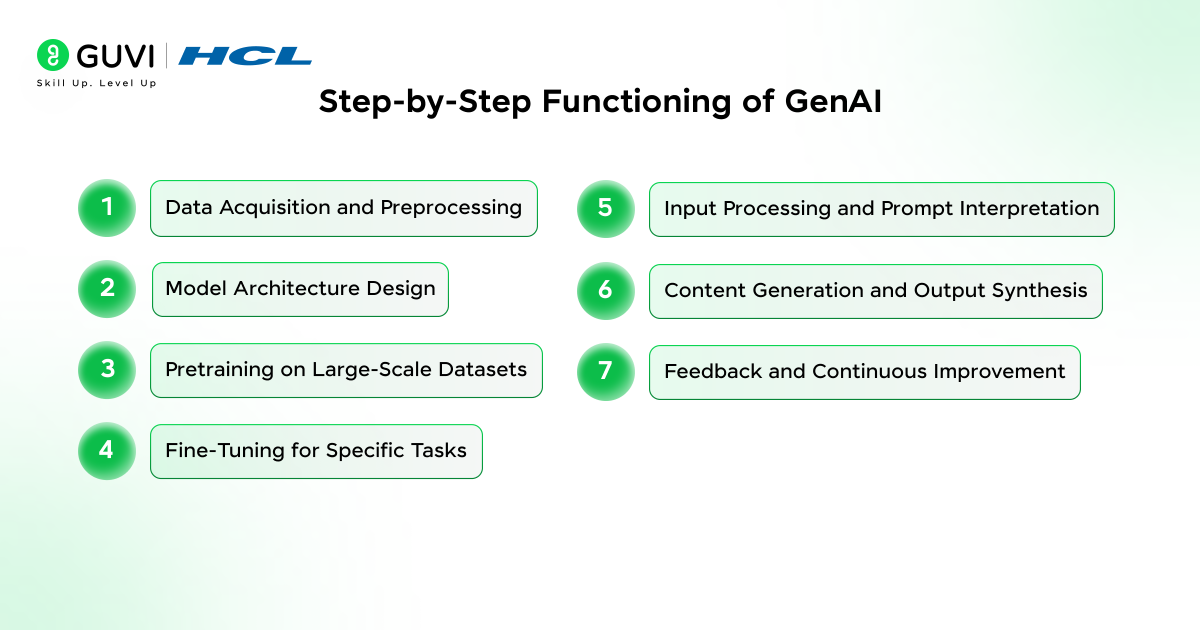
- Step 1: Data Acquisition and Preprocessing
- Step 2: Model Architecture Design
- Step 3: Pretraining on Large-Scale Datasets
- Step 4: Fine-Tuning for Specific Tasks
- Step 5: Input Processing and Prompt Interpretation
- Step 6: Content Generation and Output Synthesis
- Step 7: Feedback and Continuous Improvement
- Best Applications of Traditional ML
- Best Applications of GenAI
- Core Synergies between Traditional ML and GenAI
- Key Differences between Traditional ML and GenAI
- The Bottom Line
- FAQs
- What is the main difference between Traditional ML and Generative AI?
- Can Traditional ML and GenAI work together?
- Which is better for future AI applications: Traditional ML or GenAI?
What is Traditional ML?
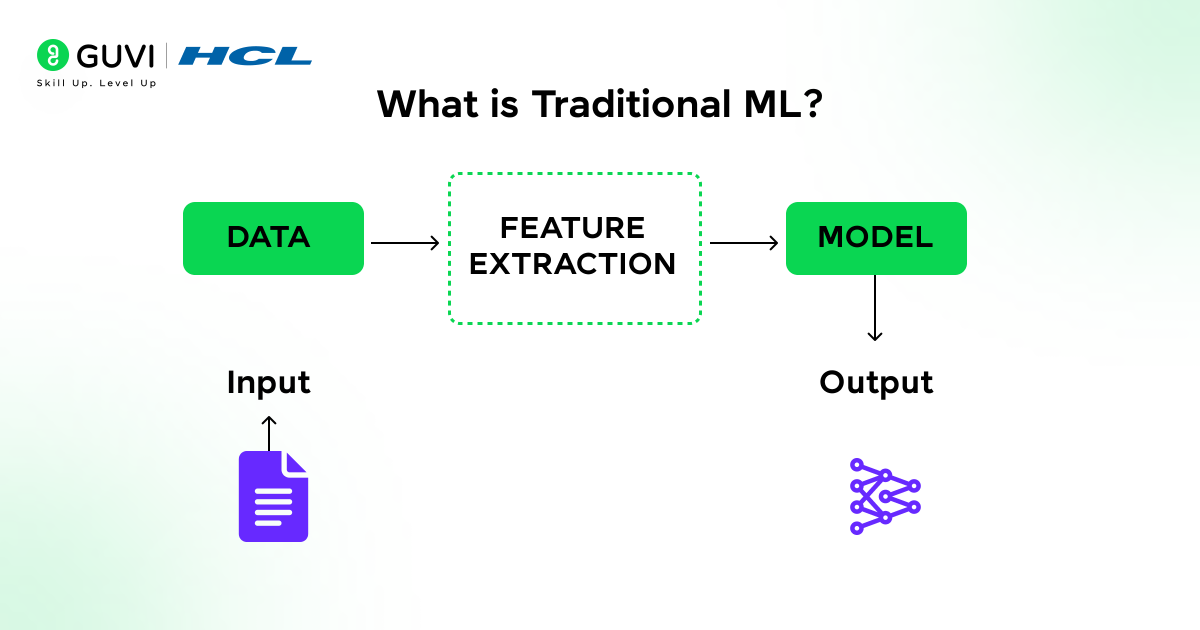
Traditional machine learning refers to systems that learn from structured data using defined algorithms and statistical models to make predictions or classifications. These models rely on labeled datasets and human-defined features, which means the quality of the output depends on how well the data is prepared and how effectively the algorithm captures relationships within it. Traditional ML focuses on pattern recognition, where models are trained to identify trends, forecast outcomes, and assist decision-making through measurable data correlations.
Examples of Traditional ML
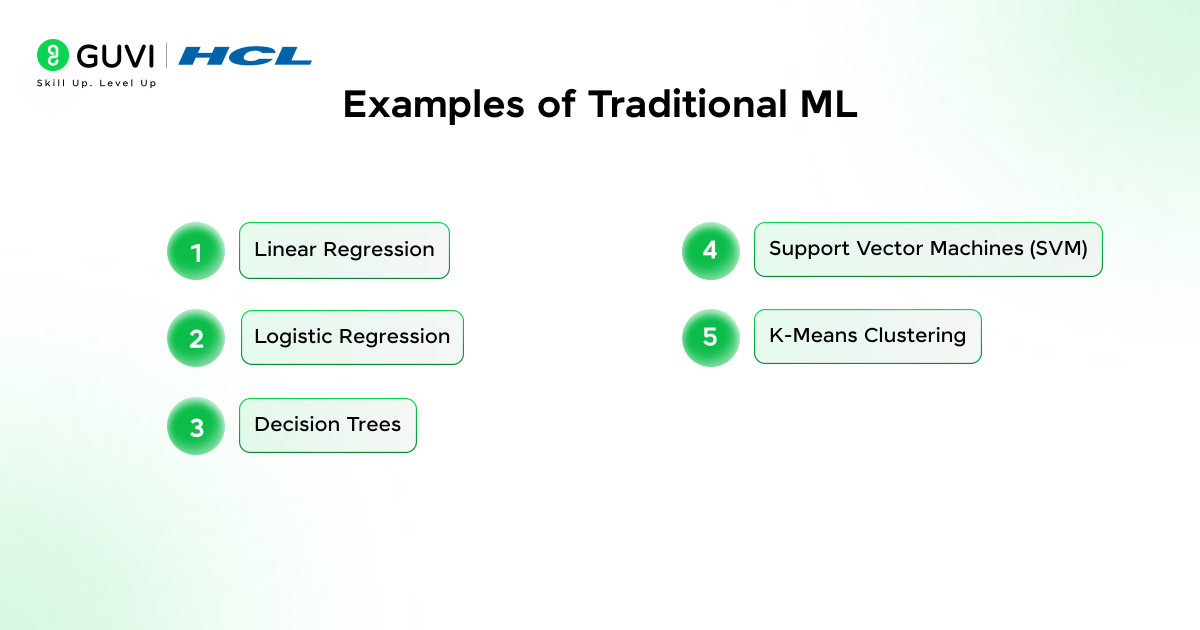
- Linear Regression: Predicts continuous outcomes such as sales forecasting or price estimation based on input variables.
- Logistic Regression: Classifies data into binary outcomes such as spam detection or fraud identification.
- Decision Trees: Splits data into branches to support rule-based predictions used in credit scoring and diagnostics.
- Support Vector Machines (SVM): Separate data points into classes for applications such as handwriting or face recognition.
- K-Means Clustering: Groups data into clusters for customer segmentation or market analysis.
What is GenAI?
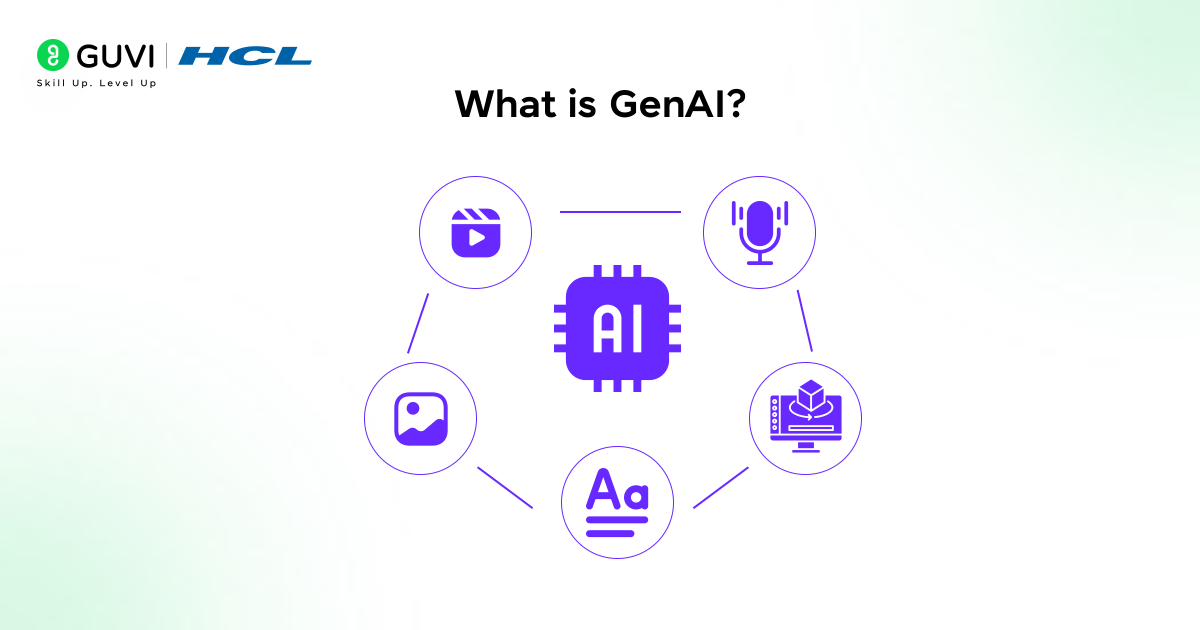
Generative AI is a modern field of artificial intelligence that focuses on creating new content instead of only predicting outcomes. It uses large-scale models trained on vast datasets to produce text, images, audio, or designs that mimic human creativity. Unlike traditional ML, GenAI works with unstructured data such as language and visuals to generate contextually relevant and original outputs. It blends analytical understanding with creative synthesis, making it useful in content creation, communication, design, and automation.
Examples of GenAI
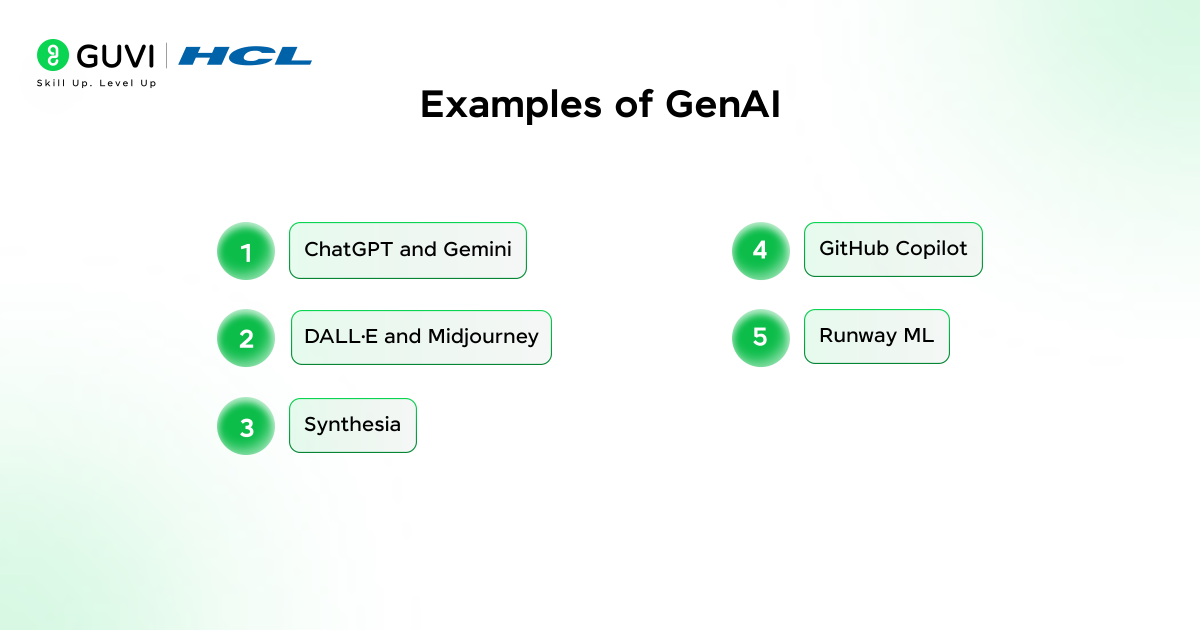
- ChatGPT and Gemini: Generate natural text for writing, explanation, and code assistance.
- DALL·E and Midjourney: Create realistic or artistic images from written prompts.
- Synthesia: Produces AI-based videos with virtual presenters and voiceovers.
- GitHub Copilot: Assists developers by generating contextual code suggestions.
- Runway ML: Generates and edits video or visual content using text-based instructions.
Top Benefits of Traditional ML
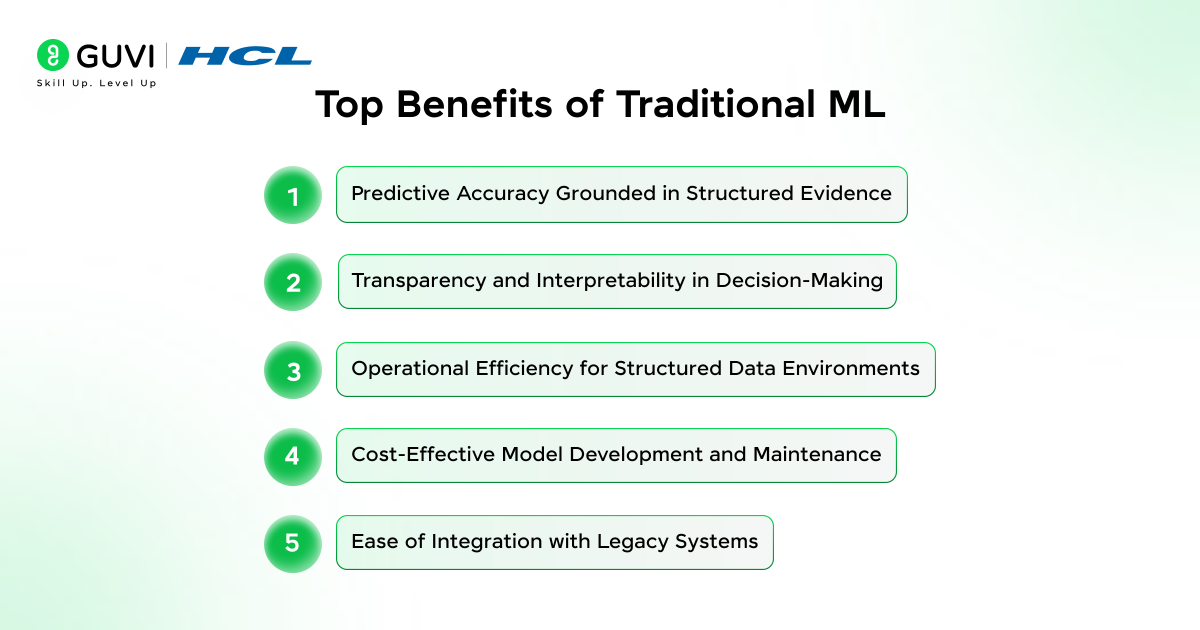
- Predictive Accuracy Grounded in Structured Evidence
Traditional ML models identify patterns within organized and labeled datasets. They help organizations forecast outcomes such as demand, risk, or behavior based on measurable data rather than assumptions. This predictive precision reinforces decision-making and operational reliability.
- Transparency and Interpretability in Decision-Making
Traditional ML provides clear reasoning behind predictions. Algorithms like regression and decision trees allow teams to trace variables and understand cause-and-effect relationships, supporting trust, regulatory compliance, and informed analysis.
- Operational Efficiency for Structured Data Environments
Traditional ML performs effectively when inputs follow consistent numerical or categorical rules. It processes data efficiently and produces dependable outcomes, making it ideal for environments with clearly defined datasets.
- Cost-Effective Model Development and Maintenance
These models require fewer computational resources and smaller datasets. The lower complexity reduces infrastructure costs while maintaining strong performance for medium-sized and enterprise applications.
- Ease of Integration with Legacy Systems
Traditional ML and its types integrate smoothly with established databases and software systems. Organizations can implement intelligent analytics without restructuring their infrastructure.
Top Benefits of GenAI
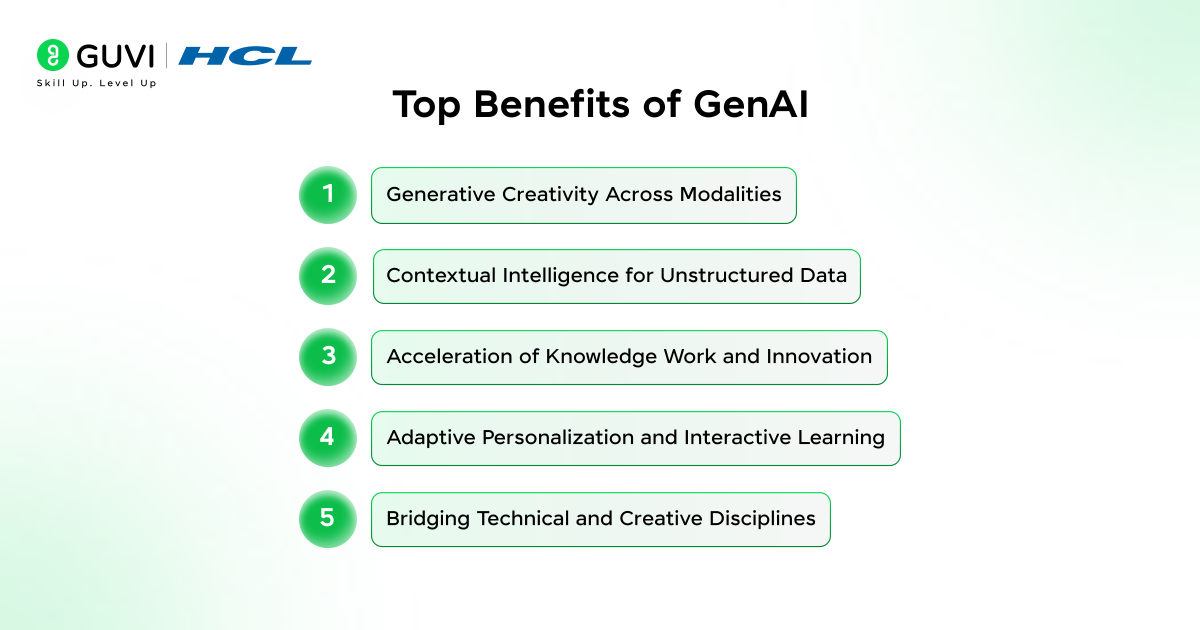
- Generative Creativity Across Modalities
GenAI expands the boundaries of automation by creating original text, images, videos, or sound. It generates contextually relevant material, transforming creative workflows and reducing dependence on manual production.
- Contextual Intelligence for Unstructured Data
GenAI processes language, visuals, and audio without requiring labeled datasets. It understands relationships and intent within complex data, producing outputs that align closely with human communication.
- Acceleration of Knowledge Work and Innovation
GenAI removes friction between ideation and execution by generating initial drafts, designs, or reports instantly. Professionals can focus on refining ideas, leading to faster innovation cycles.
- Adaptive Personalization and Interactive Learning
GenAI adjusts outputs according to user preferences or conversational feedback. It personalizes explanations, recommendations, and content, improving relevance and user engagement.
- Bridging Technical and Creative Disciplines
It connects analytical precision with design thinking, allowing engineers, writers, and designers to collaborate seamlessly. The outcome is cross-functional creativity with measurable consistency.
Master both the logic of Traditional Machine Learning and the creativity of Generative AI with HCL GUVI’s AI & ML Course, powered by IIT-M Pravartak certification. Learn to build, train, and deploy intelligent models that predict, generate, and innovate across real-world applications. Through hands-on projects, expert mentorship, and placement support, this program equips you to bridge analytical precision with AI-driven creativity, shaping the future of data and automation.
Step-by-Step Functioning of Traditional ML
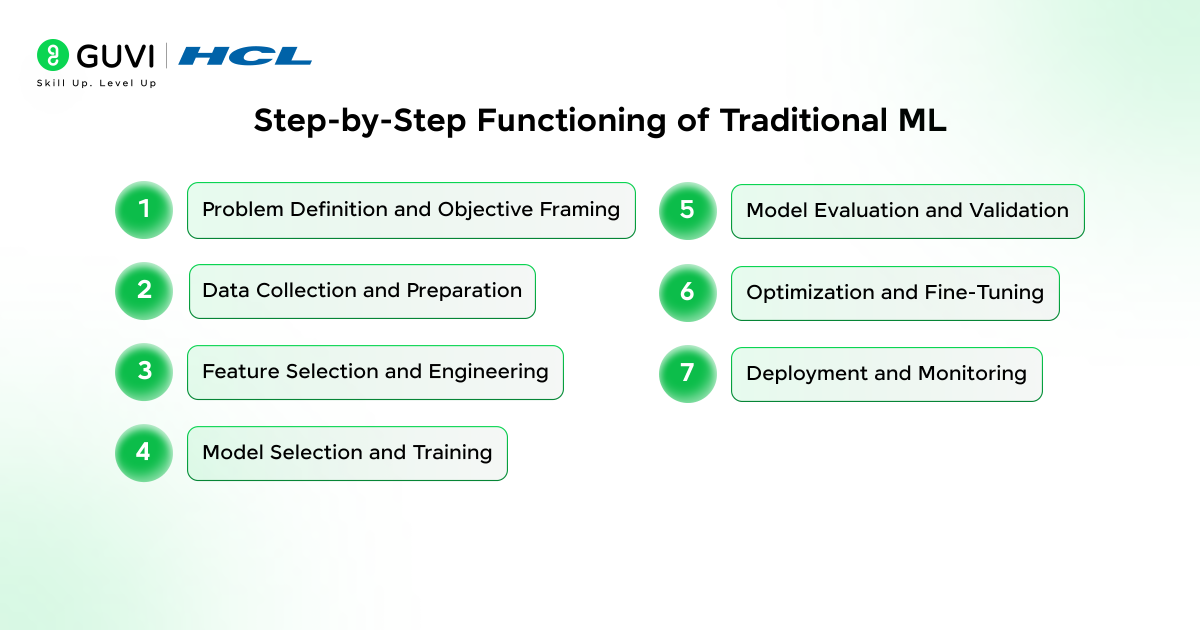
Step 1: Problem Definition and Objective Framing
The process begins with defining a specific problem to solve, such as predicting sales, detecting fraud, or classifying users. A clear goal helps determine the right data, algorithm, and success metrics for the task.
Step 2: Data Collection and Preparation
Data is gathered from relevant sources such as databases, APIs, or sensors. It is then cleaned to remove duplicates and missing values. The data is standardized and normalized to maintain consistency and accuracy before analysis.
Step 3: Feature Selection and Engineering
Important variables that influence outcomes are selected and refined. New features may be created through transformation or combination to improve model understanding and predictive power.
Step 4: Model Selection and Training
A suitable algorithm, such as logistic regression, random forest, or SVM is chosen. The model learns from training data by identifying relationships between inputs and target outputs.
Step 5: Model Evaluation and Validation
The trained model is tested using unseen data to measure accuracy, precision, recall, and reliability. Cross-validation ensures that the model performs consistently across different datasets.
Step 6: Optimization and Fine-Tuning
Hyperparameters are adjusted to balance bias and variance. Optimization techniques strengthen model stability and performance without overfitting.
Step 7: Deployment and Monitoring
The final model is deployed into production for real-world use. Continuous monitoring detects data drift and performance issues. Periodic retraining keeps the model accurate and aligned with changing data patterns.
Step-by-Step Functioning of GenAI
Step 1: Data Acquisition and Preprocessing
GenAI systems start with large volumes of text, images, or code collected from diverse sources. Data is tokenized and cleaned. It is further organized into formats that neural networks can process efficiently.
Step 2: Model Architecture Design
Neural architectures such as transformers are built to capture long-range relationships between data elements. This setup enables contextual understanding and the generation of coherent outputs.
Step 3: Pretraining on Large-Scale Datasets
The model is trained on massive unstructured datasets to learn linguistic, visual, or multimodal patterns. It develops probabilistic associations that allow prediction and creative synthesis.

Step 4: Fine-Tuning for Specific Tasks
Fine-tuning adjusts pretrained weights to align the model with domain-specific needs, such as summarizing reports, generating visuals, or assisting with code.
Step 5: Input Processing and Prompt Interpretation
User prompts are converted into vector representations that convey context and intent. This step allows the model to understand the meaning before generation.
Step 6: Content Generation and Output Synthesis
The model produces text, images, or code by predicting the next element in a sequence based on prior context. It builds complete outputs through iterative token generation or pixel synthesis.
Step 7: Feedback and Continuous Improvement
User feedback and human review guide refinement. Reinforcement learning helps the model improve relevance, reduce bias, and maintain coherence in future outputs.
Best Applications of Traditional ML
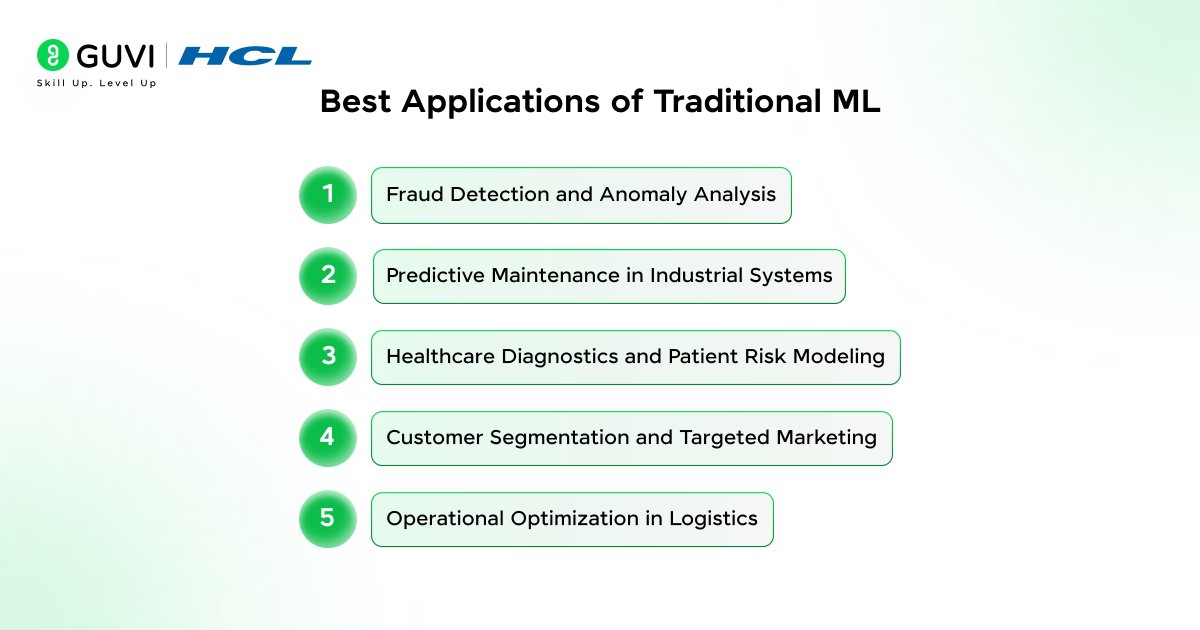
- Fraud Detection and Anomaly Analysis
Financial institutions use ML pipelines and models to identify irregular transaction behavior. These models detect patterns that signal fraud, enabling early intervention and loss prevention.
- Predictive Maintenance in Industrial Systems
Manufacturers apply ML to sensor data to predict equipment failures before they occur. This reduces downtime and improves productivity.
- Healthcare Diagnostics and Patient Risk Modeling
ML supports medical diagnosis by analyzing images, patient histories, and test results. It helps clinicians detect early disease indicators and personalize care strategies.
- Customer Segmentation and Targeted Marketing
Businesses use clustering algorithms to categorize customers by behavior and demographics. The insight enables more effective and personalized marketing campaigns.
- Operational Optimization in Logistics
Time-series and optimization models refine delivery routes. They help predict delays and manage supply chain flows with greater accuracy.
Best Applications of GenAI
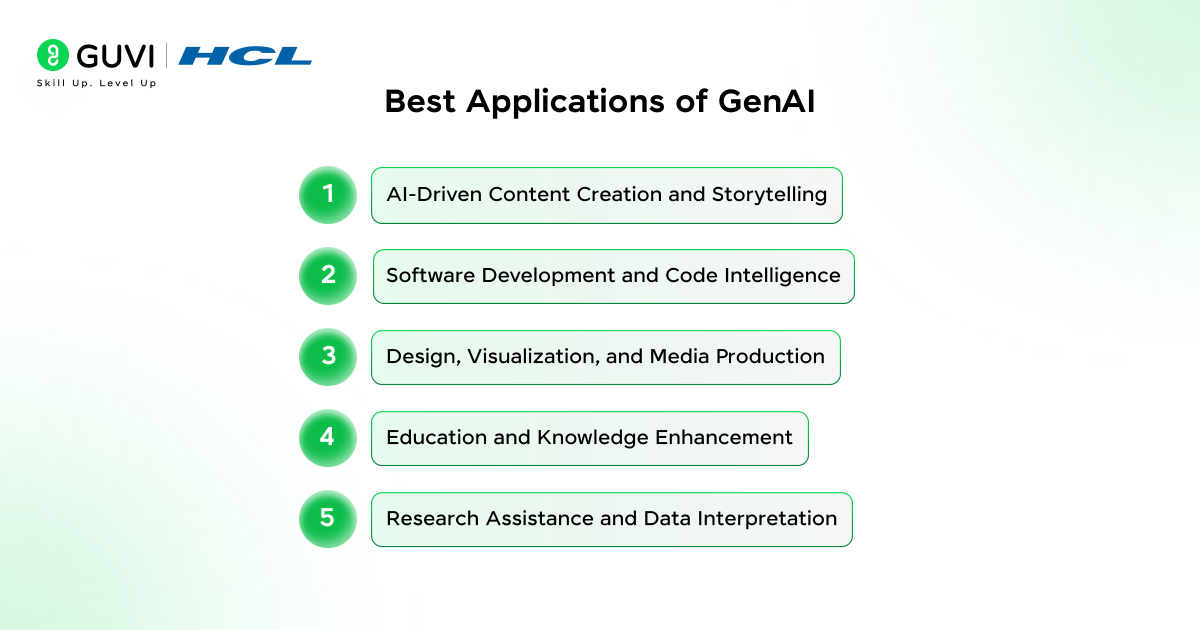
- AI-Driven Content Creation and Storytelling
Writers and marketers use GenAI to produce articles, ad copy, and creative ideas. It learns tone and context, creating consistent and brand-aligned content efficiently.
- Software Development and Code Intelligence
Tools such as Copilot and ChatGPT assist programmers by generating functional code, suggesting improvements, and documenting logic. This improves accuracy and accelerates delivery.
- Design, Visualization, and Media Production
GenAI converts text descriptions into images, animations, and visual concepts. Designers use it to quickly test aesthetics and iterate on prototypes.
- Education and Knowledge Enhancement
GenAI produces study materials, adaptive quizzes, and personalized lessons that respond to a learner’s pace and comprehension level. It supports both educators and students in achieving focused learning outcomes.
- Research Assistance and Data Interpretation
Researchers rely on GenAI to summarize documents and analyze data. This powerful form of Artificial Intelligence helps interpret complex findings. It simplifies exploration and accelerates discovery across disciplines.
Core Synergies between Traditional ML and GenAI
- Complementary Strengths in Intelligence and Creativity
Traditional ML delivers analytical precision, while GenAI contributes creative synthesis. Together, they combine structured reasoning with generative flexibility and produce solutions that are both data-driven and contextually imaginative.
- Enhanced Model Performance Through Hybrid Architectures
Traditional ML models can serve as data filters or evaluators for GenAI outputs. Integrating predictive models with generative frameworks improves accuracy and enforces quality control. The synergy strengthens both interpretability and creative reliability across applied domains.
- Efficient Data Utilization and Feature Enrichment
Traditional ML processes structured data efficiently, while GenAI converts unstructured content into meaningful representations. When used together, they expand the usable data spectrum. GenAI can extract insights from text, images, or audio, which traditional ML then analyzes quantitatively for strategic decision-making.
- Human-AI Collaboration with Structured Oversight
Traditional ML powers control and explainability, while GenAI fosters intuitive interaction. Their integration allows teams to innovate confidently, maintaining creativity without losing governance or traceability. This synergy represents a bridge between technical accountability and creative expansion.
Key Differences between Traditional ML and GenAI
| Aspect | Traditional Machine Learning (ML) | Generative AI (GenAI) |
| Core Goal | Learns from data to predict or classify outcomes | Linear with data and computation |
| Learning Type | Supervised or unsupervised learning with defined features | Self-supervised or reinforcement learning on large unstructured data |
| Data Type | Structured and labeled data | Unstructured or multimodal data (text, visuals, audio) |
| Output | Predictive or analytical results | Creative and context-aware outputs |
| Human Role | Requires manual feature design and tuning | Depends on prompt engineering and model interpretation |
| Model Examples | Linear Regression, SVM, Decision Trees | GPT, DALL·E, Gemini, Midjourney |
| Interpretability | Transparent and explainable | Complex and less interpretable |
| Computation Needs | Low to moderate | Very high; relies on GPUs and large-scale infrastructure |
| Training Data | Clean, labeled datasets | Vast unlabeled datasets across domains |
| Primary Strength | Accuracy, stability, and interpretability | Creativity, adaptability, and contextual understanding |
| Error Type | Quantifiable and measurable | Semantic or contextual; harder to trace |
| Use Cases | Prediction, fraud detection, forecasting, diagnostics | Content generation, chatbots, design, simulation |
| Scalability | Finance, healthcare, logistics, and manufacturing | High but resource-intensive |
| Decision Basis | Statistical patterns and inference | Contextual pattern recognition and synthesis |
| Validation | Measured by metrics like precision and recall | Judged by relevance, coherence, and creativity |
| User Interaction | Data-driven and indirect | Interactive and conversational |
| Ethical Focus | Bias, fairness, and model overfitting | Bias, misinformation, and originality concerns |
| Workflow Role | Supports analytics and prediction | Expands creativity and automates generation |
| Key Industries | Finance, healthcare, logistics, manufacturing | Media, education, marketing, entertainment, software design |
The Bottom Line
Traditional machine learning and generative AI represent two sides of modern intelligence: analytical precision and creative generation. Traditional ML structures understand through measurable data and logic, while GenAI extends that foundation into expressive, human-like creation. Their convergence forms a powerful ecosystem where prediction meets innovation. As industries integrate both, success will depend on balance, leveraging ML for accuracy and GenAI for imagination. Together, they reshape decision-making, accelerate design, and define the next era of intelligent and adaptive technology.
FAQs
1. What is the main difference between Traditional ML and Generative AI?
Traditional ML focuses on analyzing structured data to predict or classify outcomes. Generative AI goes beyond prediction by creating new text, images, or code using large-scale neural networks trained on unstructured data.
2. Can Traditional ML and GenAI work together?
Yes. Traditional ML ensures accuracy and structured reasoning, while GenAI brings creativity and contextual understanding. Combining both enables intelligent systems that analyze, generate, and optimize insights across industries.
3. Which is better for future AI applications: Traditional ML or GenAI?
Both are essential. Traditional ML excels in data-driven prediction, while GenAI leads in creative automation. The future of AI depends on integrating both to balance precision with innovation in real-world solutions.
Success Stories

About the Author
Vaishali
I'm a seasoned writer with four years of experience across technical, non-technical, and just about every genre or niche you can imagine. Adaptable and curious, I enjoy exploring new topics and making information engaging and easy to understand. Fueled by a steady stream of tea, I approach each project with creativity, reliability, and genuine enthusiasm for storytelling.
View all posts by Vaishali
Connect with me @













Did you enjoy this article?