


Artificial Intelligence and Machine Learning Articles
AI/ML Skills Gap 2026: Why Companies Can't Find Job-Ready Talent
20 AI/ML Interview Questions Recruiters Can Use Without a Tech Background - Best Guide
How Industry-Backed AI/ML Bootcamps Are Changing the AI/ML Hiring Pipeline - Best Guide 2026
From IT Support to AI Engineer: A Realistic Career Switch Guide 2026

Get In Touch For Details! Request More Information
Is AI/ML Becoming Less Math-Heavy in 2026? What You Actually Need to Know
Aug 03, 2026 5 Min Read 2353 Views
(Last Updated)
Artificial Intelligence and Machine Learning (AI & ML) are transforming everything humans can do in a much more efficient way while ensuring accuracy and precision. From data collection to smart business decision-making, these technologies are widely used across industries and by the public. It’s really mind-boggling to observe how AI & ML, when combined, can produce extraordinary results.
But behind this tech revolution, there is an essential element without which it would never be possible, and that is Mathematics (Math).
However, most of the AI/ML tools and platforms we use nowadays are math-heavy. So what is the real picture? Let’s discuss this in this particular blog.
Quick Answer:
AI/ML is becoming less math-heavy for most people because tools, APIs, and platforms now handle the complex equations in the background, letting users work with AI without doing heavy maths. But the core of AI still depends on strong mathematical concepts, which are handled by researchers and engineers who build and improve the models.
Table of contents
- Is Math Still Important in the Modern AI/ML field: The Real Answer
- ML Task vs Math Needed
- Which math topics you can skip if using AutoML and LLM APIs
- Understanding API-First and Infrastructure-First Roles
- API-First Roles
- Infrastructure-First Roles
- Why API-First and Infrastructure-First Roles Are on the Rise
- Faster AI Adoption
- Reduced Need for Deep Math
- Focus on Practical Implementation
- Scalability and Reliability
- Cost and Time Efficiency
- API-First vs Infrastructure-First Jobs: A Clear Overview
- Math topics that are still non-negotiable in AI/ML
- Math required for ML in 2023 vs 2025 — what actually changed
- Conclusion
- FAQs
- Do I need to be good at math to work in AI/ML today?
- Can AI/ML really work without understanding the math behind it?
- What does an infrastructure-first AI role involve?
Is Math Still Important in the Modern AI/ML field: The Real Answer
Every AI model that is capable of generating text, recognising images, or making predictions is essentially governed by mathematical rules, probabilities, and equations; research scientists and model developers still rely on linear algebra, calculus, and statistics to build, train, and upgrade these models, hence math is indispensable for the creation and progression of AI.
Still, Math has been veiled for daily use and many jobs. AI companies provide pre-trained models, APIs, and no-code tools so that product developers, designers, and operators can utilise AI without having to deal with equations.
Roles such as integrating an API, tuning prompts, deploying a model, or running data pipelines require more software and system skills, as well as practical judgement, rather than deep Math. Hence, AI can be applied across various domains without requiring everyone to be a mathematician.
While many aspects of AI can be automated, real innovation in creating custom models, solving complex problems, and advancing in AI still requires people with a deep understanding of Mathematics.
Also Read: Mathematics for Machine Learning: A Zero-to-Hero Guide for Beginners
ML Task vs Math Needed
Placement: Insert after the existing “Is Math Still Important in the Modern AI/ML Field” section, before “Understanding API-First and Infrastructure-First Roles.” This table is the direct, scannable answer the rest of that section explains in prose.
| ML Task | Math Needed | Automated by Tools? | Still Need to Understand? |
|---|---|---|---|
| Calling an LLM API (e.g., chatbot, summarizer) | None | Yes, fully | No |
| Prompt engineering | None | Partially | Basic sense of model behaviour helps |
| Using AutoML to train a model | Minimal | Yes | Basic stats — accuracy, precision, recall |
| Fine-tuning a pre-trained model | Low to moderate | Partially | Loss functions and gradient basics |
| Evaluating model performance | Moderate (statistics) | Partially | Probability and statistics |
| Feature engineering | Moderate | Partially | Data distributions, basic statistics |
| Deploying models to production (MLOps) | Low | Yes | Not math-heavy — systems knowledge instead |
| Designing a new model architecture | High (linear algebra, calculus) | No | Yes — deep, hands-on math required |
| Original AI/ML research | Very high | No | Yes — advanced math is the core skill |
Which math topics you can skip if using AutoML and LLM APIs
If you’re using AutoML platforms or LLM APIs rather than building models from scratch, you can skip manually deriving gradients, proving matrix decompositions, and working through optimisation theory by hand — the tools handle these calculations for you automatically.
- Manual backpropagation and gradient derivations — handled internally by training frameworks.
- Matrix decomposition proofs (SVD, eigendecomposition) — needed to understand a paper, not to use a tool.
- Deep optimisation theory (convexity proofs, Lagrangian duality) — relevant for research roles, not for API integration or AutoML use.
- Manual hyperparameter-tuning math — AutoML platforms search this space automatically.
- Advanced Bayesian derivations — only needed if you’re building custom probabilistic models, not calling pre-trained ones.
Understanding API-First and Infrastructure-First Roles
API-First Roles
API-first roles emphasise employing pre-built AI services via APIs rather than developing models from scratch. Individuals in these positions integrate AI functionalities into applications, websites, or products, thus facilitating the use of AI in a real-world context without the need for advanced mathematics.
This job is about integrating, testing, and managing API calls to make sure that AI is working efficiently in real-world applications.
Infrastructure-First Roles
Infrastructure-first roles are those that focus on the systems and platforms that are necessary for the AI to run stably. It essentially involves the management of servers, cloud platforms, data pipelines, and deployments.
People in these positions make sure AI models are able to scale, remain secure, and function efficiently, thus allowing companies to employ AI at a large scale without any technical hindrances.
Why API-First and Infrastructure-First Roles Are on the Rise
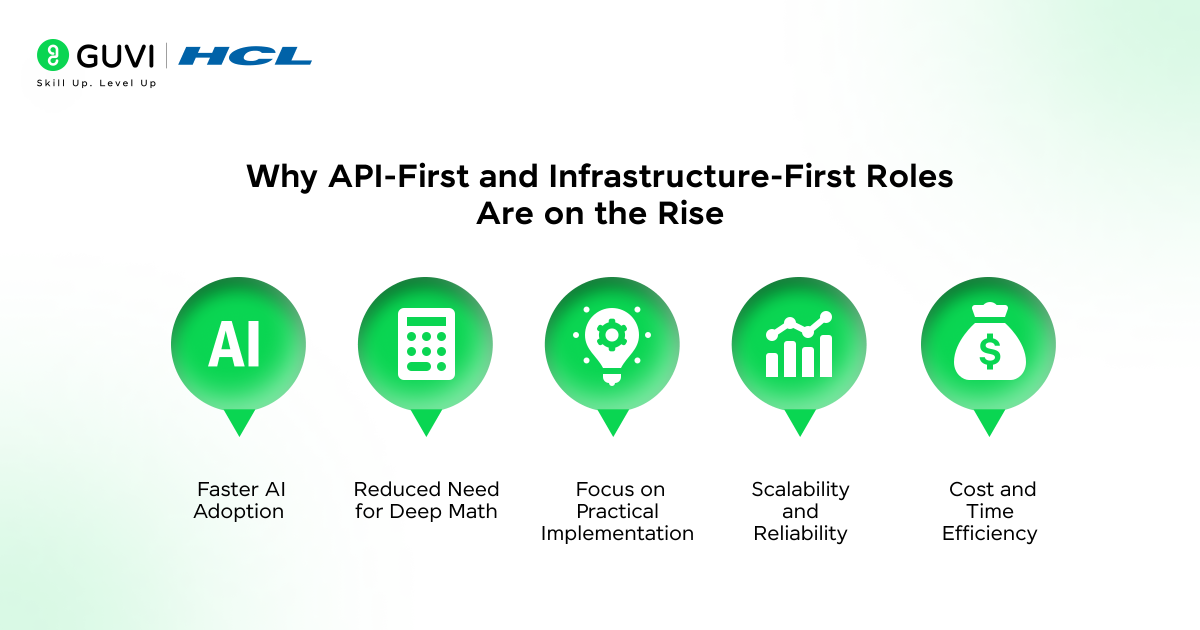
In 2026 and the years ahead, API-First and Infrastructure-First roles are on an exponential rise for several reasons; we have listed some of the best reasons for their significant growth.
These roles allow both software developers and engineers, as well as non-technical professionals, to deliver optimal results quickly and efficiently.
1. Faster AI Adoption
The use of artificial intelligence (AI) is expanding at a fast pace, and businesses are eager to utilize it quickly. Through the use of pre-built APIs and cloud computing tools, they are able to incorporate AI into their products without waiting months to build models from scratch.
APIs and infrastructure tools are the means through which non-experts can use AI effectively. In just a few integrations, developers and product teams can add AI features like chatbots, recommendations, or image recognition, thus facilitating the process of AI adoption to be much simpler and faster across various industries.
2. Reduced Need for Deep Math
In the past, AI implementation demanded deep knowledge of linear algebra, calculus, and statistics. However, today, numerous tools are available that perform the mathematical computations in the background, so users can interact with AI without having to do complicated calculations. Consequently, AI is becoming accessible to a larger number of people and different roles.
This change does not imply that math is no longer being used. Scientists and developers continue to use math to develop and enhance AI/ML models, whereas regular users concentrate on the practical use of AI, such as integrating APIs or handling workflows.

3. Focus on Practical Implementation
Nowadays, companies are more focused on AI systems that can be easily integrated and used in real-world scenarios rather than just having theoretical models. Those who work in API-first and infrastructure-first roles are mainly concerned with making AI accessible, reliable, and seamlessly connected to applications, rather than coming up with new AI/ML algorithms.
In other words, different teams invest the time in testing, deploying, and tuning AI for particular tasks. The main aim is to use AI to handle real-world problems, such as customer support automation or product recommendation, without having to concern oneself with the complex mathematics behind it.
4. Scalability and Reliability
AI models are quite demanding from the computing point of view and require the right kind of infrastructure when they are to be run at a large scale. Infrastructure-first roles ensure these models can handle high traffic and maintain speed without any malfunctioning.
Businesses require AI that is stable and reliable, whether it is aimed at a few hundred or millions of users. By maintaining servers, cloud platforms, and pipelines, these positions keep AI systems reliable, safe, and available for widespread use.
5. Cost and Time Efficiency
It’s really costly and time-consuming to create AI entirely from scratch. Incorporating APIs and infrastructure tools not only saves time and money but also lets companies utilise their resources to work with the AI applications rather than re-create them.
Teams can test new AI features, deploy updates, and scale operations without massive investment in deep technical expertise, making AI more practical for everyday use.
Also Read: Best AI Tools to Boost Productivity
API-First vs Infrastructure-First Jobs: A Clear Overview
| Category | API-First Jobs | Infrastructure-First Jobs |
| Main Focus | Using ready-made AI through APIs | Managing systems that run AI models |
| Skill Level | Beginner to intermediate | Intermediate to advanced |
| Key Skills | Integration, basic coding, testing | Cloud, servers, pipelines, deployment |
| Math Needed | Very low | Low to moderate |
| Purpose | Add AI features to apps quickly | Keep AI reliable, scalable, and secure |
| Who Can Do It | Developers, product teams, non-experts | Engineers, DevOps, IT professionals |
| Job Examples | AI API Integrator, Prompt Engineer, Automation Developer | MLOps Engineer, Cloud Engineer, AI Infrastructure Engineer |
If you’re aiming for opportunities at leading tech companies, HCL GUVI’s Intel & IITM Pravartak Certified Artificial Intelligence and Machine Learning Course can help you stand out. Learn AI and ML directly from experienced professionals and earn a certification that strengthens your profile for top-tier roles. Take the step toward upgrading your career now!
Math topics that are still non-negotiable in AI/ML
Even with AutoML and LLM APIs, five math areas remain non-negotiable for anyone who wants to genuinely understand or improve AI systems: basic statistics, probability fundamentals, linear algebra intuition, an understanding of loss/cost functions, and calculus intuition around what a gradient represents.
- Basic statistics — mean, variance, distributions, and what “accuracy” or “precision” actually measure.
- Probability fundamentals — needed to understand model confidence, uncertainty, and predictions.
- Linear algebra intuition — vectors and matrices as representations of data, even without deriving proofs.
- Loss/cost functions — what the model is actually trying to minimise, and why that choice matters.
- Calculus intuition — understanding what a gradient represents, even if a library computes it for you.
Math required for ML in 2023 vs 2025 — what actually changed
Between 2023 and 2025, the day-to-day math requirement for most AI/ML practitioners dropped significantly as AutoML platforms and LLM APIs matured — what used to require manual model-building now often takes a few API calls, though the underlying math didn’t disappear, it simply moved further behind the scenes.
| Area | 2023 Expectation | 2025–2026 Reality |
|---|---|---|
| Building a basic classifier | Manual feature engineering + model math expected | AutoML platforms handle most of this automatically |
| Using AI in a product | Often required training a custom model | Usually a pre-trained model via API call |
| Entry-level AI/ML job math bar | Linear algebra + calculus commonly screened for | Often optional for API-first and infrastructure-first roles |
| Tooling maturity | AutoML/LLM APIs existed but were limited | AutoML/LLM APIs are production-grade and widely adopted |
| Where deep math is still required | Model-building roles broadly | Concentrated in research and core model-development roles |
Conclusion
In conclusion, AI/ML are becoming more accessible as many roles no longer require heavy math. With API-first and infrastructure-first approaches, people can integrate AI into products and manage systems without building models from scratch. While the Mathematical foundation remains essential behind the scenes, today’s tools let users focus on practical applications, making AI easier to use, faster to deploy, and more widely adopted across industries.
FAQs
Do I need to be good at math to work in AI/ML today?
No, many roles let you use AI through tools and APIs without deep math, though building or improving models still needs strong math.
Can AI/ML really work without understanding the math behind it?
Yes, you can use AI via tools and APIs without knowing the math, but models themselves are built on solid mathematical foundations.
What does an infrastructure-first AI role involve?
These roles manage the systems, servers, cloud platforms, and pipelines that keep AI models running smoothly and securely.
Success Stories












Did you enjoy this article?