


Artificial Intelligence and Machine Learning Articles
Finance Manager to Data Analytics: Career Growth, Salary and Seniority
How to Evaluate LLM Outputs in Production Deployments
AI/ML Skills Gap 2026: Why Companies Can't Find Job-Ready Talent
20 AI/ML Interview Questions Recruiters Can Use Without a Tech Background - Best Guide


Get In Touch For Details! Request More Information

What Are LLM Chains? A Simple Guide That Actually Makes Sense (2025)
Dec 18, 2025 7 Min Read 2987 Views
(Last Updated)
LLM chains have transformed how we interact with large language models by connecting multiple components into a structured workflow. These chains enhance standalone LLMs by integrating prompt templates, memory systems, and external tools to perform complex tasks more effectively. When you’re working with extensive documents or need reliable AI-generated responses, a single language model call often falls short.
To address this limitation, LLM chaining emerged as a practical solution that simplifies the process of connecting multiple language model components. By creating a unified approach to information processing, these structured sequences help reduce hallucinations and enable fact-checking in generative AI applications.
Throughout this guide, you’ll learn about the different types of LLM chains and how they can help you build more reliable AI solutions without needing advanced technical expertise. Let’s begin!
Table of contents
- What Are LLM Chains and Why They Matter
- LLM chaining explained simply
- How LLM chains differ from single LLM calls
- Why chaining improves performance
- Core Components of an LLM Chain
- 1) Prompt templates and formatting
- 2) Memory and context retention
- 3) Retrievers and vector stores
- 4) Agents and decision logic
- 5) Output parsers and postprocessors
- How LLM Chains Actually Work
- 1) Step-by-step flow of a typical LLM chain
- 2) From user input to final output
- 3) Role of external tools and APIs
- 7 Types of LLM Chains You Should Know
- Simple Sequential Chains
- Multi-Step Chains
- Router Chains
- Agent-Based Chains
- Retrieval-Augmented Generation (RAG)
- Chain of Thought (CoT)
- Chain-of-Agents Collaboration (CoA)
- Real-World Use Cases of LLM Chains
- 1) Chatbots with memory and context
- 2) Document summarization and analysis
- 3) Semantic search and QA systems
- 4) Personalized content generation
- Concluding Thoughts…
- FAQs
- Q1. What is an LLM chain and how does it work?
- Q2. How do LLM chains differ from single LLM calls?
- Q3. What are some common types of LLM chains?
- Q4. What are real-world applications of LLM chains?
- Q5. How do LLM chains improve AI performance?
What Are LLM Chains and Why They Matter
Imagine an assembly line in a factory where each worker specializes in a specific task. This is essentially how LLM chains operate—connecting multiple AI models in sequence to tackle complex language tasks more effectively than any single model could alone.

LLM chaining explained simply
At its core, LLM chaining is the process of linking large language models to other components, tools, or even other LLMs to create a more powerful system. Instead of asking one big question to an AI, you break it down into smaller, manageable steps—with each step’s output becoming the input for the next.
Think of it like a recipe: first, you gather ingredients (input processing), then mix them (prompt formatting), cook them (LLM processing), and finally garnish the dish (output parsing). Each step is handled by specialized components working together.
Furthermore, these chains can take various forms:
- Sequential chains – Tasks flow linearly from one step to the next
- Parallel chains – Multiple prompts run simultaneously with the same input
- Conditional chains – Use “if-then” logic to determine the next step
- Iterative chains – Repeatedly refine outputs through multiple passes
How LLM chains differ from single LLM calls
The traditional way of using language models involves sending a single prompt and receiving one response. In contrast, LLM chains offer several key advantages:
- First, chains can process information beyond a single context window, overcoming a fundamental limitation of standalone LLMs. This means they can work with longer documents or more complex problems that would overwhelm a single model.
- Second, chains maintain memory and context between prompts. Unlike direct prompting where each interaction starts fresh, chains can remember previous steps, building on earlier work.
Notably, chains also make it easier to add preprocessing logic, validation, and instrumentation between prompts. This creates more reliable, debuggable systems that can handle complex workflows effectively.
Why chaining improves performance
The performance benefits of LLM chains stem from their structured, multi-step approach to problem-solving. By breaking complex tasks into smaller subtasks, chains boost reliability and achieve better results.
For instance, mathematical reasoning often improves dramatically when models think step-by-step rather than jumping straight to answers. This approach helps reduce errors by allowing verification at each stage of the process.
Moreover, chaining increases transparency in your AI applications. Since each step produces its own output, you can easily identify exactly where things went wrong and make targeted improvements.
The practical impact is significant—chains enable applications like:
- Document processing that can handle materials far longer than a single context window
- Multi-stage reasoning that can tackle complex problems methodically
- Systems that combine specialized models, each handling what they do best
In essence, LLM chains bring a systematic approach to AI problem-solving, allowing developers to create more reliable, powerful, and maintainable applications than would be possible with standalone models.
Core Components of an LLM Chain
Behind every effective LLM chain lies a set of specialized components working together to process information and generate responses. Understanding these building blocks helps you create more powerful AI applications that go beyond basic prompts and responses.

1) Prompt templates and formatting
- Prompt templates serve as the foundation for communicating with language models. They take your raw input and transform it into structured instructions that guide the model’s behavior. Specifically, these templates contain placeholders that get filled with dynamic variables when the chain runs.
- A typical prompt template includes instructions, external information (where applicable), user input, and output indicators. This standardized approach helps maintain consistency across multiple LLM calls.
- LangChain offers various template types, including string templates for basic prompts and chat templates for conversational formats.
2) Memory and context retention
Memory components allow LLM chains to remember previous interactions, overcoming the stateless nature of language models. Without memory, every query would be treated as an independent input, making conversations impossible.
LangChain provides several memory types:
- ConversationBufferMemory: Stores the complete conversation history
- ConversationSummaryMemory: Summarizes previous interactions to save tokens
- ConversationBufferWindowMemory: Remembers only the most recent messages
- ConversationSummaryBufferMemory: Combines summarization with recent message retention
These memory systems perform two essential tasks: reading from stored context before executing core logic and writing new information after processing.
3) Retrievers and vector stores
- Retrievers bridge the gap between external knowledge and language models. They fetch relevant information from databases to supplement the LLM’s knowledge, making responses more accurate and grounded in facts.
- Vector store retrievers are particularly common in LLM chains. These lightweight wrappers around vector stores conform to a standard retriever interface, allowing easy integration into chains. They work by converting text into mathematical representations (embeddings) that capture semantic meaning, enabling similarity-based searches.
- You can customize retrievers to use different search methods like Maximum Marginal Relevance (MMR), which balances relevance with diversity in results.
4) Agents and decision logic
- Agents add autonomous reasoning capabilities to LLM chains. Unlike fixed sequences, agents can dynamically decide what actions to take based on the current state and goal.
- These components generate reasoning traces to develop strategic plans, breaking complex problems into smaller, manageable tasks. They can select appropriate tools or APIs to complete tasks without explicit programming.
- LLM-powered agents maintain both short-term memory (conversation context) and long-term memory (user preferences and knowledge) to create persistent, contextually aware systems.
5) Output parsers and postprocessors
Output parsers transform the raw text from language models into structured data formats that applications can easily work with. This critical final step ensures consistency and usability of LLM outputs.
LangChain offers various parser types, including:
- JSON/XML parsers: Convert outputs to structured data formats
- Pydantic parsers: Validate outputs against predefined schemas
- List/CSV parsers: Format outputs as collections of items
- Output fixing parsers: Attempt to repair malformatted LLM responses
These parsers include format instructions that guide the language model to produce outputs in the expected structure, reducing errors and improving reliability.
Together, these five components form the backbone of effective LLM chains, enabling complex workflows that would be impossible with single prompt-response patterns.
LLM chains might sound like a cutting-edge 2025 concept, but their foundation dates back to early AI orchestration ideas!
Inspired by Human Reasoning: The concept behind LLM chains mirrors how humans solve problems — breaking complex tasks into smaller, logical steps. This “chain of thought” idea was first proposed in AI research as early as 2022.
LangChain Popularized It: The term LLM Chain became mainstream with the open-source LangChain framework, which provided the first practical toolkit for connecting language models with tools, databases, and memory.
LLM Chains Reduce AI Hallucinations: By verifying information at each stage, chained LLMs can reduce factual errors by up to 40% compared to single-model prompts.
These insights show how LLM chains bridge the gap between raw model intelligence and real-world reliability — bringing structure, memory, and logic into the world of generative AI.
How LLM Chains Actually Work
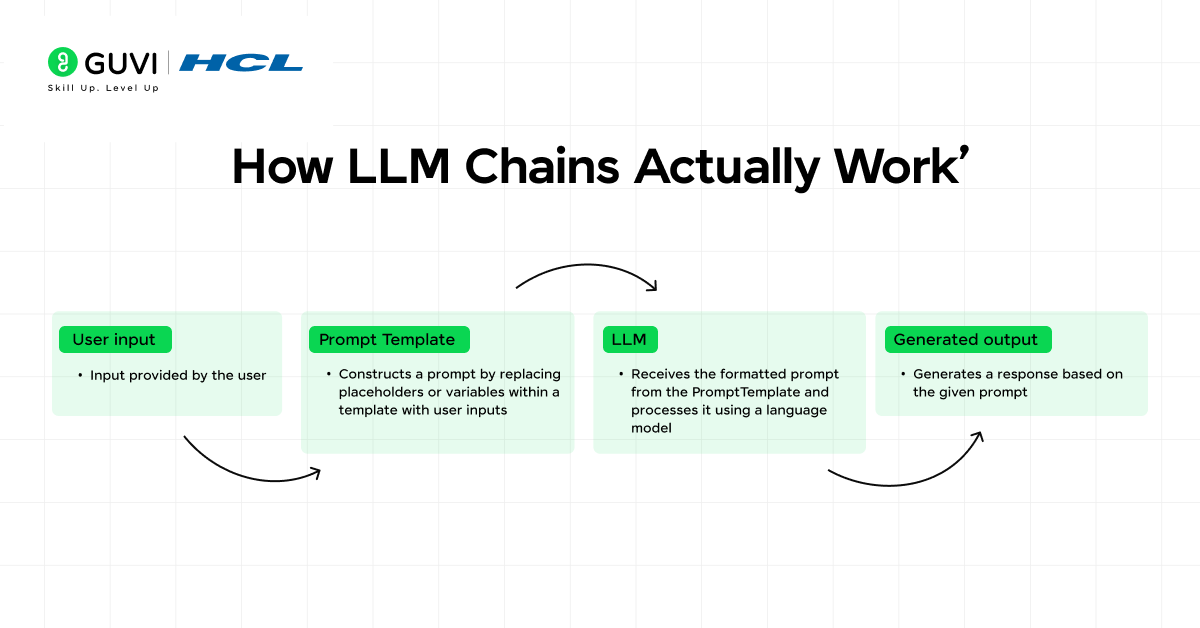
Now that you understand what LLM chains are and their components, let’s unpack the actual mechanics of how they operate in practice. Beneath their sophisticated appearance, LLM chains follow logical processes that transform raw inputs into valuable outputs.
1) Step-by-step flow of a typical LLM chain
The inner workings of an LLM chain typically follow a sequential process:
- Task decomposition – Complex tasks are broken down into smaller, manageable subtasks that can be processed individually.
- Prompt preparation – The chain formats inputs using prompt templates, adding context and instructions for the language model.
- LLM processing – The formatted prompt is sent to the language model, which generates a response based on the instructions.
- Output processing – The raw LLM output is transformed into a structured format through parsers or post-processors.
- Next step determination – The chain decides whether to proceed to another step, request external information, or deliver the final output.
This workflow represents the foundational pattern, although actual implementations vary based on the specific task. According to research, this structured approach increases accuracy on logical reasoning tasks and enables greater transparency for debugging.
2) From user input to final output
When you submit a query to an LLM chain, a sophisticated transformation process begins:
First, your input text undergoes preprocessing, which might include cleaning, chunking, or embedding, depending on the task requirements. For instance, a document analysis chain might extract relevant text sections before processing.
Next, the chain’s orchestration layer determines the appropriate pathway. Depending on the complexity, your request might follow:
- A sequential path where each step builds upon the previous one
- A parallel approach that processes different aspects simultaneously
- A routing system that classifies your input and directs it to specialized tasks
As your query moves through the chain, each component adds value – retrievers pull relevant information, the LLM generates insights, and parsers structure the output. For complex tasks, an orchestrator-worker pattern might emerge, where a central LLM breaks down tasks and delegates them to specialized workers before synthesizing their results.

3) Role of external tools and APIs
External tools significantly expand what LLM chains can accomplish beyond text generation. Through function calling, chains can interact with real-world data sources and services.
In practice, this works through a structured process:
- The LLM receives your query (e.g., “What’s the weather in Tokyo?”)
- It analyzes the intent and determines a tool is needed
- The chain outputs a structured response indicating which tool to invoke
- A parser extracts the required details and calls the actual API
- The result returns to the chain for incorporation into the final response
This capability allows chains to retrieve live information, perform calculations, or take actions in other systems. For example, a chain might combine calendar and email APIs to both schedule a meeting and send an invitation when prompted.
7 Types of LLM Chains You Should Know
Different chains address distinct challenges in AI workflows. Discovering the right LLM chains for your application can dramatically improve performance and capabilities. Here’s a breakdown of seven essential chain types you should know about:
1. Simple Sequential Chains

- Simple Sequential Chains connect multiple steps in a linear fashion, where each step has a single input and output. The output from one step automatically feeds into the next step, creating a straightforward workflow.
- This type works best for uncomplicated linear processes where tasks build directly on previous results. In LangChain, these chains offer a clean way to implement sequential operations without complex mapping between steps.
2. Multi-Step Chains

- Multi-Step Chains extend the sequential concept by supporting multiple inputs and outputs at each stage. These chains allow for more complex workflows where several pieces of information flow between steps.
- Unlike Simple Sequential Chains, they enable explicit mapping of variables, providing greater flexibility for intricate sequences that require maintaining multiple data points throughout the process.
3. Router Chains
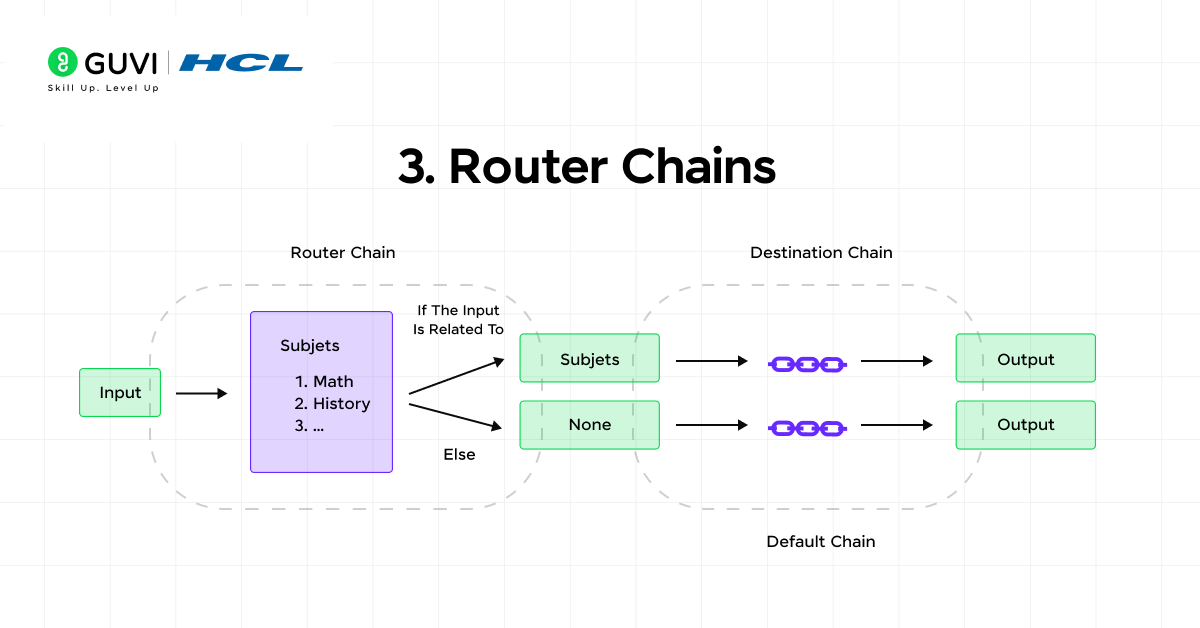
- Router Chains direct inputs to specialized subchains based on input content. They examine the incoming query and intelligently route it to the most appropriate destination chain for processing.
- This approach is particularly valuable for building multi-purpose chatbots and assistants that can handle diverse requests by sending them to the most qualified handler. Router Chains essentially function as intelligent traffic directors within your AI workflow.
4. Agent-Based Chains
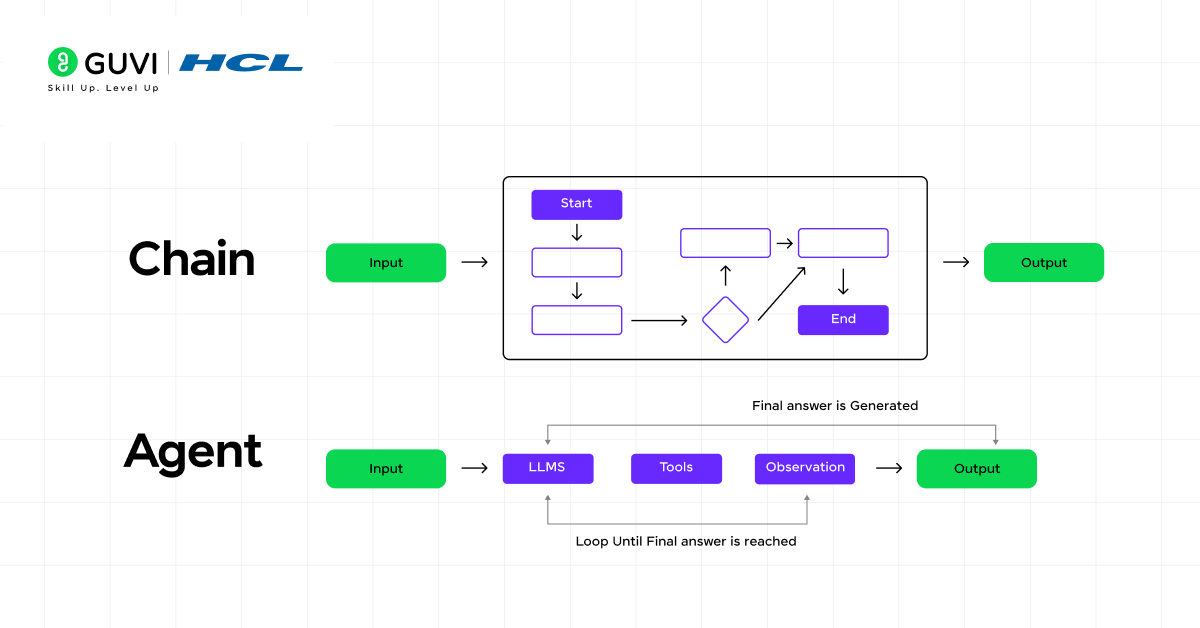
- Agent-Based Chains add autonomous decision-making capabilities to LLM chaining. Unlike fixed sequences, agents dynamically select which tools or APIs to use based on the task context.
- They break complex problems into smaller, manageable tasks through reasoning traces and can select appropriate tools without explicit programming. This approach enables iterative problem-solving with the ability to loop or backtrack if a step fails.
5. Retrieval-Augmented Generation (RAG)

- RAG chains enhance language models by incorporating external knowledge sources. When given a query, RAG systems first search knowledge bases for relevant information, then incorporate this retrieved context into the model’s prompt before generating a response.
- This technique addresses a fundamental limitation of models relying on fixed training datasets, allowing them to access current information without costly retraining. RAG significantly improves the factual accuracy of responses, making it essential for knowledge-intensive applications.
6. Chain of Thought (CoT)
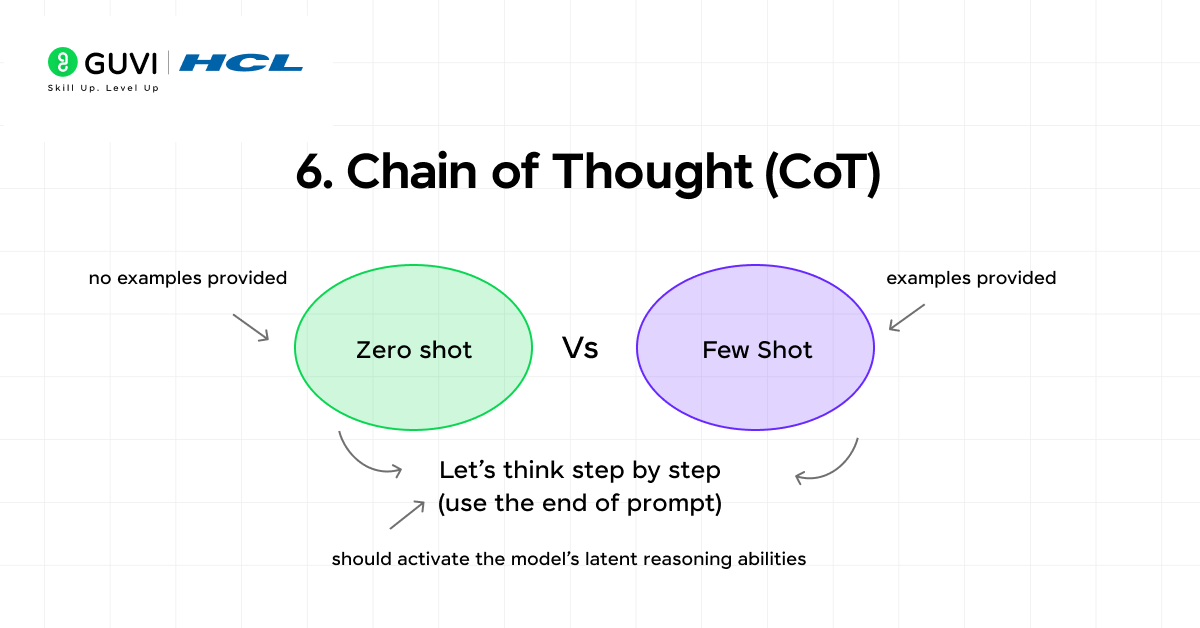
- Chain of Thought prompting guides language models to articulate their reasoning process step by step, leading to more accurate answers. By including intermediate reasoning steps in prompts, CoT unlocks sophisticated problem-solving capabilities.
- Research shows CoT prompting significantly enhances model performance—a PaLM 540B model achieved a 74% solve rate accuracy on math problems using CoT, compared to 55% with standard prompting. The approach works especially well for tasks requiring structured reasoning like mathematics and symbolic manipulation.
7. Chain-of-Agents Collaboration (CoA)

- Chain-of-Agents tackles complex tasks through sequential collaboration between multiple specialized agents. In this approach, worker agents handle different portions of input text and pass their findings to subsequent agents, with a manager agent synthesizing contributions into a coherent output.
- CoA outperforms standard approaches by up to 10% on long-context tasks in question answering, summarization, and code completion. Each agent focuses on a manageable chunk of content, overcoming limitations in processing extensive documents.
Real-World Use Cases of LLM Chains
Beyond theoretical concepts, LLM chains shine in practical applications that solve real business problems. Let’s explore four major implementation areas:

1) Chatbots with memory and context
The key feature of modern chatbots is their ability to use previous conversations as context. Without memory, every query would be treated as an independent input, making coherent conversations impossible. LangChain offers several memory options:
- ConversationBufferMemory: Stores complete conversation history
- ConversationSummaryMemory: Creates progressive summaries to save tokens
- ConversationWindowMemory: Maintains only recent messages
2) Document summarization and analysis
- Currently, LLM chaining excels at processing lengthy documents through map-reduce approaches. First, individual document sections receive their own summaries (map step).
- Then these summaries combine into a comprehensive overview (reduce step). This technique powers legal document analysis, meeting summaries, and multi-paper research reviews.
3) Semantic search and QA systems
Vector search forms the foundation for semantic search systems built with langchain chains. These systems:
- Convert documents into embeddings (vector representations)
- Store these embeddings in specialized databases
- Transform user questions into vectors with similar formatting
- Retrieve relevant passages based on semantic similarity
4) Personalized content generation
Indeed, LLM chains excel at creating tailored content. Marketing teams use them to generate personalized ad copy that improves click-through rates by up to 9% and lowers cost-per-click by 0.38%. These systems pull customer data from CRMs, combine it with language models, and produce customized messages for each recipient.
Unlock the power of LLM chains by mastering prompt chaining, tool use, and reasoning pipelines — skills you’ll explore deeply in HCL GUVI’s AI & ML Course, co-designed with Intel and IITM Pravartak, to build real-world intelligent systems.
Concluding Thoughts…
LLM chains represent a significant advancement in how we can work with language models. Throughout this guide, we’ve seen how these structured workflows transform complex tasks into manageable steps. Indeed, chains help overcome the limitations of single LLM calls by extending context windows, maintaining memory, and integrating external tools.
You don’t need to be an AI expert to start using LLM chains effectively. Many frameworks now provide pre-built components that you can assemble to create powerful workflows. Still, understanding the core concepts covered in this guide will help you design more effective solutions tailored to your specific needs.
FAQs
Q1. What is an LLM chain and how does it work?
An LLM chain is a structured sequence of connected components that use large language models alongside other tools to perform complex tasks. It works by breaking down tasks into smaller steps, processing information through multiple components, and maintaining context between prompts.
Q2. How do LLM chains differ from single LLM calls?
LLM chains can process information beyond a single context window, maintain memory between prompts, and allow for preprocessing, validation, and instrumentation. This makes them more powerful and flexible than standalone LLM calls for complex tasks.
Q3. What are some common types of LLM chains?
Common types include Simple Sequential Chains, Multi-Step Chains, Router Chains, Agent-Based Chains, Retrieval-Augmented Generation (RAG), Chain of Thought (CoT), and Chain-of-Agents Collaboration (CoA). Each type is designed for specific use cases and levels of complexity.
Q4. What are real-world applications of LLM chains?
LLM chains are used in various applications such as chatbots with memory and context, document summarization and analysis, semantic search and QA systems, and personalized content generation for marketing.
Q5. How do LLM chains improve AI performance?
LLM chains enhance AI performance by enabling step-by-step problem-solving, integrating external knowledge sources, maintaining context over long interactions, and allowing for more transparent and debuggable AI systems. This results in more accurate, reliable, and capable AI applications.
Success Stories

About the Author
Jaishree Tomar
A recent CS Graduate with a quirk for writing and coding, a Data Science and Machine Learning enthusiast trying to pave my own way with tech. I have worked as a freelancer with a UK-based Digital Marketing firm writing various tech blogs, articles, and code snippets. Now, working as a Technical Writer at GUVI writing to my heart’s content!
View all posts by Jaishree Tomar
Connect with me @













Did you enjoy this article?