


Artificial Intelligence and Machine Learning Articles
Finance Manager to Data Analytics: Career Growth, Salary and Seniority
How to Evaluate LLM Outputs in Production Deployments
AI/ML Skills Gap 2026: Why Companies Can't Find Job-Ready Talent
20 AI/ML Interview Questions Recruiters Can Use Without a Tech Background - Best Guide

Get In Touch For Details! Request More Information
Ontologies in AI: A Complete Beginner Guide
Jun 11, 2026 6 Min Read 2325 Views
(Last Updated)
You are building an AI system that needs to understand concepts like “a car is a type of vehicle” or “a person works for a company.” You need your system to reason about relationships, infer new knowledge, and share understanding across different applications.
A simple database stores facts. An ontology defines what those facts mean. It creates a formal structure that captures not just data, but the relationships, rules, and logic that govern how concepts in a domain connect to each other.
In this guide, you will learn exactly what ontologies in Ai are, how they work, why they matter for AI, and how to build them correctly for real-world knowledge representation challenges.
Table of contents
- Quick TL;DR Summary
- Why Simple Data Models Are Not Enough
- How Ontologies Work: The Core Components
- Step 1: Define classes and class hierarchies
- Step 2: Specify properties and relationships
- Step 3: Create individuals and assertions
- Step 4: Define axioms and constraints
- Step 5: Apply reasoning to infer new knowledge
- The Languages of Ontologies: RDF, RDFS, and OWL
- Types of Ontologies: From Abstract to Specific
- Type 1: Upper Ontologies
- Type 2: Domain Ontologies
- Type 3: Task Ontologies
- Type 4: Application Ontologies
- Type 5: Lightweight Ontologies
- Type 6: Heavyweight Ontologies
- Type 7: Reference Ontologies
- Common Mistakes Developers Make
- Getting Maximum Value From Ontologies
- Real-World Applications of Ontologies
- Conclusion
- FAQs
- What is the difference between an ontology and a knowledge graph?
- When should I use an ontology over a relational database?
- Can ontologies scale to millions of entities?
- What tools should I use to build ontologies?
- How do I validate that my ontology is correct?
Quick TL;DR Summary
- This guide explains what ontologies are and how they provide formal structures for knowledge representation that enable machines to understand and reason about information.
- You will learn the difference between taxonomies, ontologies, and knowledge graphs and when each approach is the right choice for your knowledge representation needs.
- The guide covers the key components of ontologies including classes, properties, individuals, and axioms that make formal knowledge representation possible.
- Step-by-step instructions show you how to design ontologies using standards like OWL and RDF and apply them to real-world AI problems.
- You will understand the different types of ontologies from upper ontologies to domain-specific ontologies and how to choose the right approach for your specific use case.
What Is an Ontology?
An ontology is a formal and explicit representation of knowledge within a specific domain that defines the entities, concepts, properties, and relationships that exist in that domain. It provides a shared conceptual framework that both humans and machines can understand, enabling systems to organize information, reason about data, and support knowledge-based applications. Ontologies are widely used in artificial intelligence, semantic web technologies, knowledge graphs, and data integration to create structured, machine-interpretable knowledge models.
Why Simple Data Models Are Not Enough
- They capture data but not meaning
Traditional databases store information in tables and rows, but they do not encode what that information means. They know that “John” has a relationship to “Acme Corp” but not whether he owns it, works for it, or bought something from it. Without explicit semantics, machine learning models and AI systems cannot reason about the data effectively.
- They cannot support automated reasoning
A database can tell you what is stored. An ontology can tell you what must be true based on what is stored. If your ontology defines that all managers are employees, and you assert John is a manager, a reasoner can automatically infer John is an employee. This kind of logical inference is impossible with simple data models.
- They do not enable knowledge sharing across systems
Different systems use different field names, different structures, and different assumptions. They provide a shared vocabulary and explicit definitions that let different systems exchange knowledge without ambiguity. The semantic web works because ontologies define what terms mean in a machine-readable way.
- They cannot handle complex domain knowledge
Real domains have hierarchies, constraints, exceptions, and complex relationships that simple schemas cannot express. Medical knowledge includes “a symptom can indicate multiple diseases” and “treatments have contraindications.” Ontologies can model these nuances formally.
- They lack the flexibility for evolving knowledge
As understanding of a domain grows, they can be extended with new classes and relationships while maintaining logical consistency. Traditional schemas require breaking changes. Ontologies are designed for knowledge evolution.
Read More: Top 20 Graph Algorithms You Must Know
How Ontologies Work: The Core Components
Step 1: Define classes and class hierarchies
Classes represent categories of things in your domain. In a medical ontology, you might have classes like Disease, Symptom, Treatment, and Patient. Classes are organized in hierarchies using subsumption relationships where more specific classes inherit properties from general ones. Infectious Disease is a subclass of Disease.
Step 2: Specify properties and relationships
Properties define how instances of classes relate to each other. Object properties connect individuals to other individuals, like “diagnosed with” connecting a Patient to a Disease. Datatype properties connect individuals to literal values, like “age” connecting a Patient to an integer. Properties can have domains, ranges, and logical characteristics.
Step 3: Create individuals and assertions
Individuals are specific instances of classes. While classes define categories, individuals are the actual things being described. Patient_12345 is an individual of class Patient. Facts about individuals are assertions, like “Patient_12345 diagnosed with Pneumonia.”
Step 4: Define axioms and constraints
Axioms are logical statements that must be true in your domain. They include restrictions like “every Treatment must have at least one Indication,” equivalences like “Aspirin is equivalent to Acetylsalicylic Acid,” and disjointness statements like “Animal and Plant are disjoint classes.” These axioms enable automated reasoning.
Step 5: Apply reasoning to infer new knowledge
A reasoner takes your ontology with its classes, properties, individuals, and axioms, then applies logical rules to derive facts that were not explicitly stated. If your ontology says all antibiotics are Medications, and Penicillin is an Antibiotic, the reasoner infers Penicillin is a Medication automatically.
The Gene Ontology (GO) is one of the most influential knowledge frameworks in bioinformatics, providing a standardized vocabulary for describing gene functions, biological processes, and cellular components. With tens of thousands of carefully curated terms, GO allows researchers around the world to annotate genetic data in a consistent, machine-readable format. This shared ontology makes it possible to compare results across studies, automate large-scale biological analyses, and uncover patterns across millions of genes and proteins, accelerating research in genomics, drug discovery, and molecular biology.
The Languages of Ontologies: RDF, RDFS, and OWL
- RDF: The foundation for semantic data
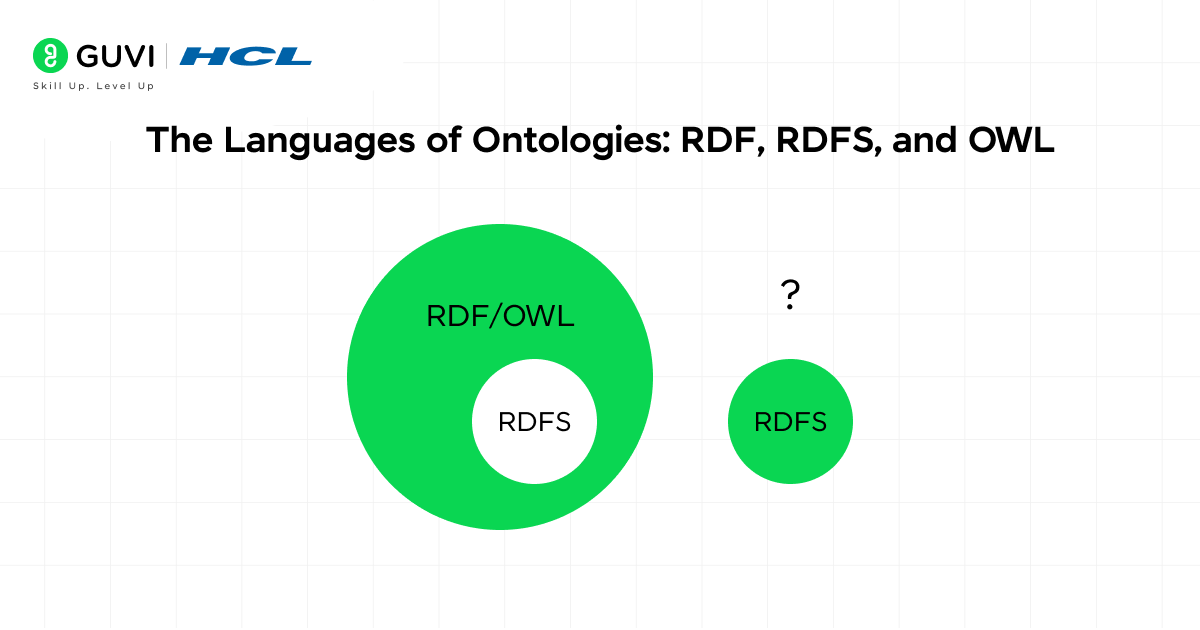
Resource Description Framework (RDF) expresses knowledge as subject-predicate-object triples. “Aspirin treats Headache” becomes a triple where Aspirin is the subject, treats is the predicate, and Headache is the object. RDF provides the basic structure for representing facts but does not include rich semantics.
- RDFS: Adding basic ontology features
RDF Schema extends RDF with classes, subclass relationships, properties, and domain and range constraints. It lets you say “Drug is a class” and “Aspirin is an instance of Drug” and “treats has domain Drug and range Disease.” RDFS adds lightweight semantic structure to RDF.
- OWL: Full ontological expressiveness
Web Ontology Language (OWL) adds logical expressiveness far beyond RDFS. It supports property characteristics like transitivity and symmetry, class expressions like unions and intersections, cardinality constraints, and equivalence and disjointness axioms. OWL comes in profiles with different computational complexity tradeoffs.
- Choosing the right language for your needs
Use RDF when you just need to express simple facts. Use RDFS when you need basic hierarchies and typing. Use OWL when you need rich logical constraints and automated reasoning. Most production knowledge graphs use RDF with selective RDFS and OWL features where reasoning is needed.
Want to understand the future of intelligent systems? Download HCL GUVI’s free Generative AI eBook and explore the technologies, concepts, and breakthroughs driving the next intelligence revolution in AI.
Types of Ontologies: From Abstract to Specific
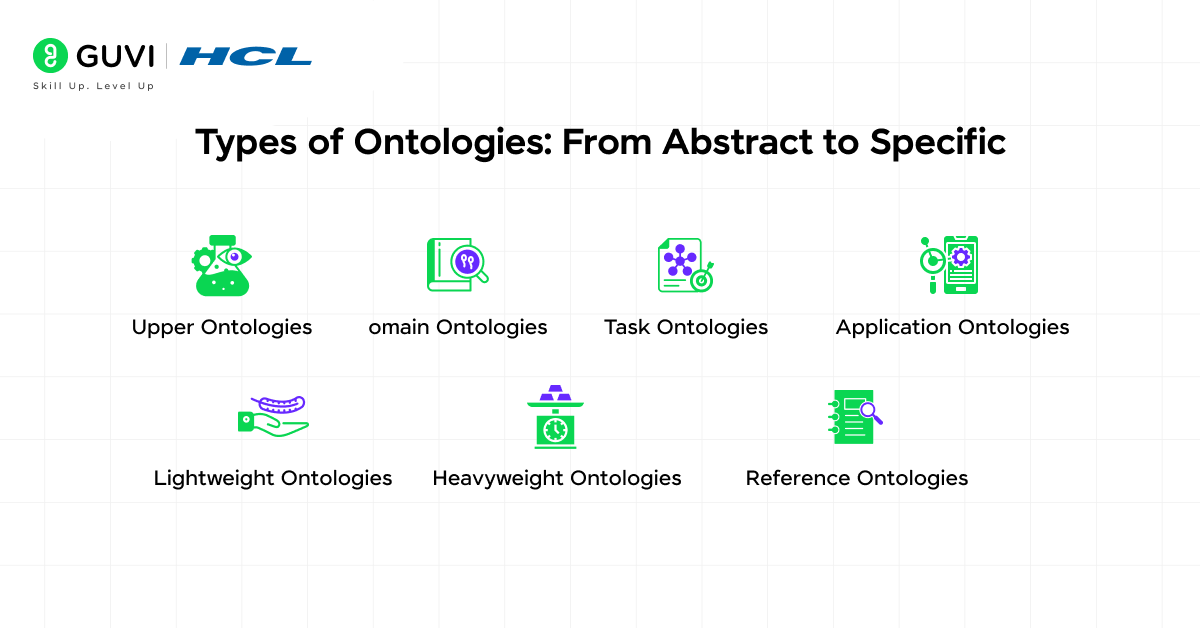
Here is how ontologies are categorized from most general to most specific and when to use each type.
Type 1: Upper Ontologies
The most abstract level of knowledge representation
Upper ontologies define very general concepts like Object, Event, Process, Quality, and Relation that apply across all domains. They provide a foundation that domain ontologies can build on. Examples include BFO (Basic Formal Ontology), DOLCE, and SUMO. Use upper ontologies when you need to integrate knowledge across fundamentally different domains.

Type 2: Domain Ontologies
Specialized knowledge for specific fields
Domain ontologies model concepts specific to fields like medicine, finance, manufacturing, or law. The SNOMED CT ontology contains over 350,000 medical concepts. The Financial Industry Business Ontology (FIBO) defines banking and finance terms. Domain ontologies capture expert knowledge in a machine-processable form.
Type 3: Task Ontologies
Organized around activities and processes
Task ontologies model activities, goals, and processes rather than static domain knowledge. A manufacturing task ontology might define Assembly, Quality Control, and Packaging as processes with inputs, outputs, and preconditions. Use task ontologies when reasoning about workflows and procedures.
Type 4: Application Ontologies
Built for specific software systems
Application ontologies combine domain and task knowledge for a particular application. A medical diagnosis system might have an application ontology that mixes disease knowledge with diagnostic reasoning processes. These are the most specific and directly executable ontologies.
Type 5: Lightweight Ontologies
Simple vocabularies and taxonomies
Lightweight ontologies provide controlled vocabularies and simple hierarchies without complex logical axioms. They are faster to build and easier to maintain but support less sophisticated reasoning. Use them when you need shared terminology but not deep inference.
Type 6: Heavyweight Ontologies
Rich logical specifications with extensive axioms
Heavyweight ontologies include comprehensive axioms that enable sophisticated automated reasoning. They take much longer to develop and maintain but can answer complex queries and detect inconsistencies automatically. Use them when correctness and deep reasoning matter more than development speed.
Type 7: Reference Ontologies
Standards for knowledge sharing
Reference ontologies serve as authoritative standards that multiple organizations adopt. They enable interoperability by providing canonical definitions of domain concepts. Building a reference ontology requires consensus across stakeholders and careful formal specification.
Common Mistakes Developers Make
- Confusing ontologies with database schemas and missing the semantic layer
- Creating overly complex hierarchies that are hard to maintain and reason over
- Not using established upper ontologies and reinventing basic concepts poorly
- Building ontologies in isolation without validating against real use cases
- Ignoring reasoning performance and creating ontologies that are too slow to use
- Mixing levels of abstraction and putting both general and specific concepts in one hierarchy
- Not versioning ontologies properly as domain understanding evolves
- Using OWL features that are theoretically elegant but computationally intractable for your data scale
Getting Maximum Value From Ontologies
- Start with competency questions that define what the ontology must answer
- Reuse existing ontologies and standards rather than building from scratch
- Validate your ontology with domain experts throughout development
- Test reasoning performance early with realistic data volumes
- Use ontology design patterns for common modeling situations
- Version your ontologies and manage evolution systematically
- Build tooling to help domain experts contribute without learning OWL syntax
Google’s Knowledge Graph contains hundreds of billions of facts about billions of entities, organized using knowledge representation techniques inspired by ontologies and semantic networks. When you search for a query such as “who directed Inception”, Google does more than match keywords—it understands that a director is a relationship between a person and a film. This structured understanding enables search engines to deliver direct answers, knowledge panels, and entity-based results instead of simply returning a list of webpages, making modern search far more intelligent and context-aware.
Real-World Applications of Ontologies
Ontologies serve as the foundation for many modern AI and machine learning applications. From deep learning models that need structured knowledge to autonomous systems that must reason about their environment, ontologies provide the semantic layer that transforms data into actionable intelligence.
- Semantic search and question answering
Search engines use ontologies to understand that “car” and “automobile” are equivalent, that “Paris” is a City, and cities have properties like population and location. This enables semantic search that answers questions rather than just matching keywords. They turn search into knowledge retrieval.
- Healthcare and biomedical research
Medical ontologies like SNOMED CT and the Disease Ontology enable electronic health records to share patient data, clinical decision support systems to reason about treatments, and researchers to integrate findings across millions of publications. Ontologies are critical infrastructure for precision medicine.
- Enterprise knowledge management
Large organizations use ontologies to organize institutional knowledge, connect information across departments, and enable employees to find expertise and resources. Ontologies model organizational structure, business processes, and domain knowledge in an integrated, searchable way.
To learn more about ontologies and knowledge representation, enroll in this AI and Machine Learning course covering AI fundamentals, Python, deep learning, NLP, and computer vision through hands-on projects and expert guidance with certification.
Conclusion
Ontologies are the foundation of knowledge representation in artificial intelligence. The core insight is that machines need more than data. They need explicit models of what concepts mean, how they relate, and what can be logically inferred from facts.
The formal structure of classes, properties, individuals, and axioms transforms information into knowledge that machines can reason about. Get the ontology design right and you enable systems to answer questions they were never explicitly programmed to handle.
They also give you the foundation to build knowledge graphs, semantic applications, and intelligent systems that understand context. The languages like RDF and OWL, the reasoning engines, and the design patterns appear across all of them.
FAQs
1. What is the difference between an ontology and a knowledge graph?
An ontology defines the schema with classes, properties, and rules. A knowledge graph is a graph database populated with instances that conform to an ontology’s structure. The ontology is the model; the knowledge graph is the data.
2. When should I use an ontology over a relational database?
Use an ontology when you need semantic reasoning, knowledge sharing across systems, or flexible schema evolution. Use a relational database when you have a stable schema, need transactional guarantees, and do not require logical inference.
3. Can ontologies scale to millions of entities?
Yes, but reasoning complexity matters. Lightweight ontologies with basic RDFS semantics scale well. Heavy OWL ontologies with complex axioms can become slow. Use OWL profiles like OWL QL and OWL RL for scalability, and test reasoning performance early.
4. What tools should I use to build ontologies?
Protégé is the most widely used ontology editor, supporting OWL and providing reasoning and visualization. For programmatic access, use libraries like Owlready2 for Python, Apache Jena for Java, or RDFLib for Python when working with RDF.
5. How do I validate that my ontology is correct?
Test it against competency questions it should answer. Run consistency checks with a reasoner. Validate with domain experts. Check that inferred knowledge matches expected results. Use ontology metrics to detect overly complex or poorly structured areas.
Success Stories

About the Author
Vishalini Devarajan
An Aerospace Engineer turned content writer, I focus on making complex concepts easy to understand through well-structured, reader-friendly blogs. Whether it’s a technical topic or a non-technical one, I love creating content that is clear, engaging, and impactful.
View all posts by Vishalini Devarajan
Connect with me @










Did you enjoy this article?