


Artificial Intelligence and Machine Learning Articles
AI/ML Skills Gap 2026: Why Companies Can't Find Job-Ready Talent
20 AI/ML Interview Questions Recruiters Can Use Without a Tech Background - Best Guide
How Industry-Backed AI/ML Bootcamps Are Changing the AI/ML Hiring Pipeline - Best Guide 2026
From IT Support to AI Engineer: A Realistic Career Switch Guide 2026
Get In Touch For Details! Request More Information
Who is an Agentic AI Developer? Role, Skills and Salary in 2026
Aug 27, 2026 8 Min Read 6934 Views
(Last Updated)
Picture a software that wakes up, checks your calendar, does the research your day needs, books the meetings, fixes its own mistakes, and only then tells you what it did. That’s not a movie plot; it’s what a new kind of engineer is building right now.
An Agentic AI Developer builds AI systems that can plan, decide, and take action on their own within defined limits, rather than just answering a single prompt and stopping there.
This guide covers what the role actually involves, how it differs from regular AI development, the skills and tools you need, a 2026 roadmap to get there, and what it pays in India and globally.
Table of contents
- TL;DR Summary
- Understanding the Term "Agentic AI"
- Who is an Agentic AI Developer?
- Agentic AI vs Regular AI Development: Key Difference
- Key Skills of an Agentic AI Developer
- Basic Knowledge in Programming
- Mastery of Large Language Models (LLMs)
- The Frameworks of Agency
- Tool Integration and Function Calling
- Safety, Security, and Ethics
- Agentic AI Developer Skills at a Glance
- Why is the Role of an Agentic AI Developer Important?
- Agentic AI Developer Salary in India and Globally
- In India (Agentic AI Developer pay by experience)
- Globally (Agentic AI Developer pay by region)
- Career Path to Becoming an Agentic AI Developer
- Common Mistakes Students Must Avoid
- The Future is Agentic: What Lies Ahead?
- Wrapping It Up…
- FAQs
- Is a Computer Science degree a requirement to be an Agentic AI Developer?
- What's the difference between an AI Engineer and an Agentic AI Developer?
- Do I need advanced math skills?
- What beginner projects can I work on?
- What is the difference between an AI course and an AI & ML course?
- Why is SQL important for AI & ML professionals?
- What job roles can I apply for after completing an AI & ML course?
- How do I choose the best AI course for my career goals?
- What should I look for before enrolling in an AI & ML course?
- How should I evaluate AI & ML certifications before enrolling?
TL;DR Summary
- An Agentic AI Developer designs autonomous AI agents that can understand context, decide on actions, use tools, and complete multi-step tasks, not just generate a response.
- The core difference from regular AI development: traditional AI development builds models that predict or classify; agentic AI development builds systems that plan and act using those models.
- The five must-have skill areas are programming fundamentals, LLM knowledge, agent frameworks (LangChain, LangGraph, AutoGen, CrewAI), tool integration/function calling, and AI safety and ethics.
- Since Agentic AI Developer is a new job title, most salary data gets grouped under the broader “AI Engineer” or “AI/ML Engineer” category; expect wide ranges rather than one fixed number.
- In India, pay roughly spans ₹3 to ₹45+ LPA by experience; globally, the US leads at roughly $90K to $250K+, with the UK, Canada, and Western Europe trailing at somewhat lower ranges.
Understanding the Term “Agentic AI”
Before we define the role, it’s important to understand the term agentic. In psychology, “agency” refers to the capacity of an individual to make choices, formulate a solution, and act independently.
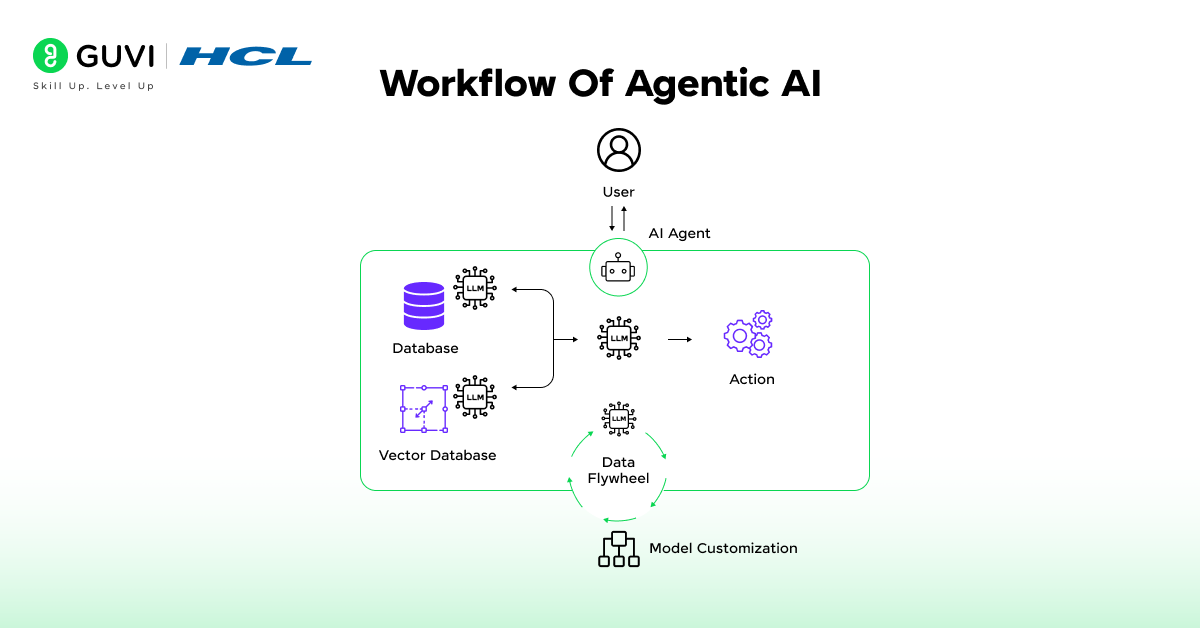
In AI terms, “agentic” describes systems or models that can act independently, make choices, and achieve their goals with little to no human involvement.
In summary, Agentic AI is not simply a system that processes data and returns a response; it incorporates the idea of building intelligent agents that can plan, reason, and carry out tasks like a digital teammate, which is exactly what an Agentic AI Developer designs.
Who is an Agentic AI Developer?
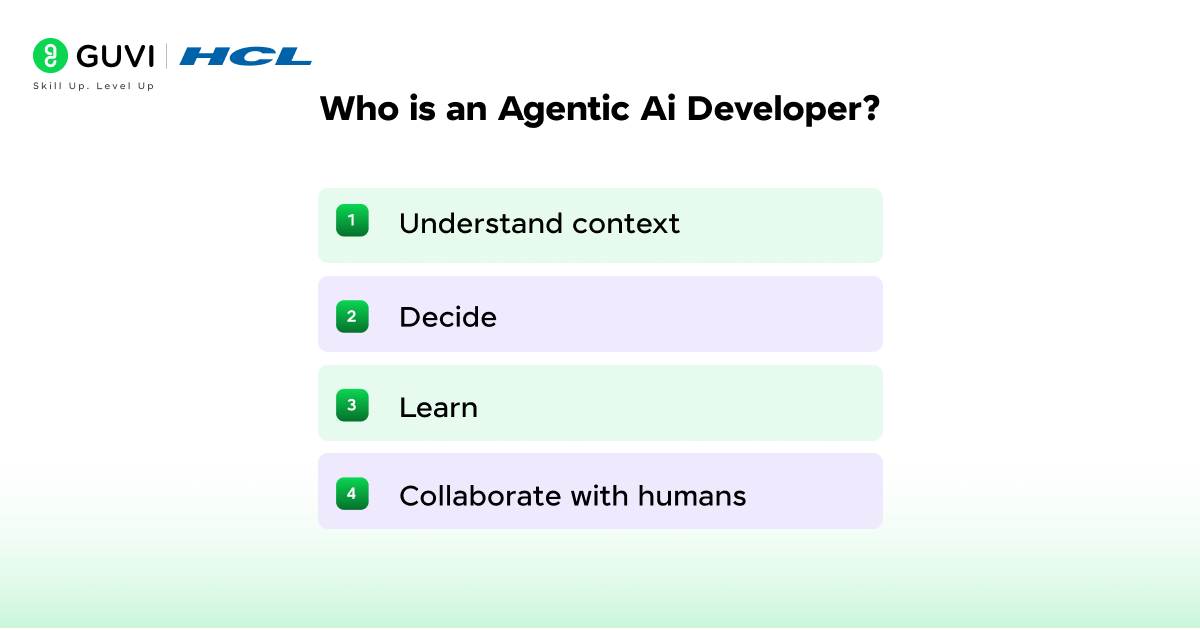
An Agentic AI Developer is a professional who designs, builds, and optimizes AI agents that can think and act autonomously, but within defined limits. Unlike a traditional AI developer, who focuses on designing and training AI models, an Agentic AI Developer focuses on creating autonomous systems that can:
- Understand context: not just follow instructions, but make decisions based on the situation.
- Decide: choose the best actions to accomplish a goal.
- Learn: get better with each interaction and more data.
- Collaborate with humans: work as a digital assistant, partner, or co-worker.
So an Agentic AI Developer builds AI that doesn’t just answer your questions, but helps you make plans, take actions, and get things done.
Curious about how AI agents really work? Start your journey with HCL GUVI’s free 5-day AI & ML Email Course and get practical lessons straight in your inbox.
Agentic AI vs Regular AI Development: Key Difference
The two roles overlap in tools and math, but they solve different problems. An Agentic AI Developer stands on top of what regular AI development produces, then adds planning, tool use, and autonomy on top of it.
| Aspect | Regular AI Development | Agentic AI Development |
|---|---|---|
| Main goal | Build a model that predicts, classifies, or generates output | Build a system that plans, decides, and acts to complete a goal |
| Typical output | A prediction, label, score, or generated text | A completed multi-step task, using tools and reasoning |
| Human involvement | A person interprets the output and decides what to do next | The agent acts within limits, then reports back |
| Feedback loop | Mostly static; the model is retrained periodically | Dynamic; the agent can retry, replan, and adjust mid-task |
| Core skills | Model training, data pipelines, evaluation metrics | LLM orchestration, function calling, agent frameworks |
| Typical tools | TensorFlow, PyTorch, scikit-learn | LangChain, LangGraph, AutoGen, CrewAI |
| Example | A model flags a transaction as potentially fraudulent | An agent investigates the flagged transaction, gathers evidence, and files a report |
In short, regular AI development answers “what is this?” while an Agentic AI Developer answers “what should be done about it, and who’s going to do it?”
Key Skills of an Agentic AI Developer
To succeed in this role, one needs a blend of technical expertise, creativity, and problem-solving skills. Here are some of the must-have skills:
1. Basic Knowledge in Programming
You cannot get away with the basics. Python is practically necessary in this field and is the lifeblood of modern AI. However, it is more than just writing a few scripts to be an Agentic AI Developer. You’ll need to:
- Master data structures (lists, dictionaries, queues, trees, graphs).
- Know APIs and how various systems are talking to one another.
- Learn to use software architecture well so that your projects can achieve scalability.
- Work with Git and version control and become a pro at collaborating and controlling codebases.
Think of this as the foundation of your “AI house.” Without strong basics, the advanced skills won’t hold up.
2. Mastery of Large Language Models (LLMs)
This is were is where agentic AI is developed. Smart agents are powered by LLMs and thus, you will require a good understanding of:
- The mechanism of LLMs: What they are capable of doing and what they cannot do, their biases and their hallucinations.
- The LLM Ecosystem: Try to get hands-on experiences with APIs to OpenAI (GPT), Anthropic (Claude), and Google (Gemini) and open-source models such as LLaMA (Meta) or Mistral.
- Context Management: Since LLMs have token limits, you need to understand how to feed the model appropriate data and at the appropriate time without exhausting it.
Example: Consider you are creating a study helper to remember what you have to do during your semester. If you don’t manage context windows properly, the model might “forget” older information and mess up your deadlines.
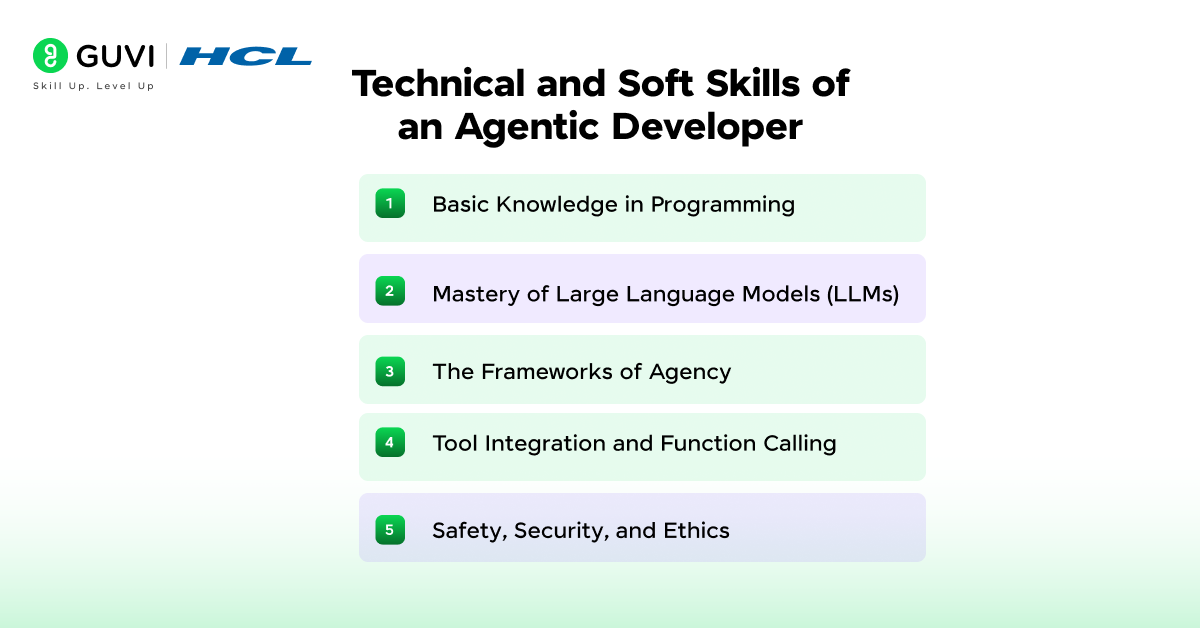
3. The Frameworks of Agency
As an Agentic AI Developer, you don’t have to reinvent the wheel. There are emerging frameworks built specifically for creating AI agents:
- LangChain / LangGraph: The go-to for chaining tasks, creating conversational applications, and creating multi-agent workflows that have state.
- AutoGen(Microsoft): A framework in which multi-agent communication and orchestration are simplified.Great for when you want multiple agents to collaborate.
- CrewAI: Ideal in role-playing agents, such as giving one AI the role of a “Researcher,” another the role of a writer, and the third the role of an editor, and collaborating as a team.
These structures resemble your Lego blocks. They assist you to put complex systems together in a short time.
4. Tool Integration and Function Calling
An AI agent’s intelligence is multiplied by the tools it can use. Imagine an agent that can not only generate text but also:
- Send emails
- Check your calendar
- Run code
- Query databases
This magic occurs in the form of function calling and API integration.
- Function Calling: Teach the agent to call specific functions like send_email() or execute_code() when needed.
- API Integration: API can be used to integrate with tools such as Slack, Google Calendar, weather information, or even cloud infrastructure.
Example: A student might create an agent that would automatically book study time with friends and check the availability of everyone on Google Calendar and send invitations.
5. Safety, Security, and Ethics
With great power comes great responsibility.The agentic AI is both immensely powerful and dangerous at the same time.That’s why safety is non-negotiable:
- Safety: Construct guardrails so your AI does not make harmful, unethical or irreversible choices.
- Security: Defend against prompt injection attacks where bad actors try to manipulate your AI’s behavior
- Cost Control: APIs may be costly to operate long workflows and you will require monitoring and optimization measures.
Being a good Agentic AI Developer does not merely mean being technical, they’re responsible architects of safe, useful systems.
Agentic AI Developer Skills at a Glance
Here’s a quick-reference table pulling together the five skill areas above, why each one matters, the tools tied to it, and roughly how hard it is to pick up.
| Skill | Why Needed | Tools | Difficulty to Learn |
|---|---|---|---|
| Python and programming fundamentals | Every agent is built on solid code, data structures, and APIs | Python, Git, REST APIs | Easy to moderate |
| LLM fundamentals | Powers the reasoning and decision-making core of any agent | OpenAI API, Anthropic Claude, Gemini, Hugging Face | Moderate |
| Agent frameworks | Saves you from reinventing orchestration and state management | LangChain, LangGraph, AutoGen, CrewAI | Moderate to hard |
| Tool integration and function calling | Lets agents actually take action, not just generate text | Function calling APIs, Slack, Calendar, database connectors | Moderate |
| AI safety, security, and ethics | Prevents harmful, biased, or manipulated agent behavior | Guardrail frameworks, prompt injection testing tools | Moderate to hard |
Why is the Role of an Agentic AI Developer Important?
The tech world is shifting from reactive AI (like chatbots that just answer queries) to proactive AI (agents that can anticipate needs and act independently). For example:
- In business, agentic AI can automate workflows, schedule meetings, or respond to customer queries without human involvement.
- In health, agentic AI can support doctors by continuously monitoring patient data and recommending actionable interventions whenever needed.
- In software development, agentic AI can assist developers by debugging code, writing documentation, or automatically deploying updates.
An Agentic AI Developer is at the heart of building these next-generation systems, making them one of the most in-demand roles of the future.
Agentic AI Developer Salary in India and Globally
Since Agentic AI Developer is a new job title, most salary trackers still group it under the broader “AI Engineer” or “AI/ML Engineer” category, rather than an Agentic AI Developer-specific bucket, so treat every figure below as a range, not a promise.
In India (Agentic AI Developer pay by experience)
Based on current AI/ML job trends, here’s an estimated salary breakdown by experience level:
| Experience Level | Years of Experience | Average Salary Range (₹ LPA) | What Employers Expect |
| Fresher / Entry-Level | 0 – 2 years | ₹3 LPA – ₹12 LPA | Strong Python skills, basic knowledge of LLMs, some project or internship experience. |
| Intermediate / Mid-Level | 2 – 5 years | ₹12 LPA – ₹25 LPA | Hands-on experience with frameworks like LangChain, AutoGen, CrewAI, ability to build and deploy AI agents. |
| Experienced / Senior | 5+ years | ₹25 LPA – ₹45+ LPA | Deep expertise in AI/ML, proven track record in deploying scalable agentic systems, leadership in AI-driven projects. |

Globally (Agentic AI Developer pay by region)
Salary benchmarks from ERI, Glassdoor, and industry compensation guides put agentic and general AI engineering pay in these ranges by region:
| Region | Entry-Level | Mid-Level | Senior-Level |
|---|---|---|---|
| United States | $90K to $130K | $120K to $180K | $180K to $250K+ |
| United Kingdom | £50K to £75K | £75K to £110K | £110K to £150K+ |
| Canada | ~$90K to $110K | ~$110K to $140K | $140K+ |
| Western Europe (avg.) | ~$60K to $80K | ~$80K to $120K | $120K to $160K+ |
| India | ₹3 LPA to ₹12 LPA | ₹12 LPA to ₹25 LPA | ₹25 LPA to ₹45+ LPA |
The US consistently pays the highest base salaries for this kind of work, while Western Europe and India offer lower absolute numbers but often stronger purchasing power relative to local cost of living.
As agentic AI matures as a distinct specialization, expect dedicated “Agentic AI Developer” salary bands to become more standardized over the next couple of years.
Career Path to Becoming an Agentic AI Developer
If you’re inspired by this role, the good news is you can absolutely learn and grow into it. Becoming an Agentic AI Developer doesn’t happen overnight, but with consistent effort and the right learning path, you can build the expertise step by step.
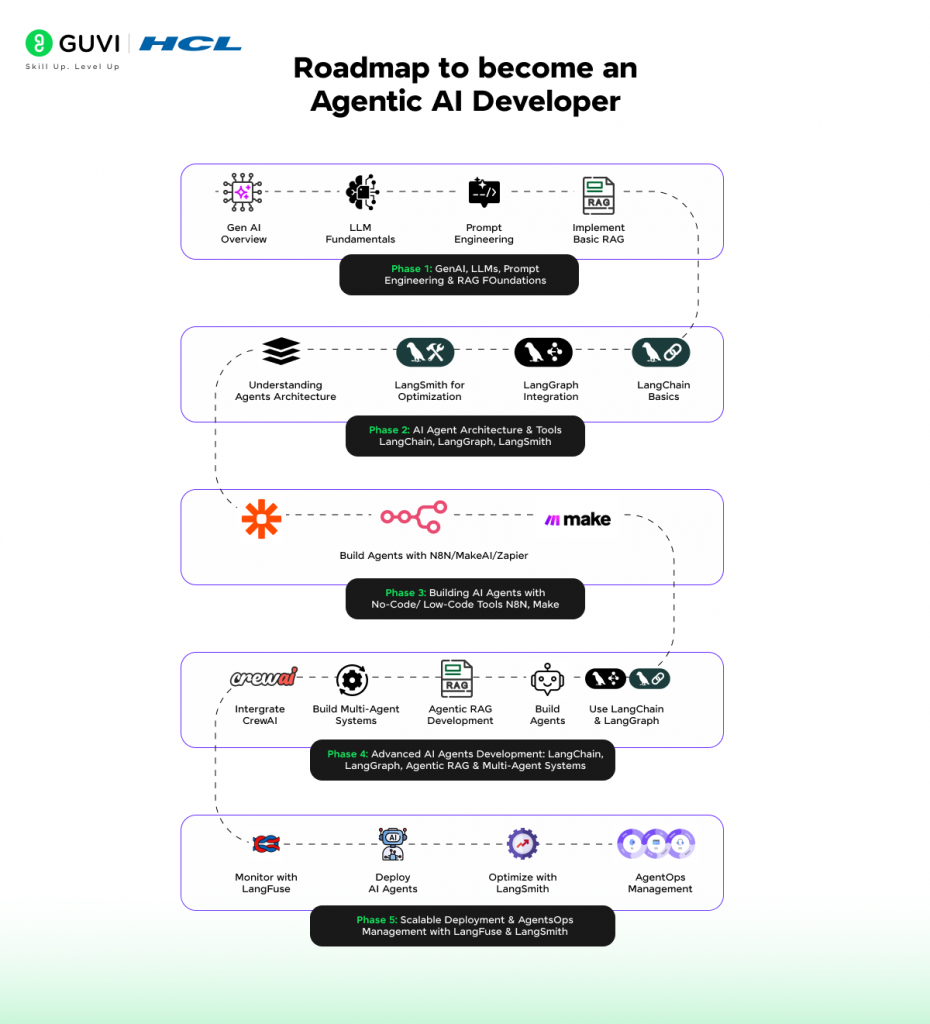
- Learn AI Basics
Begin by strengthening your knowledge of Python since this is the most used language for AI programming. After that, study the basics of machine learning and deep learning so you can develop an understanding of how algorithms learn from the data you provide. Subsequently, practice with some of the most popular platforms, TensorFlow and PyTorch - Explore Large Language Models (LLMs)
Since nearly all agentic systems are based on LLMs, you will also need to become familiar with LLMs (such as GPT + any derivative, LLaMA, Hugging Face’s transformers, etc.) and experiment with text generation tasks, summarisation and text reasoning to observe how LLMs react in particular contexts. - Work on Hands-On Projects
Theory is well and good, yet the greatest learning comes from projects. Start with smaller AI agents (for example a smart personal assistant, an automated research agent, etc.) working with a framework like LangChain, AutoGPT, or ReAct. Progressively tackle larger more challenging projects (for example, agents that can take multiple numerical steps, agents that make decisions, and agents that can complete tasks with minimal direction). - Understand Human-AI Interaction
A great AI agent is not just intelligence; it is also usability. Observe how people interact with AI systems and design and develop workflows that make interaction easy. Skills related to UX design for AI and a natural conversation flow will be an advantage to you. - Stay Ethical and Responsible
Agentic AI is powerful, but with great power comes responsibility. As a developer, you’ll need to ensure your systems are safe, unbiased, and transparent. This means learning about AI ethics, privacy, and responsible deployment practices so the AI you build is trustworthy and beneficial.
By following this path, you’ll not only learn how to build autonomous systems but also develop the mindset to create AI that is practical, safe, and impactful. And since agentic AI is still new, every project you work on helps you stand out as a pioneer in this exciting field.
Common Mistakes Students Must Avoid
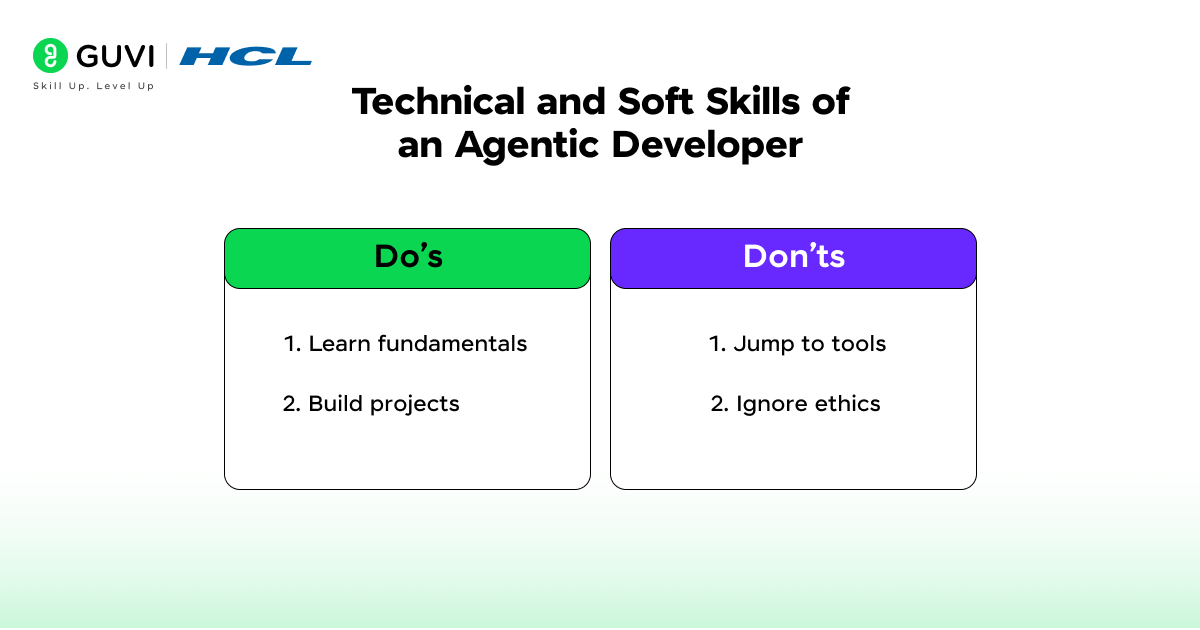
- Neglecting fundamentals: Jumping into LangChain before you understand some of the Machine Learning basics.
- Lack of practice: Reading tutorials instead of actually working on your own projects.
- Skipping ethics: Considering data privacy, bias, and a sense of responsible usage.
- Focusing on tools only: Lots of tools change, but problem-solving will last forever.
The Future is Agentic: What Lies Ahead?
The field is moving at lightning speed. The Agentic AI Developer of tomorrow will be working on even more exciting frontiers:
- Agent-Swarms: Coordinating hundreds or thousands of agents, which may be simple, to solve large-scale problems such as simulating economic markets or optimizing a global logistics network.
- Embodied Agents: Moving from the digital domain to the physical one, developing AI that can direct robots, autonomous vehicles, and smart homes with high fidelity and autonomy.
- Self-Improving Systems: Building agents whose primary purpose is to improve their own code, prompts and architecture, thus accelerating the pace of AI development itself.
- Governance and Ethics: As agents become more para-social or bonded to people, the new role will be to design AI constitution, democratic voting systems for agent swarms, and auditing all agent activity with transparency.
If you are enthusiastic about the future of AI and want to cultivate the skills to develop intelligent, autonomous agents, now is your chance. HCL GUVI’s AI & ML Course co-certified by IITM Pravartak), will help you learn everything from Python and Machine Learning to advanced LLM frameworks, in a comprehensive way, with practical projects and mentorship from trained experts.
Wrapping It Up…
So, who is an Agentic AI Developer?
They are a systems architect, a prompt whisperer, a tool-wielder, and an ethical steward. They stand between the raw potential of Large Language Models and a working AI agent that can change how people get things done.
They’re not just writing software; they’re building intelligent, proactive co-agents that extend what people can do.
If you’re a developer excited by the possibilities of AI, the Agentic AI Developer path is one of the most fulfilling you can pursue. It combines technical capability, creativity, and a healthy dose of responsibility.
It starts simply, with a shift in thinking: stop asking what your code should do, and start asking what you want your AI agent to accomplish.
The future won’t be written line by line; it will be carried out goal by goal by the Agentic AI Developer of vision. That future is being built today.
FAQs
1. Is a Computer Science degree a requirement to be an Agentic AI Developer?
No, you only need strong coding experience and an interest in AI. Many people come from non-CS backgrounds and learn through doing projects and courses.
2. What’s the difference between an AI Engineer and an Agentic AI Developer?
AI Engineers build and train models, while Agentic AI Developers turn those models into autonomous agents.
3. Do I need advanced math skills?
The only math skills needed for each project are the basics (probability, statistics, linear algebra). The math becomes somewhat complex, but most frameworks will handle that for you.
4. What beginner projects can I work on?
Beginners should work on small projects like a simple bot that automates tasks, an email assistant, or a chatbot to help students study.
5. What is the difference between an AI course and an AI & ML course?
An AI course focuses on artificial intelligence concepts, while an AI & ML course includes machine learning, deep learning, NLP, computer vision, and practical model-building skills. If you’re looking for hands-on AI and ML training, explore the HCL GUVI AI & ML Programme.
6. Why is SQL important for AI & ML professionals?
SQL helps AI & ML professionals extract, clean, and analyze data from databases, making it essential for building accurate machine learning models. Most industry-focused AI & ML programmes include SQL as a core data skill.
7. What job roles can I apply for after completing an AI & ML course?
You can apply for roles such as AI Engineer, Machine Learning Engineer, Data Scientist, NLP Engineer, Computer Vision Engineer, and AI Developer. To prepare for these roles, consider a project-based AI & ML Programme with career support.
8. How do I choose the best AI course for my career goals?
Choose an AI course based on your career goals, curriculum, hands-on projects, mentor support, industry tools, and placement assistance. A structured AI & ML Programme can help you build practical skills and a strong portfolio.
9. What should I look for before enrolling in an AI & ML course?
Look for a structured curriculum, practical projects, experienced mentors, updated AI tools, certification value, and career support. Compare programmes carefully before enrolling in an AI & ML Programme.
10. How should I evaluate AI & ML certifications before enrolling?
Evaluate AI & ML certifications based on industry recognition, curriculum relevance, hands-on learning, project experience, and career outcomes. You can also compare what’s included in the HCL GUVI AI & ML Programme before making a decision.
Success Stories

About the Author
Jebasta
I translate the language of data into stories that anyone can understand. As a writer with a data science background, I simplify analytics, AI, and decision-making so beginners and enthusiasts can confidently explore the world of data.
View all posts by Jebasta
Connect with me @






Did you enjoy this article?