


Data Science Articles
Data Warehouse vs. Data Lake vs. Lakehouse: What's the Difference?
SQL Window Functions: Practical Examples Every Analyst Needs
dbt for Beginners: Transform Data Like an Engineer
Data Storytelling: Turning Numbers into Narratives That Persuade


Get In Touch For Details! Request More Information
Data Scientist vs Full-Stack Developer in 2026: Salary, Skills and Best Career Choice
Aug 05, 2026 6 Min Read 11250 Views
(Last Updated)
Two of the most in-demand tech careers in India right now are Data Scientist and Full-Stack Developer. Both pay well, both are growing fast, and both require strong technical skills. But they are fundamentally different in what you build, how you work, and what kind of person thrives in each role. The Data Scientist vs. Full-Stack Developer question comes up constantly for students choosing a specialisation and professionals planning a career switch.
This guide breaks down the Data Scientist vs. Full-Stack Developer comparison across every dimension: roles, skills, salary, career path, and fit, so you can make a confident, informed decision in 2026. So, without further ado, let us get started!
Table of contents
- TL:DR
- Definition and Core Responsibilities
- Who Is a Data Scientist?
- Who Is a Full-Stack Developer?
- Required Technical Skills and Tools
- Data Scientist Skills
- Full-Stack Developer Skills
- Educational and Learning Paths
- Data Scientist learning path:
- Full-Stack Developer learning path:
- Career Opportunities and Industry Demand
- Data Scientist Career Path
- Full-Stack Developer Career Path
- Average Salary and Job Outlook
- India Salary by Experience Level
- Work Culture and Collaboration
- Data Scientist work culture:
- Full-Stack Developer work culture:
- Which Role Should You Choose?
- Can You Do Both?
- 💡 Did You Know?
- Data Scientist vs Full-Stack Developer: Detailed Comparison
- Real-World Examples and Applications of Data Scientist vs Full-Stack Developer
- E-commerce Platforms
- Banking and Fintech
- Healthcare
- Food Delivery
- Online Learning
- Common Mistakes to Avoid
- Conclusion
- FAQs
- Who earns more, a Full-Stack Developer or a Data Scientist?
- Is Data Scientist still a good career in 2026?
- Is full-stack development worth it in 2026?
- Which is better, data science or web development?
- Will AI replace Data Scientists?
- Is being a Data Scientist stressful?
TL:DR
A data scientist studies data to identify patterns, predict outcomes, and support business decisions. A full-stack developer builds complete web applications, covering both the user interface and server-side systems.
- Data science suits people interested in mathematics, statistics, and machine learning.
- Full-stack development suits people who enjoy coding and building usable digital products.
- Data scientists mainly produce models, insights, and dashboards.
- Full-stack developers mainly produce websites, applications, APIs, and software features.
- Full-stack development generally offers a more accessible entry path for beginners.
- Data science may offer higher average salaries but requires stronger analytical foundations.
Definition and Core Responsibilities
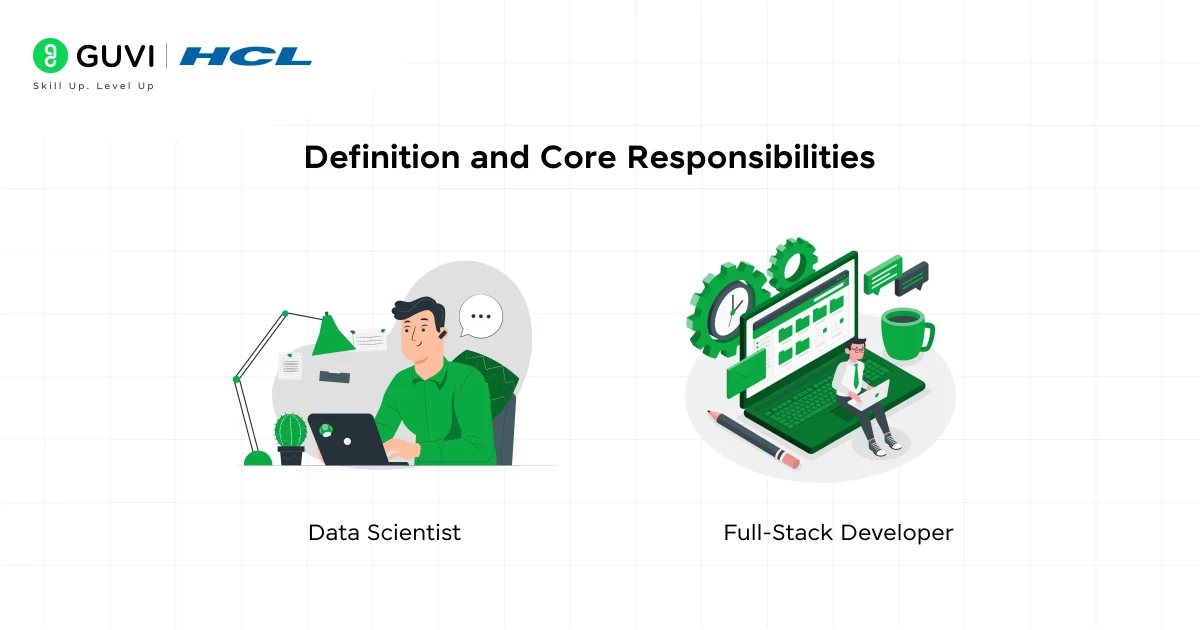
Who Is a Data Scientist?
In the Data Scientist vs. Full-Stack Developer debate, understanding what each role actually does day-to-day is the most important starting point. A data scientist collects, cleans, and analyses large datasets to uncover patterns and generate insights that drive business decisions. They build machine learning models, run statistical experiments, and communicate findings to non-technical stakeholders.
Key responsibilities:
- Collecting and cleaning data from multiple sources
- Building and evaluating ML and statistical models
- Running A/B tests and experiments
- Creating dashboards and data visualisations
- Communicating insights to business and product teams
Who Is a Full-Stack Developer?
On the other side of the Data Scientist vs. Full-Stack Developer comparison, a full-stack developer builds and maintains complete web applications — both the frontend (what users see) and the backend (the server, APIs, and database). They own features end-to-end, from the user interface to the database query.
Key responsibilities:
- Building responsive frontends using HTML, CSS, JavaScript, and React or Angular
- Developing backend APIs and server logic using Node.js, Python, or Java
- Managing databases — SQL and NoSQL
- Deploying and monitoring applications on cloud platforms
- Collaborating with designers, product managers, and DevOps engineers
If you want to know how to become a Full Stack Developer, read the blog – Full Stack Developer: Learn the Fastest Way to Become One
Required Technical Skills and Tools
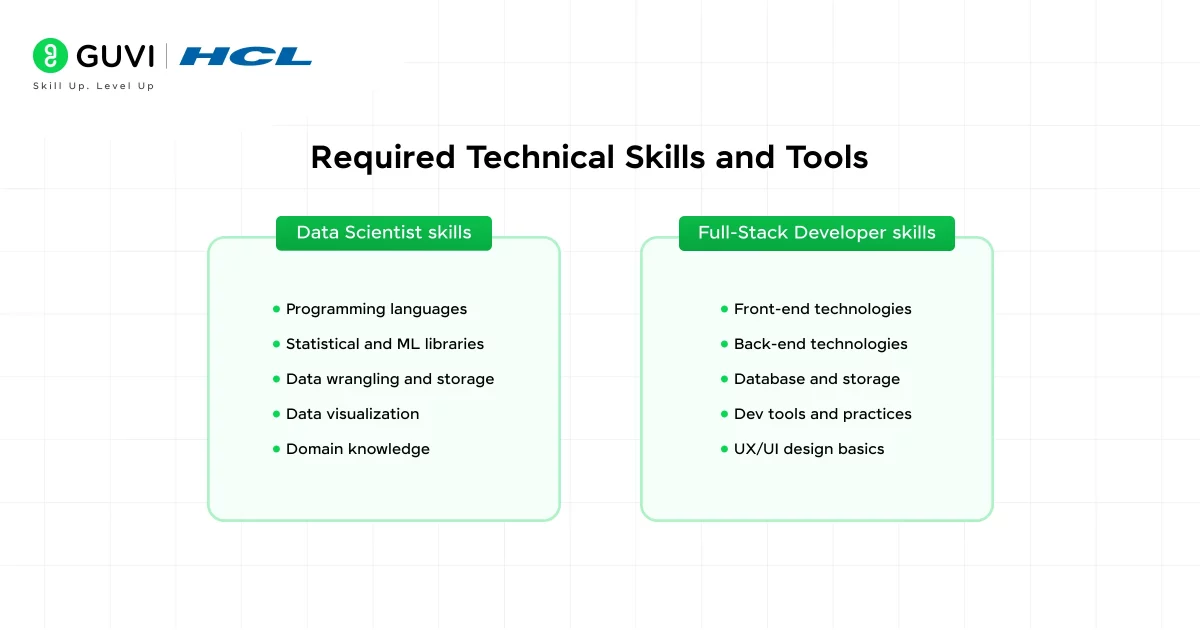
When evaluating Data Scientist vs. Full-Stack Developer as a career choice, skills are the most practical lens. Here is what each path demands.

Data Scientist Skills
| Category | Skills |
|---|---|
| Programming | Python, R, SQL |
| ML and Statistics | Scikit-learn, TensorFlow, PyTorch, NumPy, Pandas |
| Data Visualisation | Matplotlib, Seaborn, Tableau, Power BI |
| Big Data | Spark, Hadoop, Hive |
| Cloud | AWS SageMaker, Google BigQuery, Azure ML |
| Soft Skills | Storytelling with data, stakeholder communication |
Full-Stack Developer Skills
| Category | Skills |
|---|---|
| Frontend | HTML, CSS, JavaScript, React, Vue, Angular |
| Backend | Node.js, Express, Django, Spring Boot |
| Databases | MySQL, PostgreSQL, MongoDB, Redis |
| DevOps | Docker, Git, CI/CD, AWS or GCP deployment |
| APIs | REST, GraphQL |
| Soft Skills | Collaboration, problem-solving, debugging mindset |
Key insight for the Data Scientist vs. Full-Stack Developer decision: Both roles require Python and SQL. Learn those two well and switching paths later becomes much easier.
Educational and Learning Paths
Both careers value strong technical foundations, but the paths to get there can vary.
Data Scientist learning path:
Many data scientists start with a formal degree in a quantitative field (computer science, statistics, engineering, etc.). About 51% of data scientists have a bachelor’s degree, and 34% have a master’s.
Advanced degrees (master’s or PhDs) are common, especially in more research-oriented roles. However, data science is also accessible through other routes: online courses, bootcamps, and professional certificates are popular.
Many learners build portfolios by doing projects (Kaggle competitions, capstones) to demonstrate skills.
If you want to learn more about Data Science and become a Data Scientist through a structured program that starts from scratch, consider enrolling in HCL GUVI’s IIT-M Pravartak Certified Data Science Course, which empowers you with the skills and guidance for a successful and rewarding data science career!
Full-Stack Developer learning path:
Full-stack developers often have a degree in computer science or software engineering, but that’s not strictly required. Many developers are self-taught or come from coding bootcamps focusing on web development.
Education (formal or informal) typically includes computer science fundamentals plus hands-on coding practice. Bootcamps and online courses (on Coursera, Udacity, edX, etc.) can teach front-end and back-end frameworks. The key is to build a portfolio of web projects to show employers.
In both fields, lifelong learning is vital. For data science, this might mean learning new ML techniques or data tools. For full-stack, it means keeping up with evolving frameworks and languages.
Alternatively, if you want to learn more about Full-stack development and become a full-stack developer, consider enrolling in HCL GUVI’s IIT-M Pravartak certified Full Stack Development Course with AI Tools, which provides you with all the resources and guidance to have a successful full-stack career!
Career Opportunities and Industry Demand
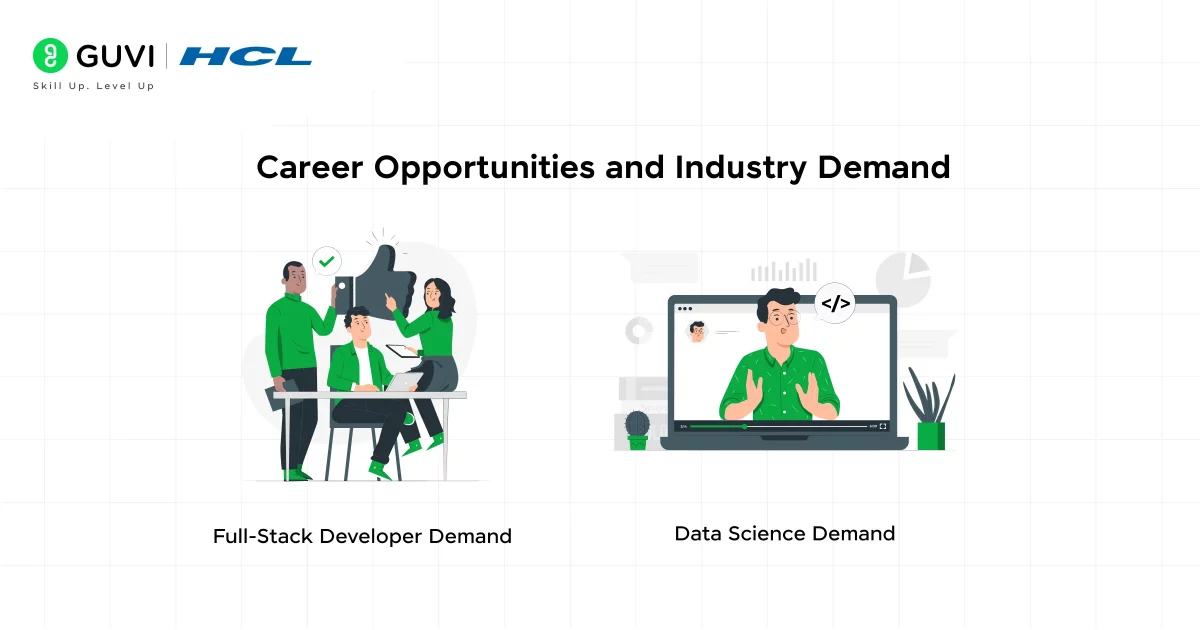
Career progression is another important dimension of the Data Scientist vs. Full-Stack Developer comparison. Both paths are well-defined and lead to strong senior roles.
Data Scientist Career Path
Junior Data Analyst → Data Scientist → Senior Data Scientist → Lead Data Scientist → Head of Data / Chief Data Officer
Specialisation tracks: ML Engineer, NLP Engineer, AI Research Scientist, Data Engineer
Full-Stack Developer Career Path
Junior Developer → Full-Stack Developer → Senior Developer → Tech Lead → Engineering Manager / Architect
Specialisation tracks: Frontend Specialist, Backend Engineer, DevOps Engineer, Cloud Architect
In the Data Scientist vs. Full-Stack Developer career path comparison, both paths offer leadership roles and the ability to move into management, product management, or entrepreneurship with experience.
Average Salary and Job Outlook
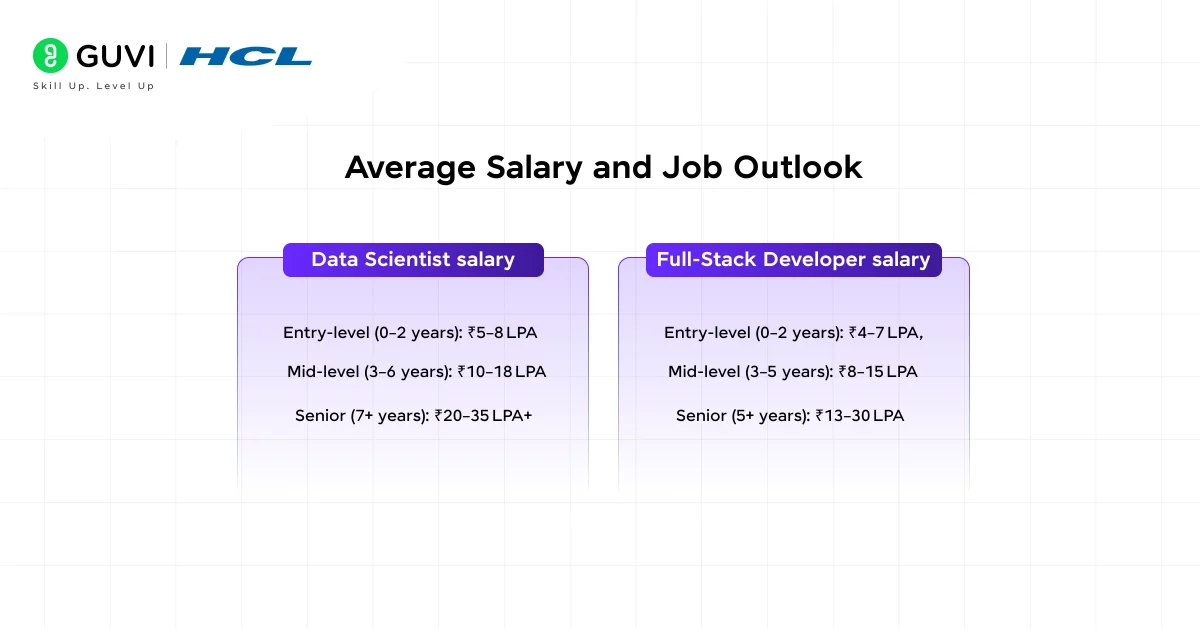
Salary is one of the most searched aspects of the Data Scientist vs. Full-Stack Developer debate. Here is what the data shows across experience levels in India.
India Salary by Experience Level
| Level | Data Scientist Salary | Full-Stack Developer Salary |
|---|---|---|
| Entry (0–2 years) | ₹6–10 LPA | ₹4–7 LPA |
| Mid (2–5 years) | ₹10–18 LPA | ₹7–14 LPA |
| Senior (5+ years) | ₹18–35 LPA | ₹14–28 LPA |
In the Data Scientist vs. Full-Stack Developer salary comparison, data scientists command higher averages in India, especially at product companies. However, full-stack developers reach their first job faster, which means they start earning sooner. The long-term earnings potential of both roles is strong in 2026.
Work Culture and Collaboration
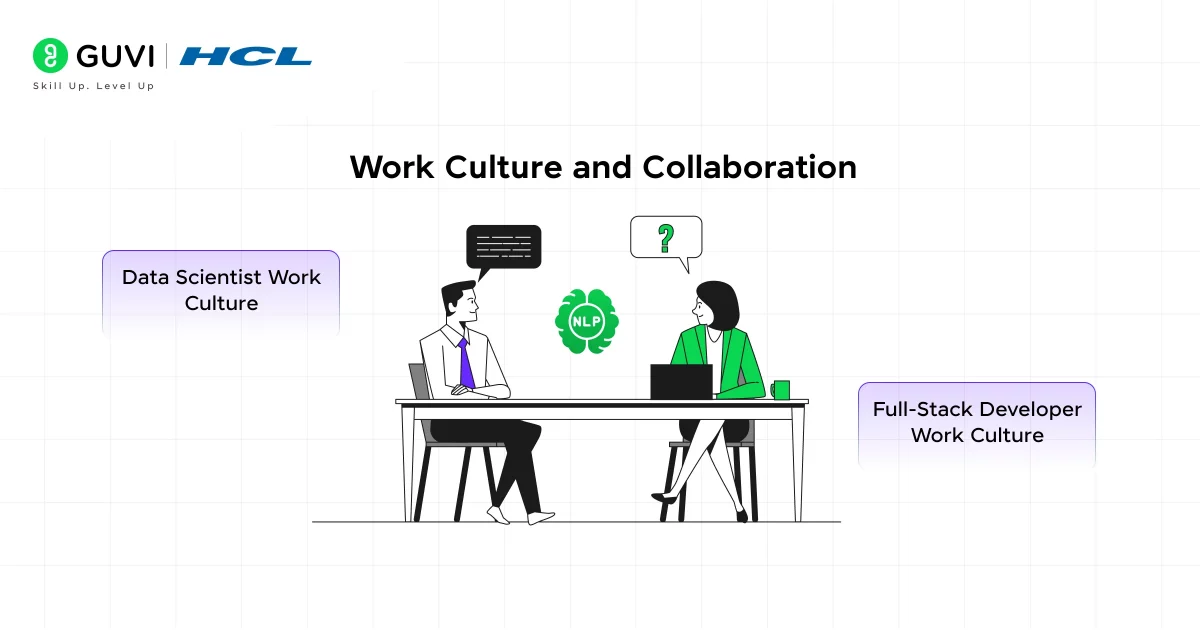
The day-to-day work environment for data scientists and full-stack developers can differ:
Data Scientist work culture:
Data scientists often work in interdisciplinary teams. They collaborate with business stakeholders (product managers, executives) to understand problems and with engineers to deploy models.
Their work can be project-based and research-like: exploring data, prototyping models, then iterating. This role requires strong problem-solving and analytical skills, as one must formulate questions and test hypotheses with data.
Depending on the company, there may be some flexibility, but deadlines around product releases or business decisions can demand intense focus periods.
Full-Stack Developer work culture:
Full-stack developers typically work in software teams using agile or Scrum processes. They constantly communicate with other developers (front-end, back-end, DevOps), designers, and QA.
Teamwork is crucial – each part of the application must fit together. According to Scaler, full-stack devs have cultures focused on “teamwork, adaptability, and continuous learning”. Sprints and frequent releases mean regular coding cycles and reviews.
Work-life balance is generally stable, but deadlines (especially before launches) can lead to overtime.
Which Role Should You Choose?
This is the heart of the Data Scientist vs. Full-Stack Developer question. Use this quick decision guide:
| If You… | Choose |
|---|---|
| Love working with data, statistics, and finding patterns | Data Scientist |
| Want to see your work go live as a product users interact with | Full-Stack Developer |
| Have a maths or statistics background | Data Scientist |
| Are starting from scratch with no prior technical experience | Full-Stack Developer |
| Want to get hired faster (shorter learning curve) | Full-Stack Developer |
| Want higher starting salary potential | Data Scientist |
| Enjoy research and experimentation over shipping features | Data Scientist |
| Like building and deploying things end-to-end | Full-Stack Developer |
| Work well with ambiguity and open-ended questions | Data Scientist |
| Prefer clear specs and defined outcomes | Full-Stack Developer |
Still unsure about the Data Scientist vs. Full-Stack Developer choice? Start with Full-Stack Development. It is more accessible as a beginner, gets you employed faster, and the Python and SQL skills you build transfer directly to data science if you want to switch later.
Can You Do Both?
A common follow-up to the Data Scientist vs. Full-Stack Developer question is — do I have to choose? The answer is no, eventually. Companies building data-driven products need engineers who can both build the application and work with the data it generates. Some emerging role titles that bridge the Data Scientist vs. Full-Stack Developer divide:
- ML Engineer — builds and deploys machine learning models in production systems, blending data science with software engineering
- Data Engineer — builds the pipelines and infrastructure that data scientists rely on
- Full-Stack Data Scientist — end-to-end ownership from data collection to model deployment to product integration
If you start as a full-stack developer, adding Python data science skills is a natural next step in the Data Scientist vs. Full-Stack Developer journey. If you start in data science, learning to build APIs and deploy models with Flask or FastAPI extends your impact significantly.
💡 Did You Know?
- According to LinkedIn’s India Jobs Report 2026, both Data Scientists and Full-Stack Developers rank among the top five most in-demand technology roles in the country.
- Job postings for both careers grew by more than 40% between 2023 and 2025, reflecting strong demand across industries.
- While India produces over 1.5 million engineering graduates each year, fewer than 15% possess the practical, job-ready skills employers look for, making project-based learning a key factor in getting hired.
Data Scientist vs Full-Stack Developer: Detailed Comparison
| Comparison Factor | Data Scientist | Full-Stack Developer |
|---|---|---|
| Primary focus | Extracting meaningful insights from data | Building complete web applications |
| Main output | Models, reports, forecasts and dashboards | Websites, applications, APIs and software features |
| Core languages | Python, SQL and R | JavaScript, TypeScript, Python, Java and SQL |
| Mathematics requirement | High | Low to moderate |
| Main skills | Statistics, machine learning, data analysis and visualisation | Frontend development, backend development, databases and deployment |
| Common tools | Pandas, Scikit-learn, PyTorch, Jupyter, MLflow and Power BI | React, Next.js, Node.js, Django, Git, Docker and PostgreSQL |
| Daily work | Cleaning data, testing models and presenting findings | Coding, testing, debugging and deploying features |
| Learning difficulty | Requires stronger mathematical and statistical foundations | More accessible for learners who enjoy programming |
| Common projects | Prediction models, recommendation systems and business dashboards | E-commerce websites, dashboards, SaaS products and mobile backends |
| Best suited for | People who enjoy numbers, patterns and open-ended questions | People who enjoy building products and solving coding problems |
| Career options | Data Scientist, ML Engineer, Data Analyst and AI Engineer | Frontend Developer, Backend Developer, Software Engineer and DevOps Engineer |
Real-World Examples and Applications of Data Scientist vs Full-Stack Developer
Data scientists and full-stack developers often work on the same product. However, they solve different problems and produce different outcomes.
1. E-commerce Platforms
A full-stack developer builds the product catalogue, shopping cart, payment flow, login system, and order-tracking features.
A data scientist studies customer behaviour, predicts product demand, recommends products, and identifies customers who may stop purchasing.
2. Banking and Fintech
A full-stack developer creates online banking portals, transaction dashboards, payment systems, and customer-facing applications.
A data scientist develops fraud-detection models, credit-risk systems, customer segmentation models, and financial forecasts.
3. Healthcare
A full-stack developer builds appointment platforms, telemedicine applications, patient portals, and hospital-management systems.
A data scientist analyses medical data, identifies health patterns, predicts patient risks, and supports clinical research.
4. Food Delivery
A full-stack developer builds the ordering interface, restaurant dashboard, payment system, and delivery-tracking features.
A data scientist forecasts demand, recommends restaurants, estimates delivery times, and helps determine how many delivery partners are needed.
5. Online Learning
A full-stack developer builds course pages, student dashboards, payment systems, assessments, and progress-tracking features.
A data scientist studies learning behaviour, recommends courses, predicts student drop-off, and identifies topics where learners need additional support.
Common Mistakes to Avoid
- Choosing a career based on salary alone. In the Data Scientist vs. Full-Stack Developer comparison, data science pays more on average, but if you hate statistics and love building products, you will struggle to stay motivated long enough to get there. Pick the role that matches how you naturally think.
- Trying to learn both simultaneously from day one. The overlap in Python and SQL is real, but the depth required in each path is significant. Master one before expanding into the other — trying to pursue the full Data Scientist vs. Full-Stack Developer skill set at once leads to shallow knowledge in both.
- Skipping projects and going straight into job applications. Both sides of the Data Scientist vs. Full-Stack Developer debate require a portfolio. A data scientist with no Kaggle projects and a full-stack developer with no deployed apps will not pass screening at any reputable company in 2026.
Conclusion
In conclusion, Data Scientists and Full-Stack Developers both enjoy strong career prospects and play crucial roles in technology, but they satisfy different interests: Both paths require strong coding skills, continual learning, and collaboration, but the day-to-day work differs.
Ultimately, both careers are dynamic and rewarding. Whichever you choose, focus on building a strong portfolio, staying curious, and collaborating well with others. The tech industry needs talented people in both data science and software development, so choose the one that excites you most, and you’re likely to find success.
FAQs
1. Who earns more, a Full-Stack Developer or a Data Scientist?
Data scientists often earn more on average because the role requires expertise in statistics, machine learning, and data modelling. However, experienced full-stack developers working in product companies, cloud platforms, or software architecture can earn equally competitive salaries.
2. Is Data Scientist still a good career in 2026?
Yes, data science remains a strong career in 2026. Companies need professionals who can analyse large datasets, build machine learning models, evaluate AI systems, and convert data into practical business decisions.
3. Is full-stack development worth it in 2026?
Yes, full-stack development remains worthwhile because businesses continue to build websites, SaaS platforms, mobile backends, APIs, and AI-powered applications. Developers who understand cloud deployment, cybersecurity, system design, and AI-assisted development have stronger opportunities.
4. Which is better, data science or web development?
Data science is better for people who enjoy mathematics, statistics, machine learning, and analytical work. Web development is better for people who enjoy coding interfaces, developing APIs, managing databases, and building applications users can directly access.
5. Will AI replace Data Scientists?
AI will automate tasks such as data cleaning, code generation, and basic model development. However, data scientists will still be needed to select suitable methods, validate results, detect bias, interpret findings, and connect models with business objectives.
6. Is being a Data Scientist stressful?
Data science can become stressful when datasets are incomplete, business expectations are unclear, or models fail to produce reliable results. Strong planning, communication, experimentation, and realistic project expectations can make the workload more manageable.
Success Stories

About the Author
Vaishali
I'm a seasoned writer with four years of experience across technical, non-technical, and just about every genre or niche you can imagine. Adaptable and curious, I enjoy exploring new topics and making information engaging and easy to understand. Fueled by a steady stream of tea, I approach each project with creativity, reliability, and genuine enthusiasm for storytelling.
View all posts by Vaishali
Connect with me @






Did you enjoy this article?