


Data Science Articles
Data Warehouse vs. Data Lake vs. Lakehouse: What's the Difference?
SQL Window Functions: Practical Examples Every Analyst Needs
dbt for Beginners: Transform Data Like an Engineer
Data Storytelling: Turning Numbers into Narratives That Persuade


Get In Touch For Details! Request More Information

DevOps vs Data Science in 2026: Which Is Better for Freshers in India?
Aug 23, 2026 5 Min Read 18174 Views
(Last Updated)
Still stuck between DevOps and Data Science? You’re not alone. Thousands of students and working professionals face this exact crossroads of DevOps vs Data Science every year, and choosing wrong can cost you months of effort. This article breaks down both fields clearly so you can make a confident, informed decision based on your strengths and career goals.
Quick Answer
DevOps focuses on software delivery, cloud infrastructure, automation, and reliability. Data Science focuses on data analysis, machine learning, and business insights.
The right choice depends on your skills and career interests:
- Choose DevOps for cloud, automation, CI/CD, Linux, and infrastructure.
- Choose Data Science for Python, SQL, statistics, and machine learning.
- DevOps Engineers in India earn around ₹7.9 lakh per year on average.
- Data Scientists earn around ₹12.1 lakh per year on average.
- Both fields offer strong career opportunities in India in 2026.
Table of contents
- What is DevOps and What Does a DevOps Engineer Actually Do?
- Key responsibilities of a DevOps Engineer:
- Core skills you need for DevOps:
- What is Data Science and What Does a Data Scientist Actually Do?
- Key responsibilities of a Data Scientist:
- Core skills you need for Data Science:
- DevOps vs Data Science: A Detailed Comparison
- Real-World Example: How Both Fields Are Used in Practice
- Best DevOps and Data Science Career Paths in India in 2026
- How to Choose Between DevOps and Data Science?
- Common Mistakes People Make When Choosing Between the Two
- Conclusion
- FAQs
- Is DevOps better than Data Science in 2026?
- Which pays more in India: DevOps or Data Science?
- Which is easier to learn: DevOps or Data Science?
- Is DevOps or Data Science better for freshers?
- Does DevOps require more coding than Data Science?
What is DevOps and What Does a DevOps Engineer Actually Do?

DevOps, short for Development and Operations, is a practice that brings together software developers and IT operations teams to deliver software faster and more reliably. It is less about writing code from scratch and more about building the systems that support code at scale.
If you enjoy solving infrastructure problems, automating repetitive tasks, and keeping production systems stable, DevOps will feel like a natural fit for you.
Key responsibilities of a DevOps Engineer:
- Automating deployment pipelines using Jenkins or GitLab CI
- Managing cloud infrastructure on AWS, Azure, or GCP
- Containerising applications using Docker and Kubernetes
- Monitoring system performance and responding to incidents
- Bridging the gap between development and operations teams
Core skills you need for DevOps:
- Scripting with Python, Bash, or Shell
- Cloud platforms (AWS, Azure, GCP)
- CI/CD pipeline tools (Jenkins, GitLab)
- Containerisation and orchestration (Docker, Kubernetes)
- Infrastructure as Code (Terraform, Ansible)
The global DevOps market was valued at over $10 billion in 2023 and is expected to grow at a CAGR of 19.7% through 2028, driven largely by enterprise cloud adoption and the shift to microservices architecture. (Source: MarketsandMarkets)
If you are more interested in DevOps than Data Science but don’t know how to start your career in that, refer to our article – A Complete DevOps Career Roadmap
What is Data Science and What Does a Data Scientist Actually Do?
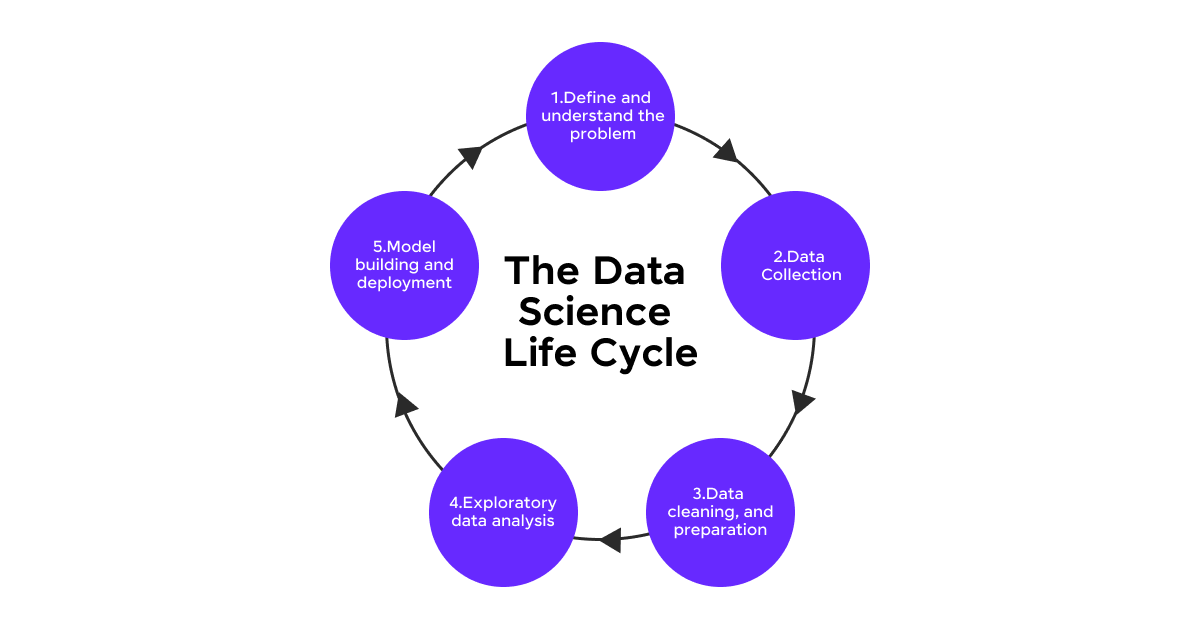
Data Science is the practice of extracting meaningful insights from large datasets to help businesses make better decisions. It sits at the intersection of statistics, programming, and domain knowledge.
If you enjoy working with numbers, building models, and communicating your findings to non-technical stakeholders, Data Science is probably your calling.

Key responsibilities of a Data Scientist:
- Collecting and cleaning raw datasets for analysis
- Building predictive models using machine learning techniques
- Using statistical methods to uncover trends and patterns
- Communicating findings through data visualisations and dashboards
- Collaborating with business teams to define data problems
Core skills you need for Data Science:
- Python or R for data analysis
- SQL for querying databases
- pandas 3.0 for data manipulation
- scikit-learn 1.9 for machine learning
- TensorFlow 2.21 for deep learning
- Tableau or Power BI for data visualisation
- Statistics and probability
- Machine learning fundamentals
- Note- The Data Science ecosystem has also changed significantly. pandas reached the 3.0 release line in 2026 while scikit-learn 1.9 arrived in June 2026. TensorFlow currently supports the 2.21 build line.
DevOps vs Data Science: A Detailed Comparison
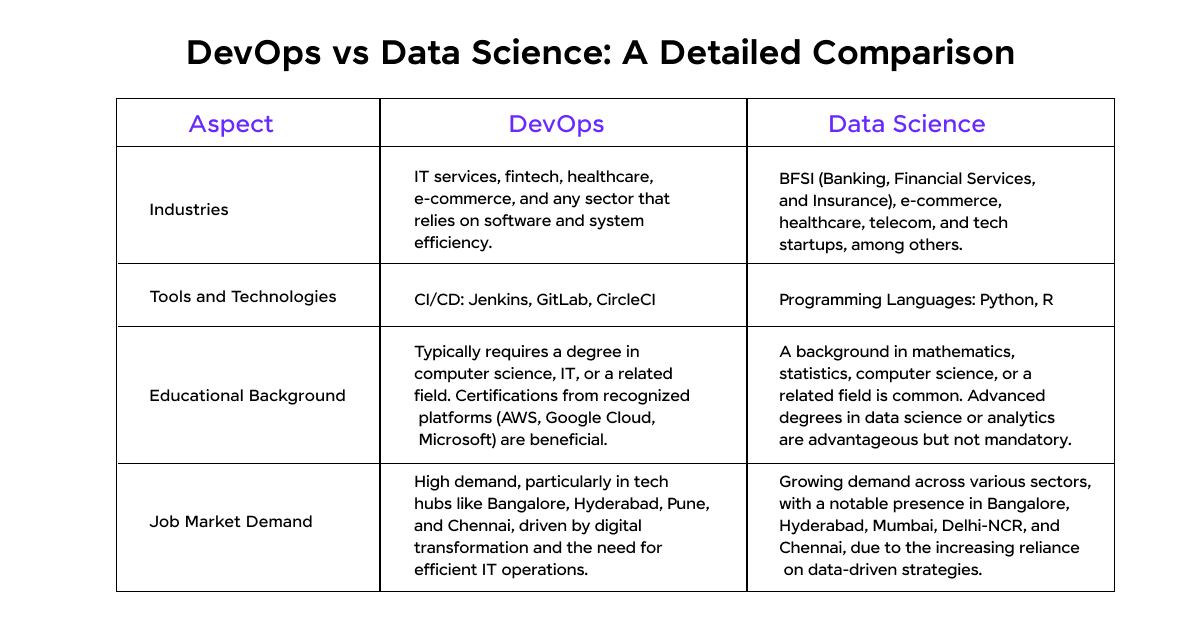
Now that you understand both the domains in the battle of DevOps vs Data Science, it is time for you to see the comparison in detail.
Here’s a detailed comparison of DevOps vs Data Science careers in India, highlighting the key aspects and industry-specific nuances:
| Aspect | DevOps | Data Science |
|---|---|---|
| Tools and Technologies | – CI/CD: Jenkins, GitLab, CircleCI – Infrastructure as Code: Terraform, Ansible – Monitoring: Prometheus, Grafana – Containers: Docker, Kubernetes | – Programming Languages: Python, R – Data Analysis: Pandas, SQL – Machine Learning: scikit-learn, TensorFlow, Keras – Visualization: Tableau, Power BI, Matplotlib |
| Educational Background | Typically requires a degree in computer science, IT, or a related field. Certifications from recognized platforms (AWS, Google Cloud, Microsoft) are beneficial. | A background in mathematics, statistics, computer science, or a related field is common. Advanced degrees in data science or analytics are advantageous but not mandatory. |
| Job Market Demand | High demand, particularly in tech hubs like Bangalore, Hyderabad, Pune, and Chennai, driven by digital transformation and the need for efficient IT operations. | Growing demand across various sectors, with a notable presence in Bangalore, Hyderabad, Mumbai, Delhi-NCR, and Chennai, due to the increasing reliance on data-driven strategies. |
| Industries | IT services, fintech, healthcare, e-commerce, and any sector that relies on software and system efficiency. | BFSI (Banking, Financial Services, and Insurance), e-commerce, healthcare, telecom, and tech startups, among others. |
This comparison of DevOps vs Data Science highlights the nuances of both fields that offer promising opportunities and require a unique set of skills, but the best choice depends on your personal interests and career goals.
Real-World Example: How Both Fields Are Used in Practice
To make this more concrete, consider how a large e-commerce company like Flipkart uses both.
The DevOps team ensures that during a high-traffic sale event, thousands of new server instances spin up automatically, deployments run without downtime, and monitoring dashboards flag issues in real time. Without DevOps, the platform goes down under load.
The Data Science team, meanwhile, is building recommendation models that predict what a user is likely to buy next, analysing cart abandonment patterns, and forecasting demand for inventory planning. Without Data Science, the business operates on gut instinct instead of data.
Both teams are essential. The question is which type of problem excites you more.
According to LinkedIn’s Jobs on the Rise report, Data Science and DevOps/Cloud Engineering consistently rank among the fastest-growing job categories in India. Companies hiring for these roles include Infosys, TCS, Flipkart, Razorpay, and Swiggy.
Best DevOps and Data Science Career Paths in India in 2026
Both DevOps and Data Science can lead to several specialised technology careers. You do not have to remain in the same role throughout your career.
Here are some of the best career paths to consider in India in 2026:
| Career Track | Starting or Core Roles | Advanced Roles | Best For |
| DevOps | DevOps Engineer, Cloud Engineer, Build and Release Engineer | Senior DevOps Engineer, SRE, Platform Engineer, DevOps Lead | Cloud and automation enthusiasts |
| Cloud Infrastructure | Cloud Support Engineer, Cloud Engineer | Cloud Architect, Solutions Architect | Professionals interested in AWS, Azure, or GCP |
| Site Reliability Engineering | DevOps Engineer, Systems Engineer | SRE, Senior SRE, Reliability Lead | People interested in performance and system reliability |
| Data Science | Junior Data Scientist, Data Analyst | Senior Data Scientist, Lead Data Scientist | Analytical problem-solvers |
| Machine Learning | ML Associate, Junior ML Engineer | ML Engineer, Senior ML Engineer, AI Engineer | People interested in predictive models and AI |
| Data and Analytics | Data Analyst, BI Analyst | Analytics Lead, Data Science Manager | Professionals interested in business insights |
The strongest career path is usually the one that matches your existing strengths. A learner with Linux, networking, or cloud experience may find DevOps easier to enter. Someone with mathematics, statistics, economics, or analytics experience may find Data Science more natural.
How to Choose Between DevOps and Data Science?
Choosing between the two fields comes down to knowing yourself. Here are a few honest questions to help you decide.
Choose DevOps if you:
- Enjoy working with infrastructure and cloud systems
- Like problem-solving under pressure (production outages, performance issues)
- Prefer tools-heavy, hands-on technical work
- Have a background in networking, system administration, or backend development
Choose Data Science if you:
- Enjoy working with numbers, patterns, and statistics
- Like building models and testing hypotheses
- Are comfortable with ambiguity and open-ended problems
- Have a background in maths, economics, or any quantitative field
The career growth paths are also worth noting. In DevOps, you can move into roles like Site Reliability Engineer, Cloud Architect, or VP of Engineering. In Data Science, you can specialise in ML Engineering, AI Research, Data Engineering, or become a Chief Data Officer.
Common Mistakes People Make When Choosing Between the Two
This section is worth reading carefully, especially if you are still undecided.
1. Choosing based on salary alone. Many people pick Data Science because the top-end salaries look higher. But entry-level Data Science roles are highly competitive and often require strong maths fundamentals. If you do not have that foundation, you will struggle.
2. Underestimating DevOps complexity. DevOps looks simpler on the surface because it does not involve building models. In reality, managing cloud infrastructure at scale, handling security compliance, and maintaining 99.9% uptime is genuinely hard. Do not enter DevOps thinking it is “easier.”
3. Skipping the fundamentals. Whether it is Linux and networking for DevOps or statistics and linear algebra for Data Science, many beginners skip the foundations and jump straight into tools. This creates serious knowledge gaps later in your career.
4. Ignoring domain fit. If you are coming from a finance or economics background, Data Science will feel more natural. If you are from a systems or IT background, DevOps is likely a smoother transition.
5. Trying to learn both at once. Many beginners try to cover both fields simultaneously. This leads to surface-level knowledge in both. Pick one, go deep, and build from there.
If you want to learn more about Data science and its implementation in the real world, then consider enrolling in HCL GUVI’s Certified Data Science Course which not only gives you theoretical knowledge but also practical knowledge with the help of real-world projects.
Conclusion
Both DevOps and Data Science are excellent career choices in 2026, and both will remain in strong demand as companies scale their technology operations and AI capabilities. The right pick is entirely based on your natural strengths and what kind of work genuinely excites you.
If you want to build the systems that power products, go with DevOps. If you want to make sense of the data those systems generate and turn it into business decisions, go with Data Science. Either way, picking one and committing fully will always beat half-learning both. Start with the fundamentals, work on real projects, and the right career will follow.
FAQs
Is DevOps better than Data Science in 2026?
Neither field is universally better. DevOps is a stronger option if you enjoy cloud infrastructure, automation, CI/CD, Linux, and system reliability. Data Science is better suited to people who enjoy statistics, data analysis, machine learning, and analytical problem-solving.
Your existing background should also influence the decision. IT and networking experience can make DevOps easier to enter while mathematics, statistics, economics, or analytics experience can provide an advantage in Data Science.
Which pays more in India: DevOps or Data Science?
Data Science currently has the higher average salary.
Indeed reports an average salary of around ₹7.9 lakh per year for DevOps Engineers in India. The reported salary range is approximately ₹4.1 lakh to ₹15.3 lakh per year.
Data Scientists earn an average of around ₹12.1 lakh per year with a reported range of approximately ₹7.0 lakh to ₹21.0 lakh per year. These figures can change depending on experience, location, company, and specialised skills.
Which is easier to learn: DevOps or Data Science?
DevOps may feel easier for learners who already understand Linux, networking, cloud platforms, or software development. Data Science may feel easier for learners who are comfortable with mathematics, statistics, Python, and working with data.
Neither field is easy at an advanced level.
DevOps becomes complex when managing production infrastructure at scale. Data Science becomes more challenging when working with advanced statistics, machine learning, experimentation, and large datasets.
Is DevOps or Data Science better for freshers?
Both can be good career options for freshers.
DevOps may suit freshers who enjoy practical infrastructure work and want to learn Linux, cloud platforms, Docker, Kubernetes, and CI/CD.
Data Science may suit freshers who enjoy mathematics, data analysis, Python, SQL, and machine learning.
Freshers should choose based on the skills they are willing to practise consistently rather than selecting a field only because it appears more popular.
Does DevOps require more coding than Data Science?
Data Science generally involves more regular programming for data cleaning, analysis, model building, and machine learning. Python and SQL are particularly important.
DevOps also requires coding but much of it involves scripting, configuration, Infrastructure as Code, and automation. DevOps professionals commonly work with Python, Bash, Shell, YAML, Terraform, and CI/CD configuration files. Therefore, both careers require programming skills but the type and purpose of coding are different.
Success Stories

About the Author
Lukesh S
A professional content writer who has experience in freelancing and now working as a Technical Content Writer at HCL GUVI having sound knowledge in Blog Writing and Creative Writing!
View all posts by Lukesh S
Connect with me @

Did you enjoy this article?
Comments








Interesting
I like it I more gather about it!