


Data Science Articles
Hypothesis Testing: A Beginner's Guide for Data Scientists
Pandas Advanced Techniques for Data Scientists
SQL Window Functions: Practical Examples Every Analyst Needs


Get In Touch For Details! Request More Information
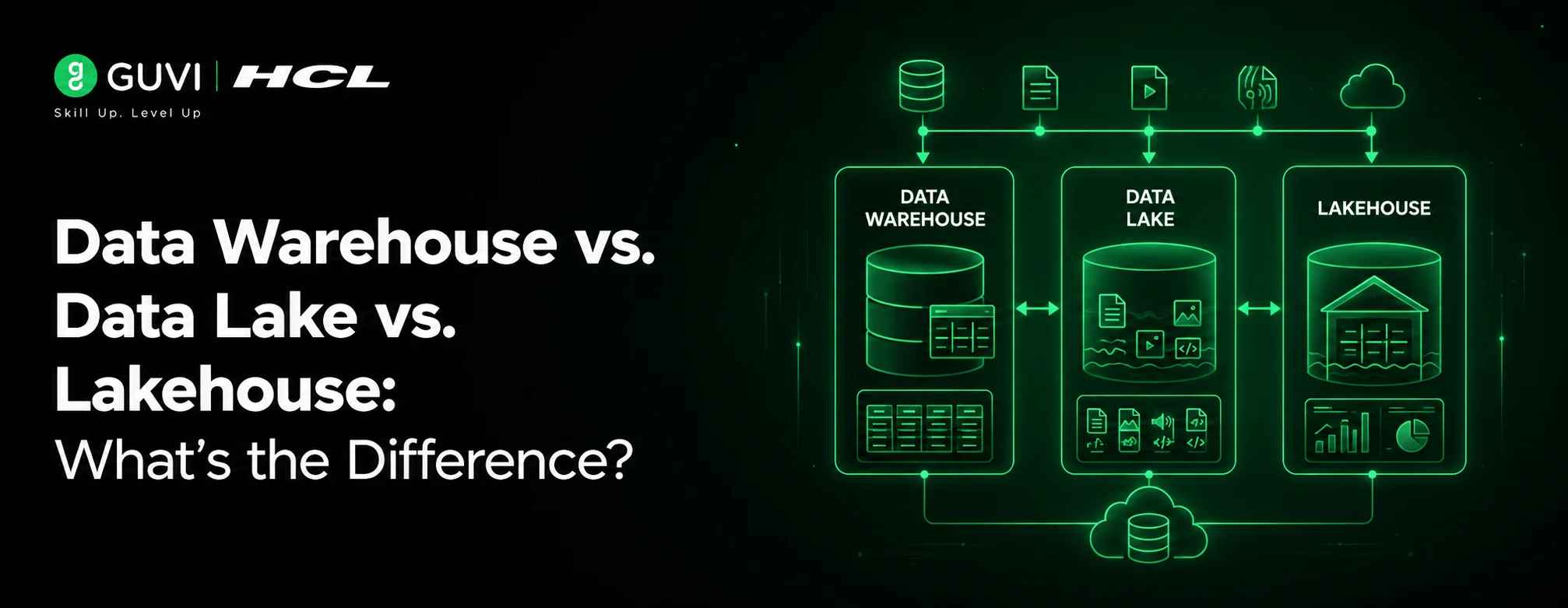
Data Warehouse vs. Data Lake vs. Lakehouse: What’s the Difference?
Aug 07, 2026 4 Min Read 426 Views
(Last Updated)
Table of contents
- TL;DR Summary Box
- Introduction
- Direct Answer
- What Is a Data Warehouse?
- Typical Data Warehouse Workflow
- What Is a Data Lake?
- What Is a Data Lakehouse?
- Data Warehouse vs Data Lake vs Lakehouse: Key Differences
- How Does a Data Warehouse Work?
- How Does a Data Lake Work?.
- How Does a Lakehouse Work?
- Advantages of a Data Warehouse
- Advantages of a Data Lake
- Advantages of a Lakehouse
- Pros and Cons Comparison
- When Should You Choose Each Architecture?
- Choose a Data Warehouse If...
- Choose a Data Lake If...
- Choose a Lakehouse If...
- Real-World Example
- Common Misconceptions
- Conclusion
- FAQs
- What is the main difference between a data warehouse and a data lake?
- What is a data lakehouse?
- Which architecture is best for machine learning?
- Can a company use both a data warehouse and a data lake?
- Why are lakehouses becoming popular?
TL;DR Summary Box
- Data warehouses are optimized for structured analytics and reporting.
- Data lakes store large volumes of raw data in multiple formats.
- Lakehouses combine warehouse performance with lake flexibility.
- Choose based on your analytics, AI, governance, and scalability requirements.
- Many organizations are adopting lakehouses for unified data architectures.
Introduction
As organizations generate more data than ever before, choosing the right data architecture has become a critical business decision. Should you store structured business data in a data warehouse, keep all raw data in a data lake, or adopt a modern data lakehouse that combines the strengths of both?
The answer isn’t always straightforward. Each architecture is designed for different workloads, users, and business goals. Selecting the wrong approach can increase costs, reduce performance, and make analytics more difficult. In this article, you’ll learn how data warehouses, data lakes, and lakehouses differ, their advantages and limitations, real-world use cases, and how to determine which architecture best fits your organization.
Direct Answer
A data warehouse stores structured, cleaned data optimized for reporting and business intelligence. A data lake stores raw structured, semi-structured, and unstructured data at scale for analytics and machine learning. A data lakehouse combines the flexibility of a data lake with the reliability, governance, and performance of a data warehouse, making it suitable for modern data platforms that support both analytics and AI workloads.
What Is a Data Warehouse?
A data warehouse is a centralized repository that stores structured, processed data from multiple business systems. Before data is loaded, it is cleaned, transformed, and organized into schemas optimized for querying and reporting.
Business analysts and executives typically use data warehouses for dashboards, financial reporting, and historical analysis.
Typical Data Warehouse Workflow
Operational Systems
│
▼
ETL Process
│
▼
Data Warehouse
│
▼
Reports & Dashboards
Data warehouses prioritize consistency, accuracy, and fast SQL queries.
What Is a Data Lake?
A data lake stores massive amounts of raw data in its original format. Unlike a warehouse, data does not need to be transformed before storage.
A data lake can contain:
- Structured data
- Semi-structured data
- Unstructured data
- Images
- Videos
- Sensor data
- Log files
- Documents
Data scientists and machine learning engineers often use data lakes because they preserve raw data for future analysis.
What Is a Data Lakehouse?
A data lakehouse combines the scalability and flexibility of a data lake with the governance, transactional reliability, and query performance traditionally associated with data warehouses.
Instead of maintaining separate storage systems for analytics and AI, a lakehouse enables both workloads on a unified platform.
This approach reduces data duplication while improving consistency across teams.
Data Point
Industry adoption of lakehouse architectures has accelerated as organizations seek unified platforms that support business intelligence, data engineering, and AI without maintaining multiple data repositories.
Data Warehouse vs Data Lake vs Lakehouse: Key Differences
Although all three architectures store data, they differ significantly in how they manage, process, and serve that data.
| Feature | Data Warehouse | Data Lake | Data Lakehouse |
| Data Type | Structured | Structured, semi-structured, unstructured | All data types |
| Data Processing | Before loading (Schema-on-Write) | During analysis (Schema-on-Read) | Supports both approaches |
| Primary Users | Business analysts | Data engineers, data scientists | Analysts, engineers, and data scientists |
| Query Performance | Excellent | Variable | Excellent |
| Governance | Strong | Often limited | Strong |
| Machine Learning | Limited | Excellent | Excellent |
| Reporting | Excellent | Moderate | Excellent |
| Scalability | High | Very High | Very High |
How Does a Data Warehouse Work?
Data warehouses typically follow an ETL (Extract, Transform, Load) process.
The workflow includes:
- Extract data from business systems.
- Clean and validate the data.
- Transform it into standardized formats.
- Load it into analytical tables.
- Query using SQL or BI tools.
This process ensures high-quality, trusted data for decision-making.
How Does a Data Lake Work?.
Data lakes generally use an ELT (Extract, Load, Transform) approach.
Instead of transforming data before storage, raw data is loaded immediately. Transformation occurs later when users analyze specific datasets.
This approach supports greater flexibility, especially for exploratory analytics and machine learning projects.
Pro Tip
A well-governed data lake prevents the common problem of a “data swamp,” where poorly managed data becomes difficult to find and trust.
How Does a Lakehouse Work?
A lakehouse stores raw data like a data lake while adding features such as ACID transactions, metadata management, schema enforcement, and optimized query engines.
This allows organizations to run:
- Business intelligence reports
- SQL analytics
- Machine learning workloads
- Streaming analytics
—all on the same data platform.
Advantages of a Data Warehouse
Data warehouses excel in business reporting environments.
Benefits include:
- Fast SQL queries
- High-quality curated data
- Mature governance
- Reliable reporting
- Strong security controls
- Consistent business metrics
These strengths make warehouses ideal for executive reporting and operational dashboards.

Advantages of a Data Lake
Data lakes prioritize flexibility and scalability.
Benefits include:
- Low-cost storage
- Support for multiple data formats
- Easy ingestion of large datasets
- Machine learning readiness
- Big data processing
- Long-term archival
They are particularly valuable for organizations working with IoT, AI, and large-scale analytics.
Advantages of a Lakehouse
Lakehouses combine many of the benefits of both architectures.
Key advantages include:
- Unified storage platform
- Reduced data duplication
- Improved governance
- Faster analytics
- AI and BI on the same platform
- Lower infrastructure complexity
Many organizations use lakehouses to modernize legacy analytics environments.
Pros and Cons Comparison
| Architecture | Pros | Cons |
| Data Warehouse | Excellent reporting, governance, performance | Less flexible for raw and unstructured data |
| Data Lake | Scalable, flexible, AI-friendly | Requires strong governance to avoid data quality issues |
| Data Lakehouse | Unified analytics platform, supports BI and AI | Newer architecture that may require updated skills and tooling |
When Should You Choose Each Architecture?
Choose a Data Warehouse If…
A data warehouse is ideal when your primary focus is structured reporting and business intelligence.
Typical use cases include:
- Financial reporting
- Executive dashboards
- Sales analytics
- Regulatory reporting
- Historical business analysis
Choose a Data Lake If…
A data lake is a better fit when handling diverse data types or advanced analytics.
Common scenarios include:
- Machine learning
- IoT sensor data
- Log analytics
- Image and video processing
- Research and experimentation
Choose a Lakehouse If…
A lakehouse is suitable when multiple teams need a shared platform for analytics and AI.
It works well for organizations that want to:
- Reduce duplicate data pipelines
- Support SQL and machine learning together
- Improve governance across large datasets
- Modernize legacy analytics systems
Understand the difference between data warehouse, data lake, and lakehouse. Master big data engineering with HCL GUVI’s Big Data Engineering Course. Start your data engineering journey here
Real-World Example
Consider a global retail company.
Its finance department relies on curated sales reports for monthly planning, making a data warehouse an effective solution.
Meanwhile, the company’s recommendation engine processes customer clicks, search history, and product images—workloads better suited to a data lake.
As the organization expands its AI initiatives, it adopts a lakehouse to consolidate storage, improve governance, and enable analysts and data scientists to work from the same trusted data foundation.
Common Misconceptions
- “Data Lakes Replace Data Warehouses”
Not necessarily. Many organizations continue to use both, depending on workload requirements.
- “Lakehouses Eliminate All Complexity”
While lakehouses simplify architecture, organizations still need robust governance, data quality processes, and operational monitoring.
- “A Data Lake Doesn’t Need Governance”
Without proper cataloging, metadata, and access controls, a data lake can quickly become difficult to manage.
Warning
Invest in governance from the beginning, regardless of which architecture you choose.
Conclusion
Choosing between a data warehouse, data lake, and data lakehouse is about selecting the architecture that best supports your organization’s current and future data strategy. Data warehouses provide trusted reporting, data lakes enable flexible analytics, and lakehouses bridge the gap by supporting both business intelligence and AI on a unified platform.
Rather than following technology trends, focus on your data maturity, governance needs, and business objectives. A thoughtful architecture today will provide the flexibility, performance, and scalability needed to support tomorrow’s analytics and AI initiatives.
FAQs
What is the main difference between a data warehouse and a data lake?
A data warehouse stores structured, processed data for reporting, while a data lake stores raw structured, semi-structured, and unstructured data for flexible analytics and machine learning.
What is a data lakehouse?
A data lakehouse is a modern architecture that combines the scalability of a data lake with the governance, transactional capabilities, and query performance of a data warehouse.
Which architecture is best for machine learning?
Data lakes and lakehouses are generally better suited for machine learning because they can store diverse data types and support large-scale analytics.
Can a company use both a data warehouse and a data lake?
Yes. Many organizations use a data warehouse for business intelligence and a data lake for data science, AI, and large-scale analytics.
Why are lakehouses becoming popular?
Lakehouses reduce data duplication, improve governance, and allow analytics, business intelligence, and machine learning to operate on a unified platform.
Success Stories

About the Author
HCL GUVI
This article was selected and published as part of the HCL GUVI AI Blogathon 2026, an initiative designed to encourage students, AI enthusiasts, and aspiring tech writers to simplify complex AI concepts through impactful technical content. The contest recognized high-quality, original, and insightful AI-focused blogs, with selected authors receiving publication opportunities on the HCL GUVI blog platform along with official author credits and recognition.
View all posts by HCL GUVI
Connect with me @







Did you enjoy this article?