


Career Articles
Accountant vs Data Analyst Salary in India After Switching Careers - Best Guide
Finance Managers: Could Data Science Be Your Next Career Move?
Insurance Claims Executive to Data Analyst: Is It a Good Switch?
Banking Executive (Loans, KYC) to Data Analyst: Skills and Career Path

Get In Touch For Details! Request More Information
Ultimate Roadmap to Become a Java Full Stack Developer in 2026
Sep 04, 2026 5 Min Read 24179 Views
(Last Updated)
Full stack developer is a broad term that covers a lot of ground, but narrow it down to Java specifically, and you get the Java Full Stack Developer role, one with real staying power: enterprise systems, banking platforms, and large-scale backend infrastructure all still run on Java at massive scale.
A Java Full Stack Developer builds complete web applications by handling both the frontend (HTML, CSS, JavaScript, React) and backend (Java, Spring Boot, REST APIs), along with database management and cloud deployment.
This guide is a structured, phase-by-phase roadmap that takes you from Java fundamentals to a job-ready portfolio.
Table of contents
- TL;DR Summary
- Java Full Stack Developer Roadmap at a Glance
- Java Full Stack vs Python Full Stack vs MERN Stack
- Phase 1 of Becoming a Java Full Stack Developer: Learn the Fundamentals
- 1 Core Programming Concepts
- Phase 2 of the Java Full Stack Developer Path: Master Java
- 1 Core Java: The Foundation Every Java Full Stack Developer Needs
- 2 Advanced Java
- Phase 3: Database Management
- 1 Relational Databases (SQL)
- 2 NoSQL Databases
- Phase 4: Back-End Development (Java Frameworks)
- 1 Java Servlets and JSP
- 2 Spring Framework
- Phase 5: Front-End Development
- 1 Core Front-End Technologies
- 2 Front-End Frameworks
- Phase 6: Build RESTful APIs and Web Services
- 1 REST API Design
- 2 API Implementation with Spring Boot
- Phase 7: Version Control and Collaboration
- 1 Git and GitHub
- Phase 8: Testing
- 1 Unit Testing
- 2 Integration Testing
- Phase 9: DevOps and Deployment
- 1 Build Tools
- 2 Continuous Integration / Continuous Deployment (CI/CD)
- 3 Containerization
- Phase 10: Cloud Computing
- 1 Cloud Platforms
- 2 Cloud Databases
- Phase 11: Soft Skills and Collaboration
- 1 Agile Methodology
- 2 Communication and Collaboration
- Final Phase: Build Projects and Portfolio
- Full-Stack Projects
- Portfolio Website
- Java Full Stack Developer Salary in India (2026)
- Conclusion
- FAQs
- How long does it take to become a Java Full Stack Developer?
- Do I need to know Python or JavaScript to become a Java Full Stack Developer?
- Which is better: Java Full Stack Developer path or MERN Stack?
- Is Spring Boot necessary for Java Full Stack development?
- What is the salary of a Java Full Stack Developer in India?
TL;DR Summary
- What it is: the Java Full Stack Developer role covers both frontend and backend of web applications, with Java and Spring Boot powering the backend specifically
- Core skills needed: Core Java, Spring Boot, a frontend framework (React or Angular), SQL databases, Git, Docker, and basic cloud platform knowledge
- Salary in India: ranges from roughly ₹3-7 LPA for freshers to ₹25 LPA+ for senior roles, detailed further below
- Timeline: a structured roadmap with hands-on projects can get you job-ready in 9 to 12 months
- How it compares: the Java Full Stack Developer path remains the strongest choice for enterprise and IT services roles, while MERN and Python stacks lean more toward startups and product companies
Java Full Stack Developer Roadmap at a Glance
Here’s the full path in one table before diving into each phase in detail.
| Phase | Focus | Key Output |
|---|---|---|
| 1. Fundamentals | Programming basics and OOP concepts | Comfort with variables, control structures, and the four OOP pillars |
| 2. Master Java | Core and advanced Java | Working knowledge of collections, multithreading, generics, and streams |
| 3. Database Management | SQL and NoSQL | Ability to design, query, and manage relational and non-relational data |
| 4. Backend Development | Spring Boot and related frameworks | A working REST API built with Spring Boot |
| 5. Frontend Development | HTML, CSS, JavaScript, React/Angular/Vue | A dynamic, component-based UI |
| 6. RESTful APIs | API design and implementation | A properly designed, documented API |
| 7. Version Control | Git and GitHub | Comfortable branching, committing, and collaborating |
| 8. Testing | JUnit, Mockito, integration testing | Confidence that your code actually works before shipping |
| 9. DevOps and Deployment | Build tools, CI/CD, Docker | An automated build and deployment pipeline |
| 10. Cloud Computing | AWS, GCP, or Azure | A deployed application on a real cloud platform |
| 11. Soft Skills | Agile, Scrum, communication | Ability to work effectively inside a real development team |
| Final Phase | Projects and portfolio | 2-3 complete, deployed projects on GitHub |
Java Full Stack vs Python Full Stack vs MERN Stack
Before committing to the Java Full Stack Developer path specifically, it helps to know how it actually compares to the other two dominant full stack routes.
| Factor | Java Full Stack | Python Full Stack | MERN Stack |
|---|---|---|---|
| Backend language | Java | Python | JavaScript (Node.js) |
| Common frameworks | Spring Boot | Django or Flask | Express.js |
| Best known for | Enterprise systems, banking, large-scale IT services work | Rapid development, strong AI/ML crossover | Startups, single-language consistency |
| Where it’s strongest | IT services majors, large enterprises, GCCs | Product companies blending web and data work | Product companies and fast-moving startups |
| Learning curve | Steeper, more verbose syntax and structure | Generally considered the easiest to start with | Moderate, easier if you already know JavaScript |
Java Full Stack remains the safer long-term bet if enterprise and IT services roles are your target, since Java’s presence in large, established companies isn’t going anywhere.
If you’re leaning toward startups or want a lighter syntax to start with, Python or MERN might suit you better; nothing here rules out learning more than one path over time.
Phase 1 of Becoming a Java Full Stack Developer: Learn the Fundamentals
1.1 Core Programming Concepts
Before jumping into Java, it’s worth getting comfortable with programming basics that apply regardless of language.
- Basics of programming: variables, data types, control structures (if-else, loops), and functions
- Object-Oriented Programming (OOP): the four pillars, encapsulation, inheritance, polymorphism, and abstraction
Phase 2 of the Java Full Stack Developer Path: Master Java
2.1 Core Java: The Foundation Every Java Full Stack Developer Needs
- Basic Java syntax: variables, operators, and control structures
- OOP in Java: classes, objects, constructors, inheritance, interfaces, and polymorphism
- Collections Framework: Java collections like List, Map, Set, and their implementations
- Multithreading: creating threads, thread synchronization, and concurrent programming
- Exception handling: try-catch blocks and custom exceptions
- File I/O: reading and writing files in Java
Resources:
- Book: “Head First Java” by Kathy Sierra, a solid starting point for any future Java Full Stack Developer
- Online: Oracle’s official Java tutorials, Udemy, Coursera
2.2 Advanced Java
- Generics: parameterized types and working with type safety
- Streams and lambda expressions: functional-style programming with streams
- JVM internals: how the Java Virtual Machine works, including garbage collection and memory management
Phase 3: Database Management
3.1 Relational Databases (SQL)
- SQL basics: creating, reading, updating, and deleting data using SQL
- Joins and aggregations: combining data from multiple tables and summarizing it
- Database design: normalization, indexing, and relationships (one-to-one, one-to-many, many-to-many)
Tools: MySQL or PostgreSQL for hands-on relational database practice.
3.2 NoSQL Databases
- MongoDB: working with NoSQL databases for unstructured or semi-structured data
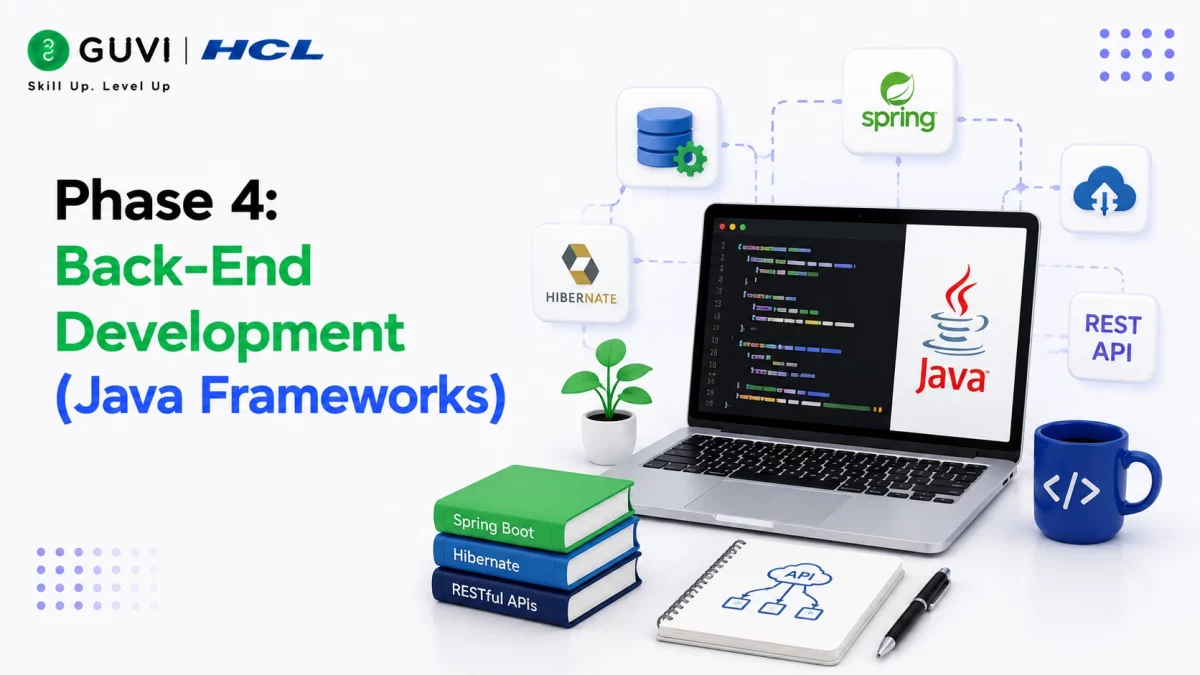
Phase 4: Back-End Development (Java Frameworks)
4.1 Java Servlets and JSP
- Java Servlets: handling HTTP requests and responses
- JSP (Java Server Pages): building dynamic web pages with Java code embedded in HTML
4.2 Spring Framework
Spring is the dominant framework every Java Full Stack Developer needs to master thoroughly, since it powers most enterprise-level applications.
- Spring Core: Dependency Injection (DI) and Inversion of Control (IoC) principles
- Spring Boot: building stand-alone Spring applications with minimal configuration, including RESTful APIs, request/response handling, and annotations like
@RestController,@RequestMapping, and@GetMapping - Spring Data JPA: working with databases through ORM, using JPA and Hibernate
- Spring Security: implementing authentication and authorization
- Spring MVC: building web applications with Spring’s Model-View-Controller pattern
Resources:
- Book: “Spring in Action” by Craig Walls
- Online: Spring’s official documentation, Udemy courses
Phase 5: Front-End Development
5.1 Core Front-End Technologies
- HTML: the structure of web pages, elements, attributes, and forms
- CSS: styling with CSS, including Flexbox, Grid, and responsive design with Bootstrap
- JavaScript: DOM manipulation, event handling, and asynchronous operations using promises and async/await
5.2 Front-End Frameworks
- React.js: components, JSX, props, state management, hooks, form handling, and consuming APIs to render data
- Angular: components, services, dependency injection, and Angular’s template syntax
- Vue.js: a lighter, more approachable alternative to React and Angular
Resources: Udemy or FreeCodeCamp for hands-on practice with React, Angular, or Vue.
Java remains one of the most widely used programming languages in the world, powering enterprise applications, financial systems, e-commerce platforms, cloud services, and large-scale backend infrastructures. Its reliability, platform independence, extensive ecosystem, and strong support for scalable application development have made it a preferred technology choice for organizations of all sizes. As businesses continue modernizing their digital systems, demand for Java Full Stack Developers remains strong, particularly for professionals who can work across backend technologies such as Spring Boot and frontend frameworks like React or Angular. This combination of enterprise adoption and long-term industry relevance continues to make Java one of the most valuable skills in software development.

Phase 6: Build RESTful APIs and Web Services
6.1 REST API Design
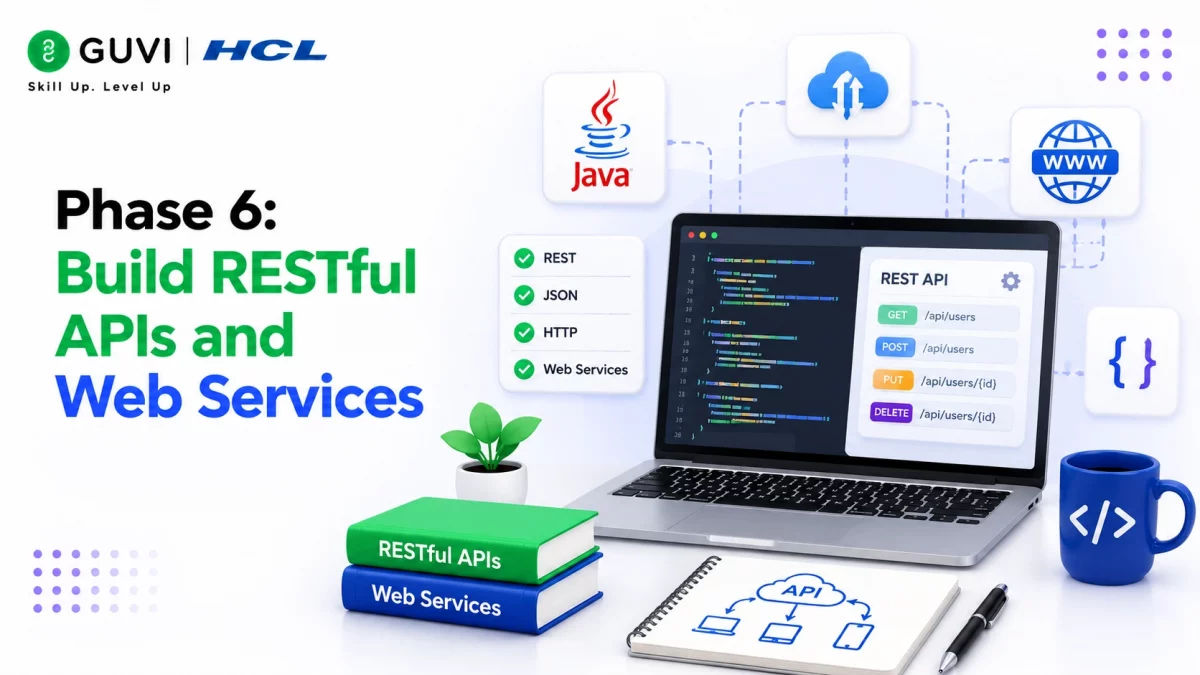
- HTTP methods: GET, POST, PUT, DELETE, PATCH
- JSON: the format used for API requests and responses
- API design principles: versioning, statelessness, and RESTful conventions
6.2 API Implementation with Spring Boot
- Build a RESTful API using Spring Boot
- Handle requests and responses, including validation and error handling
- Integrate with databases using Spring Data JPA
Phase 7: Version Control and Collaboration
7.1 Git and GitHub
- Git: initializing repositories, staging changes, committing, and branching strategies
- GitHub: hosting projects and collaborating through pull requests and code reviews
Phase 8: Testing
8.1 Unit Testing
- Writing unit tests with JUnit and using Mockito for mocking dependencies
- Applying the Test-Driven Development (TDD) approach
8.2 Integration Testing
- Testing interactions between different components of your application
- Using Spring Boot’s testing module to test REST APIs
Phase 9: DevOps and Deployment
9.1 Build Tools
- Maven/Gradle: managing project dependencies and automating the build process
9.2 Continuous Integration / Continuous Deployment (CI/CD)
- CI/CD pipelines using Jenkins or GitLab CI
- Automating testing, building, and deploying your application
9.3 Containerization
- Learning Docker to containerize your Java applications
- Creating Docker images, working with containers, and deploying across environments
Phase 10: Cloud Computing
10.1 Cloud Platforms
As a Java Full Stack Developer, you’ll eventually deploy applications to a cloud platform, most commonly one of:
- AWS (Amazon Web Services)
- Google Cloud Platform (GCP)
- Microsoft Azure
10.2 Cloud Databases
- Working with cloud-based databases like AWS RDS or Google Cloud Firestore
Phase 11: Soft Skills and Collaboration
11.1 Agile Methodology
- Agile practices like Scrum and working in sprints
- Tools like JIRA or Trello for tracking progress and managing tasks
11.2 Communication and Collaboration
- Improving communication skills, essential for any Java Full Stack Developer working in teams or with clients and stakeholders
Final Phase: Build Projects and Portfolio
Full-Stack Projects
- E-commerce platform: product listings, shopping cart, and payment integration
- Blogging platform: user authentication, with the ability to post, edit, and delete articles
- Task management tool: user login, task creation, and real-time updates using WebSockets
Portfolio Website
As a Java Full Stack Developer, create a personal website showcasing your projects, skills, and experience.
If you want to become a job-ready Java Full Stack Developer, consider enrolling in HCL GUVI’s Certified Java Full-Stack Developer Course.
It teaches you everything from scratch, with hands-on projects along the way.
Java Full Stack Developer Salary in India (2026)
| Experience Level | Salary Range (India) | What Drives It |
|---|---|---|
| Fresher (0-1 years) | ₹3L to ₹7L | Strong fundamentals and project exposure help secure better entry offers |
| Mid-level (2-4 years) | ₹6L to ₹12L | Hands-on experience with Spring Boot, microservices, and React |
| Senior (5+ years) | ₹12L to ₹25L+ | Architecture knowledge, cloud expertise, and leadership skills |
| Senior at product companies/GCCs | ₹25L to ₹40L+ | Product-based companies typically pay 30-50% more than service-based companies at the same level |
For a Java Full Stack Developer, service-based companies (TCS, Infosys, Wipro) tend to offer the lower end of each band, while product companies and Global Capability Centres offer the upper end, and often pay a real premium for the same skill set.
Conclusion
Becoming a Java Full Stack Developer is a journey that rewards dedication, consistency, and hands-on practice, and it’s worth remembering that every experienced Java Full Stack Developer started at exactly the same Phase 1 you’re on now.
This roadmap gives every future Java Full Stack Developer a clear path through frontend, backend, database management, and cloud deployment. Stay focused, build real projects, and keep learning.
FAQs
How long does it take to become a Java Full Stack Developer?
With a structured roadmap and consistent effort, most aspiring Java Full Stack Developers can become job-ready in 9 to 12 months. This can move faster with full-time study or slower if you’re learning part-time alongside other commitments.
Do I need to know Python or JavaScript to become a Java Full Stack Developer?
Every Java Full Stack Developer needs JavaScript for frontend work regardless of backend language, since it’s the standard for interactivity in the browser. Python isn’t required for this specific path, since Java handles the backend role Python would otherwise fill.
Which is better: Java Full Stack Developer path or MERN Stack?
Neither is universally “better.” A Java Full Stack Developer tends to be stronger positioned for enterprise, banking, and IT services roles, while MERN suits startups and product companies that prefer a single-language stack. Many developers eventually learn both.
Is Spring Boot necessary for Java Full Stack development?
Yes, practically speaking, for any Java Full Stack Developer. Spring Boot is the dominant framework for building Java backend applications today, and most Java Full Stack job listings expect working knowledge of it.
What is the salary of a Java Full Stack Developer in India?
A fresher-level Java Full Stack Developer typically earns ₹3L to ₹7L, mid-level developers earn ₹6L to ₹12L, and senior developers earn ₹12L to ₹25L or more, with product companies and GCCs often paying 30-50% above service-based companies at the same experience level.
Success Stories

About the Author
Jebasta
I translate the language of data into stories that anyone can understand. As a writer with a data science background, I simplify analytics, AI, and decision-making so beginners and enthusiasts can confidently explore the world of data.
View all posts by Jebasta
Connect with me @












Did you enjoy this article?