


Data Science Articles
Accountant vs Data Analyst Salary in India After Switching Careers - Best Guide
Finance Managers: Could Data Science Be Your Next Career Move?
Insurance Claims Executive to Data Analyst: Is It a Good Switch?
Banking Executive (Loans, KYC) to Data Analyst: Skills and Career Path


Get In Touch For Details! Request More Information

Ultimate Guide to Data Science Models (2026)
Oct 23, 2026 9 Min Read 13803 Views
(Last Updated)
Data science models are algorithms trained on historical data to find patterns and relationships. Once trained, they use those patterns to make predictions, classify information, or support decisions on new, unseen data, powering things like recommendation systems, fraud detection, and demand forecasting.
Every business today runs on predictions, from what you’ll buy next to whether to approve a loan. Behind those predictions sit data science models, the engines that turn raw numbers into decisions companies actually act on.
But not all models work the same way, and picking the wrong one can quietly cost a business accuracy, time, and money. This blog breaks down what these models really are, the main types you’ll come across, and how they’re used in the real world.
Table of contents
- TL;DR Summary
- What are Data Science Models?
- How Data Science Models Work
- Why Data Science Models Matter
- Types of Data Science Models
- a. Predictive Models
- b. Descriptive Models
- c. Prescriptive Models
- d. Advanced and Deep Learning Models
- Types of Data Science Models: Quick Overview
- Code Examples for Each Model Type
- Model Selection Guide
- Real-World Applications of Data Science Models
- Model Evaluation Metrics
- Choosing the Right Model for Your Problem
- Conclusion
- FAQs
- What are data science models?
- What are the 4 types of data science models?
- Which data science model is best for beginners?
- What is the difference between predictive and prescriptive data science models?
- What skills are needed to build data science models?
- How do you evaluate a data science model's performance?
TL;DR Summary
- This blog covers how data science models learn from data to predict outcomes, group patterns, recommend actions, or process complex inputs like images and text.
- It explains the four main categories: predictive, descriptive, prescriptive, and advanced/deep learning data science models.
- Each type of data science model solves a different kind of problem, so picking the right one depends on your actual goal.
- Real-world examples across healthcare, finance, and e-commerce show how these models already run behind the scenes of daily decisions.
- It also covers how to judge whether a data science model is actually performing well using metrics like accuracy, RMSE, and F1 score.
The Transformer model, the architecture behind GPT and BERT, was introduced by Google researchers in a 2017 paper titled “Attention Is All You Need.”
What are Data Science Models?
A data science model is a system trained on data to find patterns and relationships between variables, instead of following rules written by a person.
Data science models learn by studying examples and adjusting themselves until their output closely matches reality. Once trained, these models take new data and turn it into a prediction, category, or recommendation for decision-making.
How Data Science Models Work
Data science models follow a defined process from raw data to final output:
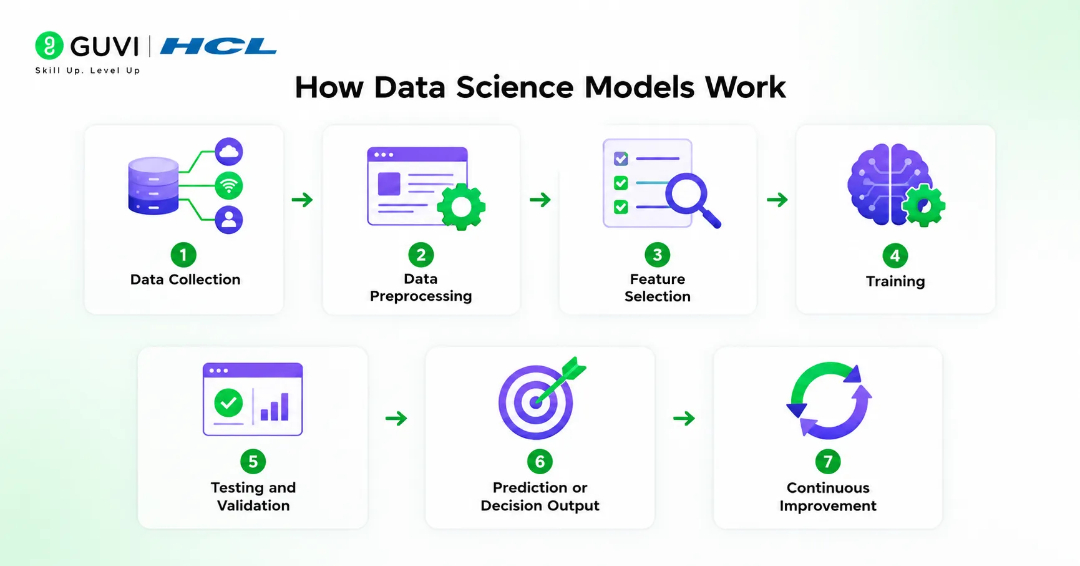
1. Data Collection
The process starts with collecting relevant data from sources like databases, sensors, transactions, or user activity. Data quality directly affects how well the model performs later.
2. Data Preprocessing
Raw data is rarely clean. This stage involves handling missing values, removing duplicates, fixing inconsistencies, and converting data into a format the model can actually process.
3. Feature Selection
Not every variable in a dataset is useful. Here, the most relevant variables, called features, are identified since they have the strongest influence on the outcome the model is trying to predict or classify.
4. Training
The model is exposed to a portion of the data, known as the training set. During this stage, it identifies patterns and relationships between the features and the target outcome, adjusting its internal parameters to reduce errors.
5. Testing and Validation
Once trained, the model is checked against data it has not seen before, usually a separate testing set. This step reveals whether the model has genuinely learned the patterns or just memorized the training data.
6. Prediction or Decision Output
After validation, the model is ready to work on new, real-world data. It generates an output, a predicted number, a classification, or a recommended action, based on what it learned during training.
7. Continuous Improvement
Models are rarely static. As new data comes in, they are often retrained or fine-tuned to stay accurate, since patterns in real-world data can shift over time.
Enroll in HCL GUVI’s Advanced Data Science & Generative AI Course. Curious about data science models? This 6-month program takes you from fundamentals to real-world application, covering 16+ modules, 10+ hands-on projects, and mentorship from industry experts. Get IITM-Pravartak certified and placement support with 1000+ hiring partners. Start building your data science career today!
Why Data Science Models Matter
Data science models matter for the following reasons, as they shape how decisions are made across industries today:
- Faster decision making: Models process large volumes of data in seconds, cutting down time spent on manual analysis.
- Higher accuracy: They catch patterns and correlations that are easy for humans to miss, especially in complex datasets.
- Cost reduction: Businesses use them to predict demand, optimize inventory, and avoid wasteful spending.
- Personalization at scale: Platforms like Netflix and Amazon rely on them to tailor recommendations to each individual user.
- Risk management: Banks and insurers use them to flag fraud, assess credit risk, and predict potential defaults before they happen.
Types of Data Science Models
Data science models fall into four major categories:
- Predictive Models
- Descriptive Models
- Prescriptive Models
- Advanced and Deep Learning Models
Each category includes different model types, suited to different kinds of problems.
a. Predictive Models
Predictive models study historical data to forecast what’s likely to happen next, whether that’s next month’s sales, a customer about to churn, or where a stock price is headed.
1. Logistic Regression
Logistic regression is a model used to predict outcomes that fall into two categories, like yes or no, true or false, pass or fail. It calculates the probability of an event happening and classifies the result based on that probability.
Example: A bank uses logistic regression to predict whether a loan applicant will default, based on factors like income, credit score, and existing debt.
2. Random Forest
Random forest builds many decision trees and combines their results to produce a more accurate, stable prediction. Instead of relying on a single tree that might get things wrong, it takes a vote across many trees to settle on the final answer.
Example: An e-commerce company uses random forest to predict which customers are likely to make a purchase in the next 30 days, based on browsing history and past orders.
3. Forecasting Models (ARIMA/Prophet)
These models study trends and seasonality in time-based data to predict future values, using statistical patterns from the past. ARIMA (AutoRegressive Integrated Moving Average) relies directly on past data points, while Prophet is better suited to handle missing values and irregular seasonal shifts.
Example: A retail chain uses Prophet to forecast festive season demand for a product, based on past sales spikes during similar periods.
b. Descriptive Models
Descriptive models summarize and explain what’s happening in existing data. They group similar data points together and highlight relationships, giving you a clear picture of the current situation rather than predicting anything.
1. Clustering (K-Means)
K-Means groups data points into clusters based on similarity, where each point belongs to the cluster whose center, or centroid, is closest to it. The algorithm keeps adjusting these centroids until the groups stabilize.
Example: A telecom company uses K-Means to segment customers into groups based on usage patterns, helping them design targeted plans for each segment.
Also Read: What is Clustering in Data Science?
2. Dimensionality Reduction (PCA)
PCA (Principal Component Analysis) reduces a dataset with many variables into a smaller set of variables that still capture most of the original information. This makes large, complex datasets easier to visualize and analyze.
Example: A genomics researcher uses PCA to reduce thousands of gene expression variables to a handful of components before further analysis.
3. Association Rule Mining (Apriori)
Apriori identifies relationships between items in large datasets by finding which items frequently occur together. It’s built on the idea that if a set of items appears often, its smaller combinations do too.
Example: A grocery store uses Apriori to discover that customers who buy bread often also buy butter, and places them closer together on shelves.
c. Prescriptive Models
Prescriptive models recommend specific actions based on the data. They evaluate different possible outcomes and suggest the best course of action, commonly used in pricing strategy and resource planning.
1. Optimization Models (Linear Programming)
Linear programming finds the best outcome, such as maximum profit or minimum cost, given a set of constraints and limited resources. It works by defining a goal and the rules the solution must follow.
Example: A manufacturing plant uses linear programming to decide how many units of each product to make, given limited raw materials and labor hours.
2. Recommendation Systems
Recommendation systems suggest relevant products, content, or actions to users based on their past behavior or the behavior of similar users. They typically rely on collaborative filtering or content-based filtering.
Example: Netflix uses a recommendation system to suggest shows based on what a user has already watched and what similar viewers enjoyed.
3. Reinforcement Learning Models
Reinforcement learning models learn by trial and error, receiving rewards or penalties based on the actions they take, and gradually improving their strategy to maximize long-term reward.
Example: A ride-hailing app uses reinforcement learning to dynamically adjust pricing based on real-time demand and driver availability.
d. Advanced and Deep Learning Models
Advanced and deep learning models process complex data like images, text, and speech using layered neural networks. They’re designed to detect intricate patterns that simpler models can’t pick up on.
1. Convolutional Neural Networks (CNN)
CNNs process visual data by scanning images in small sections to detect features like edges, shapes, and textures. These features are then combined to recognize more complex patterns.
Example: A healthcare app uses CNNs to detect tumors in X-ray and MRI scans by identifying abnormal patterns in the images.
2. Recurrent Neural Networks (RNN)/LSTM
RNNs handle sequential data, where the order of information matters, by carrying context from previous steps forward. LSTM is an upgraded version that handles longer sequences without losing important earlier context.
Example: A virtual assistant uses LSTM to understand a sentence word by word, keeping track of context to predict the next word accurately.
3. Transformers (BERT, GPT)
Transformers process entire sequences of data at once instead of step by step, using a mechanism called attention to weigh the importance of different words or elements in relation to each other.
Example: A search engine uses BERT to better understand the intent behind a search query rather than just matching keywords.
Types of Data Science Models: Quick Overview
Here’s a quick snapshot of the data science models discussed above, organized by category for easy reference:
| Model | Category | What It Does | Example |
|---|---|---|---|
| Logistic Regression | Predictive Models | Predicts outcomes that fall into two categories by calculating probability | Predicting loan default risk |
| Random Forest | Predictive Models | Combines multiple decision trees for a more accurate, stable prediction | Predicting customer purchase likelihood |
| Forecasting Models (ARIMA/Prophet) | Predictive Models | Studies trends and seasonality to predict future values | Forecasting festive season demand |
| Clustering (K-Means) | Descriptive Models | Groups data points into clusters based on similarity | Customer segmentation for telecom plans |
| Dimensionality Reduction (PCA) | Descriptive Models | Reduces many variables into a smaller set while keeping key information | Simplifying gene expression data |
| Association Rule Mining (Apriori) | Descriptive Models | Finds items that frequently occur together in data | Bread and butter product placement |
| Optimization Models (Linear Programming) | Prescriptive Models | Finds the best outcome given a set of constraints | Deciding production quantities in manufacturing |
| Recommendation Systems | Prescriptive Models | Suggests relevant products or content based on user behavior | Netflix show recommendations |
| Reinforcement Learning Models | Prescriptive Models | Learns by trial and error using rewards and penalties | Dynamic pricing in ride-hailing apps |
| Convolutional Neural Networks (CNN) | Advanced and Deep Learning Models | Detects visual patterns like edges and shapes in images | Tumor detection in medical scans |
| Recurrent Neural Networks (RNN)/LSTM | Advanced and Deep Learning Models | Handles sequential data by carrying context forward | Predicting the next word in a sentence |
| Transformers (BERT, GPT) | Advanced and Deep Learning Models | Processes entire sequences at once using attention to weigh importance | Understanding intent behind search queries |
Enroll in HCL GUVI’s Advanced Data Science & Generative AI Course. Curious about data science models? This 6-month program takes you from fundamentals to real-world application, covering 16+ modules, 10+ hands-on projects, and mentorship from industry experts. Get IITM-Pravartak certified and placement support with 1000+ hiring partners. Start building your data science career today!
Code Examples for Each Model Type
1. Logistic Regression
Used for binary classification, predicting one of two outcomes from input features.
from sklearn.linear_model import LogisticRegression
from sklearn.model_selection import train_test_split

X_train, X_test, y_train, y_test = train_test_split(X, y, test_size=0.2, random_state=42)
model = LogisticRegression()
model.fit(X_train, y_train)
predictions = model.predict(X_test)
print("Accuracy:", model.score(X_test, y_test))
2. Random Forest

An ensemble of decision trees that reduces overfitting compared to a single tree.
from sklearn.ensemble import RandomForestClassifier

rf_model = RandomForestClassifier(n_estimators=100, random_state=42)
rf_model.fit(X_train, y_train)
predictions = rf_model.predict(X_test)
print("Feature importances:", rf_model.feature_importances_)
3. Forecasting Models (ARIMA)
Forecasts future values in a time series based on its own past values.
from statsmodels.tsa.arima.model import ARIMA

model = ARIMA(sales_series, order=(1, 1, 1))
fitted_model = model.fit()
forecast = fitted_model.forecast(steps=12)
print(forecast)
4. Clustering (K-Means)
Groups similar data points together without labeled data.
from sklearn.cluster import KMeans

kmeans = KMeans(n_clusters=3, random_state=42)
clusters = kmeans.fit_predict(X)
print("Cluster centers:", kmeans.cluster_centers_)
5. Dimensionality Reduction (PCA)
Compresses many correlated features into a smaller set that still captures most of the variance.
from sklearn.decomposition import PCA

pca = PCA(n_components=2)
reduced_data = pca.fit_transform(X)
print("Variance explained:", pca.explained_variance_ratio_)
6. Association Rule Mining (Apriori)
Finds items that frequently occur together, the classic “customers who bought X also bought Y” model.
from mlxtend.frequent_patterns import apriori, association_rules

frequent_itemsets = apriori(basket_df, min_support=0.05, use_colnames=True)
rules = association_rules(frequent_itemsets, metric="lift", min_threshold=1.0)
print(rules[["antecedents", "consequents", "support", "confidence", "lift"]])
7. Optimization Models (Linear Programming)
Finds the best allocation of limited resources under a set of constraints.
from scipy.optimize import linprog

c = [-20, -30]
A = [[1, 2], [3, 1]]
b = [40, 60]
result = linprog(c, A_ub=A, b_ub=b, method="highs")
print("Optimal values:", result.x)
8. Recommendation Systems
Suggests items by finding users or items with similar behavior patterns.
from sklearn.metrics.pairwise import cosine_similarity

similarity_matrix = cosine_similarity(user_item_matrix)
similar_users = similarity_matrix[0].argsort()[::-1][1:6]
print("Most similar users:", similar_users)
9. Reinforcement Learning Models
Learns a policy by trial and error, updating its estimate of which action pays off best in each state.
import numpy as np

q_table = np.zeros((num_states, num_actions))
learning_rate = 0.1
discount = 0.9

for episode in range(1000):
    state = env.reset()
    action = np.argmax(q_table[state])
    next_state, reward, done, _ = env.step(action)
    q_table[state, action] += learning_rate * (
        reward + discount * np.max(q_table[next_state]) - q_table[state, action]
    )
10. Convolutional Neural Networks (CNN)
Built for image data, learning spatial patterns like edges and shapes through convolutional layers.
from tensorflow.keras import layers, models

cnn_model = models.Sequential([
    layers.Conv2D(32, (3, 3), activation="relu", input_shape=(28, 28, 1)),
    layers.MaxPooling2D((2, 2)),
    layers.Flatten(),
    layers.Dense(64, activation="relu"),
    layers.Dense(10, activation="softmax")
])

cnn_model.compile(optimizer="adam", loss="sparse_categorical_crossentropy", metrics=["accuracy"])
11. Recurrent Neural Networks (RNN) / LSTM
Built for sequential data, carrying information forward from earlier steps to later ones.
from tensorflow.keras import layers, models

lstm_model = models.Sequential([
    layers.LSTM(64, input_shape=(timesteps, features)),
    layers.Dense(1)
])

lstm_model.compile(optimizer="adam", loss="mse")
12. Transformers (BERT, GPT)
Used for language tasks, here a pretrained model classifying sentiment with no training required.
from transformers import pipeline

classifier = pipeline("sentiment-analysis")
result = classifier("This product completely changed how our team works.")
print(result)Model Selection Guide
The article’s existing “Choosing the Right Model” section gives goal-based bullets. This is a decision table version for a quicker lookup.
| Your Goal | Recommended Model(s) | Why |
|---|---|---|
| Predict a category (yes/no, spam/not spam) | Logistic Regression, Random Forest | Simple, interpretable, strong baseline for classification |
| Predict a number (price, demand) | Random Forest, Linear Programming (for constrained optimization) | Handles non-linear relationships without heavy tuning |
| Forecast future values over time | ARIMA, Prophet | Built specifically for sequential, time-dependent data |
| Group similar records with no labels | K-Means Clustering | Finds natural groupings without needing a target variable |
| Reduce a large number of features | PCA | Keeps most of the signal while cutting dimensionality |
| Find products frequently bought together | Apriori | Purpose-built for co-occurrence patterns in transactions |
| Recommend items to users | Recommendation Systems (collaborative filtering) | Learns from similar users’ or items’ past behavior |
| Make sequential decisions with delayed rewards | Reinforcement Learning | Designed for trial-and-error optimization over time |
| Classify images | CNN | Captures spatial patterns that standard models miss |
| Work with sequences (text, sensor data) | RNN/LSTM, Transformers | Built to handle order and context across a sequence |
| Understand or generate language | Transformers (BERT, GPT) | State of the art for language understanding and generation |
Start by matching your goal to a row here, then check the dataset size and whether you need interpretability, those two factors usually narrow it down to one model from there.
Real-World Applications of Data Science Models
Data science models are already shaping decisions across industries, and these are some of the following areas where they’re put to work:
1. Healthcare
Doctors use data science models to spot patterns in medical scans, lab reports, and patient history that could point to diseases like cancer or diabetes early on.
Hospitals also run these models to predict which patients are likely to be readmitted, so they can adjust care plans ahead of time.
2. Finance and Banking
Banks lean on these models to check credit risk before approving loans and to catch fraudulent transactions as they happen, not after the damage is done.
Every transaction gets scanned against patterns the model has learned, and anything unusual gets flagged instantly.
3. Retail and E-commerce
Amazon’s recommendation section, the demand forecasts that keep warehouses stocked, and the customer segmentation behind targeted ads all run on data science models.
Retailers use these to predict what people want before they even search for it and to avoid overstocking or running out of popular items.
4. Transportation and Logistics
Uber and similar ride-sharing apps use these models to figure out the fastest routes, estimate arrival times, and adjust prices when demand spikes.
On the maintenance side, predictive models flag when a vehicle part is likely to fail, well before it actually breaks down.
Enroll in HCL GUVI’s Advanced Data Science & Generative AI Course. Curious about data science models? This 6-month program takes you from fundamentals to real-world application, covering 16+ modules, 10+ hands-on projects, and mentorship from industry experts. Get IITM-Pravartak certified and placement support with 1000+ hiring partners. Start building your data science career today!
Model Evaluation Metrics
Once data science models are trained, they need to be tested against specific metrics to check how well they actually perform before being trusted with real decisions.
Different model types call for different evaluation metrics, since a metric that works for classification won’t make sense for a regression problem.
| Metric | Used For | What It Measures | Formula |
|---|---|---|---|
| Accuracy | Classification | Percentage of correct predictions out of all predictions made | (TP + TN) / (TP + TN + FP + FN) |
| Precision | Classification | How many predicted positives were actually correct | TP / (TP + FP) |
| Recall | Classification | How many actual positives the model correctly identified | TP / (TP + FN) |
| F1 Score | Classification | Balance between precision and recall | 2 × (Precision × Recall) / (Precision + Recall) |
| RMSE | Regression | Average magnitude of prediction errors | √(Σ(Predicted − Actual)² / n) |
| MAE | Regression | Average absolute difference between predicted and actual values | Σ|Predicted − Actual| / n |
| R-squared | Regression | How well the model explains variance in the data | 1 − (Sum of Squared Residuals / Total Sum of Squares) |
Here’s what each term in these formulas represents:
- TP (True Positive): Cases where the model correctly predicted the positive class
- TN (True Negative): Cases where the model correctly predicted the negative class
- FP (False Positive): Cases where the model predicted positive, but the actual result was negative
- FN (False Negative): Cases where the model predicted negative, but the actual result was positive
- Predicted: The value the model estimated
- Actual: The real, observed value
- n: Total number of data points
- Σ: Sum of all values in the given set
Picking the right metric matters as much as picking the right model, since the wrong metric can make a poor model look good on paper.
Choosing the Right Model for Your Problem
Picking the right data science model comes down to one question: what are you actually trying to find out?
Different problems call for different types of data science models, and matching them correctly makes the difference between reliable results and wasted effort.
- Predicting a future number or category → Use Predictive Models, since they’re built on historical outcomes to estimate what comes next
- Understanding patterns in existing data → Use Descriptive Models, since they summarize and group data without forecasting anything
- Deciding on the best action to take → Use Prescriptive Models, since they weigh multiple outcomes and point toward the most effective choice
- Working with images, text, or speech → Use Advanced and Deep Learning Models, since simpler data science models can’t handle this level of complexity
Important Note:
A common mistake is picking a data science model based on what’s trending rather than what the problem actually needs.
A random forest might outperform a neural network on a small structured dataset, while a transformer would be complete overkill for predicting monthly expenses.
Dataset size matters too, since deep learning models generally need large volumes of data to perform well.
Enroll in HCL GUVI’s Advanced Data Science & Generative AI Course. Curious about data science models? This 6-month program takes you from fundamentals to real-world application, covering 16+ modules, 10+ hands-on projects, and mentorship from industry experts. Get IITM-Pravartak certified and placement support with 1000+ hiring partners. Start building your data science career today!
Conclusion
Learning the different types of data science models is a powerful step toward becoming confident in building and deploying machine learning solutions. It helps you match the right model to the right problem, instead of defaulting to the same algorithm for every task.
By understanding what each model does best, you not only improve your results but also learn how to make smarter modeling decisions, an essential skill for any data professional.
FAQs
1. What are data science models?
Data science models are systems trained on data to find patterns and make predictions, classifications, or recommendations.
2. What are the 4 types of data science models?
The four main types of data science models are predictive, descriptive, prescriptive, and advanced/deep learning models.
3. Which data science model is best for beginners?
Logistic regression and decision trees are the easiest data science models to start with, since they’re simple to understand and interpret.
4. What is the difference between predictive and prescriptive data science models?
Predictive models forecast future outcomes, while prescriptive models recommend specific actions based on those outcomes.
5. What skills are needed to build data science models?
Python or R, statistics, and knowledge of machine learning libraries like scikit-learn are essential for building data science models.
6. How do you evaluate a data science model’s performance?
Metrics like accuracy, precision, recall, RMSE, and F1 score evaluate how well a model performs.
Success Stories

About the Author
Jebasta
I translate the language of data into stories that anyone can understand. As a writer with a data science background, I simplify analytics, AI, and decision-making so beginners and enthusiasts can confidently explore the world of data.
View all posts by Jebasta
Connect with me @















Did you enjoy this article?