


Academics Articles
Is the HCL GUVI AI/ML Program Right for You? A Quick Self-Assessment
Inside the HCL GUVI AI/ML Curriculum: What You’ll Actually Build
Wipro Elite NTH Eligibility Criteria 2026: CGPA, Branch & Backlog Rules Explained
What is Wipro Elite NTH? Complete Overview for 2026 Graduates
Get In Touch For Details! Request More Information
Ever wondered what it actually feels like to sit in a Harvard classroom, without paying Harvard tuition? Turns out, you genuinely can, and thousands of people do it every year.
Free Harvard courses online let you access real lectures, materials, and coursework from Harvard faculty without paying a cent for the learning itself. Most are self-paced and open to anyone, whether you’re brushing up on a skill, exploring a new field, or just curious what a Harvard class actually feels like.
Here’s the part most people don’t realize going in: free usually means free to audit, so you get the full course experience, but a certificate at the end typically costs extra. We’ve pulled together some of the best Harvard courses worth your time below.
Table of contents
- TL;DR Summary
- Best Free Harvard Courses Online
- Each Harvard Course, Explained in Detail
- CS50's Introduction to Computer Science
- CS50's Web Programming with Python and JavaScript
- CS50's Introduction to Cybersecurity
- CS50's Introduction to Programming with Scratch
- Data Analysis: Basic Probability and Statistics
- Statistics and R
- Using Python for Research
- Data Science: Building Machine Learning Models
- Contract Law: From Trust to Promise to Contract
- Justice Today: Money, Markets, and Morals
- Exercising Leadership: Foundational Principles
- Leaders of Learning Essentials
- Managing Happiness
- Remote Work Revolution for Everyone
- Tangible Things
- CS50 vs Other Harvard Courses: Where Should You Start?
- Who Should Take These Free Harvard Courses, and How to Get the Most Out of Them
- Free vs Paid: What You Actually Get With a Harvard Certificate
- Common Mistakes When Auditing a Free Harvard Course
- Conclusion
- FAQs
- Are Harvard's free online courses actually free?
- Do I need to apply or get accepted to take these courses?
- Will a Harvard audit certificate help my resume?
- How long do these Harvard courses take to complete?
- Can I get a real Harvard degree from these free courses?
TL;DR Summary
- What it is: free access to real Harvard lectures and coursework, self-paced and open to anyone, no application required
- The catch: auditing is free; a certificate at the end is a separate, optional paid add-on
- Where to start: CS50 stands out among free Harvard courses for hands-on, practical skills with genuine resume value
- Time commitment: ranges from fully self-paced to structured programs running 3 to 10 weeks
- Worth paying for a certificate? only if you specifically need it for a resume, job application, or LinkedIn profile
Best Free Harvard Courses Online
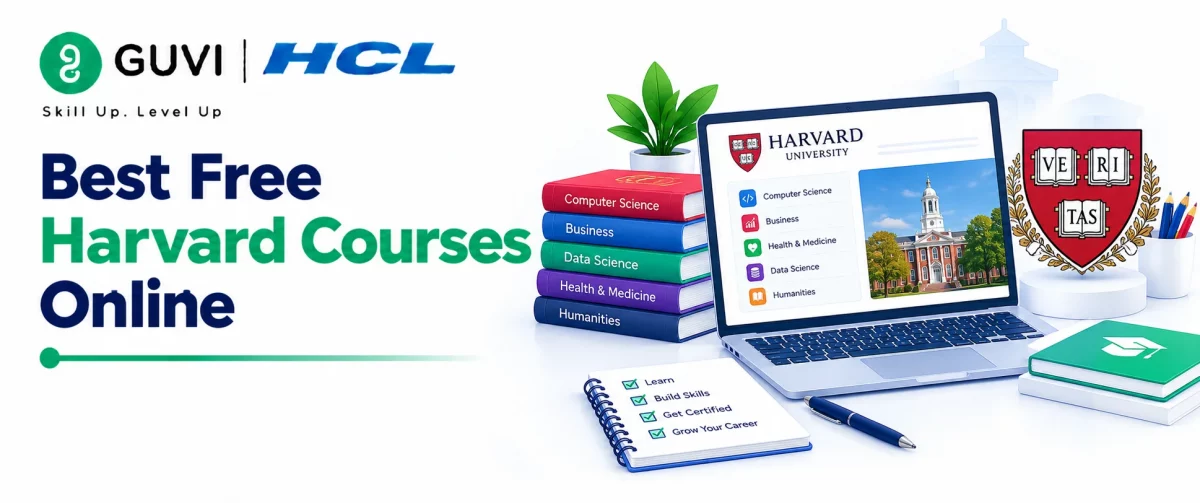
Here’s a quick look at these Harvard courses and what each one covers:
| Course | What It Covers | Duration | Certificate Cost | Official Link |
|---|---|---|---|---|
| CS50’s Introduction to Computer Science | Programming fundamentals in C, Python, SQL, JavaScript, HTML, and CSS | Self-paced | Optional, paid | Link |
| CS50’s Web Programming with Python and JavaScript | Building web apps with Python, JavaScript, and SQL using frameworks like Django | 12 weeks | Optional, paid | Link |
| CS50’s Introduction to Cybersecurity | Protecting data, devices, and systems from common security threats | 5 weeks | Optional, paid | Link |
| CS50’s Introduction to Programming with Scratch | Beginner-friendly intro to programming logic using Scratch | 3 weeks | Optional, paid | Link |
| Data Analysis: Basic Probability and Statistics | Core probability and statistics concepts for quantitative reasoning | 7 weeks | Optional, paid | Link |
| Statistics and R | Basic statistical concepts and R programming for analyzing data | 4 weeks | Optional, paid | Link |
| Using Python for Research | Applying Python 3 skills to real research problems | Self-paced | Optional, paid | Link |
| Data Science: Building Machine Learning Models | Building a movie recommendation system using machine learning techniques | 8 weeks | Optional, paid | Link |
| Contract Law: From Trust to Promise to Contract | How contracts are formed, enforced, and broken | 8 weeks | Optional, paid | Link |
| Justice Today: Money, Markets, and Morals | Ethical controversies around financial markets | 8 weeks | Optional, paid | Link |
| Exercising Leadership: Foundational Principles | Mobilizing people to solve tough problems and lead through change | Self-paced | Optional, paid | Link |
| Leaders of Learning Essentials | Exploring your own theories of learning and leadership | 10 weeks | Optional, paid | Link |
| Managing Happiness | Understanding what’s within your control to build a fulfilling life | Self-paced | Optional, paid | Link |
| Remote Work Revolution for Everyone | Building trust, productivity, and alignment in virtual work | 3 weeks | Optional, paid | Link |
| Tangible Things | Exploring history and museum studies through everyday objects and artifacts | 10 weeks | Optional, paid | Link |
Also Read: Top 5 Tech Careers in 2026 for Students and Freshers
Each Harvard Course, Explained in Detail
Here’s a closer look at each course from the table above, what it actually covers, who teaches it, and what the certificate involves.
1. CS50’s Introduction to Computer Science
Overview: Harvard’s flagship computer science course, taught by Professor David J. Malan. Covers algorithmic thinking, data structures, and problem-solving across C, Python, SQL, and JavaScript, with problem sets drawn from real-world domains like biology, cryptography, and finance.
Duration: Self-paced
Fee: Free to audit
Certificate: Available for a fee once you complete 9 problem sets plus a final project.
Link: pll.harvard.edu/course/cs50-introduction-computer-science
2. CS50’s Web Programming with Python and JavaScript
Overview: Picks up where CS50 leaves off, going deeper into building real web apps with Python, JavaScript, and SQL using frameworks like Django, React, and Bootstrap.
Duration: 12 weeks
Fee: Free to audit
Certificate: Available for a fee on completion.
Link: pll.harvard.edu/course/cs50s-web-programming-python-and-javascript
3. CS50’s Introduction to Cybersecurity
Overview: Taught by Professor David J. Malan, this course is built for technical and non-technical learners alike, covering how to recognize and evaluate real-world cybersecurity threats, both at home and at work.
Duration: 5 weeks
Fee: Free to audit
Certificate: Available for a fee on completion
Link: pll.harvard.edu/course/cs50s-introduction-cybersecurity
4. CS50’s Introduction to Programming with Scratch
Overview: A gentle, beginner-first introduction to programming logic using Scratch, designed to prepare you for later coding courses without assuming any prior experience.
Duration: 3 weeks
Fee: Free to audit
Certificate: Available for a fee on completion
Link: pll.harvard.edu/course/cs50s-introduction-programming-scratch
5. Data Analysis: Basic Probability and Statistics
Overview: Builds core probability and statistics skills for quantitative reasoning, part of Harvard’s broader Data Science certificate series.
Duration: 7 weeks
Fee: Free to audit
Certificate: Available for a fee on completion
Link: pll.harvard.edu/course/data-analysis-basic-probability-and-statistics
6. Statistics and R
Overview: Covers statistical inference, p-values, and confidence intervals while analyzing real data in R, with an emphasis on reproducible research practices.
Duration: 4 weeks
Fee: Free to audit
Certificate: Available for a fee on completion
Link: pll.harvard.edu/course/statistics-and-r
7. Using Python for Research
Overview: Bridges the gap between introductory Python courses and applying Python to real research work, using six case studies spanning different scientific disciplines.
Duration: Self-paced
Fee: Free to audit
Certificate: Available for a fee on completion
Link: pll.harvard.edu/course/using-python-research
8. Data Science: Building Machine Learning Models
Overview: A hands-on course where you build a movie recommendation system, learning core machine learning concepts like regularization and model evaluation along the way.
Duration: 8 weeks
Fee: Free to audit
Certificate: Available for a fee on completion
Link: pll.harvard.edu/course/data-science-building-machine-learning-models
9. Contract Law: From Trust to Promise to Contract
Overview: Taught by the late Professor Charles Fried, one of the world’s leading authorities on contract law, this course explores how contracts are formed, enforced, and broken.
Duration: 8 weeks
Fee: Free to audit
Certificate: Available for a fee on completion
Link: pll.harvard.edu/course/contractsx-trust-promise-contract
10. Justice Today: Money, Markets, and Morals
Overview: Explores ethical controversies around financial markets, part of the broader tradition of Harvard’s famously popular “Justice” course on moral and political philosophy.
Duration: 8 weeks
Fee: Free to audit
Certificate: Available for a fee on completion
Link: pll.harvard.edu/course/justice-today-money-markets-and-morals-edx
11. Exercising Leadership: Foundational Principles
Overview: Focused on mobilizing people to tackle tough problems and building the capacity to lead through difficult, ambiguous situations.
Duration: Self-paced
Fee: Free to audit
Certificate: Available for a fee on completion
Link: pll.harvard.edu/course/exercising-leadership-foundational-principles
12. Leaders of Learning Essentials
Overview: Encourages you to explore and question your own theories of learning and leadership, with practical tools for imagining and building the future of education.
Duration: 10 weeks
Fee: Free to audit
Certificate: Available for a fee on completion
Link: pll.harvard.edu/course/leaders-learning-essentials
13. Managing Happiness
Overview: Taught by Harvard professor and social scientist Arthur Brooks, this course uses philosophical and scientific insight to challenge your assumptions about happiness and build lasting well-being habits.
Duration: Self-paced
Fee: Free to audit

Certificate: Available for a fee on completion
Link: pll.harvard.edu/course/managing-happiness
14. Remote Work Revolution for Everyone
Overview: Taught by Harvard Business School Professor Tsedal Neeley, based on her book of the same name, covering how to build trust, productivity, and alignment across virtual teams.
Duration: 3 weeks
Fee: Free to audit
Certificate: Available for a fee on completion
Link: pll.harvard.edu/course/remote-work-revolution-everyone
15. Tangible Things
Overview: An unusual, interdisciplinary course exploring history and museum studies through the lens of everyday objects and artifacts.
Duration: 10 weeks
Fee: Free to audit
Certificate: Available for a fee on completion
Link: pll.harvard.edu/course/tangible-things
Interested in going further with data? HCL GUVI’s Advanced Data Science & Generative AI Course covers Python, machine learning, deep learning, NLP, MLOps, and generative AI across 16+ modules, with live sessions in English, Hindi, Telugu, and Tamil.
CS50 vs Other Harvard Courses: Where Should You Start?
With 15 Harvard courses in the table above, picking a starting point can feel harder than it should. Here’s a simple way to narrow it down.
- Want to learn to code from zero? Start with CS50’s Introduction to Computer Science. It’s the most popular of all free Harvard courses for a reason, structured, hands-on, and genuinely respected on a resume.
- Already comfortable coding, want to build real web apps? Move to CS50’s Web Programming with Python and JavaScript after finishing the intro course.
- Curious about data over code? Data Analysis: Basic Probability and Statistics or Statistics and R are gentler entry points than the machine learning course.
- Interested in ideas over technical skills? Justice Today or Exercising Leadership are excellent choices, discussion-driven rather than problem-set-driven.
- Short on time and just want a taste? CS50’s Introduction to Programming with Scratch or Remote Work Revolution are both under 4 weeks.
If you’re unsure, CS50 remains the safest first pick among Harvard courses, it’s the most structured, the most supported by community forums, and the one that translates most directly into a practical skill.
Who Should Take These Free Harvard Courses, and How to Get the Most Out of Them
Auditing a course sounds simple, sit back and watch lectures, but the people who actually get value out of it tend to approach it a little differently.
- Treat deadlines loosely, but don’t ignore them completely. Self-paced doesn’t mean no structure. Give yourself a rough weekly target so the course doesn’t quietly die in your bookmarks.
- Actually do the assignments. Even without grading pressure, working through problem sets, especially in CS50, is where the real learning happens, not just watching lectures.
- Take notes like you’ll need them later. You won’t have a certificate to prove what you learned, so your notes and completed projects become your proof of skill instead.
- Join the community if there is one. Courses like CS50 have active forums and study groups, which make a huge difference when you’re stuck and there’s no professor to email.
- Don’t chase the certificate unless you need it. If it’s for genuine learning, skip the fee. If it’s for a resume or LinkedIn, it might be worth the cost for that specific course.
Also Read: Top 5 Free Courses by HCL GUVI: Best Upskilling Courses in Tech [2026]
Free vs Paid: What You Actually Get With a Harvard Certificate
The free-vs-paid decision trips people up more than it should, so here’s exactly what each tier gets you.
| What You Get | Free (Audit) | Paid (Certificate) |
|---|---|---|
| Full lecture access | Yes | Yes |
| Course materials and readings | Yes | Yes |
| Graded assignments | Usually yes | Yes |
| Verified certificate from Harvard | No | Yes |
| Resume/LinkedIn credential | No | Yes |
| Typical cost | ₹0 | Varies by course, check the official link |
The honest takeaway: if your goal is learning, the free tier already gives you everything that matters. The certificate is essentially proof for someone else, a recruiter, an employer, a LinkedIn profile viewer, not proof for yourself.
Common Mistakes When Auditing a Free Harvard Course
A handful of avoidable mistakes are why people start a course and never finish it.
- Enrolling in too many courses at once. Excitement leads people to audit three or four Harvard courses simultaneously, then finish none of them. Pick one, finish it, then move to the next.
- Skipping the assignments entirely. Watching lectures passively feels like progress but doesn’t build the skill the course is actually teaching.
- Assuming “self-paced” means “no deadline pressure needed.” Without any external structure, self-paced courses are the easiest thing in the world to abandon after week two.
- Paying for a certificate before finishing the course. Some platforms let you pay upfront; wait until you’re confident you’ll actually complete it.
- Not checking course prerequisites. A few of these, like the machine learning course, assume prior Python experience. Skipping the intro can leave you lost by week two.
Conclusion
Free Harvard courses aren’t about collecting certificates, they’re about actually learning something from people who are genuinely good at teaching it.
Pick one that fits what you’re trying to do right now, work through it properly, and worry about the certificate only if you actually need it for something. The learning itself is what sticks.
FAQs
-
1. Are Harvard’s free online courses actually free?
Yes, the courses themselves are free to audit. Only the certificate costs money if you want one.
-
2. Do I need to apply or get accepted to take these courses?
No, there’s no application or admission process. Anyone can enroll and start right away.
-
3. Will a Harvard audit certificate help my resume?
It can, especially for hands-on courses like CS50, but the real value is the skills, not the paper.
-
4. How long do these Harvard courses take to complete?
It varies, some are self paced with no deadline, others run 3 to 10 weeks depending on the course.
-
5. Can I get a real Harvard degree from these free courses?
No, these are standalone courses, not degree programs, and don’t count toward any Harvard degree.
Success Stories

About the Author
Jebasta
I translate the language of data into stories that anyone can understand. As a writer with a data science background, I simplify analytics, AI, and decision-making so beginners and enthusiasts can confidently explore the world of data.
View all posts by Jebasta
Connect with me @









Did you enjoy this article?