


Full Stack Development Articles
Claude for Architecture and Engineering Documentation
Freelancing as a Python Developer: Getting Your First Client

Get In Touch For Details! Request More Information
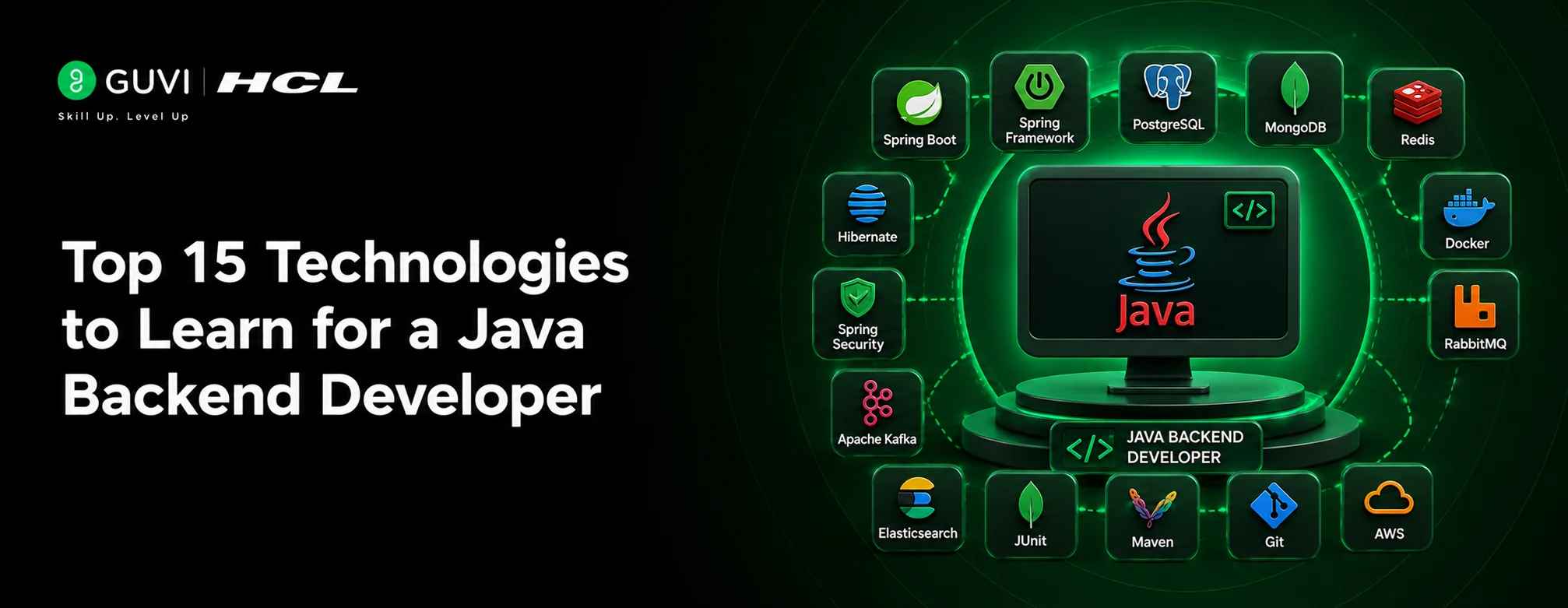
Top 15 Technologies to Learn for a Java Backend Developer in 2026
Aug 21, 2026 5 Min Read 48159 Views
(Last Updated)
Learning Java syntax Java backend development is the practice of building the server side of applications using Java, covering everything from frameworks like Spring Boot to databases, cloud deployment, and API design.
A Java backend developer today needs more than syntax knowledge. You need working familiarity with frameworks, containers, cloud platforms, and testing tools to build systems that scale.isn’t sufficient in today’s dynamic software development landscape. Backend developers need to learn various tools and frameworks to excel.
Table of contents
- TL;DR Summary
- What Does a Java Backend Developer Actually Do?
- Top 15 Technologies to Learn for a Java Backend Developer
- Spring Framework and Spring Boot: Essential Frameworks for Modern Java Development
- Microservices Architecture: To Design Scalable and Flexible Systems
- Containerization Technologies: To Streamline Deployment and Scaling
- Cloud Services: To Use the Power of the Cloud
- RESTful Services and APIs: To Build Interoperable Web Services
- Database Technologies: To Manage Data Effectively
- Messaging Systems: To Facilitate Asynchronous Communication
- Security: To Safeguard Applications
- Search Engines: To Enhance Data Retrieval
- Performance Monitoring and Optimization: To Ensure Application Efficiency
- CI/CD Tools: To Automate Build and Deployment
- Unit Testing and Integration Testing: To Ensure Code Quality
- Reactive Programming: To Manage Asynchronous Data Streams
- WebSockets and Real-Time Communication: To Enable Live Interactions
- API Documentation: To Improve Usability and Maintenance
- Java Backend Skills: Beginner vs Job-Ready vs Advanced
- How Long Does It Take to Learn These Technologies?
- Conclusion
- FAQs
- What is the most important technology for a Java backend developer to learn first?
- Do Java backend developers need to learn cloud platforms like AWS?
- Is Docker necessary for a Java backend developer?
- Can I become a Java backend developer without knowing Spring Boot?
- How is a Java backend developer different from a full stack developer?
TL;DR Summary
- Java backend developers in 2026 need to know Spring Boot, microservices, Docker/Kubernetes, cloud platforms, and database technologies at minimum.
- Beyond core Java, employers expect messaging systems (Kafka), API security (JWT, OAuth), and testing frameworks (JUnit, Mockito).
- The right learning order matters: Java fundamentals and Spring Boot first, then databases and REST APIs, then cloud, containers, and DevOps tools.
- Most learners can reach job-ready proficiency in 6 to 9 months with consistent, project-based practice.
- Salaries for Java backend developers in India start around ₹4 to ₹6 LPA for freshers and can exceed ₹18 LPA with 4+ years of experience.
What Does a Java Backend Developer Actually Do?
A Java backend developer builds and maintains the server side of an application. This means writing the logic that processes data, talks to databases, and responds to requests from the frontend.
Your day-to-day work typically includes designing APIs, managing database queries, securing endpoints, and making sure the application performs well under load. If you want the fuller picture of responsibilities and required skills, HCL GUVI’s guide to backend development breaks this down in more depth
Also Read: 40 Java Interview Questions for Freshers with Clear & Concise Answers
Top 15 Technologies to Learn for a Java Backend Developer
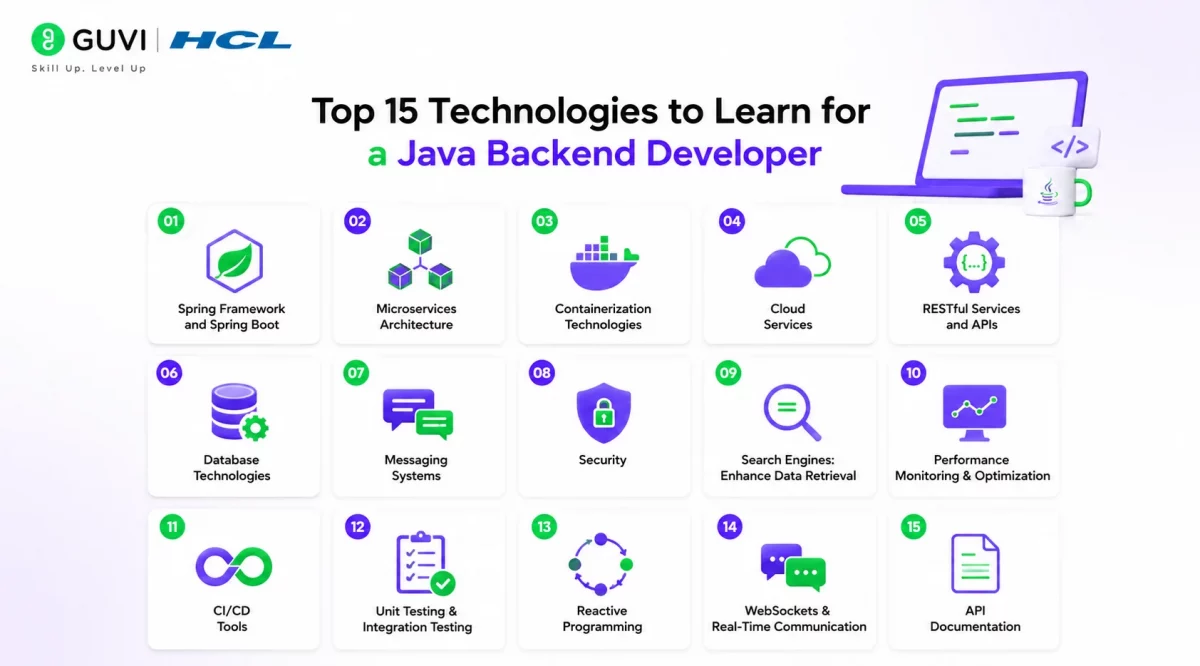
For a Java backend developer, mastering the following technologies can certainly enhance your skills and make you highly proficient in building robust and scalable applications. Here’s a breakdown of each technology:
1. Spring Framework and Spring Boot: Essential Frameworks for Modern Java Development
Spring Framework is important for enterprise Java application development, providing a comprehensive programming and configuration model. Spring Boot, an extension of Spring, simplifies application setup with its convention-over-configuration approach, allowing developers to focus on functionality rather than boilerplate code.
Mastery of Spring can significantly enhance a developer’s productivity and open up numerous opportunities in the Java ecosystem.
Also Explore: Top 7 Java Libraries for Machine Learning
2. Microservices Architecture: To Design Scalable and Flexible Systems
Microservices architecture breaks down applications into smaller, loosely coupled services, each responsible for a specific function. This approach offers enhanced scalability, flexibility, and faster deployment times compared to traditional monolithic architectures. For Java backend developers, understanding microservices involves learning design principles, inter-service communication, and decentralized data management.
Must Read: A Comprehensive Guide to Microservices Architecture and Implementation
3. Containerization Technologies: To Streamline Deployment and Scaling
Containerization, with Docker leading the way, packages applications with their dependencies into containers, ensuring consistency across environments from development to production. Kubernetes, an orchestration platform, manages these containers, automating deployment, scaling, and operations.
For Java backend developers, mastering containerization and orchestration is important for developing microservices-based applications and achieving high availability and scalability.
Also Read: List of Top 30 AWS Services
4. Cloud Services: To Use the Power of the Cloud
Cloud computing platforms like AWS, Azure, and Google Cloud Platform provide a vast array of services that can host, scale, and manage applications. For Java backend developers, understanding cloud services is essential for using the cloud’s flexibility, scalability, and cost-efficiency.
Learning to deploy Java applications on these platforms involves understanding cloud-specific services, such as compute instances, storage options, and managed databases, as well as cloud-native technologies like serverless computing and auto-scaling.
Familiarity with cloud services enables developers to build resilient, scalable applications that can adapt to changing loads and reduce operational costs.
5. RESTful Services and APIs: To Build Interoperable Web Services
RESTful services and APIs are the backbone of modern web and mobile applications, enabling different systems to communicate and share data over the Internet. For Java backend developers, creating effective RESTful services involves understanding HTTP protocols, resource naming, statelessness, and content negotiation.
6. Database Technologies: To Manage Data Effectively
Database management is a core skill for Java backend developers. While traditional relational databases like MySQL and PostgreSQL are widely used, the growing diversity of application needs has led to the rise of NoSQL databases such as MongoDB, Cassandra, and Redis. Each database type offers distinct advantages in terms of structure, scalability, and performance.
7. Messaging Systems: To Facilitate Asynchronous Communication
Messaging systems like Apache Kafka and RabbitMQ enable asynchronous communication between different parts of an application, improving performance and scalability. For Java backend developers, understanding messaging and event-driven architectures is important for building systems that can handle high throughput and are resilient to failures.
8. Security: To Safeguard Applications
Security is a paramount concern in application development. Java backend developers must understand secure coding practices, authentication, authorization, and common security vulnerabilities. Spring Security and OAuth 2.0 are widely used frameworks and protocols for securing Java applications. Learning these technologies helps developers protect sensitive data, prevent unauthorized access, and ensure their applications are safe from attacks.
Understanding JWT for secure token-based authentication and incorporating encryption, secure API access, and data validation is important for building trust and integrity in applications.
9. Search Engines: To Enhance Data Retrieval
Search engines like Elasticsearch and Solr are powerful tools for adding search functionality to applications and handling large volumes of data with speed and accuracy. For Java backend developers, integrating search engines involves understanding indexing, querying, and data analysis.
These technologies not only provide fast data retrieval but also support complex search operations, real-time analytics, and data visualization.
Read: Top 10 Java Programs For Freshers | Start Coding With A Flair!
10. Performance Monitoring and Optimization: To Ensure Application Efficiency
Performance monitoring and optimization are important for maintaining and improving the efficiency of Java applications. Tools like Prometheus, Grafana, and the ELK Stack provide insights into application performance, helping developers identify and troubleshoot bottlenecks.

Understanding how to implement monitoring solutions and analyze performance metrics enables Java backend developers to optimize application speed, reliability, and resource usage.
11. CI/CD Tools: To Automate Build and Deployment
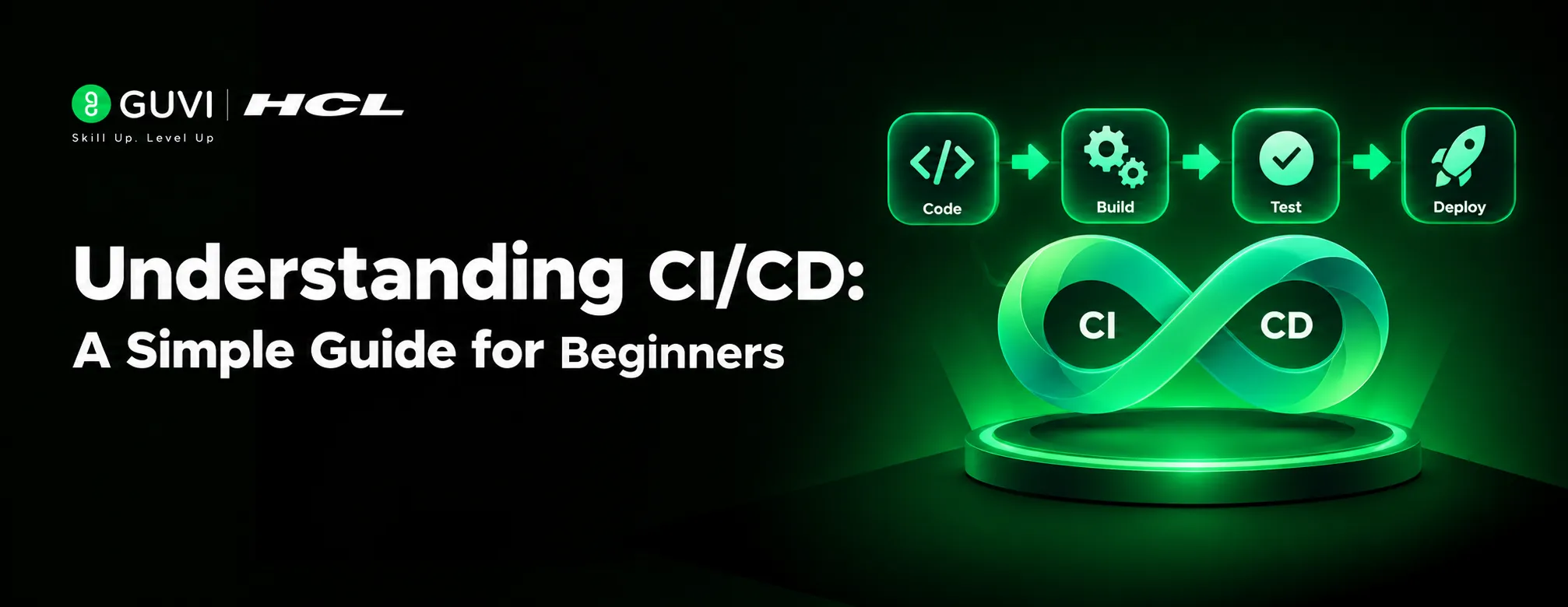
Continuous Integration and Continuous Deployment (CI/CD) tools like Jenkins, GitLab CI/CD, and GitHub Actions automate the software development lifecycle, from code integration to deployment. For Java backend developers, mastering CI/CD practices and tools is important for improving code quality, accelerating release cycles, and enhancing collaboration.
Learning to set up CI/CD pipelines enables developers to automate testing, build processes, and deployment, reducing manual errors and ensuring consistent application updates. These practices support agile development methodologies, facilitating rapid and reliable software delivery.
12. Unit Testing and Integration Testing: To Ensure Code Quality
Unit testing and integration testing are fundamental practices for ensuring the quality and reliability of Java applications. Frameworks like JUnit, Mockito, and TestNG enable Java backend developers to write and execute tests that validate individual components and their interactions.
Learning these testing frameworks and adopting Test-Driven Development (TDD) practices help developers identify and fix issues early, improve code quality, and facilitate maintainable codebases.
13. Reactive Programming: To Manage Asynchronous Data Streams
Reactive programming is a paradigm that deals with asynchronous data streams and the propagation of change, making it well-suited for applications with dynamic, real-time data flows. For Java backend developers, understanding reactive programming involves learning frameworks like Project Reactor, which Spring WebFlux uses for building non-blocking, reactive applications.
Mastering reactive programming enables developers to handle complex data interactions and concurrency with ease, leading to more responsive and scalable applications. This approach is particularly beneficial in microservices architectures and applications requiring real-time data processing.
14. WebSockets and Real-Time Communication: To Enable Live Interactions
WebSockets provide a full-duplex communication channel over a single, long-lived connection, making them ideal for real-time web applications like chat systems and live updates. Java backend developers need to understand how to implement WebSockets to facilitate live, bidirectional communication between the client and server.
Learning to use WebSockets alongside traditional HTTP communications allows developers to enhance the interactivity and responsiveness of applications, providing users with immediate feedback and engaging experiences.
15. API Documentation: To Improve Usability and Maintenance
API documentation is important for the usability and maintenance of web services. Tools like Swagger (OpenAPI) help Java backend developers create, manage, and share API documentation. Learning to document APIs effectively enables developers to communicate the functionalities, parameters, and return types of API endpoints clearly, making it easier for other developers to integrate and work with the APIs.
Java Backend Skills: Beginner vs Job-Ready vs Advanced
| Skill Area | Beginner Level | Job-Ready Level | Advanced Level |
|---|---|---|---|
| Core Java | Syntax, OOP basics | Collections, multithreading, exception handling | JVM internals, garbage collection tuning |
| Framework | Basic Spring | Spring Boot, Spring Security | Spring Cloud, reactive programming |
| Database | Basic SQL queries | JDBC, Hibernate, one NoSQL DB | Query optimization, sharding |
| Deployment | Local server setup | Docker basics | Kubernetes orchestration |
| Architecture | Monolithic apps | REST APIs, basic microservices | Event-driven microservices at scale |
| Testing | Manual testing | JUnit, Mockito | Test automation, TDD |
How Long Does It Take to Learn These Technologies?
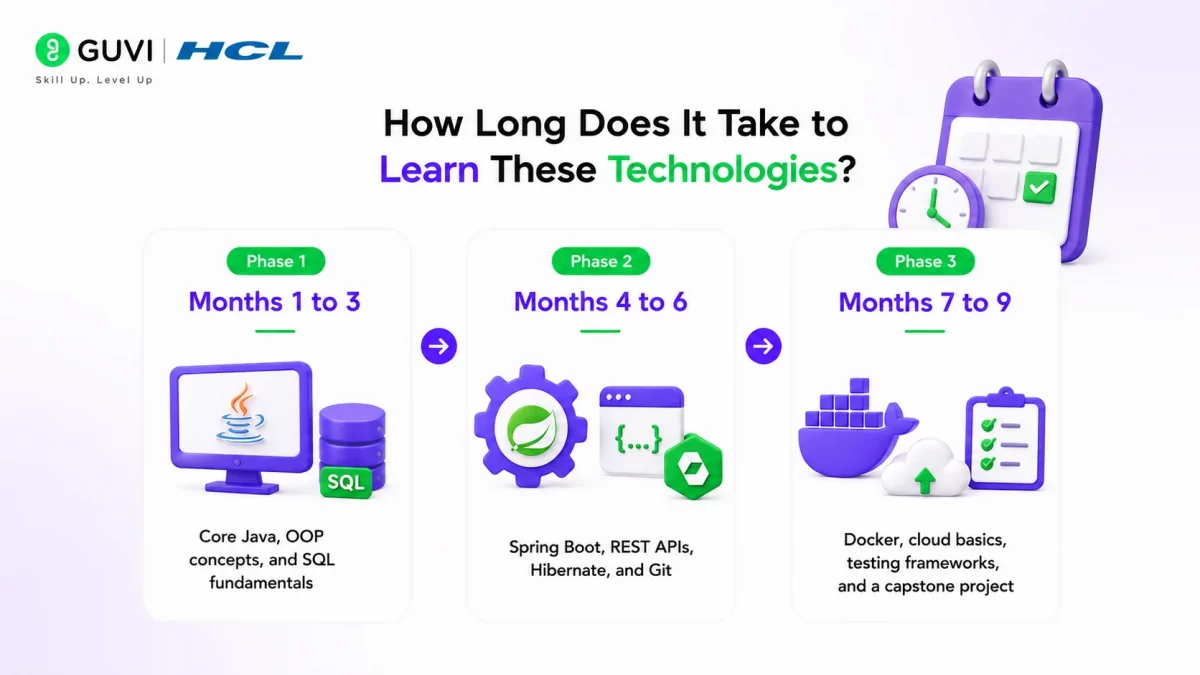
Most learners move through this in three phases:
- Months 1 to 3: Core Java, OOP concepts, and SQL fundamentals
- Months 4 to 6: Spring Boot, REST APIs, Hibernate, and Git
- Months 7 to 9: Docker, cloud basics, testing frameworks, and a capstone project
If you already know Java syntax, this timeline can shrink to 4 to 6 months with focused, project-based learning.
If you’d rather learn this stack with guided mentorship and hands-on projects instead of piecing it together from scattered tutorials, HCL GUVI’s Java Full Stack Development Course walks you through Spring Boot, databases, and deployment with a placement-focused structure.
Conclusion
By mastering the technologies outlined in this blog and staying updated with the emerging trends, developers can position themselves as versatile, in-demand professionals capable of tackling complex challenges and driving innovation in the ever-evolving backend development. Let’s start this journey of continuous learning and growth together.
FAQs
What is the most important technology for a Java backend developer to learn first?
Spring Boot is the highest-priority technology after core Java, since it’s used across the majority of backend job postings and forms the base for building REST APIs and microservices.
Do Java backend developers need to learn cloud platforms like AWS?
Yes. Most companies deploy Java applications on cloud infrastructure, so familiarity with at least one platform, typically AWS, is expected even for entry-level roles.
Is Docker necessary for a Java backend developer?
Docker has become a standard requirement, especially for teams working with microservices, since it ensures applications run consistently across development and production environments.
Can I become a Java backend developer without knowing Spring Boot?
It’s technically possible using plain Java or older frameworks, but the vast majority of current job postings specifically ask for Spring Boot experience, making it hard to skip.
How is a Java backend developer different from a full stack developer?
A backend developer focuses only on server-side logic, databases, and APIs, while a full stack developer also handles frontend technologies. HCL GUVI’s full stack developer guide explains this distinction in more detail.
Success Stories

About the Author
Lukesh S
A professional content writer who has experience in freelancing and now working as a Technical Content Writer at HCL GUVI having sound knowledge in Blog Writing and Creative Writing!
View all posts by Lukesh S
Connect with me @


























Did you enjoy this article?