

Full Stack Development Articles
Full Stack Development Course With Career Support: What Should You Expect?
Best Full Stack Development Training Programs for Career Switchers
Best Full Stack Developer Courses for Working Professionals in India
From Manual Operations to Fullstack Development : A Career Transition Guide

Get In Touch For Details! Request More Information
Top 5 Full Stack Development Certification Courses in 2026
Nov 27, 2026 5 Min Read 29329 Views
(Last Updated)
A full stack development certification course can help you build the technical skills needed to develop complete web applications, covering everything from frontend development to backend programming and database management.
But with so many certification courses available online, how do you choose the right one? Your decision will depend on your current skill level, preferred tech stack, budget, and career goals.
In this guide, we’ll explore the top 5 full stack development certification courses in 2026, comparing their curriculum, fees, duration, hands-on projects, and certification benefits to help you make an informed choice.
Table of contents
- TL;DR
- Quick Comparison Table
- Why Full Stack Developer Certifications Matter in 2026
- Top 5 Full Stack Development Certification Courses
- 1) HCL GUVI’s Full Stack Development Course
- 2) IBM Full Stack Software Developer Certificate (Coursera)
- 3) Internshala Advanced Web Development Course with AI
- 4) The Complete Full-Stack Web Development Bootcamp (Udemy)
- 5) Codecademy Full-Stack Career Path
- Concluding Thoughts...
- FAQs
- Q1. What are the key benefits of obtaining a full stack developer certification in 2026?
- Q2. How long does it typically take to complete a full stack developer certification program?
- Q3. What technologies should a comprehensive full stack certification course cover?
- Q4. Are full stack developer certifications suitable for complete beginners?
- Q5. How do full stack developer certifications impact job prospects and salary potential?
TL;DR
- Top Courses: HCL GUVI, IBM (Coursera), Internshala, Udemy and Codecademy.
- Key Skills: Frontend and backend development, databases, APIs, version control and cloud deployment.
- Learning Formats: Live mentor-led programmes and flexible self-paced courses.
- Certification: Options include institution-backed certifications, professional certificates and course completion certificates.
- Choosing the Right Course: Compare curriculum, fees, hands-on projects, certification credibility and career support before enrolling.
Quick Comparison Table
| Course | Learning Format | Duration | Certification |
|---|---|---|---|
| HCL GUVI Full Stack Development | Live + recorded | 6 or 9 months | IITM Pravartak + MongoDB certification |
| IBM Full Stack Software Developer | Self-paced | ~6 months* | IBM Professional Certificate |
| Internshala Advanced Web Development Course with AI | Recorded lessons + live masterclasses | 3 months | Internshala and NSDC & Skill India certificates |
| Udemy Complete Full-Stack Web Development Bootcamp | Self-paced | Approx. 62 hours | Certificate of Completion |
| Codecademy Full-Stack Engineer Career Path | Self-paced | Approx. 150 hours | Professional Certification |
Why Full Stack Developer Certifications Matter in 2026
In today’s tech landscape, a full stack developer certification isn’t just another credential—it’s becoming essential for career advancement. The tech industry’s rapid evolution has created unique opportunities for developers who can handle both front-end and back-end responsibilities.

This surge isn’t just a temporary trend but represents a fundamental shift in how companies structure their technical teams.
- Cost-effectiveness: Companies can save approximately INR 4,219,022.54 over three years when hiring versatile developers instead of separate specialists
- Project ownership: Full stack developers can manage entire projects from conceptualization to deployment
- Reduced team dependencies: Their diverse skill set minimizes the need for large teams and complex inter-departmental relationships
- Faster problem resolution: When issues arise, full stack developers can identify and fix problems across the entire technology stack
Top 5 Full Stack Development Certification Courses
Now that we’ve discussed why full stack certifications matter in today’s tech world, let’s discuss the full stack development certification courses worthy of your time. We will be discussing the top 5 full stack development certification courses in 2026, what they offer, the credibility they provide, what skills you’ll learn, what projects you’ll build, and much more in Delta so that you can make the correct choice for the success of your career:
1) HCL GUVI’s Full Stack Development Course
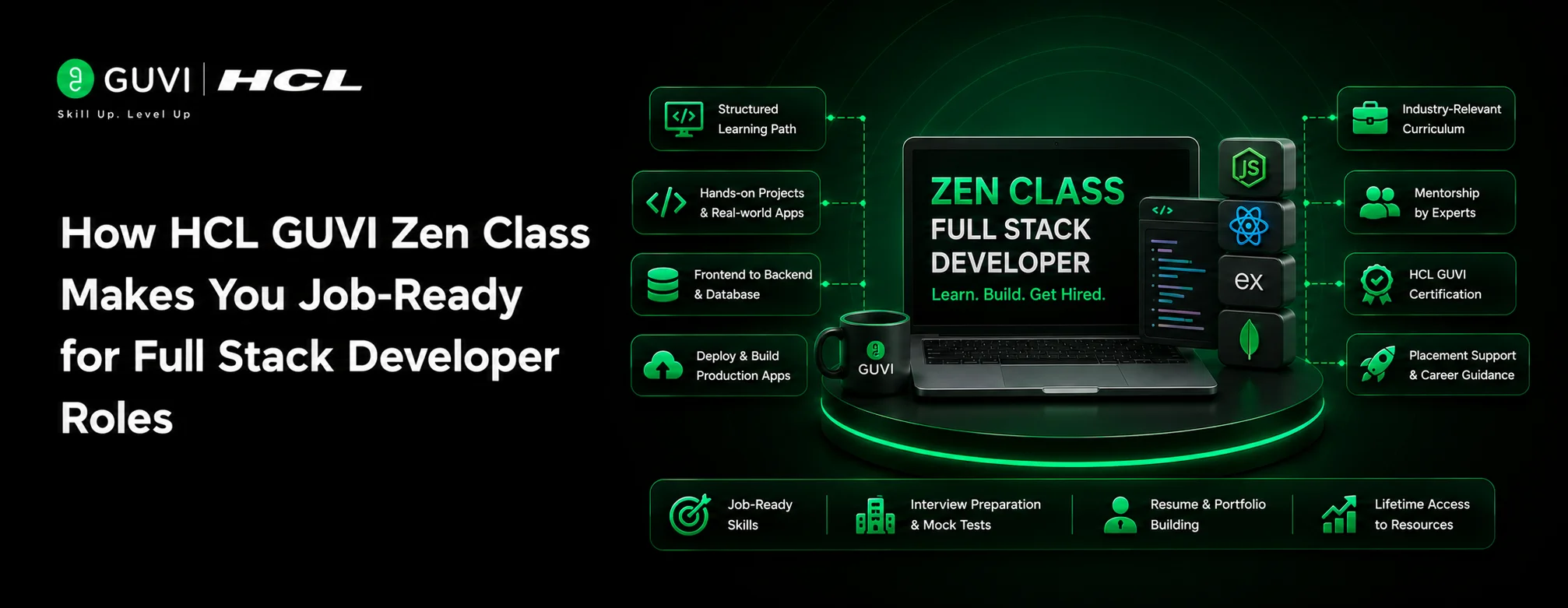
Looking for a full stack certification program with strong industry credentials? HCL GUVI’s Software and AI Engineer Programme combines hands-on full stack development training with AI-powered coding practices, industry mentorship and placement assistance. Learners can choose between two career tracks: Full Stack Engineering and Backend Engineering.
Duration: 6 or 9 months, with flexible weekday and weekend batches.
Learning Format: 130+ hours of live, mentor-led classes with lifetime access to recordings.
Course Price: ₹1,14,999 (discounted from ₹1,39,999, subject to applicable offers and price changes).
EMI Option: ₹11,585/month for 12 months.
Certification: IITM Pravartak, MongoDB & NSDC
Languages: English, Tamil, Hindi and Telugu.
What you’ll learn (Tech Stack):
At its core, HCL GUVI’s full stack developer certification course focuses on the MERN stack, which includes:
- MongoDB (NoSQL database)
- Express.js (Backend framework)
- React.js (Frontend library)
- Node.js (JavaScript runtime environment)
- MySQL for relational database management
- AWS (Amazon Web Services) for cloud deployment
- Data Structures and Algorithms (DSA) to build efficient applications
What you’ll build for your portfolio:
- E-Commerce Web Application
- Student Management System
- Cloud Deployment Pipeline
- AI-Powered Document Q&A Chatbot
- Personal Portfolio and Coding Tracker
Best For: Beginners to intermediate learners
Course Link: HCL GUVI’s Full Stack Development Course
2) IBM Full Stack Software Developer Certificate (Coursera)
IBM’s partnership with Coursera has created one of the most accessible entry points into professional development. Their Full Stack Software Developer Certificate stands out among full stack development certification courses for its industry credibility and comprehensive curriculum designed by leading experts.
Duration: 6 months (approximately 10 hours per week).
Learning Format: Self-paced, with a series of 15 courses.
Certification: IBM Full Stack Software Developer Professional Certificate.
Course Price: Subscription-based.
Course Rating: 4.6/5
What you’ll learn (Tech Stack):
Unlike narrowly focused courses, IBM’s certification provides comprehensive coverage across both front-end and back-end technologies. The curriculum covers:
- HTML5 and CSS3 for structure and styling
- JavaScript fundamentals and advanced concepts
- RESTful API development
- Database integration (SQL and NoSQL)
- Microservices architecture
- CI/CD pipelines for automated deployment
What you’ll build for your portfolio:
- Cloud-native full-stack app using React, Express, and NoSQL (final capstone)
- AI-powered web application deployed on IBM Cloud with CI/CD pipelines
- Interactive web tools (e.g., interest calculator) using HTML/CSS/JavaScript
Best For: Beginners and career switchers
Course Link: IBM Full Stack Software Developer Certificate (Coursera)
3) Internshala Advanced Web Development Course with AI
Internshala’s full stack development certification course combines MERN stack training with practical assignments and placement assistance. Alongside technical skills, learners receive career guidance, resume-building support and AI-powered interview practice.
- Duration: 3 months (70 hours of learning).
- Learning Format: Recorded lessons, live masterclasses and doubt-clearing sessions.
- Course Price: To be confirmed.
- Certification: Internshala Trainings and NSDC & Skill India certificates.
What you’ll learn (Tech Stack):
- HTML, CSS and Tailwind CSS
- JavaScript and DOM manipulation
- React.js for frontend development
- Node.js and Express.js for backend development
- MongoDB for database management
- Git and GitHub for version control
- Data Structures and Algorithms (DSA)
What you’ll build for your portfolio:

- YouTube clone using the MERN stack (capstone project)
- Personal portfolio website
- Weather forecast application using JavaScript
- ShoppyGlobe e-commerce application and backend APIs
Best For: College students, fresh graduates and aspiring web developers.
Course Link: Enroll Here
4) The Complete Full-Stack Web Development Bootcamp (Udemy)
Among the most popular bootcamp learning experiences, The Complete Full-Stack Web Development Bootcamp by master developer Dr. Angela Yu stands out as a comprehensive coding journey that transforms complete beginners into job-ready developers. This Udemy bestseller has established itself as a reliable path for aspiring developers seeking full stack certification without breaking the bank and is a great full stack development certification course option.
- Duration: Approximately 62 hours (374 lectures across 45 sections).
- Learning Format: Self-paced video lessons and coding exercises.
- Course Price: ₹3,199 (subject to discounts and price changes).
- Certification: Udemy Certificate of Completion.
- Course Rating: 4.7/5.
What you’ll learn (Tech Stack):
In contrast to narrowly focused programs, this certification covers a comprehensive technology stack including:
- Frontend: HTML5, CSS3, JavaScript, React.js, Bootstrap and jQuery
- Backend: Node.js, Express.js, REST APIs
- Database: PostgreSQL, SQL
- Additional tools: Git, GitHub, NPM, Command Line
- Advanced concepts: Authentication, React Hooks, Web3 and blockchain development
What you’ll build for your portfolio:
- Personal portfolio website hosted on GitHub
- Blog website using Node.js and Express.js
- Responsive web design agency website
Best For: Beginners to advanced learners
Course Link: The Complete Full-Stack Web Development Bootcamp (Udemy)
5) Codecademy Full-Stack Career Path
Codecademy’s Full-Stack Engineer Career Path stands as one of the industry’s most interactive learning experiences, offering a comprehensive curriculum that builds job-ready skills through hands-on practice.
Duration: 6–8 months Codecademy recommends setting aside approximately 150 hours to complete the course, which translates to roughly six months at a moderate pace.
Learning Format: Self-paced, with 51 units, 161 lessons and 96 projects.
Course Price: Various plans ranging from ₹600-₹1200/monthly for the Codecademy platform
Certification: Codecademy Professional Certification upon passing all required certification exams.
Prerequisites: No prior coding experience required.
What you’ll learn (Tech Stack):
The curriculum is structured around both front-end and back-end development, covering:
- Frontend: HTML, CSS, JavaScript, and React for building complex interactive interfaces
- Backend: Node.js, Express for server-side logic
- Database: PostgreSQL for data storage and retrieval
What you’ll build for your portfolio:
- Personal portfolio site (GitHub-hosted) using HTML, CSS, and JS
- Back-end API with PostgreSQL using Express and RESTful principles
- Interactive React applications with state management and routing
Best For: Structured learners and job seekers
Course Link: Codecademy Full-Stack Career Path
Build your full stack development skills with HCL GUVI’s mentor-led programme, hands-on projects, industry-recognized certifications and dedicated placement assistance.
Concluding Thoughts…
Full stack development certifications undoubtedly provide a structured pathway to launching a successful tech career. Throughout this guide, you’ve explored seven exceptional certification options, each offering unique advantages depending on your current skill level, learning preferences, and career goals.
Remember that the best certification ultimately depends on factors like your current experience, preferred tech stack, and learning style. Take time to evaluate each option carefully, considering both immediate learning objectives and long-term career aspirations.
Whichever path you choose, completing a respected full stack development certification will significantly enhance your employability and open doors to exciting opportunities in India’s thriving tech ecosystem. Good Luck!
FAQs
Q1. What are the key benefits of obtaining a full stack developer certification in 2026?
Full stack developer certifications validate your skills, demonstrate your commitment to learning, and can lead to higher earning potential. They provide structured learning paths, hands-on experience, and often include job placement support, making them valuable for career advancement and switching.
Q2. How long does it typically take to complete a full stack developer certification program?
A full stack development certification course can take anywhere from a few weeks to nine months, depending on the curriculum, learning format and your study schedule. Self-paced courses offer greater flexibility, while mentor-led programmes typically follow a structured timeline.
Q3. What technologies should a comprehensive full stack certification course cover?
A well-rounded full stack certification should cover front-end technologies (HTML, CSS, JavaScript, React), back-end development (Node.js, Express, Python), database management (SQL, NoSQL), version control (Git), and cloud deployment. Some programs also cover AI-assisted coding, debugging and software development workflows.
Q4. Are full stack developer certifications suitable for complete beginners?
Yes, many full stack developer certifications are designed for beginners with no prior programming experience. However, some advanced programs may require basic coding knowledge. It’s important to choose a certification that matches your current skill level and learning goals.
Q5. How do full stack developer certifications impact job prospects and salary potential?
Full stack developer certifications can strengthen your job prospects by helping you build practical skills and portfolio projects valued by employers. However, your earning potential depends on your technical proficiency, experience, location and employer. Some programmes also offer placement assistance and interview preparation.
Success Stories























Did you enjoy this article?