

Full Stack Development Articles
Full Stack Development Course With Career Support: What Should You Expect?
Best Full Stack Development Training Programs for Career Switchers
Best Full Stack Developer Courses for Working Professionals in India
From Manual Operations to Fullstack Development : A Career Transition Guide

Get In Touch For Details! Request More Information
Why Full-Stack Skills Provide a Strong Foundation for AI
Nov 24, 2026 6 Min Read 2011 Views
(Last Updated)
Artificial Intelligence (AI) models such as GPT, Llama, and Claude rarely reach everyday users on their own; instead, they are combined with other components, such as frontends, backends, databases, APIs, and servers, to result in an end to end software product. For better comprehension, ChatGPT is a product built on OpenAI’s GPT models, Meta AI is built on Meta’s Llama models, and Claude is Anthropic’s assistant built on its Claude models.
Without Full Stack Development, AI models can stay isolated, leaving the final output incomplete and leading to scalability issues in real world scenarios. Without full stack skills, it becomes much harder to resolve technical problems such as latency, data flow bottlenecks, and security vulnerabilities.
If full stack skills are so crucial to enhancing the performance and quality of AI products, let’s now understand why proficiency in full stack development is essential for working with AI effectively.
Table of contents
- TL;DR Summary
- What Is Full Stack AI Development?
- Full-Stack AI Development: Understanding the Process
- Full Stack Developer vs AI/ML Engineer vs Full Stack AI Developer
- How a Full Stack AI App Is Built, Layer by Layer
- Best Reasons Why Full-Stack Skills Are Beneficial for AI
- End-To-End Application Understanding
- Efficient AI Model Integration
- Better Data Management
- Improved Deployment And Scalability
- Enhanced User Experience
- Faster Problem-Solving And Debugging
- Cost And Performance Optimization
- Increased Career Opportunities
- Key Full-Stack Skills Needed to Work in AI
- Frontend Development
- Backend Development
- Database Management
- API Integration
- Server and Cloud Management
- AI/ML Model Understanding
- Data Processing and Analysis
- Testing and Deployment
- AI Tools Every Full Stack Developer Should Know
- Real Project Ideas That Combine Full Stack Skills and AI
- Roadmap: From Full Stack Skills to AI Integration
- Salary Snapshot: Full Stack Developer vs AI Engineer
- 💡 Did You Know?
- Common Mistakes to Avoid
- Learning ML Theory Without Building Apps
- Exposing API Keys in the Frontend
- Skipping Input Validation and Rate Limits
- Ignoring AI Costs
- Neglecting Core Full Stack Skills
- Conclusion
- FAQs
- What does a Full-Stack AI developer do?
- Do I need Full-Stack skills to work in AI?
- Can AI models work without Full-Stack integration?
TL;DR Summary
- What it is: This blog explains why full stack skills give you a strong foundation for building and working with AI applications.
- Short answer: Full stack skills help you build complete AI applications by connecting the frontend, backend, database, and AI models. They make it easier to deploy, manage, and scale AI features in real world products while improving performance, reliability, and user experience.
- Key full stack skills: Frontend, backend, databases, API integration, cloud deployment, basic AI/ML understanding, data processing and testing.
- Where it helps: Chatbots, AI search, recommendation features and any product that puts an AI model in front of real users.
- Next step: Build full stack skills with one stack (such as MERN), then add LLM APIs and build an AI powered project.
What Is Full Stack AI Development?
Full stack AI development means building a complete application where an AI feature sits inside a working product. A full stack AI developer typically:
- Builds the screens users interact with
- Writes the backend logic and APIs that send data to an AI model and return results
- Stores data, prompts and responses in a database
- Deploys and monitors the app so it stays fast and reliable
Want to build these full stack skills step by step? Enrolling in the HCL GUVI Full Stack Development Course gives you live classes, real projects, including an AI chatbot that answers questions from documents, and one to one mentor support.
Full-Stack AI Development: Understanding the Process
Full-Stack AI Development is essentially a journey of creating AI-driven apps that encompass not only the usual full-stack development capabilities but also AI integration.
On the one hand, it means architecting and coding the client-side to offer an intuitive interface and an interactive experience for users. On the other hand, the server-side, which is responsible for managing the core functionalities, user requests, and system operations, is also developed.
Databases serve as the storage units where large volumes of data are kept and handled in a very efficient manner. On the other hand, APIs are the middleware that frontend, backend, and AI models use to communicate with each other without any hiccup.
The AI part is basically the one that takes the data, makes the predictions, or comes up with the new ideas, and after that, it becomes part of the app.
Full-Stack AI Development is not just limited to coding but also embraces testing, deployment, and ongoing maintenance to make sure that the application is running smoothly and also provides correct AI-driven outputs in real-world situations.
____________________________________________________________________________
Expert mentorship can help you land high-paying roles in top tech companies. Enroll in HCL GUVI’s IITM Pravartak Certified MERN Full Stack Development Course with AI Integration to gain real-world project experience and expert guidance. Take the next step in your tech career today.
Full Stack Developer vs AI/ML Engineer vs Full Stack AI Developer
These roles overlap, but each uses full stack skills differently.
| Factor | Full Stack Developer | AI/ML Engineer | Full Stack AI Developer |
|---|---|---|---|
| Main focus | Complete web applications | Building and training models | Web apps with AI features built in |
| Core skills | Frontend, backend, databases, deployment | Python, ML algorithms, data processing | Full stack skills plus AI APIs and model integration |
| Typical tools | React, Node.js, MongoDB, Docker | PyTorch, TensorFlow, Scikit learn | React, Node.js or Django, LLM APIs, vector databases |
| Typical output | Websites and web apps | Trained models and experiments | AI powered products used by real customers |
How a Full Stack AI App Is Built, Layer by Layer
Here is how full stack skills map to each layer of a typical AI application.
| Layer | What It Does | Common Tools |
|---|---|---|
| Frontend | Collects user input and shows AI results | React, Angular, Vue.js |
| Backend and API | Handles requests, calls the AI model, applies business rules | Node.js, Express.js, Django, Flask |
| AI layer | Generates answers, predictions or recommendations | LLM APIs, Hugging Face models, TensorFlow, PyTorch |
| Data layer | Stores users, documents, prompts and embeddings | PostgreSQL, MongoDB, vector databases |
| Deployment | Runs and scales the app | Docker, Kubernetes, AWS, Azure, Google Cloud |
Best Reasons Why Full-Stack Skills Are Beneficial for AI
There are several reasons why full-stack skills are vital for AI, but we have mentioned the most pragmatic ones. Through these reasons, you can clearly understand why being a competent full-stack developer is like a cherry on top for working in the AI domain.
1. End-To-End Application Understanding
Having full-stack skills means that you have a holistic understanding of the working of any application, starting from the user interface (UI) to the server and the database. This is very useful for creating AI-powered applications that operate effortlessly in the real world.
Knowledge of the overall workflow enables developers to anticipate problems, improve performance, and ensure that the AI is fully compatible with the other components of the application.
2. Efficient AI Model Integration
Full stack skills enable you to integrate AI models with frontend and backend systems efficiently. You can ensure that the inputs, outputs, and predictions are handled correctly as they flow through the app.
As a result, the number of errors is reduced, the performance is enhanced, and AI features are more likely to deliver reliable results to users in real time.
3. Better Data Management
Developers with full stack skills are capable of storing, fetching, and handling data in a proper way in databases. This is an essential aspect, since AI models depend on large, carefully curated datasets to be operational.
Efficient data handling helps improve processing speed; it prevents storage problems and, at the same time, is instrumental in maintaining data quality, which leads to more accurate AI predictions.
4. Improved Deployment And Scalability
With full-stack skills, developers can seamlessly implement AI applications, and as the need for users increases, they can also expand them. In other words, you can oversee servers, cloud resources, and backend infrastructure to serve additional users.
Scalable deployment keeps AI applications from slowing or failing, enabling them to be used in the real world even under high demand.
Also Read: AWS vs Azure vs Google Cloud: Comparing the Top Cloud Service Providers
5. Enhanced User Experience
Full-stack developers are capable of creating interfaces through which AI functionalities appear to be very simple and natural for the users. A flawless, engaging frontend is what users need to use AI outputs as efficiently as possible.
The integration of frontend and backend competencies is instrumental in developing such applications in which AI results are not only obtainable but also significant and easy to understand for users, thereby enhancing overall user satisfaction.
6. Faster Problem-Solving And Debugging
Full-stack knowledge makes it possible to locate and correct problems swiftly throughout the whole application, which means that the problem is not necessarily in the AI model only.
It is possible to follow the error path from the frontend to the backend and the database in a very efficient way. This is an excellent time-saver and reduces the risk of AI features breaking during development and maintenance.
7. Cost And Performance Optimization
By having full-stack skills, one can tailor server usage, database queries, and API calls for AI applications to lower operational costs and improve response times.
An effective use of resources prevents AI models from slowing down, making the application not only faster but also more sustainable.
8. Increased Career Opportunities
Developers who combine full stack skills with AI knowledge are a great asset as they can create full fledged AI powered solutions. With this combination of skills, one can take on a variety of roles in tech companies.

The ability to integrate AI into real applications gives you a competitive edge, as many companies are adding AI features to their products.
Key Full-Stack Skills Needed to Work in AI
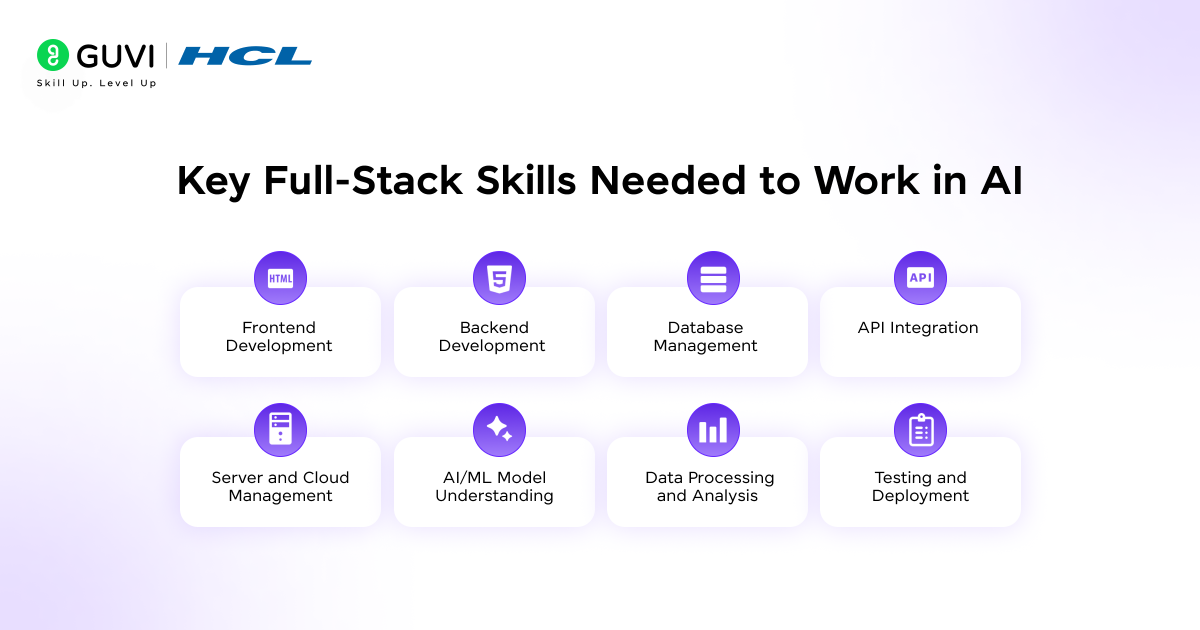
The following are the full-stack skills one should have hands-on experience with to contribute to the field of Artificial Intelligence (AI). These skills help make AI solutions more reliable, practical, and accessible to end customers.
1. Frontend Development
Frontend development focuses on creating the user interface and experience. It ensures users can interact with AI applications smoothly and intuitively.
Essential Tools Used:
React, Angular, Vue.js, HTML/CSS, Bootstrap
2. Backend Development
Backend development manages the logic, server, and operations behind the scenes. It processes user requests and connects AI models with the application.
Essential Tools Used:
Node.js, Django, Flask, Express.js, Ruby on Rails
3. Database Management
Database management systems store, organize, and retrieve data efficiently for AI applications. Proper data handling ensures AI models get accurate input.
Essential Tools Used:
MySQL, MongoDB, PostgreSQL, Firebase, SQLite
4. API Integration
API integration connects different parts of an application, including the frontend, backend, and AI models. It enables smooth communication and data exchange.
Essential Tools Used:
Postman, Swagger, REST API, GraphQL, Axios
5. Server and Cloud Management
Server and cloud management ensure AI applications run reliably and scale with user demand. It handles deployment, hosting, and resource optimization.
Essential Tools Used:
AWS, Azure, Google Cloud, Docker, Kubernetes
6. AI/ML Model Understanding
Understanding AI/ML models helps developers effectively integrate intelligent features into applications. It ensures predictions and insights work correctly.
Essential Tools Used:
TensorFlow, PyTorch, Scikit-learn, Keras, OpenCV
7. Data Processing and Analysis
Data processing cleans and prepares data for AI models, while analysis extracts insights. Both are crucial for accurate AI predictions, and tools like Tableau help you present those insights to users and stakeholders.
Essential Tools Used: Pandas, NumPy, Matplotlib, Jupyter Notebook, Tableau
8. Testing and Deployment
Testing ensures AI applications work correctly, while deployment makes them available to users. Tools like Selenium test the user interface that displays AI results, while CI/CD tools automate safe releases.
Essential Tools Used: Selenium, Jenkins, Git, Docker, Travis CI
AI Tools Every Full Stack Developer Should Know
Once your core full stack skills are in place, these tools help you add AI features to your apps.
- LLM APIs: Services from OpenAI, Anthropic and Google let you add chat, summarisation and text generation through simple API calls.
- LangChain: A framework that helps you connect LLMs with your own data, tools and workflows.
- Hugging Face: A hub of open models and datasets you can use or fine tune.
- Vector databases: Tools like Pinecone or PostgreSQL with pgvector store embeddings so your app can search documents by meaning.
You can learn more about how AI is used across the development lifecycle in this blog on AI in software development.
Real Project Ideas That Combine Full Stack Skills and AI
Building projects is the best way to prove your full stack skills in AI work.
| Project | Full Stack Skills Used | AI Feature |
|---|---|---|
| Document Q&A chatbot | React UI, Node.js API, vector database | Answers questions from uploaded PDFs using RAG |
| AI powered product search | Search page, backend filters, database | Finds products by meaning, not just keywords |
| Resume analyser | Upload form, backend parsing, storage | Scores resumes against a job description |
| Smart support desk | Ticket dashboard, APIs, authentication | Suggests replies and tags tickets automatically |
For more ideas to adapt with AI features, browse these full stack development project ideas.
Roadmap: From Full Stack Skills to AI Integration
Here is a simple plan at around 2 to 4 hours a day.
| Stage | Focus | Timeline |
|---|---|---|
| 1 | HTML, CSS and JavaScript | Months 1 to 2 |
| 2 | React and Git | Months 3 to 4 |
| 3 | Node.js, Express and a database | Months 5 to 6 |
| 4 | LLM API integration and prompt design | Month 7 |
| 5 | RAG, vector databases and deployment | Months 8 to 9 |
For a detailed breakdown of the first stages, see how long it takes to become a full stack developer.
Want a guided path through this roadmap? Joining the HCL GUVI Full Stack Development Course helps you build full stack skills with 130+ hours of live classes, GenAI modules and projects like an AI chatbot that answers questions from documents.
Salary Snapshot: Full Stack Developer vs AI Engineer
Combining full stack skills with AI knowledge can open roles in both areas. Here is how pay compares in India.
| Role | Salary Range |
|---|---|
| Full Stack Developer | ₹1.8 Lakhs to ₹15.4 Lakhs |
| AI Engineer | ₹3.5 Lakhs to ₹33 Lakhs |
Note: Salary figures may change over time as users update their reported data. Please refer to the linked source for the latest salary ranges.
💡 Did You Know?
- ChatGPT was launched by OpenAI on November 30, 2022, and is a full product built around GPT models with a web frontend, backend services and databases.
- The term “Retrieval Augmented Generation” (RAG) was introduced in a 2020 research paper from Facebook AI Research, and it is now a common pattern in full stack AI apps.
Common Mistakes to Avoid
1. Learning ML Theory Without Building Apps
Theory helps, but employers want to see your full stack skills in working products. Build at least one AI powered app end to end.
2. Exposing API Keys in the Frontend
Never put AI API keys in browser code. Good full stack skills mean calling AI services from your backend instead.
3. Skipping Input Validation and Rate Limits
AI endpoints can be misused or become expensive. Validate inputs and limit how often users can call them.
4. Ignoring AI Costs
Every API call costs money. Cache repeated results and choose the right model size for each task.
5. Neglecting Core Full Stack Skills
Jumping straight to AI tools without solid full stack skills in JavaScript, APIs and databases makes integration much harder.
Conclusion
In conclusion, Full-Stack skills are the secret sauce that turns AI from an innovative model into a real, usable product. They allow developers to connect the frontend, backend, databases, and AI models seamlessly, ensuring smooth data flow and efficient performance. With Full-Stack knowledge, AI solutions become easier to deploy, scale, and maintain, while also enhancing user experience and reliability, making them truly valuable in real-world applications.
Ready to build your full stack skills for the AI era? Signing up for the HCL GUVI Full Stack Development Course gives you mentor led classes, portfolio projects, one to one mock interviews, and an IITM Pravartak certification with a complimentary MongoDB certification.
FAQs
What does a Full-Stack AI developer do?
A Full-Stack AI developer builds AI solutions and connects them with frontend, backend, databases, and APIs to create fully functional applications.
Do I need Full-Stack skills to work in AI?
While not mandatory, Full-Stack skills make it much easier to deploy, scale, and integrate AI models into real-world products.
Can AI models work without Full-Stack integration?
Yes, but they remain limited to experiments or research; without Full-Stack integration, users cannot easily access or use them in real applications.
Success Stories

About the Author
Jebasta
I translate the language of data into stories that anyone can understand. As a writer with a data science background, I simplify analytics, AI, and decision-making so beginners and enthusiasts can confidently explore the world of data.
View all posts by Jebasta
Connect with me @



























Did you enjoy this article?